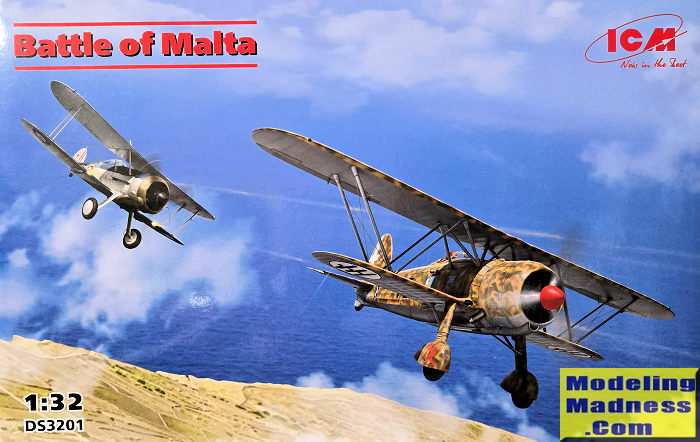
| KIT #: | 32042 |
| PRICE: | $96.00 (part of double kit) |
| DECALS: | Four options |
| REVIEWER: | Scott Van Aken |
| NOTES: | Part of kit DS3201 |
| HISTORY |
The Gloster Gladiator is a British biplane fighter. It was used by the Royal Air Force (RAF) and the Fleet Air Arm (FAA) (as the Sea Gladiator variant) and was exported to a number of other air forces during the late 1930s.
Developed privately as the Gloster SS.37, it was the RAF's last biplane fighter aircraft, and was rendered obsolescent by newer monoplane designs even as it was being introduced. Though often pitted against more advanced fighters during the early days of the Second World War, it acquitted itself reasonably well in combat.
| THE KIT |
 This one is part of a double kit that includes a Fiat CR.42.
If you were going to get both kits, this is definitely the best way to do it as
the two separately would be $130.00.
This one is part of a double kit that includes a Fiat CR.42.
If you were going to get both kits, this is definitely the best way to do it as
the two separately would be $130.00.
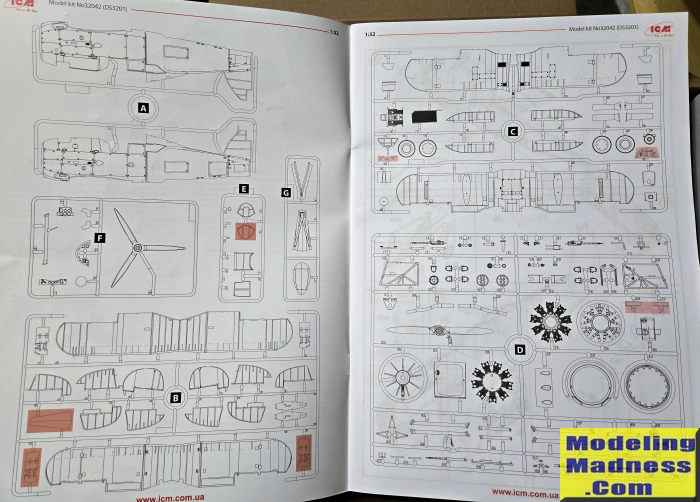
The kit is superbly detailed and instructions start with the interior. The interior builds a bit differently from many, starting by installing the sidewall bits that includes full framework in the cockpit section along with the upper piece that goes from side to side. Then the lower cockpit that includes the floor, rudder pedals, control stick and seat are built up and installed on one side. Any other interior items are then installed and while the instructions show the tail wheel glued in at this time, I'd leave that off until near the end if possible.
Once all the interior pieces are attached, then the fuselage halves can be glued together. The tailplanes with separate rudder and elevators, are then tackled along with the cockpit entry doors and the clear bits. Wings with their separate ailerons are next, starting with the lower wing. The insert for the tail hook is next. If you want to do a standard Gladiator Mk.II, the proper lower fuselage insert is on the sprues.
With the lower wing installed, the struts and upper wing are next. This may well be the trickiest part of the build. Landing gear are next and will be installed once the lower wing guns are attached. Part G1 is the life raft housing so if doing an RAF Gladiator II, this will not be attached.
 The last
major subassembly is the engine and cowling. As with the Fiat CR.42, you can
either pose this with the cowling covers off, in which case, you glue the
cylinder heads in place. If closed, those latter items are left off. The kit
includes both a wooden two blade prop and the metal three blade version. The
final steps are rigging diagrams and the Gladiator is very much a standard
single bay biplane so there is a fair amoung of rigging.
The last
major subassembly is the engine and cowling. As with the Fiat CR.42, you can
either pose this with the cowling covers off, in which case, you glue the
cylinder heads in place. If closed, those latter items are left off. The kit
includes both a wooden two blade prop and the metal three blade version. The
final steps are rigging diagrams and the Gladiator is very much a standard
single bay biplane so there is a fair amoung of rigging.
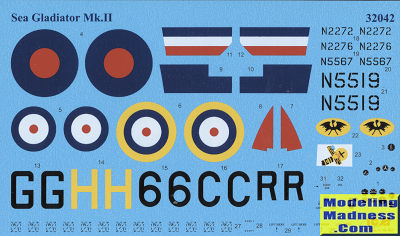
Instructions are a nicely done booklet with detail sections to help with some of the building. Four markings options are provided all of them in the same basic scheme. I'd ignore the kit color information on this and go with the usual FAA shades as ICM only lists ICM paints that are close. On all options, the underside left wing and forward fuselage is black. The decal sheet is superbly printed and in register.
| CONCLUSIONS |
Overall, it looks like a very nice kit. I've built a fair number of ICM kits, including a few in 1/32 and found them all to fit well and result in nice models when done. I believe this will be just like that.
| REFERENCES |
https://en.wikipedia.org/wiki/Gloster_Gladiator
April 2026
Copyright ModelingMadness.com. All rights reserved. No
reproduction in part or in whole without express permission.
If you would like your product reviewed fairly and
fairly quickly, please
contact
the editor
or see other details in the
Note to
Contributors.