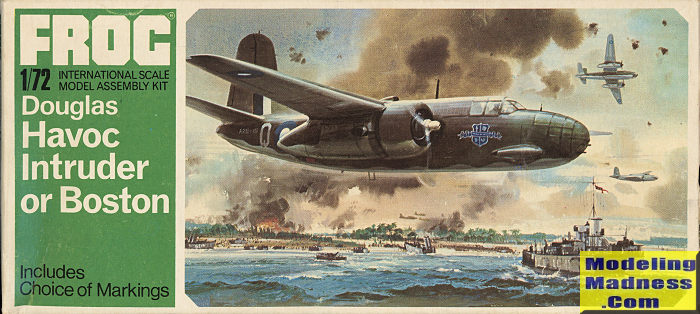
Frog 1/72 A-20 Havoc/Boston
| KIT #: | F-208 |
| PRICE: | $10.00 'used for 2 kits' |
| DECALS: | Two options |
| REVIEWER: | Scott Van Aken |
| NOTES: | Fairly crude kit by today's standards |
| HISTORY |
Though initially built for France and treated with indifference by the US Army, things changed after the original DB-7s were modified and upgraded. The Army liked these later aircraft because of its good performance and because it had no adverse handling characteristics. As a result, the type was ordered, initially in small numbers but later orders increased.
The A-20C was an attempt to develop a standard,
international version of the DB-7/A-20/Boston, produced from 1941. It reverted
to the slanting nose glass, and it had RF-2600-23 engines, self-sealing fuel
tanks, and additional protective armor. These were equipped to carry an external
2,000 lb (910 kg) aerial torpedo. A total of 948 were built for Britain and the
Soviet Union, but many were retained by the USAAF after the Japanese attack on
Pearl Harbor. The Soviet A-20s were often fitted out with turrets of indigenous
design.
| THE KIT |
When I got back into model building in the mid-1970s, I built a lot of Frog kits. Several reasons. One is that I was a die-hard 1/72 modeler. Another is that they had kits of what was then some rather exotic aircraft. They also provided multiple markings options. The kits were standard fare for most model companies at the time. Raised external panel lines, sparse cockpits with crew figures, separate flight controls, and fairly basic, if not crude detailing.
The cockpit and gunner's position consist of a floor and seat. Nothing else. There is no bombardier's position. Two crew members are provided for the seats. The nose gear must be installed when gluing the fuselage halves together. This feature is also true of the main gear when gluing the engine nacelles together. There is no gear well detail of any sort.
The control surfaces are all separate and are two pieces for each surface. There are low ejector stubs that must be removed prior to gluing the halves together. The fit is only fair and you'll find that there are fairly extensive gaps between the control and flight surfaces. As mentioned, the main gear will need to be installed prior to closing the nacelle halves. The gear themselves are fairly generic and the wheels are definitely toy-like. The kit will need a lot of nose weight to keep from tail sitting. No rear fuselage prop is provided, but you can always make one is required. Test fitting one of the two row engines found that the rear cylinders are off by about 10 degrees from where they should be. Fixing this will require some effort. There is also no positive locator for the engine, which will be troublesome in getting it centered. No real exhaust is provided. As I said, these kits are fairly crude by today's standards.
 Instructions
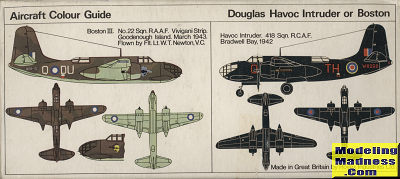
are well done, though the paper has become fairly brittle over the years. The
unusable decals are for two aircraft. one is the box art plane with the RAAF in
1943 based in New Guinea. You'll have to drill the nose and install gun barrels
to duplicate this one. The other is an all black 418 Squadron RAF plane from
1942. The decals (not shown) are heavily yellowed and not usable. Fortunately,
there are aftermarket sheets that can be used. This kit appears to be an A-20C,
which was used by a number of countries.
Instructions
are well done, though the paper has become fairly brittle over the years. The
unusable decals are for two aircraft. one is the box art plane with the RAAF in
1943 based in New Guinea. You'll have to drill the nose and install gun barrels
to duplicate this one. The other is an all black 418 Squadron RAF plane from
1942. The decals (not shown) are heavily yellowed and not usable. Fortunately,
there are aftermarket sheets that can be used. This kit appears to be an A-20C,
which was used by a number of countries.
| CONCLUSIONS |
I am often asked why I buy ancient kits like this when there are much more accurate and newer kits out there. I simply like to see what I can do with oldies like this. I guess there is some nostalgia involved as I never built this kit in the past. I'm sure I will regret the choice to some extent once I start building it. However, few kits are not worth building and I'm sure this one will actually be completed, unlike some of the more fussy newer offerings.
| REFERENCES |
https://en.wikipedia.org/wiki/Douglas_A-20_Havoc
June 2025
Copyright ModelingMadness.com. All rights reserved. No reproduction in part or in whole without express permission.
If you would like your product reviewed fairly and fairly quickly, please contact the editor or see other details in the Note to Contributors.