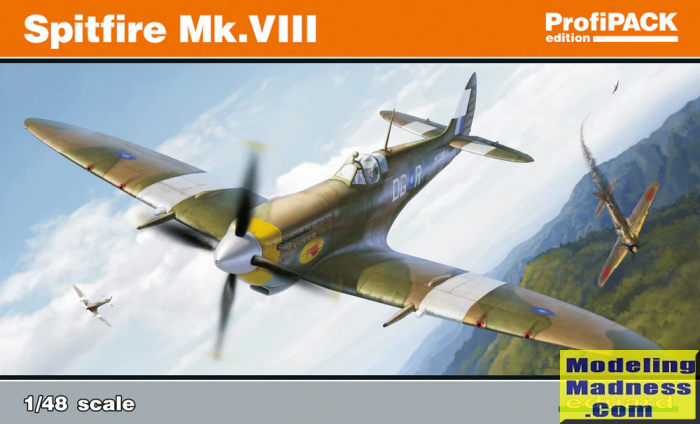
Eduard 1/48 Spitfire VIII
| KIT #: | 8294X |
| PRICE: | $10.00 |
| DECALS: | None supplied |
| REVIEWER: | Scott Van Aken |
| NOTES: | Overtrees kit |
| HISTORY |
The Mk VIII was an adaptation of the Mk VII without the pressurised cabin and was intended to become the main production model of the Spitfire. When the "interim" Mk IX proved to be adequate against the German Focke-Wulf Fw 190 it was decided to use the shadow factory at Castle Bromwich to produce that version only; the Mk VIII Spitfires were all built by Supermarine. Apart from the lack of pressurisation, the Mk VIII differed little from the Mk VII beyond the reshaped fin and pointed rudder.
Some early production models had extended wingtips but the majority were fitted with the standard version. According to Supermarine's Chief Test pilot Jeffrey Quill "When I am asked which mark of Spitfire I consider the best from the flying point of view, I usually reply 'The Mark VIII with standard wingtips.' I hated the extended wingtips...They were of no practical value to the Mark VIII and simply reduced the aileron response and the rate of roll." New Zealand ace Alan Peart described the extended wingtips causing structural damage to Mk VII Spitfires in Burma, and being replaced by standard wingtips. There were three sub-variants for low altitude (LF Mk VIII), medium altitude (F Mk VIII) and high altitude (HF Mk VIII) which were powered respectively by the Merlin 66, Merlin 63 and Merlin 70 engines.
The F Mk VIII's top speed was 408 mph (657 km/h) at 25,000 ft (404 mph for the LF Mk VIII at 21,000 ft (6,400 m) and 416 mph (669 km/h) for the HF Mk VIII at 26,500 ft), with a service ceiling of 43,000 ft (41,500 ft for the LF Mk VIII and 44,000 ft (13,000 m) for the HF Mk VIII). The two main tanks were given an extra 11 gal for a total of 96 gal which, along with the wing tanks, allowed the fighter to fly for a maximum distance of 660 mi (1,060 km) with a full internal fuel load and 1,180 miles (1,900 km) with a full internal load and a 90 gal drop tank. Provision was made to allow the Mk VIII to carry a single "slipper" drop tank of 30, 90 or 170 gal capacity. With a 170 gal tank, the aeroplane could fly over 1,500 mi (2,400 km). When carrying the 90 or 175 gal tank the aircraft was restricted, once airborne and at cruising altitude, to straight and level flight. A maximum external bomb load of 1,000 pounds (1 × 500 lb (230 kg) bomb attached to the centre bomb-rack plus a 250 lb (110 kg) bomb under each wing) could be carried.
| THE KIT |
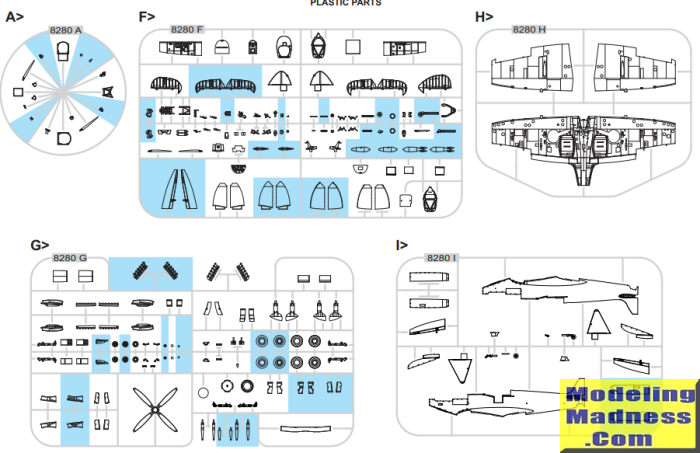 As
you know, Eduard often produces more plastic sprues for a kit than they have
boxes, instructions, or decals. They have been releasing these as their 'overtrees'
series. Now this is a pretty good deal as the price of these kits is greatly
reduced from even the 'weekend' editions and a boon for those who have already
bought one of the standard kits so will have instructions and unused decal
options.
As
you know, Eduard often produces more plastic sprues for a kit than they have
boxes, instructions, or decals. They have been releasing these as their 'overtrees'
series. Now this is a pretty good deal as the price of these kits is greatly
reduced from even the 'weekend' editions and a boon for those who have already
bought one of the standard kits so will have instructions and unused decal
options.
For those of us who are really cheap and already have aftermarket sheets for the subject in question, it is an excellent deal. When an on-line offer was made for their Spitfire VIII kit at $10 each, I bought two of them. I already had a nice Aeromaster decal sheet for Australian Mk.VIII aircraft to use. I also found that Scalemates had the instructions on their site so I simply downloaded these to use for whenever I got around to building the kit.
A nice thing about most Eduard kits
is th
| CONCLUSIONS |
| REFERENCES |
https://en.wikipedia.org/wiki/Supermarine_Spitfire_(late_Merlin-powered_variants)
March 2026 Copyright ModelingMadness.com. All rights reserved. No
reproduction in part or in whole without express permission. If you would like your product reviewed fairly and fairly quickly, please
contact the editor or see other details in the
Note to
Contributors.