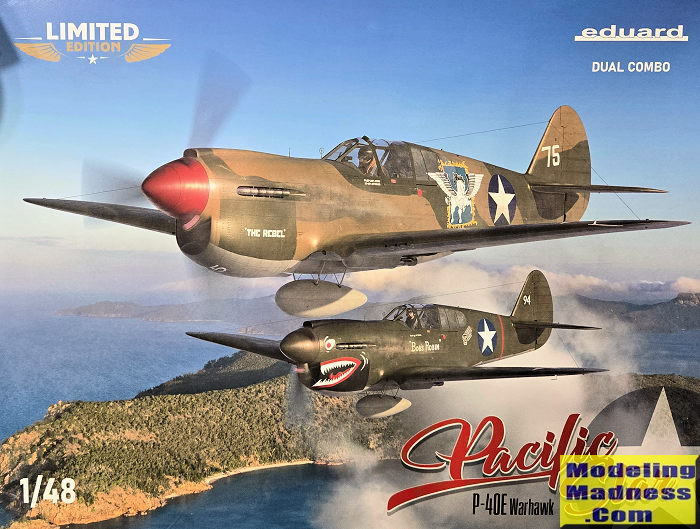
Eduard 1/48 P-40E Warhawk 'Pacific Star'
| KIT #: | 11185 |
| PRICE: | $89.00 delivered |
| DECALS: | Ten options |
| REVIEWER: | Scott Van Aken |
| NOTES: | 2025 boxing. Two complete kits |
| HISTORY |
The Curtiss P-40 Warhawk is an American single-engined, single-seat, all-metal fighter-bomber that first flew in 1938. The P-40 design was a modification of the previous Curtiss P-36 Hawk which reduced development time and enabled a rapid entry into production and operational service. The Warhawk was used by most Allied powers during World War II, and remained in frontline service until the end of the war. It was the third most-produced American fighter of World War II, after the North American P-51 Mustang and Republic P-47 Thunderbolt; by November 1944, when production of the P-40 ceased, 13,738 had been built, all at Curtiss-Wright Corporation's main production facilities in Buffalo, New York.
The P-40D was the first combat ready Warhawk. It was built in small numbers and replaced by the P-40E, the type the USAAF took into combat in the southwest Pacific. At low altitude, the P-40E could hold its own against some Japanese fighters as long as it used its ruggedness and speed. It generally came out second best in a turning fight against the lighter Japanese planes, but tactics dictated avoiding those situations. The E model served on all but the European front. Despite nearing obsolescence, it was widely used in the ground attack mission with some airframes lasting until the end of hostilities.
| THE KIT |
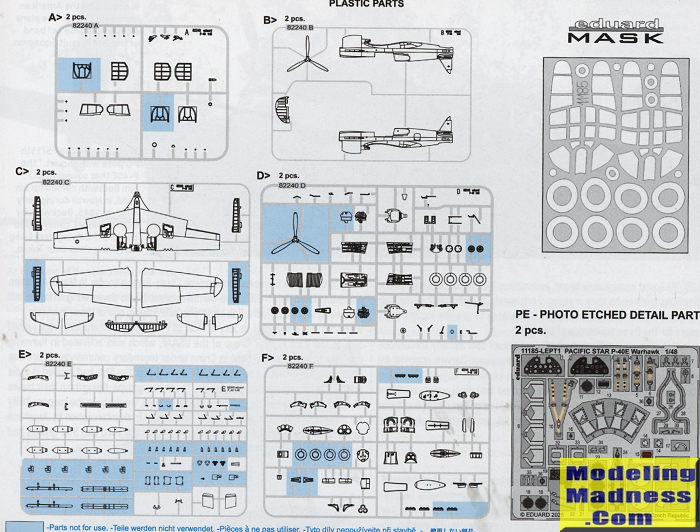 About
a year or so ago, Eduard embarked on a program to cover aircraft that fought in
the Pacific War. They had already done the Hellcat so started out with the F4F
Wildcat. This was followed by the A6M, which is still an on-going program, and
now the P-40. All of these types have been well covered by other kit makers such
as Tamiya, Hasegawa, and even Monogram. However, Eduard has a reputation for
adding in as much detail as possible and this somewhat high parts count appeals
to many modelers. Besides, there are always those who are attracted to the new
and all of this drives sales.
About
a year or so ago, Eduard embarked on a program to cover aircraft that fought in
the Pacific War. They had already done the Hellcat so started out with the F4F
Wildcat. This was followed by the A6M, which is still an on-going program, and
now the P-40. All of these types have been well covered by other kit makers such
as Tamiya, Hasegawa, and even Monogram. However, Eduard has a reputation for
adding in as much detail as possible and this somewhat high parts count appeals
to many modelers. Besides, there are always those who are attracted to the new
and all of this drives sales.
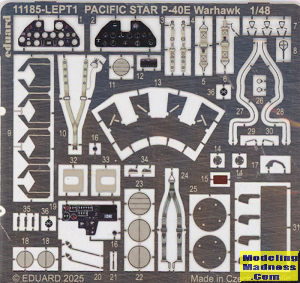 Not
surprisingly, Eduard started with the E model P-40, the variant that was widely
used by both the US and Allies in both the southwest Pacific and the CBI. Since
this is a double kit, the fairly large box is jammed full of sprues. Each pair
is separately bagged and it is fairly obvious that there will be other variants
such as the N (which has already been announced). This means that one the sprues
there will be parts not used in this build such as the smaller wheels and wide
blade prop of the P-40N. Best to keep some of those in your spares box for your
other P-40N kits that might be lacking these details.
Not
surprisingly, Eduard started with the E model P-40, the variant that was widely
used by both the US and Allies in both the southwest Pacific and the CBI. Since
this is a double kit, the fairly large box is jammed full of sprues. Each pair
is separately bagged and it is fairly obvious that there will be other variants
such as the N (which has already been announced). This means that one the sprues
there will be parts not used in this build such as the smaller wheels and wide
blade prop of the P-40N. Best to keep some of those in your spares box for your
other P-40N kits that might be lacking these details.
As expected, there are a lot of options. For instance, you can have open or closed cowl flaps (which can also be done in p.e.) and Eduard provided two different flap controls in the cockpit depending on your choice. There are also optional rear bulkheads for the interior and even different seats. I found it interesting that there is a small fuselage light that you are to build then fill and sand smooth, just like on other kits.
The exhaust is molded as six pieces per side, which adds to the parts count, however, it means you can install them after painting. In the main gear wells, you can model them with or without the canvas inside. The gun barrel part is an insert for the leading edge of the wing as is the 'knuckle' for the landing gear. Before assembling the wing one must decide on what will be carried on the centerline (if anything) and open the appropriate holes.
Separate control surfaces are supplied, which are shown assembled in the neutral position. I'm sure a bit of surgery can change that. The kit does not provide separate flaps, which is fine as they were not normally left lowered. The wing tip and other formation lights are separate items. Wheels are four parts so you can paint wheels and tires separately. There is a masking set provided that includes wheel masks, but it seems to me you don't really need them.
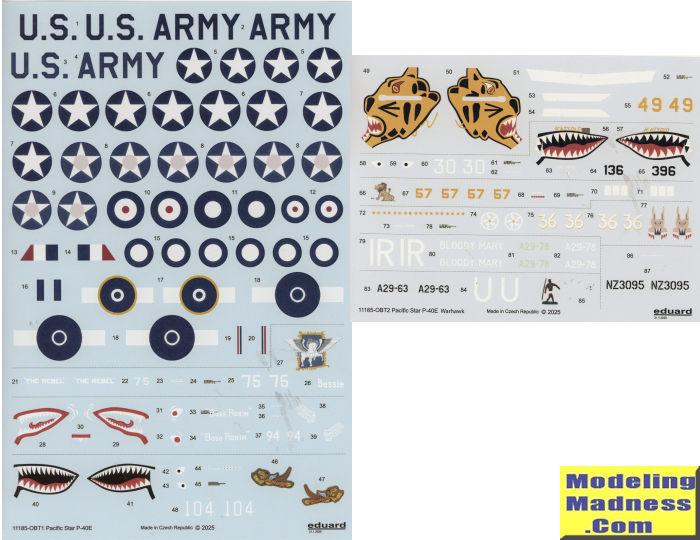 Landing
gear is well done with both the main and tail gear able to be installed after
painting. The main gear has a number of small pits as part of the retraction
mechanism. Canopy and windscreen are separate so you can pose the canopy open.
As mentioned, a masking set is provided along with colorful placement
instructions.
Landing
gear is well done with both the main and tail gear able to be installed after
painting. The main gear has a number of small pits as part of the retraction
mechanism. Canopy and windscreen are separate so you can pose the canopy open.
As mentioned, a masking set is provided along with colorful placement
instructions.
Two different drop tanks and two different bombs are included. The bombs have p.e. fins which means that when the weekend edition is produced, bombs will not be an option. None of these planes have a radio mast so if you want to duplicate the antenna, there will be some rigging involved. A diagram is provided for that purpose.
The instruction book is very good. It starts with a history before going into the building. All color information is provided in Gunze references. There are ten markings options as befits a kit like this. There are a variety of camouflage schemes. Three of them are in a US equivalent RAF scheme of dark earth, dark green, over neutral grey. That includes one of the box art planes from the 9th FS/49th FG. Another is an ex Flying Tiger plane with the 23rd FG. A third is also with the 23rd FG, this being Robert Smith's plane with the 16th FS. In OD are 'Bob's Robin' with the 9th FS/49th FG. This one has US ARMY under the wings and faded red dot in the insignia. John Chennault's Aleutian Tiger with the 343rd FG is next followed by George Kiser's plane with the 8th FS/49th FG. Another with the faded center insignia is William Hennon's plane with the 7th FS/49th FG. In OD and dark earth are two Australian planes. One with 76 Squadron in the early markings with the red center to the insignia. The other is with 82 Squadron with the later insignia and a white tail. The final option is with the New Zealand air force from 15 Squadron in a green with a white tail and large white stripes on the nose and fuselage. These stripes will need to be painted. While there are a lot of aftermarket sheets for the P-40E, Eduard has provided a lot of options with this one.
| CONCLUSIONS |
Some of us have a goodly stash of P-40s from other companies and are often left wondering why a company would put their resources into doing an aircraft that has already been kitted many times. Well, as time goes on, the detail level seems to increase with each new tooling. That is fairly obvious looking at this one in the box.
That doesn't mean you should dump what you already have. This one simply provided another options for your money. If you can handle the admittedly fiddly build of most Eduard kits, then this one should make you quite happy.
| REFERENCES |
https://en.wikipedia.org/wiki/Curtiss_P-40_Warhawk
May 2025
Copyright ModelingMadness.com. All rights
reserved. No reproduction in part or in whole without express permission from
the editor.
Review kit courtesy of my wallet If you would like your product reviewed fairly and fairly quickly, please contact the editor
or see other details in the
Note to
Contributors. Back to the Main Page
Back to the Review
Index Page
Back to the Previews Index Page