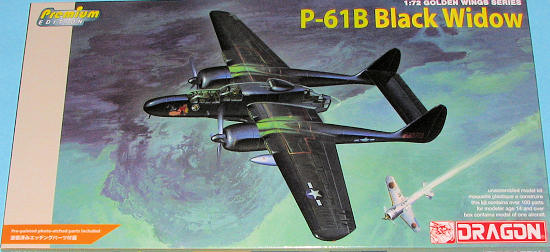
Dragon 1/72 P-61B Black Widow
| KIT #: | 5036 |
| PRICE: | $28.00 HSSRP |
| DECALS: | Three Options |
| REVIEWER: | Scott Van Aken |
| NOTES: | includles color photo etch |
| HISTORY |
The 6th NFS based on Guadalcanal received their first P-61s in early June, 1944. The aircraft were quickly assembled and underwent flight testing as the pilots transitioned from the squadron's aging P-70s. The first operational P-61 mission occurred on 25 June, and the type scored its first kill on 30 June 1944 when a Japanese Mitsubishi G4M "Betty" bomber was shot down.
Throughout the summer of 1944, P-61s operating in the Pacific Theater would see sporadic action against Japanese aircraft. Most missions ended with no enemy aircraft sighted, but when the enemy was detected they were often in groups, with the attack resulting in multiple kills for that pilot and radar operator, who would jointly receive credit for the kill.
In the Pacific Theater in 1945, P-61 squadrons struggled to find targets. One squadron succeeded in destroying a large number of Kawasaki Ki-48 "Lily" Japanese Army Air Force twin-engined bombers, another shot down several Mitsubishi G4M "Bettys", while another pilot destroyed two Japanese Navy Nakajima J1N1 "Irving" twin-engined fighters in one engagement; but most missions ended with no enemy aircraft sighted. Several Pacific Theater squadrons finished the war with no confirmed kills at all. The 550th could only claim a crippled B-29 Superfortress, shot down after the crew had bailed out having left the plane on autopilot.
On 30 January 1945, a lone P-61 performed a vital mission that was instrumental in the successful effort of the U.S. Rangers to free over 500 Allied POWs held by the Japanese at the Cabanatuan prison camp in the Philippines. As the Rangers crept up on the camp, a P-61 swooped low and performed aerobatic maneuvers for several minutes. The distraction of the guards allowed the Rangers to position themselves, undetected, within striking range of the camp. The story of the rescue and the role of the P-61 is told in the book Ghost Soldiers (by Hampton Sides) and in The Great Raid, a movie based upon the book, though the absence of a flying P-61 forced the filmmakers to feature a Lockheed Hudson in the film in its place.
Last kill of World War II
It is widely believed. that the last enemy aircraft destroyed before the Japanese surrender was downed by a P-61B-2 named "Lady in the Dark" (s/n 42-39408) of the 548th NFS. The aircraft was piloted by Lt. Robert W. Clyde and R/O Lt. Bruce K. LeFord on 14 August/15 August 1945 claiming a Nakajima Ki-44 "Tojo". It should be noted, though, that the destruction of the "Tojo" came without a shot being fired. After the pilot of the "Tojo" sighted the attacking P-61, he descended to wave-top level and began a series of evasive maneuvers which ended with his aircraft striking the water and exploding. Lts. Clyde and LeFord were never officially credited with this possible final kill of the War.
| THE KIT |
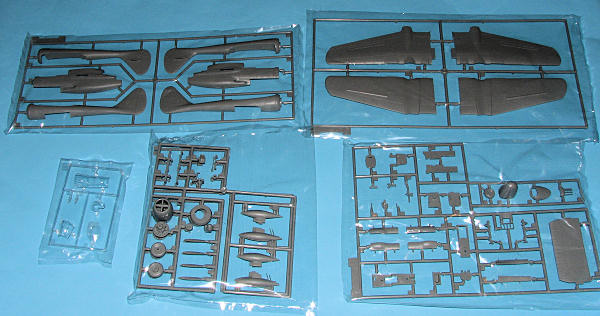 This
particular kit was released back over a decade ago when Dragon was known as
DML. The kit holds up well with what is produced today with the usual nicely
engraved panel lines and crisp detailing. Dragon has packed each sprue
number in its own bag, meaning that only the engine/cowling/prop/main gear
sprues have been duplicated. Molding is in great shape and while I did find
some ejector pin marks, there is no flash or sink areas readily apparent.
Even the inner gear door area is nicely detailed. The least detailed part of
the kit that I could see, was the engine faces. The cylinders are devoid of
detailing, but then, they are als
This
particular kit was released back over a decade ago when Dragon was known as
DML. The kit holds up well with what is produced today with the usual nicely
engraved panel lines and crisp detailing. Dragon has packed each sprue
number in its own bag, meaning that only the engine/cowling/prop/main gear
sprues have been duplicated. Molding is in great shape and while I did find
some ejector pin marks, there is no flash or sink areas readily apparent.
Even the inner gear door area is nicely detailed. The least detailed part of
the kit that I could see, was the engine faces. The cylinders are devoid of
detailing, but then, they are als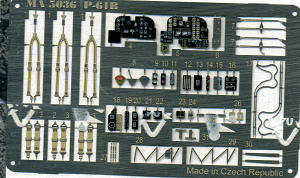 o
pretty much hidden by the props and spinners.
o
pretty much hidden by the props and spinners. 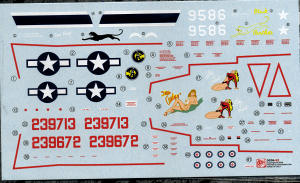 a bit on
the old side, that information was probably not available to the kit
engineers and we get what appears to me to be the 'standard' turret.
a bit on
the old side, that information was probably not available to the kit
engineers and we get what appears to me to be the 'standard' turret. | CONCLUSIONS |
| REFERENCES |
May 2009
If you would like your product reviewed fairly and quickly, please contact me or see other details in the Note to Contributors.
Back to the Previews Index Page