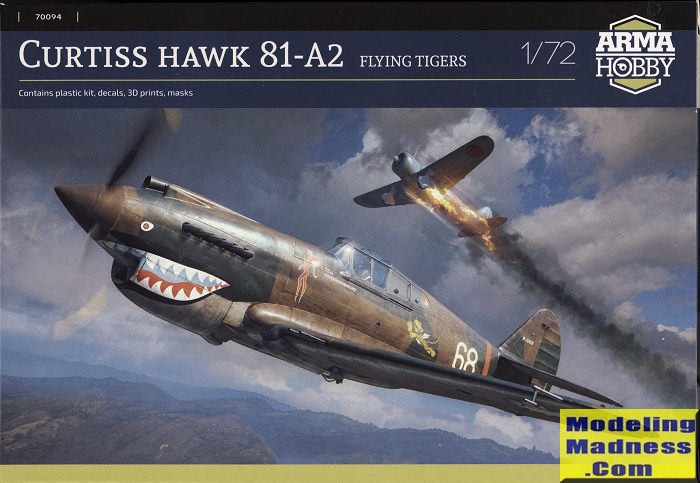
Arma Hobby 1/72 Hawk 81-A2
| KIT #: | 70094 |
| PRICE: | Gift |
| DECALS: | Three options |
| REVIEWER: | Scott Van Aken |
| NOTES: | Includes resin bits. |
| HISTORY |
The Flying Tigers, known officially as the 1st American Volunteer Group (AVG), were a unit of the Chinese Air Force, recruited from amongst US Navy, Marine Corps and Army aviators and ground crew.
AVG leader Claire Chennault received crated Model Bs which his airmen assembled in Burma at the end of 1941, adding self-sealing fuel tanks and a second pair of wing guns, such that the aircraft became a hybrid of B and C models. These were not well-liked by their pilots: they lacked drop tanks for extra range, and there were no bomb racks on the wings. Chennault considered the liquid-cooled engine vulnerable in combat because a single bullet through the coolant system would cause the engine to overheat in minutes. The Tomahawks also had no radios, so the AVG improvised by installing a fragile radio transceiver, the RCA-7-H, which had been built for a Piper Cub. Because the plane had a single-stage low-altitude supercharger, its effective ceiling was about 25,000 feet (7,600 m). The most critical problem was the lack of spare parts; the only source was from damaged aircraft. The planes were viewed as cast-offs that no one else wanted, dangerous and difficult to fly. But the pilots did appreciate some of the planes' features. There were two heavy sheets of steel behind the pilot's head and back that offered solid protection, and overall the planes were ruggedly constructed.
Compared to opposing Japanese fighters, the P-40B's strengths were that it was sturdy, well-armed, faster in a dive and possessed an excellent rate of roll. While the P-40s could not match the maneuverability of the Japanese Army air arm's Nakajima Ki-27s and Ki-43s, nor the much more famous Zero naval fighter in slow, turning dogfights, at higher speeds the P-40s were more than a match. Chennault trained his pilots to use the P-40's particular performance advantages. The P-40 had a higher dive speed than any Japanese fighter aircraft of the early war years, for example, and could exploit so-called "boom-and-zoom" tactics. The AVG was highly successful, and its feats were widely publicized by an active cadre of international journalists to boost sagging public morale at home. According to its official records, in just 61⁄2 months, the Flying Tigers destroyed 297 enemy aircraft for the loss of just four of its own in air-to-air combat.
| THE KIT |
 Arma
Hobby is somewhat a new kid on the block. They have a reputation for well made,
well detailed kits that are generally a step above what has come before them.
Looking in the box, I would compare them somewhat to equivalent kits from
Special Hobby, though SH kits are known to be tricky to build.
Arma
Hobby is somewhat a new kid on the block. They have a reputation for well made,
well detailed kits that are generally a step above what has come before them.
Looking in the box, I would compare them somewhat to equivalent kits from
Special Hobby, though SH kits are known to be tricky to build.
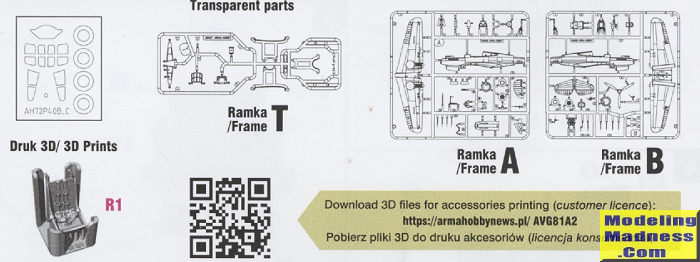
The kit itself is quite standard when it comes to 1/72 kits. The one deviation from standard construction sequences is that Arma has you assemble the wings first. This comprises of separate wheel wells and a full span upper and lower wing. As with the real aircraft, the upper wing is the floor of the cockpit. There are a couple of items to add to each sidewall. Some of these items have decals to attach. The instrument panel also takes a decal if you wish. One then assembles and paints the radiator section that fits into the lower nose. I was surprised to see that the instructions have you paint the area around the radiators with red. Only then do you install that piece, the instrument panel and the rear bulkhead into the cockpit halves. Then the forward radiator piece and the piece that holds the prop shaft are installed and the halves joined.
Notice that the nose guns and fairings are molded into the fuselage halves. The upper cowling is then installed along with the carb intake, exhausts and the lower forward cowling piece. With this first issue kit a set of resin gun barrels are provided to replace the wing and cowl guns if you so desire. The fuselage is then attached to the wing. It is only now that the resin seat is installed.
At this point, the cowl flaps and aft section to the wings are installed, followed by the one piece tailplane, fin, and rudder. Then the landing gear are built up and installed. Then the main gear doors. Small retraction struts (two per side) are then attached to the main gear. Prop and spinner are glued in place as are the wing guns and pitot tube. Finally, the clear bits. Arma includes a set of canopy and wheel masks, something I wish every kit maker would do. I should add at this point that Arma includes a clear stand along with this kit. This is a jig to ensure that you get the main landing gear straight. There is a brace for the rear fuselage and the wings along with depressions for the main wheels. This is a first in my exprience.
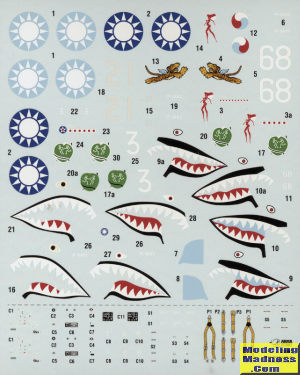 Markings are for three Flying Tigers; Charles Older with 3 Pursuit, Greg
Boyington with 1 Pursuit, and Dick Rossi with 1 Pursuit. All three are in US
equivalent dark earth/dark green over sky. Paints are provided from multiple
manufacturers. The decals are superbly printed and should work just fine.
Instructions are very well done and in color. I should mention that Arma is mum
about what shade to paint the area behind the quarter windows.
Markings are for three Flying Tigers; Charles Older with 3 Pursuit, Greg
Boyington with 1 Pursuit, and Dick Rossi with 1 Pursuit. All three are in US
equivalent dark earth/dark green over sky. Paints are provided from multiple
manufacturers. The decals are superbly printed and should work just fine.
Instructions are very well done and in color. I should mention that Arma is mum
about what shade to paint the area behind the quarter windows.
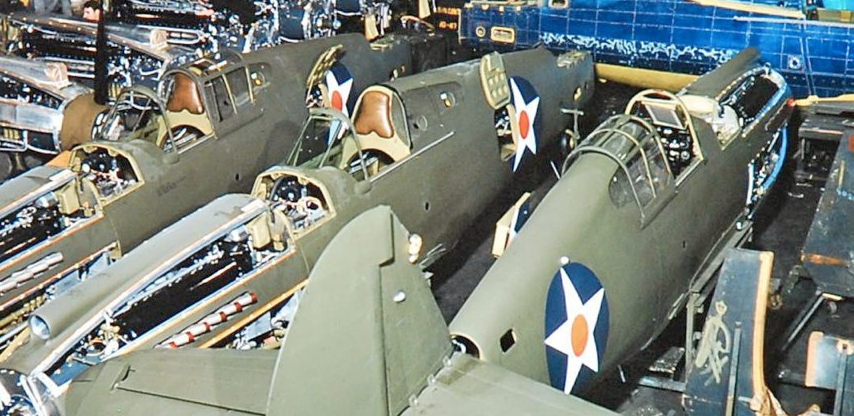
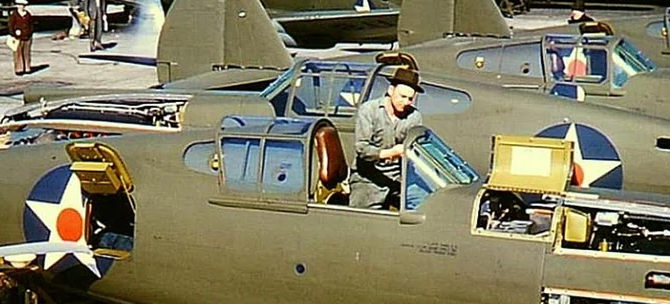
There is much debate over whether this area should be interior or exterior shade. So I took the liberty of doing a web search. There are a lot of photos of early P-40s being built, but I thought this one will clear things up, at least for the B/C variant. As a bonus, it shows the installation of the armored glass behind the windscreen. Just to muddy the water a bit. The second photo shows aircraft from this same batch, but it appears the area is a greenish shade. However, if you look closely, you will see that this is caused by the light going through the Plexiglas. The more layers of Plexiglas, the greener it gets. As Curtiss interior green is more of a yellowish shade, it is pretty obvious that the area under the quarter windows is the exterior color.
| CONCLUSIONS |
This kit was given to me by my friend Kevin Krajniak, who bought a first release direct from Poland. I have to say that I am looking forward to starting this one, but have to finish something underway before I can do that. While this is a pricey kit in the US, from all reports, it is the best one out there in this scale.
| REFERENCES |
https://en.wikipedia.org/wiki/Curtiss_P-40_Warhawk
September 2026
Copyright ModelingMadness.com. All rights reserved. No reproduction in part or in whole without express permission from the editor.
If you would like your product reviewed fairly and fairly quickly, please contact the editor or see other details in the Note to Contributors.