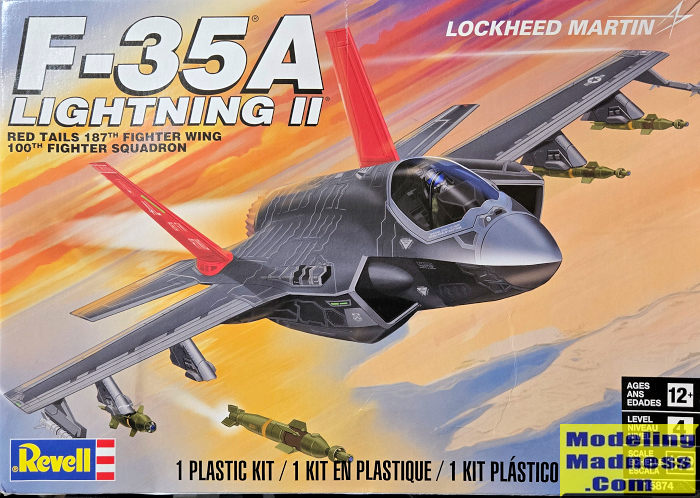
| KIT #: | 15874 |
| PRICE: | $28.54 |
| DECALS: | Three options |
| REVIEWER: | Scott Van Aken |
| NOTES: | 2025 tooling |
| HISTORY |
The Lockheed Martin F-35 Lightning II is an American family of single-seat, single-engine, supersonic stealth strike fighters. A multirole combat aircraft designed for air superiority and strike missions, it also has electronic warfare and intelligence, surveillance, and reconnaissance capabilities. Lockheed Martin is the prime contractor, with partners Northrop Grumman and BAE Systems. The aircraft has three main variants: the conventional takeoff and landing F-35A, the short take-off and vertical-landing F-35B, and the catapult-assisted take-off but arrested recovery F-35C. With 883 aircraft in service as of 2025, it is the world's fourth-most-numerous military aircraft, and most-numerous stealth aircraft. The aircraft has been plagued by huge cost overruns, slow production rates, and on-going software issues.
| THE KIT |
Produced last year, this kit looks to be the best of the batch in this scale. For sure it has a lot of parts, many of those attached to the 'beast' mode with pylons and weapons. Molded in their usual greenish-grey plastic the detailing is actually quite good. There is a nicely detailed main gear well, which is the first subassembly in the instructions. The kit can be built in three different configurations: stealth mode with no pylons, air to air mode with wingtip pylons, and beast mode with a full underwing load. When doing any of the second two modes, holes need to be opened up in the lower wings.
The fuselage incorporates most of the upper and lower wings in each half. The various gear wells and the cockpit have to be installed prior to joining the halves together. On the upper half, the transponders and drag chute holes will need to be opened if needed. 20 grams need to be installed in the nose, which is actually a lot of weight. Intakes, exhaust, wing flaps, and tailplanes are next followed by the landing gear and wheels. The latter can be left off until after painting. If building gear down and weapons bay open then these doors will need to be cut.
There are clear nose parts that again, can be added after painting. Available weapons are Sidewinders, AMRAAMS, and LGBs. One of the last things is building up the cockpit. Canopy can be built open and this is my biggest complaint. The frame and clear part of the canopy are separate. Good luck getting the attachment area to be invisible.
 Instructions
are very well done with lots of construction steps and indications on whether
the kit is built gear up or down. Color information is by Revell paints and
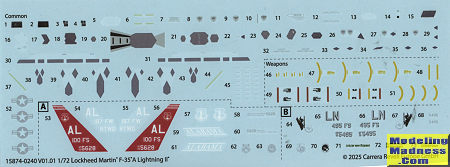
there is a lot of mixing required. Markings are provided for three aircraft. One
is the box art plane that temporarily wore red fins for the introduction of the
100FS, Alabama ANG. This unit used to be the 160 FS, but when the Red Tails at
Luke AFB were disbanded, the unit numbers were moved. It is appropriate as
Tuskegee is in Alabama. A second, smaller red flash is provided for the normal
Boss Bird. The third option is from the 495FS at Lakenheath which used to fly
the F-15. The sheet is well printed and includes markings for the weapons.
Instructions
are very well done with lots of construction steps and indications on whether
the kit is built gear up or down. Color information is by Revell paints and
there is a lot of mixing required. Markings are provided for three aircraft. One
is the box art plane that temporarily wore red fins for the introduction of the
100FS, Alabama ANG. This unit used to be the 160 FS, but when the Red Tails at
Luke AFB were disbanded, the unit numbers were moved. It is appropriate as
Tuskegee is in Alabama. A second, smaller red flash is provided for the normal
Boss Bird. The third option is from the 495FS at Lakenheath which used to fly
the F-15. The sheet is well printed and includes markings for the weapons.
| CONCLUSIONS |
Frankly, I'm not a fan of the F-22 or F-35 as I generally find the markings carried to be boring. One of these days I'll build an F-35 as I have this and a couple of Hasegawa kits. This one seems to be the least complex to paint and has a number of nice details the Hasegawa kits do not have.
| REFERENCES |
https://en.wikipedia.org/wiki/Lockheed_Martin_F-35_Lightning_II
July 2026 Copyright ModelingMadness.com. All rights reserved. No
reproduction in part or in whole without express permission. If you would like your product reviewed fairly and fairly quickly, please
contact the editor
or see other details in the
Note to
Contributors.