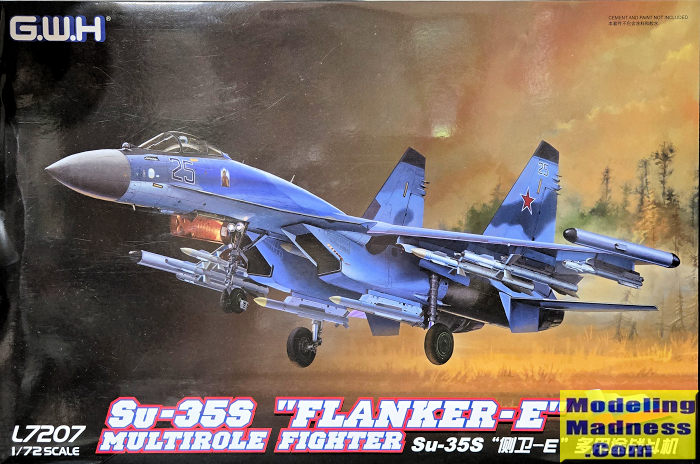
| KIT #: | L 7207 |
| PRICE: | $74.99 SRP |
| DECALS: | Three options |
| REVIEWER: | Scott Van Aken |
| NOTES: | 2018 tooling |
| HISTORY |
In 2003, even as Russia aimed to export the Su-27M, Sukhoi launched a project to produce a fighter to bridge the gap between upgraded variants of the Su-27 and Su-30MK, and Russia's fifth-generation Sukhoi PAK FA. The project's aim was a second modernization of the Su-27 airframe (hence its classification as a "4++ generation fighter") by incorporating several characteristics that would be implemented on the PAK FA. Additionally, the aircraft was to be an alternative to the Su-30 family on the export market. The design phase was to take place until 2007, when it would be available for sale. It was later reported that the programme was launched due to concerns that the PAK FA project would encounter funding shortages. The project's in-house designation is T-10BM (Bolshaya Modernizatsiya, "Big Modernization") while the aircraft is marketed as the Su-35.
While the aircraft maintains a strong superficial resemblance to the Su-27, the airframe, avionics, propulsion and weapons systems of the Su-35 have been thoroughly overhauled. Technological advancements have produced more compact and lighter hardware, such as the radar, shifting the centre of gravity to the aircraft's rear. These improvements removed the need for canards and saw the abandonment of the "tandem triplane" featured on several Su-27 derivatives. Also omitted was the Su-27's dorsal airbrake, which was replaced by differential deflection of the vertical stabilizers. Other aerodynamic refinements include a height reduction of the vertical stabilizers, a smaller aft-cockpit hump, and shorter rearward-projecting "sting".
The reinforced airframe sees extensive use of titanium alloys, increasing its durability to some 30 years or 6,000 service hours, and raising the maximum takeoff weight to 34.5 tonnes. Internal fuel capacity was increased by more than 20% to 11.5 tonnes, and could be raised to 14.5 tonnes with the addition of drop tanks; in-flight refueling can also be used to extend missions.
Sukhoi has overhauled the avionics suite, at the heart of which is the information management system that enhances man-machine interaction. The system, which has two digital computers, collects and processes data from various tactical and flight-control systems and presents the relevant information to the pilot through the two main multi-function displays, which, together with three secondary MFDs, form the glass cockpit. The aircraft features many other upgrades to its avionics and electronic systems, including digital fly-by-wire flight-control system, and the pilot is equipped with a head-up display and night-vision goggles.
The Su-35 employs an Irbis-E passive electronically scanned array radar that constitutes an essential component of the aircraft's fire-control system. The radar is capable of detecting a 3-square-metre (32 sq ft) aerial target at a distance of 400 km (250 mi), and can track 30 airborne targets and engage eight of them at the same time. Su-35S uses the N135 Irbis passive antenna array with electronic scanning radar for improved locating. The radar can also map the ground using a variety of modes, including the synthetic aperture mode. The Irbis-E is complemented by an OLS-35 optoelectronic targeting system that provides laser ranging, TV, Infra-red search and track (IRST) functionality. The Su-35 is compatible with a multitude of long- and short-range air-to-air missiles, precision and unguided air-to-ground weaponry that include missiles, fuel-air bombs and rockets. A maximum weapon payload of 8 tonnes can be carried on the fourteen hardpoints. The fighter may use missiles with a range of up to 300 km.
The Su-35 is powered by a pair of izdeliye (Product) 117S (AL-41F1S) turbofan engines. Developed jointly by Sukhoi, NPO Saturn and UMPO, the engine is a heavily upgraded AL-31F variant, and draws on the design of the fifth-generation PAK FA's Saturn 117 (AL-41F1) engines. Its thrust output is estimated at 142 kN (31,900 lbf), 20 kN (4,500 lbf) more than the Su-27M's AL-31F. It has a service life of 4,000 hours, compared to the AL-31F's 1,500; the two engines feature thrust-vectoring capability. Each thrust vectoring (TVC) nozzle has its rotational axis canted at an angle, similar to the configuration on the Su-30MKI. The thrust vectoring nozzles operate in one plane for pitch, but the canting allows the aircraft to produce both roll and yaw by vectoring each engine nozzle differently. A similar thrust vectoring system is also implemented on the PAK FA.
The engine may give the Su-35 limited supercruise capability, or sustained supersonic speed without the use of afterburners. Radar-absorbent material is applied to the engine inlets and the front stages of the engine compressor to halve the Su-35's frontal radar cross-section (RCS); the canopy was also modified to deflect radar waves.
| THE KIT |
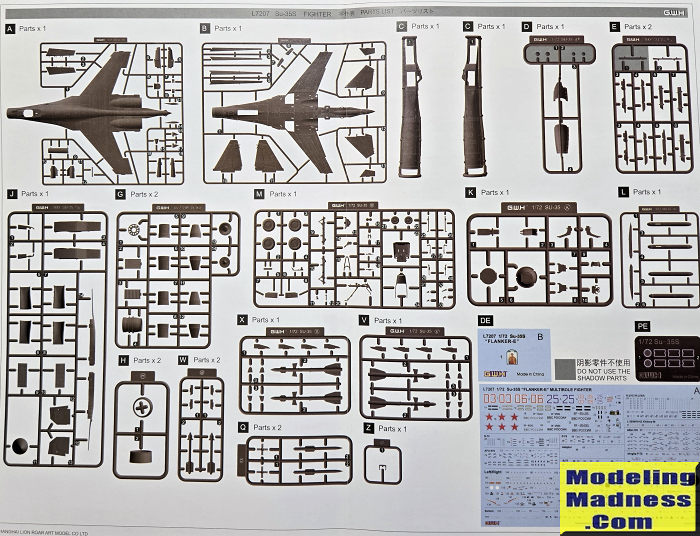 GWH
(a Lion Roar company) has built quite a positive reputation for the quality
of their kits. I can see why that is the case as this one is very nicely
detailed. A few years back I built the Hasegawa Su-35S and found it to be a
fairly nice build that made into a fairly large model. When this one was
offered at a very good price by an IPMS member, I decided to pick it up.
GWH
(a Lion Roar company) has built quite a positive reputation for the quality
of their kits. I can see why that is the case as this one is very nicely
detailed. A few years back I built the Hasegawa Su-35S and found it to be a
fairly nice build that made into a fairly large model. When this one was
offered at a very good price by an IPMS member, I decided to pick it up. 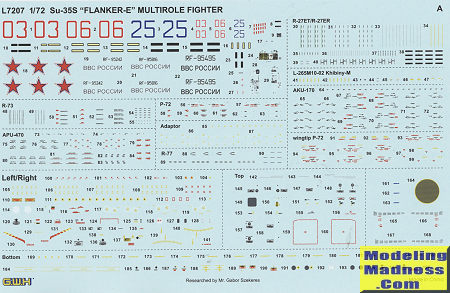 The kit
provides a lot of different missiles and you can really load out the
aircraft. Even if you don't use the wing tip pylons, there are pylons for
ten missiles (five on each side).
The kit
provides a lot of different missiles and you can really load out the
aircraft. Even if you don't use the wing tip pylons, there are pylons for
ten missiles (five on each side). | CONCLUSIONS |
Looking forward to getting around to building this one. I would like to do something other than a Russian plane, however only the Chinese currently operate the type and while Algeria has ordered them, I'm not sure if they have all been delivered. One thing for sure, this will take up a fair amount of shelf space.
| REFERENCE |
https://en.wikipedia.org/wiki/Sukhoi_Su-35#Modernization
February 2023
Copyright ModelingMadness.com. All rights reserved. No reproduction in part or in whole without express permission from the editor.
If you would like your product reviewed fairly and fairly quickly, please contact the editor or see other details in the Note to Contributors.