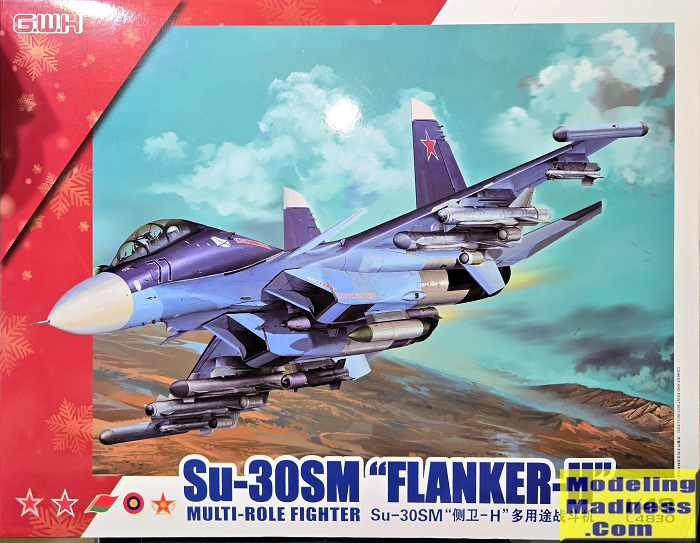
| KIT #: | L 4830 |
| PRICE: | $125.00 delivered |
| DECALS: | Eight options |
| REVIEWER: | Scott Van Aken |
| NOTES: | 2022 tooling |
| HISTORY |
The Su-30 started as an internal development project in the Sukhoi Su-27 family by Sukhoi. From the Su-27UB two-seat trainer, the Su-27PU heavy interceptor was developed. The design plan was revamped and the Su-27PU was renamed to Su-30 by the Russian Defense Ministry in 1996. Of the Flanker family, the Su-27, Su-30, Su-33, Su-34 and Su-35 have been ordered into limited or serial production by the Russian Defense Ministry. Later, different export requirements split the Su-30 into two distinct version branches, manufactured by competing organizations: KnAAPO and the Irkut Corporation, both of which come under the Sukhoi aerospace group's umbrella.
Irkut traditionally served the Soviet Air Defense and, in the early years of Flanker development, was responsible for manufacturing the Su-27UB, the two-seat trainer version. When India showed an interest in the Su-30, Irkut offered the multirole Su-30MKI, which originated as the Su-27UB modified with avionics appropriate for fighters. Along with its ground-attack capabilities, the series adds features for the air-superiority role, such as canards, thrust-vectoring, and a long-range phased-array radar. Its derivatives include the Su-30MKM, MKA, and SM for Malaysia, Algeria, and Russia respectively. The VKS operates several Su-30s and has also ordered the Su-30SM variant, of which 130 were on hand in 2024, but that number has dropped in past years.
This kit is the Su-30SM for Serijnyi Modernizirovannyi - "Serial Modernized". Announced 2011, a specialized version of the thrust-vectoring Su-30MKI for the VKS to be produced by the Irkut Corporation. NATO reporting name Flanker-H. The Su-30SM is considered a 4+ generation fighter jet. The aircraft has been upgraded according to Russian military requirements for radar, radio communications systems, friend-or-foe identification system, ejection seats, weapons, and other aircraft systems. It is equipped with the N011M Bars radar with a maximum detection range 400 km, search range 200 km using a phased array antenna, frontal horizontal fins and steerable thrusters for supermaneuvrability as well as with wide-angle HUD. The aircraft can be used to gain air supremacy same as for targeting adversary on the ground using wide range of weapons including air-to-air, air-to-surface and guided and unguided bombs with total weapons weight up to 8,000 kg. It is also equipped with the one barrel, 30 mm GSh-30-1 autocannon. To ensure operations at major distances from airfield, the ability of in-flight refuelling (IFR) is included. This version is only one of several variants of the Flanker H family.
| THE KIT |
 Thanks
to reading several books in which the Su-30SM played a prominent role, I thought
I'd take the time and effort to get a good kit of it. Previously, Kitty Hawk
produced this version and I had the kit, but provided it to another modeler who
really wanted it. That left me with only the option of either buying that kit
again, or trying the GWH version. Much of what I read about the GWH kit
recommended it as the one to get so I put in an order for one.
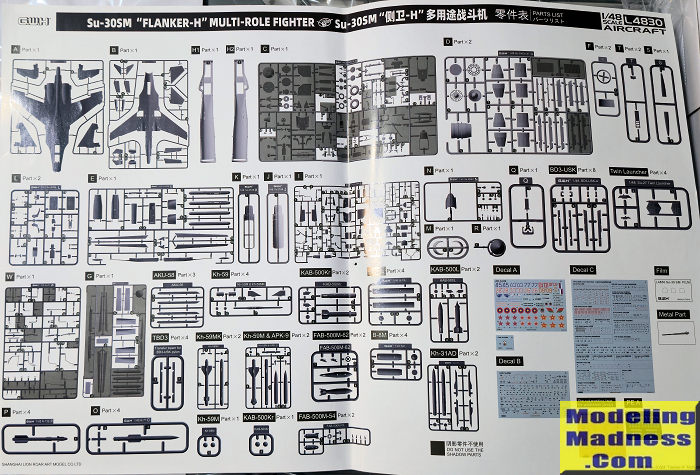
What arrived was a very large box just jammed with sprues. The fuselage halves and tail bits are packaged in cardboard and there are separate boxes for the short range missiles and the clear bits. A small p.e. fret is provided for the AoA, the gunsight frame and some other small bits. The kit also includes canopy masks.
You might expect a lot of options on a kit like this and you'd be right. The most numerous are the weapons. The builder has the option to install all 12 pylons or none of them. Installation requires opening holes in the wings and fuselage. For all those pylons, there are a variety of bombs, rockets, missiles and electronic pods that can be installed. A load out diagram is provided. Some of these are dependent on which markings option is chosen so read carefully.
In fact, it is a good idea to go through the instructions several times before starting the build. The instructions are excellent and provide areas of concern in red to make sure that you know how to install bits or just what alignment is needed. Where important, color information is also supplied.
Back to the options. In no particular order: open or closed canopy, open or closed radome, open or closed parabrake door, extended or retracted air brake. The lower intake air bleed doors can be modeled open or closed. You also have open or closed exhaust nozzles. The open nozzles (normal on the ground) can be posed lowered. Also the flaps and slats can be posed lowered as is typical on the ground. This info is noted in the instructions as some positions/parts are only viable when in the air. Speaking of which, the kit can be modeled in the flying position, which requires the elimination of some parts during the build. An interesting note is that the canards are not to be glued and have a specific installation sequence.
 As
mentioned, the instruction book is excellent and should be followed without
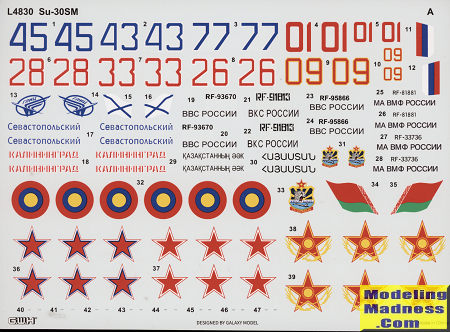
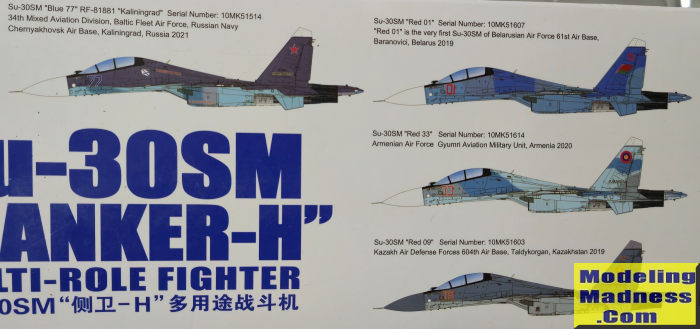
deviation. Markings are provided for eight aircraft. Five of them are Russian.
Three are in standard Flanker camouflage of a wraparound scheme of blues and
greys. Two of them are later with the upper surface in a dark grey with the
underside the same as the wraparound camouflage. There is a Belarus aircraft in
a darker scheme of blues and grey, a Kazakhstan plane in medium grey upper and
light blue underside. Finally an Armenian plane in standard camouflage. A large
camo and markings guide is provided and the decals are superbly done. There are
three decal sheets with two consisting of aircraft stencils and weapons
markings. Five and a half pages of the instructions are dedicated to a placement
guide.
| CONCLUSIONS |
This is a very nicely detailed kit that has the possibility of being a fussy build thanks to all of that detail. Just decaling the cockpit instrument and side panels will take time thanks to all the individual decals. Gear wells also have a lot of detail plumbing to add. Probably the most difficult part will be determining which markings option to use as all are fairly colorful (as far as modern jets go). For sure if one takes one's time, a superb and quite large model will result.
| REFERENCES |
https://en.wikipedia.org/wiki/Sukhoi_Su-30
November 2026 Copyright ModelingMadness.com. All rights reserved. No
reproduction in part or in whole without express permission. If you would like your product reviewed fairly and fairly quickly, please
contact the editor
or see other details in the
Note to
Contributors.