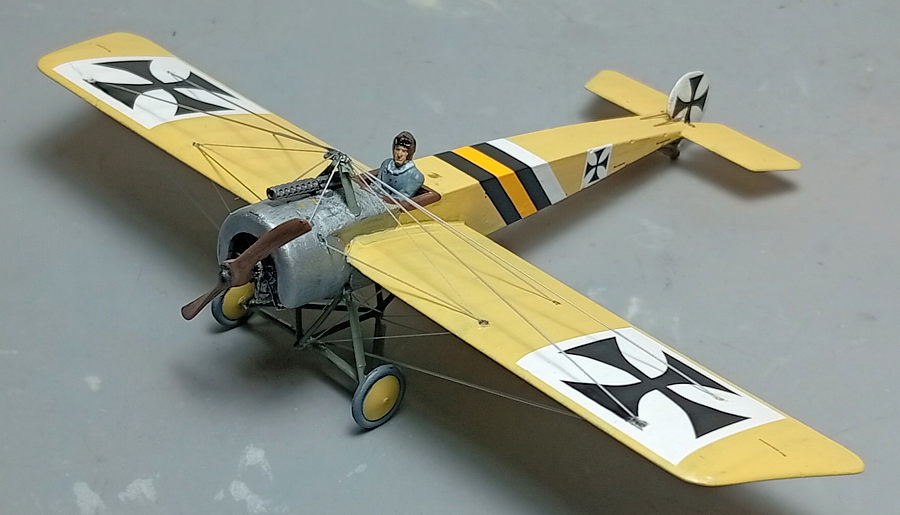
Airfix 1/72 Fokker Eindekker E.II
| KIT #: | A01085 |
| PRICE: | 10 Euros |
| DECALS: | One option |
| REVIEWER: | Spiros Pendedekas |
| NOTES: |
| HISTORY |
Among the many names recorded in the history of the First World War, only a few have become legendary. The famous aces, with their victories and colourful personalities, naturally attracted most of the attention. Yet behind those well-known figures stood hundreds of young pilots who helped shape the very beginnings of military aviation.
One of these forgotten pioneers was Leutnant Kurt Alexander Otto Feodor Freiherr von Crailsheim, a young German officer who belonged to the first generation of fighter pilots. Serving with Feldflieger-Abteilung 53 during 1915, he flew one of the revolutionary Fokker Eindeckers, aircraft that would forever change the nature of aerial warfare.
 The Fokker
Eindecker was not just another aircraft. It represented the beginning of the
true fighter aeroplane. With its synchronized machine gun firing safely through
the propeller arc, it gave German pilots a technological advantage and marked
the start of a new era where pilots would no longer simply observe the
battlefield but actively fight for control of the skies.
The Fokker
Eindecker was not just another aircraft. It represented the beginning of the
true fighter aeroplane. With its synchronized machine gun firing safely through
the propeller arc, it gave German pilots a technological advantage and marked
the start of a new era where pilots would no longer simply observe the
battlefield but actively fight for control of the skies.
Flying these fragile machines required exceptional skill and courage. The aircraft were primitive by later standards, with open cockpits, limited instruments and unreliable engines. Every flight demanded concentration and confidence. Pilots like von Crailsheim were not simply operating machines—they were exploring an entirely new dimension of warfare.
Von Crailsheim achieved one of Feldflieger-Abteilung 53's early aerial victories while flying the Fokker Eindecker. However, like many pioneers of aviation, his greatest danger did not come from enemy aircraft. On 30 December 1915, he suffered severe injuries in a landing accident and sadly passed away on 4 January 1916, at only twenty-three years of age.
Today his name is not among the most famous of the First World War aviators, but his story represents an entire generation of young men who helped transform aviation from an experiment into a vital part of modern warfare.
This model is dedicated to the memory of Kurt von Crailsheim and all those early aviators whose courage opened the skies to a new age.
| THE KIT |
Released by Airfix in 2017, the 1/72 Fokker Eindecker is a modern tooling that beautifully captures one of the most iconic fighters of the First World War. The kit represents Airfix's philosophy of producing models that combine good detail with enjoyable construction and are offered at a sensible price.
Featuring fine surface detail and convincing fabric representation, it is not an over-engineered kit filled with unnecessary complexity, but rather a model designed to be enjoyable for builders of different experience levels. It provides enough detail straight from the box while still offering opportunities for those who wish to add further refinements.
 The
particular example presented here has an especially meaningful background. It
was one of several kits generously donated by a beloved hobby shop to our local
modelling club, supporting the children's modelling seminars that we organize.
These donations help introduce young people to our hobby and strengthen the
modelling community through generosity and friendship.
The
particular example presented here has an especially meaningful background. It
was one of several kits generously donated by a beloved hobby shop to our local
modelling club, supporting the children's modelling seminars that we organize.
These donations help introduce young people to our hobby and strengthen the
modelling community through generosity and friendship.
Among those donated kits was this little red Airfix box. When my son saw it, he immediately chose the Fokker Eindecker as his favorite. Before long, it had found its way onto my workbench. Seeing his enthusiasm, I suggested that we build it together - and so began a very special father-and-son project.
For a more in-depth look at the kit's contents, you may read its preview, found in the ever growing MM archives.
| CONSTRUCTION |
I started by assembling the cockpit interior. The cockpit floor is molded integrally with the lower fuselage section, which also incorporates the tailplanes. As mentioned in the preview, these tailplanes are rather delicate, so some care must be taken during assembly to avoid accidental damage. And yes... that is exactly how I know!
The rear cockpit bulkhead and seat-supporting framework were attached to the floor before the subassembly was trapped between the fuselage halves. The upper forward fuselage section received what appears to be the fuel tank together with the simple instrument board, typical of these early aircraft.
Most cockpit components, including the rear bulkhead, sidewalls and seat frame, were painted in various beige and brown shades to represent wood. The seat was finished in dark brown color, while the control column and instrument board were painted black.
 The pilot
figure was installed as well. Although quite good for the scale, I made one
small modification by cutting and slightly repositioning his head to create a
more natural pose. He received a light grey flying suit, leather boots and
helmet, black goggles and a flesh-coloured face.
The pilot
figure was installed as well. Although quite good for the scale, I made one
small modification by cutting and slightly repositioning his head to create a
more natural pose. He received a light grey flying suit, leather boots and
helmet, black goggles and a flesh-coloured face.
The cockpit itself is extremely Spartan, but this is more or less how it should be. The real Fokker Eindecker was a simple machine, and the kit captures that character well. The addition of the pilot figure, however, transforms the interior completely. The figure gives life to the otherwise empty cockpit and makes the small aircraft feel much more alive.
The nicely molded rotary engine was then attached to the firewall and secured with its spindle, allowing it to rotate together with the propeller. It was painted steel and enhanced with a black wash to bring out the details. The side and upper cowling panels were added, completing the basic fuselage assembly.
Before the next assembly stages, a small amount of filling and sanding was carried out. Fortunately, very little work was required, as the fit was excellent.
The wings were then attached and showed a very positive fit, requiring no adjustment. The landing gear followed, consisting of three delicate strut assemblies that required careful alignment. The two side steps were added, together with the upper cabane struts, where the numerous flying and landing wires are attached.
The two-piece tail skid was also assembled and fitted. The rudder was deliberately left separate to facilitate painting, as it is a delicate part and quite prone to damage.
With these steps completed, major assembly was finished. The whole process was surprisingly straightforward, even easy, without sacrificing detail. Bravo, Airfix!
With the almost complete model ready, I moved on to the paint shop, but not to the usual one, as a slightly unusual idea came to mind: why not hand-paint the model, just like in the old days? It seemed perfectly appropriate for such an early aircraft...
| COLORS & MARKINGS |
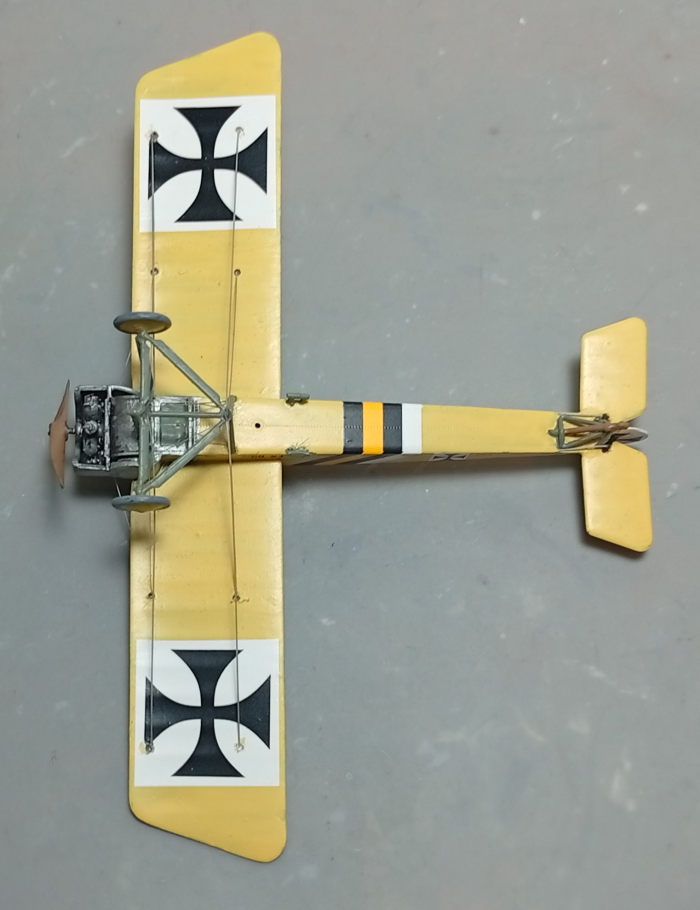 The
complete model received an overall coat of Humbrol 74 Linen. This color seemed
to be a good approximation of the typical appearance of doped linen fabric used
on these early aircraft. Perhaps it is slightly darker than the real thing, but
at this scale I found the result convincing. The cabane, the two side cowling
panels and the bottom metal panel were painted Tamiya XF-11 Silver.
The
complete model received an overall coat of Humbrol 74 Linen. This color seemed
to be a good approximation of the typical appearance of doped linen fabric used
on these early aircraft. Perhaps it is slightly darker than the real thing, but
at this scale I found the result convincing. The cabane, the two side cowling
panels and the bottom metal panel were painted Tamiya XF-11 Silver.
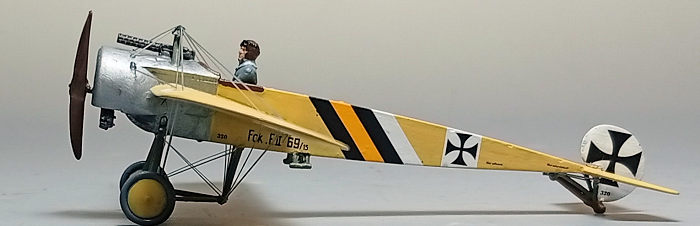
The landing gear struts, the main structure of the tail skid and the upper cabane struts - the framework to which the numerous flying and landing wires are attached - were painted Humbrol 78 Green. The same colour was also applied to the small side steps. The lower wooden portion of the tail skid was painted with Humbrol 118, creating a simple but effective representation of the natural wood components found on these early machines. A coat of Future prepared the bird for the decals.
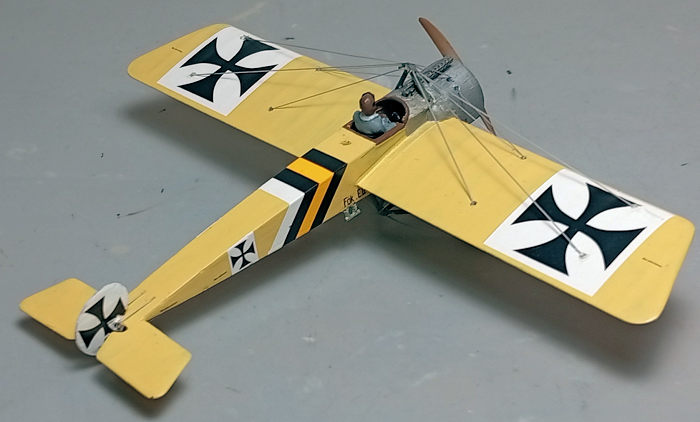
I used the kit decals to represent the aircraft of Leutnant Kurt von Crailsheim. The Carograf printed decals proved to be yet another pleasant surprise. They performed beautifully: from the moment they left the backing paper, requiring only a few seconds to half a minute to release, they settled very nicely over the various surfaces of the model, were easy to handle, and proved surprisingly strong even when subjected to my usual accidental mishandling.
Once everything was in place, another coat of Future sealed the decals and prepared the model for the final finishing stages.
| FINAL CONSTRUCTION |
The wheels were assembled and attached in position. Their covers were painted in the same linen colour as the main aircraft finish, while the tires were painted light gray, representing the appearance of the rubber used during the period.
The rudder, which had been deliberately left separate during the painting process, was completed next. It was painted white, received its cross decal and was finally attached to the rear of the aircraft.
The correct propeller for my version was painted Humbrol 118 Tan, followed by subtle streaks of Humbrol 98 Chocolate to simulate the natural grain of laminated wood. Once completed, it was attached in position, adding the final characteristic feature to the nose of the Eindecker.
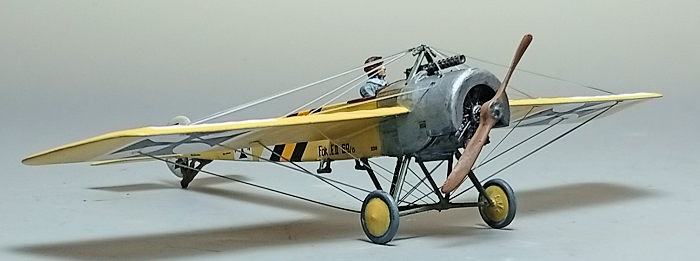 Weathering
was kept to a minimum. Apart from a subtle black wash to enhance certain details
and some light shading with dark colored dry pastels here and there to add
depth, the model was left with a restrained appearance.
Weathering
was kept to a minimum. Apart from a subtle black wash to enhance certain details
and some light shading with dark colored dry pastels here and there to add
depth, the model was left with a restrained appearance.
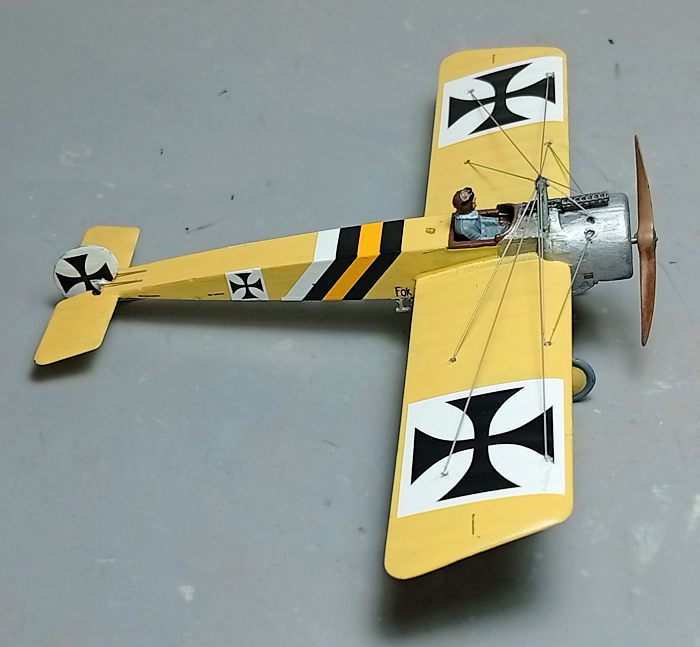
I decided to go all the way and add the rigging, as I believe the appearance of the Fokker Eindecker is greatly defined by its wire structure. Although some younger or less experienced modellers may very well choose to omit this step, I feel that on this particular aircraft the rigging is such a distinctive feature that it is worth the additional effort. Without it, the model simply loses part of the character that makes the Eindecker so recognisable.
The rigging was completed using pieces of stretched sprue of different lengths, carefully positioned to represent the numerous flying and landing wires of the real aircraft. In total, approximately 28 individual wires were added throughout the airframe.
With the completion of the rigging, and a final satin coat, the little Fokker finally came to life, displaying the delicate but purposeful appearance of the original machine!
| CONCLUSIONS |
The Airfix 1/72 Fokker Eindecker proved to be a wonderful little project from start to finish. In an era when some kits can become overly complex, with high parts counts and complex engineering, this model follows a much more enjoyable philosophy. It is not over-engineered or intimidating. Instead, it offers a beautifully balanced experience: simple enough to be relaxing, yet detailed enough to satisfy the experienced modeller. Construction was a pleasure, with very good fit throughout the build. A little extra care is needed with the smaller parts, especially the delicate landing gear structure, where careful alignment is important. But this only adds to the charm of building a pioneering aircraft from the early days of aviation.
One of the highlights of this project was choosing to hand-paint the model. Using my Humbrol paints and my Humbrol Senator brush, I felt transported back to a slower, more traditional style of modelling. Painting this historic aircraft by hand created a special connection with a machine that itself represents craftsmanship and the human touch.
However, this Fokker Eindecker is much more than just another model in my collection. It carries the story of friendship and generosity, coming from a donation by a beloved hobby shop to our local modelling club, helping us introduce children to the joy of this wonderful hobby. Most importantly, it became a father-and-son project. Every step of the process became a shared memory. The painting, the assembly, and even the small challenges along the way were moments we experienced together. The finished model is special not because of its size, but because of the story behind it.
I can only congratulate Airfix for continuing to produce kits that combine excellent molding, good detail, accurate proportions, and beautiful decals, while remaining enjoyable for both beginners and experienced modellers. This Fokker Eindecker represents everything a great model kit should be: a fascinating subject, pleasant construction, and a rewarding result.
A historic aircraft, a wonderful kit, a return to traditional modelling, the kindness of friends, and above all, the unforgettable memory of building together with my son. The Airfix Fokker Eindecker may be a small model, but it carries a very big story.
Thanks to Plastimodellismo hobby shop for the review sample.
Happy Modeling
Spiros Pendedekas
4 August 2026 Copyright ModelingMadness.com. All rights reserved. No
reproduction in part or in whole without express permission. If you would like your product reviewed fairly and fairly quickly, please
contact
the editor
or see other details in the
Note to
Contributors.