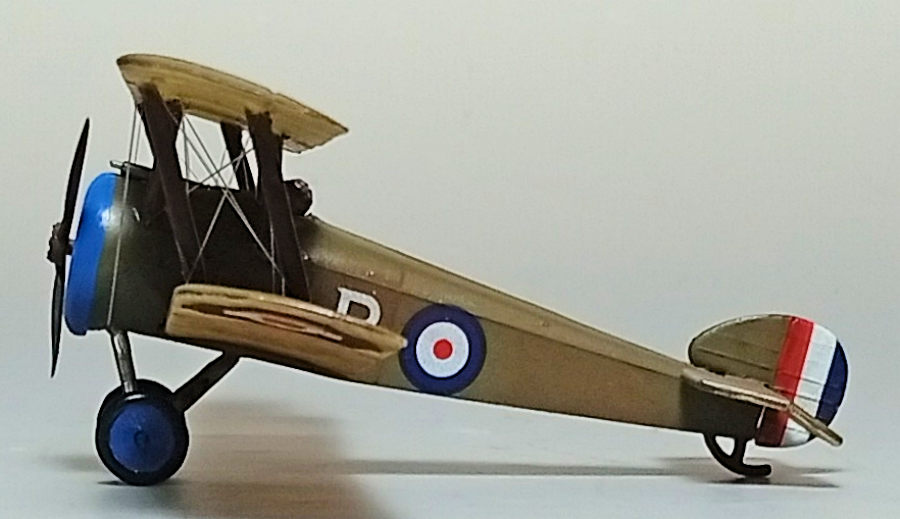
Academy 1/72 Sopwith Camel
| KIT #: | 1624 |
| PRICE: | $21.00 SRP |
| DECALS: | 5 Euros |
| REVIEWER: | Spiros Pendedekas |
| NOTES: |
| HISTORY |
THE BLUE OF CAMEL "B"
By the time Lieutenant Alexandros Mavridis first saw the Sopwith Camel marked B, the little fighter had already lived one life. Built in Britain and bearing the scars of previous service, it still carried its British roundels on the wings and fuselage, while the simple letter B remained on the side. There had been no time for a complete repaint or a new identity. Instead, the mechanics had given it only a few hurried touches: the engine cowling and wheel covers were painted medium blue, with the old finish still showing through in places. It was not a smart-looking aircraft, but to Mavridis it looked like a survivor.
At twenty-seven, Mavridis was already an experienced pilot and had developed a healthy respect for the machines that carried men into combat. He preferred to inspect his aircraft personally and trusted what he could hear and feel more than what an instrument told him. From the beginning, he treated the Camel almost as a companion rather than a piece of equipment. He learned the particular rhythm of its rotary engine, the vibrations that warned him of trouble and the subtle changes in its handling. Before every flight, he would place his hand briefly on the medium-blue cowling, a small habit the mechanics noticed but never questioned. “She's been through a lot,” he once remarked. “So have we.”
During the final months of the Great War, Mavridis and the Camel flew patrols, escort missions and attacks over the Aegean and the eastern Mediterranean. Long periods of routine could be interrupted without warning by enemy aircraft, ground fire or mechanical failure. Mavridis was brave, but never reckless. The war had taught him that surviving was not cowardice and that bringing an aircraft home was sometimes as important as winning a fight. When the Armistice came in November 1918, he believed his combat flying was finally over. History, however, had other plans.
 By
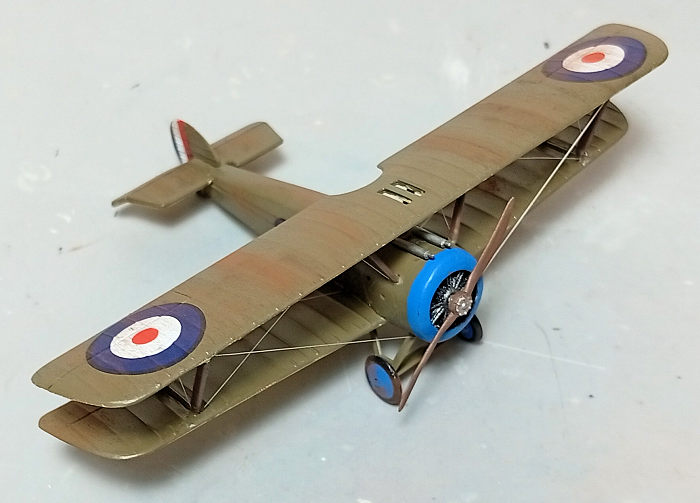
1919, Greek forces were operating in Asia Minor, and the old Camel was once
again sent into combat. The environment could not have been more different
from the Western Front. Rough airfields, intense heat, dust and a shortage
of spare parts placed enormous demands on both aircraft and mechanics.
Machines were repaired repeatedly and kept flying long after they might have
been retired under normal circumstances. The Camel marked B was no
exception. Its British roundels remained, its letter remained, and the
medium-blue cowling gradually became chipped and battered. To the men on the
ground it was simply “the blue-nosed Camel,” and Mavridis would accept no
suggestion that its distinctive color should be changed. “I know her by it,”
he once told a mechanic.
By
1919, Greek forces were operating in Asia Minor, and the old Camel was once
again sent into combat. The environment could not have been more different
from the Western Front. Rough airfields, intense heat, dust and a shortage
of spare parts placed enormous demands on both aircraft and mechanics.
Machines were repaired repeatedly and kept flying long after they might have
been retired under normal circumstances. The Camel marked B was no
exception. Its British roundels remained, its letter remained, and the
medium-blue cowling gradually became chipped and battered. To the men on the
ground it was simply “the blue-nosed Camel,” and Mavridis would accept no
suggestion that its distinctive color should be changed. “I know her by it,”
he once told a mechanic.
One hot afternoon, Mavridis was ordered to reconnoiter a valley ahead of the Greek positions after reports of enemy movement along a dusty road. He climbed into the cockpit, checked the controls and rested his hand for a moment on the cowling before starting the engine. The Camel lifted from the rough field and headed toward the valley. He located the enemy column and made a low pass, but almost immediately rifle and machine-gun fire rose toward him. The aircraft shuddered as bullets passed around it, yet Mavridis held his course long enough to gather the information he needed before climbing toward the hills.
That was when he saw the enemy fighters. He pushed the Camel into a dive and engaged the nearest aircraft, twisting through a violent turning fight as both machines dropped toward the hills. For a few moments Mavridis had the advantage, but another fighter appeared behind him and opened fire. Several rounds struck the Camel. Oil spread everywhere and the engine began to cough. Mavridis broke away and turned toward the Greek lines, but the engine finally stopped. Suddenly the only sound was the wind rushing past the aircraft.
Below him was a maze of dry hills and valleys with no airfield within reach. Then he spotted a narrow strip of flat ground between two ridges and turned toward it. There was no time to try again. Mavridis brought the aircraft in as smoothly as he could, touching down on one wheel before the Camel swung violently and its lower wing struck the earth. The aircraft spun through a cloud of dust and finally stopped beside a low stone wall.
Mavridis climbed from the wreck with a cut on his forehead and looked back at the aircraft. The propeller was twisted, one wing was badly damaged and the fuselage was riddled with bullet holes, but the medium-blue cowling was still intact. He walked over and placed his hand on it for the last time. Then he heard engines approaching. The enemy fighters had found him.
He grabbed his map, pistol and whatever else he could carry and ran toward the hills. Before disappearing among the rocks, he turned for one last look at the Camel. He knew he would probably never see it again. Moments later, the enemy aircraft swept over the valley and opened fire on the wreck, throwing dust and fragments into the air. Mavridis watched helplessly from cover until the aircraft disappeared into the distance. He wanted to return to his Camel, but he knew that its final mission was already over. It had brought him down alive; now he had to leave it behind.
A Greek patrol eventually recovered the wreck, but the Camel was beyond repair. The engine, instruments, guns and other useful components were removed, while the damaged airframe was abandoned. Curiously, however, the cowling was gone. Nobody could say who had taken it. The mechanics insisted they had not removed it, and the patrol commander remembered seeing it attached when the wreck was first discovered. The Camel marked B disappeared from the records, and with it went the last official trace of the aircraft.
 Then,
many years later, an old Greek family in the Smyrna region discovered a
battered aircraft cowling in a storage building behind their house. It was
dented, scratched and covered in dust, but beneath the dirt there was still
a surprisingly strong layer of medium-blue paint. An elderly member of the
family remembered stories he had heard as a child about a Greek aircraft
that had crashed in the hills during the campaign. There was no serial
number, no identification plate and nothing that could prove where the
cowling had come from. There was only the blue paint and an old story.
Then,
many years later, an old Greek family in the Smyrna region discovered a
battered aircraft cowling in a storage building behind their house. It was
dented, scratched and covered in dust, but beneath the dirt there was still
a surprisingly strong layer of medium-blue paint. An elderly member of the
family remembered stories he had heard as a child about a Greek aircraft
that had crashed in the hills during the campaign. There was no serial
number, no identification plate and nothing that could prove where the
cowling had come from. There was only the blue paint and an old story.
The family kept it for many years, but eventually the house changed hands and the strange piece of metal disappeared once again. Perhaps it was thrown away. Perhaps someone recognized what it might be and quietly kept it. Perhaps it is still hidden somewhere today. There is no way to know whether it really belonged to the Camel marked B, and that uncertainty is precisely what makes the story so intriguing.
Mavridis survived the campaign, but he never saw his Camel again. Years later, when an old friend asked whether he ever missed flying, he was silent for a moment before answering, “I don't miss the flying. I miss one particular airplane.” When his friend asked which one, Mavridis smiled faintly. “The one with the blue cowling.”
Perhaps the battered cowling discovered years later really had belonged to Camel B. Perhaps it had come from another aircraft, or perhaps the story of its discovery had become distorted with time. There was no serial number, no identification plate, nothing that could prove its origin. Only the medium-blue paint remained as a tantalizing clue.
The Camel disappeared. Its pilot survived. The records eventually fell silent. But somewhere, perhaps still hidden beneath layers of dust in an old workshop or forgotten collection, that battered piece of metal may have survived too. And beneath the scratches, dents and years of dust, there may still be a little of the same medium-blue paint that once caught the sunlight over the hills of Asia Minor.
The same blue Mavridis touched before every flight. The same blue he saw for the last time beside that lonely stone wall.
The blue of Camel B.
| THE KIT |
 The origins
of this little kit are quite interesting. The tooling dates back to the
vintage-kit era and was originally issued by Marusan, heavily based on the even
older Revell offering.. The kit was subsequently reissued through several
manufacturers, including , Eldon, Nichimo, Fuji, Entex and Esci.
The origins
of this little kit are quite interesting. The tooling dates back to the
vintage-kit era and was originally issued by Marusan, heavily based on the even
older Revell offering.. The kit was subsequently reissued through several
manufacturers, including , Eldon, Nichimo, Fuji, Entex and Esci.
From the mid-1980s onwards, the kit also appeared under the Academy brand (being essentially a copy of the previous molds), and has remained in the company’s catalog through a number of reboxings, totally unchanged. Thus, this small Sopwith Camel has a surprisingly substantial history behind it, having survived through numerous reissues and manufacturers over several decades.
The particular kit reviewed here was ordered from one of my beloved hobby shops, now operating exclusively through the Internet. It was exactly the same kit that the shop had previously donated to my local modeling club as an introductory present for children joining our modeling seminars. My elder 11-year old son, loved that little kit and wanted to build one again, so here it is.
It is a sweet little kit by all means. Although based on very old tooling, it is an easy-going model that should provide a straightforward and enjoyable build, especially for newcomers to the hobby or younger modelers.
Should you want to have a peek at its contents, you need look no further than our Editor’s Preview, found in the MM archives.
| CONSTRUCTION |
From the outset, it was decided that this would be a father-and-son build. The idea was to keep things simple and enjoyable: my son would start the model, with his father adding the finishing touches. It seemed the perfect approach for such a small and straightforward kit, and, as things turned out, it worked beautifully.
Construction started with the two fuselage halves being joined, followed by the engine at the front, which is molded integrally with the cowling. The lower wing was also attached at this stage. A first round of filling and sanding was then carried out before adding the more fragile components. With a biplane, I prefer to get the bulk of the filling and sanding out of the way before adding the struts and upper wing, and this approach worked particularly well here.
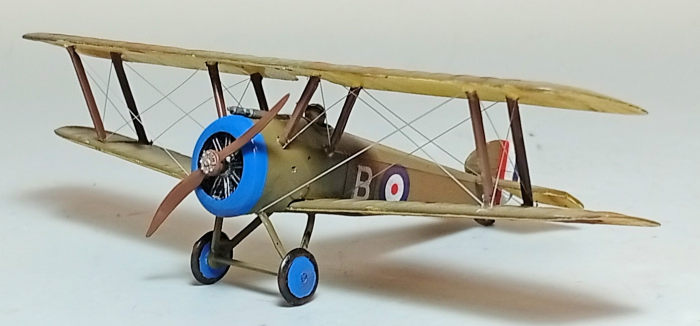 The wing
struts were subsequently attached to the lower wing and fuselage. After allowing
them to cure sufficiently to hold their position, but not completely harden, the
upper wing was carefully offered up. This proved to be a much easier operation
than initially anticipated. With the struts still having a little flexibility,
they could easily be adjusted to meet the upper wing, which was then glued in
position once everything was properly aligned.
The wing
struts were subsequently attached to the lower wing and fuselage. After allowing
them to cure sufficiently to hold their position, but not completely harden, the
upper wing was carefully offered up. This proved to be a much easier operation
than initially anticipated. With the struts still having a little flexibility,
they could easily be adjusted to meet the upper wing, which was then glued in
position once everything was properly aligned.
The rear stabilizers came next, followed by the rather delicate main landing gear. The wheels, together with the rudder and fin, were left off at this stage to facilitate painting.
That was essentially it. The whole construction process took less than half an hour, making for a wonderfully simple and enjoyable build, pleasantly reminiscent of the models of old.
Fit, while certainly not perfect, was good enough, with no particularly difficult seams to tackle. After some filling and sanding, the little bird was ready for the paint shop.
| COLORS & MARKINGS |
From the outset, it was decided that this model would be hand-painted. It seemed entirely feasible for such a small and simple model, while also being rather nostalgic and, frankly, quite attractive. Because what could be more appealing than a hand-painted 1/72 biplane finished with Humbrol enamels and a Humbrol Senator red-sable paintbrush? Nothing, really. So, here we go!
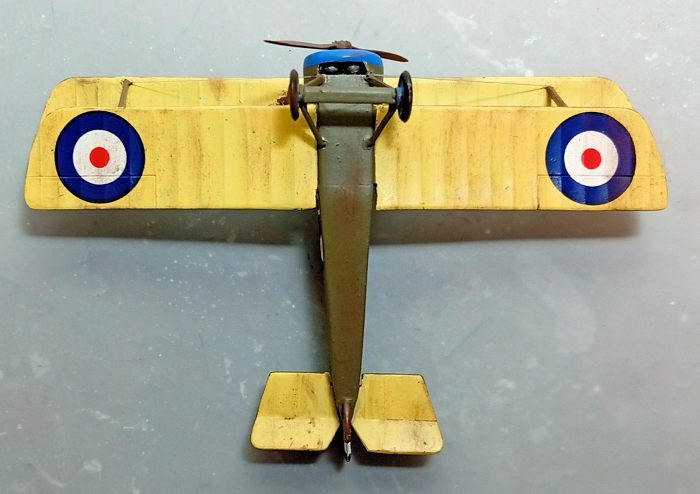
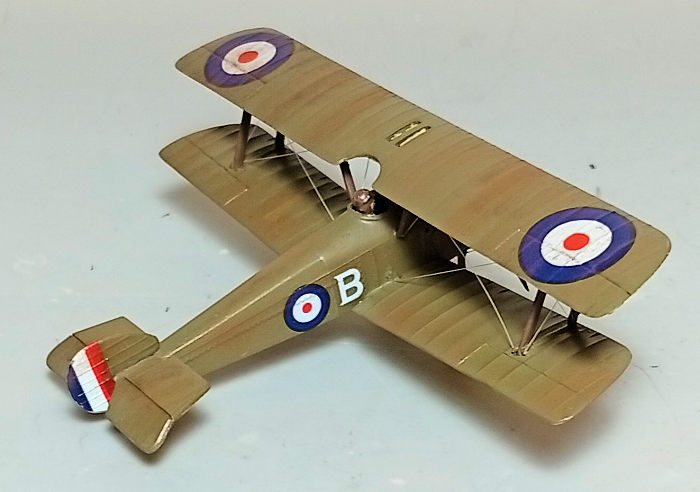 I first
applied a coat of Humbrol 74 Linen to the lower surfaces. Once this had dried,
the upper surfaces, the complete fuselage and the fin received a coat of Humbrol
155 Olive Drab. The wing struts were painted a dark brown "wood" shade.
I first
applied a coat of Humbrol 74 Linen to the lower surfaces. Once this had dried,
the upper surfaces, the complete fuselage and the fin received a coat of Humbrol
155 Olive Drab. The wing struts were painted a dark brown "wood" shade.
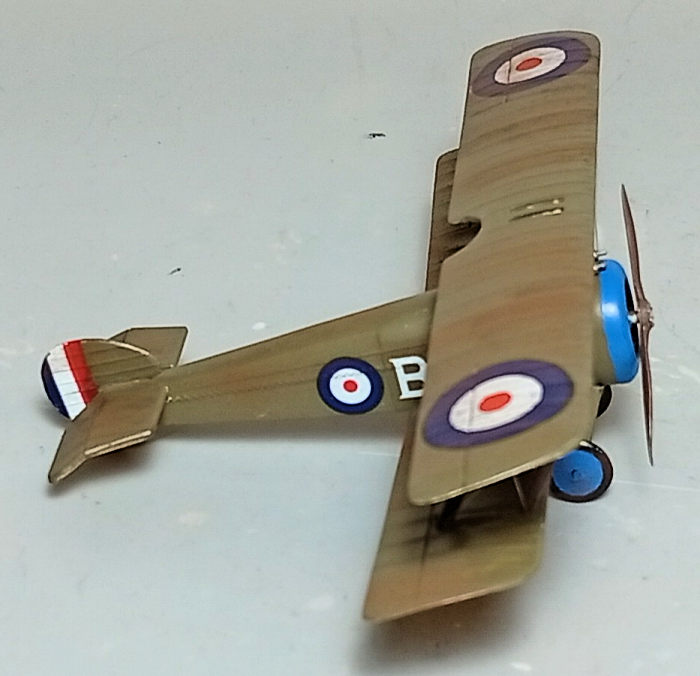
Once the paintwork had dried thoroughly, a coat of Future was applied to prepare the little Camel for decaling. For the markings, I decided to use the kit decals to depict an imaginary machine, carrying the white “B” code on the fuselage sides. In our little what-if scenario, this particular Camel represents an aircraft rushed from British to Greek hands during the final stages of the First World War.
The Academy decals behaved very nicely. They were well printed, settled down without any problems and, importantly, were not nearly as temperamental as some older Academy decals could be. This suggests that Academy has made considerable improvements in the quality of its decals over the years.
A final coat of Future sealed the decals and completed the basic finish.
| FINAL CONSTRUCTION |
I decided to add a pilot to the cockpit, as leaving it completely empty would have made the little Camel look rather deserted. I used one of the spare First World War pilot figures from the parts box. His leather jacket was painted light brown, the flying helmet dark brown, and his face in flesh color. His goggles were painted black, while a white scarf completed the figure. He was then thrown in the cockpit.
The wheels were painted with black tires and French Blue rims, using Humbrol 14 French Blue, adding a little Greek character to our hypothetical machine in Greek service. The tail skid was painted a dark brown “wood” shade.
I decided to carry the same French Blue color onto the engine cowling, which was carefully hand-painted. The engine itself, molded as a single piece with the cowling, was painted black and then heavily dry-brushed with silver. This simple treatment really brought out the detail of the old molding.
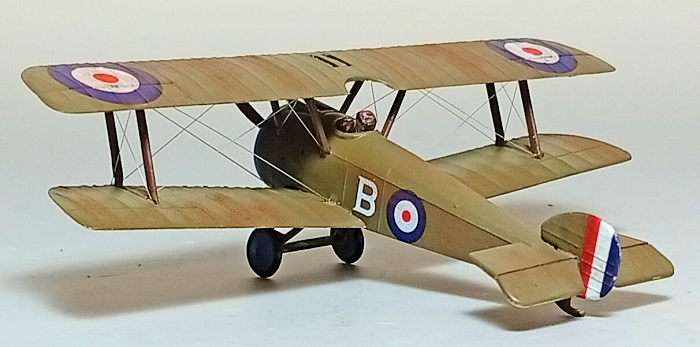 The paired
guns were painted Gunmetal and attached at this stage. They protruded rather too
far from the fuselage, so I shortened them slightly to give them a more
realistic appearance. The propeller was painted in a dark wood color from the
leftovers on the workbench, given a silver hub, and attached in position.
The paired
guns were painted Gunmetal and attached at this stage. They protruded rather too
far from the fuselage, so I shortened them slightly to give them a more
realistic appearance. The propeller was painted in a dark wood color from the
leftovers on the workbench, given a silver hub, and attached in position.
I also decided to add some rigging. Roughly 80% of the rigging found on the real aircraft was reproduced, using stretched sprue. I deliberately left out some of the more complicated areas, including the rigging around the tail, the wires associated with the control/support bars for the upper and lower ailerons, and, most importantly, the rather horrendous arrangement immediately above the guns. This was, after all, intended to remain a simple and enjoyable build!
The stretched sprue was carefully attached to the appropriate locations and, despite the inevitable fiddling involved, it added considerably to the appearance of the finished Camel.
For weathering, I used various shades of brown and black pastels, concentrating them over the wings and other areas to give the fabric a suitably used appearance. A final matte coat sealed everything and gave the little bird its final finish.
With that, the camouflage, markings, weathering and finishing were complete, and our simple little Camel was finally ready to take to the skies
| CONCLUSIONS |
Academy’s little Sopwith Camel is a very neat kit by all means. It certainly does not hide its old and rather simplistic origins, but then again, it does not pretend to be something it is not. Academy itself seems to have recognized this in its more recent boxings by labeling it as an “Easy Kit,” and that description is pretty much spot on.
The entire model can be assembled in around an hour, and it can easily be brush-painted, making it an ideal project for a newcomer to our hobby. Young modelers in particular should find plenty of satisfaction in putting together a recognizable First World War biplane without having to wrestle with hundreds of parts or complicated assemblies. The more demanding modeler will naturally find the detail somewhat basic, but there are considerably more sophisticated Sopwith Camel kits available for those looking for ultimate fidelity. This little Academy offering is aimed at a different audience, and it succeeds very well in that role.
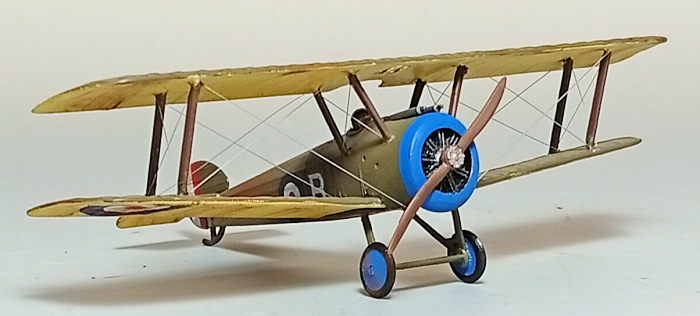 That,
really, is where its charm lies. It is simple, inexpensive and unpretentious,
yet it offers plenty of room for a little extra care. Some careful brush
painting, a touch of weathering and even a little rigging, as we added here, can
turn it into a surprisingly attractive little model. At €5 or less, it is also
difficult to ask for much more.
That,
really, is where its charm lies. It is simple, inexpensive and unpretentious,
yet it offers plenty of room for a little extra care. Some careful brush
painting, a touch of weathering and even a little rigging, as we added here, can
turn it into a surprisingly attractive little model. At €5 or less, it is also
difficult to ask for much more.
For me, however, this particular Camel became something more than just another small build. It was started by my son and completed with the finishing touches added by his father, which made the whole experience especially enjoyable. It brought back memories of a simpler time in modeling, when a small box, a handful of parts, a paintbrush and a few tins of Humbrol could provide an afternoon of pure enjoyment. Having a father and son share that experience makes a simple little kit rather special.
The model was also given a little extra life through the fictional story of Lieutenant Alexandros Mavridis and his Greek Camel “B,” complete with its distinctive medium-blue cowling. Although the story is entirely fictional, it was inspired by the very real service of Greek Sopwith Camels during the First World War and the Asia Minor Campaign. In that way, the little Academy Camel became not only a model, but the starting point for a small journey into history, imagination and memory.
So, no, this is not the Sopwith Camel for the modeler looking for ultimate detail. It does not need to be. It is a kit that knows exactly what it is and does what it sets out to do very well. More importantly, it is the sort of kit that can put a smile on a youngster’s face, bring a father and son together at the modeling bench, and remind an experienced modeler why he started building models in the first place.
At €5 or less, I can warmly recommend it as an easy-going, inexpensive and thoroughly enjoyable introduction to WWI biplanes. Add a little imagination—and perhaps a story of your own—and there is even more enjoyment to be found inside that tiny box.
Sometimes the simplest models really do provide the biggest smiles.
Highly recommended under these conditions, and definitely a lovely little walk down memory lane.
Happy Modeling!
Spiros Pendedekas
| REFERENCES |
Copyright ModelingMadness.com. All rights reserved. No reproduction in part or in whole without express permission from the editor.
Thanks t
If you would like your product reviewed fairly and fairly quickly, please contact the editor or see other details in the Note to Contributors.