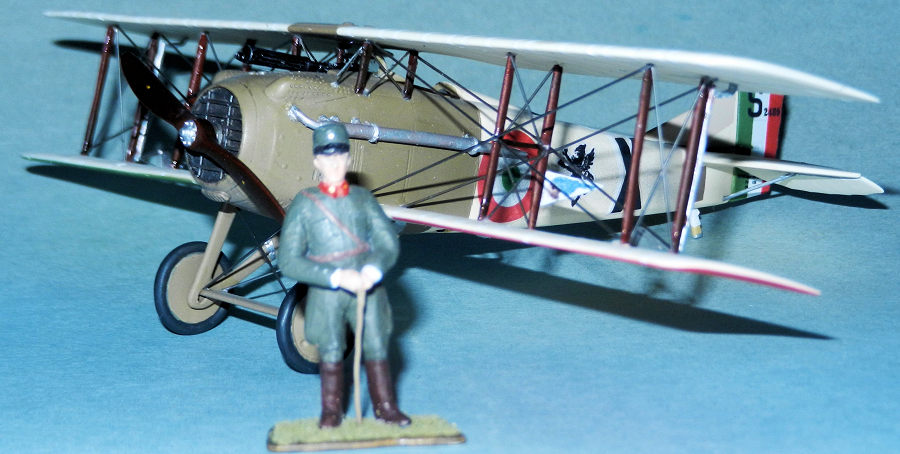
Special Hobby 1/48 SPAD VII
| KIT #: | 48031 |
| PRICE: | CAD$30.00 |
| DECALS: | Two options |
| REVIEWER: | Pablo Calcaterra |
| NOTES: | Hasegawa 36107 pilot figure |
| HISTORY |
Eduardo was a very energetic kid who kept on running into trouble due to his curiosity and hunger for adventures. Like riding his elder brother’s motorcycle and crashing thru the glass windows of a bank…or joining an artistic troupe and performing using roller blades…till he was discovered by his angry brother. Having followed all the news about the progress of aviation he decided he wanted to be a pilot. In November 1912 he took all his savings and travelled by train to Buenos Aires where he witnessed his first planes in the air at the Vila Lugano Aviation School. All planes were of French origin (Farman, Voisin, Bleriot…). The leader at the school was the famous Pablo Castaibert who had witnessed the Wrights first flights in North Carolina.
Olivero asked to be trained to be a pilot but his 16 years he was pushed aside and laughed at. His savings had run dry, he had no money to pay the rent of his small room, he was eating dark bread and protein was coming from little frogs he was capturing in ponds and frying…Finally he managed to convince one of the pilots to be his helper and started running small errands around the airfield. His enthusiasm around the field and his desire to fly were so evident that Castaibert realized there was something special in Eduardo. There was some special “spark” in the kid. Finally one day in 1913 the famous Frenchman asked Olivero if we wanted to learn to fly! After several classes on the ground he took to the air early 1914. Though he had not reached the minimum age Castaibert managed to convince (under Eduardo’s “pressure”) the official inspectors to test the young eagle. On June 18 1914 he passed the test…but was denied his brevet (which would have been #43!) because he was underaged (17 years and 7 months old)…thus probably in fact he was one of if not the youngest pilot in the world at the time.
A few days later he “borrowed” the plane and flew to Tandil to the amazement of family and neighbours. He took some to the air including young ladies. When Castaibert found out where Olivero and his plane were he commanded him to return to Villa Lugano.
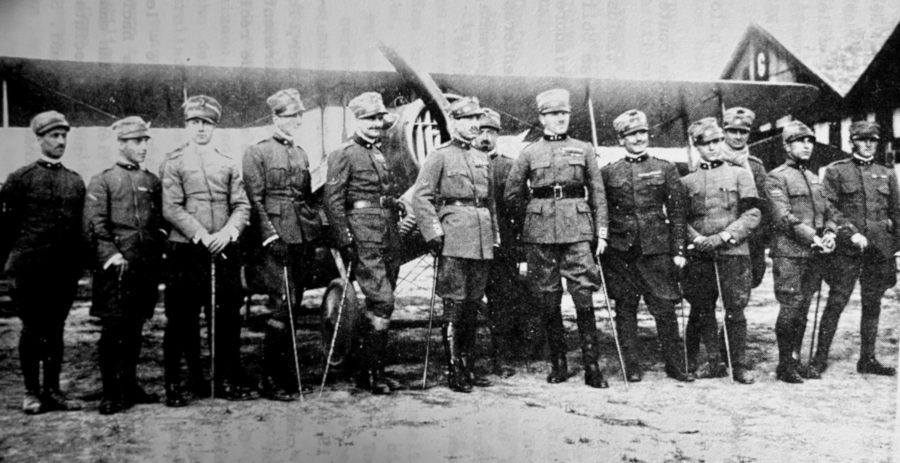
He started now to make money…but war had started in Europe. Some of the French and Italian fliers living in Argentina decided to fly for their countries. And though he faced a stern opposition from his family, Eduardo finally left Tandil in July 1915 to join the Italian forces. Late August 1915 and he is in Turin where he joins the Armed Forces. Showing his papers and refusing to get basic training he is sent to an air base that is flying Nieuport-Machis where he will get the basic instruction in fighters and then…straight to the front! He joins the Second Squadron where he interacts with the veterans who explain to the newcomers the real aspects of air war. All planes have a different painting designed by their pilots. Olivero has the head of an Argentine native (Pampa) on his plane. It is called the Testa de Indiano…Cabeza de Indio…Head of a Native.
 His first
taste of war was a nighttime bombardment by the Austrian Air Force. Soon he was
flying escort missions to Italian bombers. Not much later he achieved his first
victory: a “draken” (an observation ballon that had no time to react to the
sudden attack of the Argentine). On November 13 1916 he got his first airplane
kill: an Aviatik shot down. The pilot survived and was found by Olivero the
following day. His defeated adversary gave him as a present his pipe. March 1
1917 and while being on duty he scrambled with Lt. Olivi because two Albatros
were approaching the area. The Italian planes get the upper hand but Olivero was
dragged to the Austrian lines where he was hit by AAA and managed to return to
his lines with the last drops of fuel as the tanks had been hit. He broke a leg
and got some bruises which left him out of combat for some days. On this month
he was transferred to the 76 Squadriglia.
His first
taste of war was a nighttime bombardment by the Austrian Air Force. Soon he was
flying escort missions to Italian bombers. Not much later he achieved his first
victory: a “draken” (an observation ballon that had no time to react to the
sudden attack of the Argentine). On November 13 1916 he got his first airplane
kill: an Aviatik shot down. The pilot survived and was found by Olivero the
following day. His defeated adversary gave him as a present his pipe. March 1
1917 and while being on duty he scrambled with Lt. Olivi because two Albatros
were approaching the area. The Italian planes get the upper hand but Olivero was
dragged to the Austrian lines where he was hit by AAA and managed to return to
his lines with the last drops of fuel as the tanks had been hit. He broke a leg
and got some bruises which left him out of combat for some days. On this month
he was transferred to the 76 Squadriglia.
Olivero became more proficient and was even tasked to take secret messages by plane to the Italian High Command. He became such a reliable pilot that on October 13 1917 he was ordered to be the single escort to a recco flight deep behind the enemy lines. There he was attacked by enemy planes while managing to distract them from the recco plane. One against seven Germans…though his plane had been hit and his machine put out of order he had managed to shot down two enemies and return to the Italian lines with the last drops of gas in his tanks!
In November he was transferred yet again. This time to the 91 Squadriglia led by the famous Baracca. During the ground attack missions Lt Olivero was asked to lead a mission…and who was he leading but a Lt Cnl,, two Captains and the very Baracca! Yes, a Lt leading 4 ranking officers. The mission was a success and he was congratulated for the tactic and approach used during the attack.
On February 2nd 1918 Olivero volunteered to fly a recco mission sporting an extra fuel tank (his Spad used to be Baracca’s and was equipped with a vertical camera) over Ljubljana via Trieste and Adelsberg. He took off at 10.37 and returned to an Italian airfield at 14.00 with the precious pictures after evading the attack of 5 enemy fighters. This is confirmed as the longest flight of a Spad in the Italian front of the entire war. When he landed Baracca pinned on his chest a medal issued by the King of Serbia.
When the great Baracca was shot down and killed Olivero served as a guard of the coffin at the airfield. Moreover, he was one of the pilots that participated in the fly past during the funeral.
During the ground attack missions the Spads had small antipersonnel bombs attached to the landing gear. These and the strafing attacks had a significant impact on the failed last large attack of the Austrians that caused eventually their retreat and surrender on this front.
After having lost several comrades the 91 Squadriglia celebrated the end of the war in November 1918. Olivero refused to go on leave during his stay in Italy. He participated in 553 sorties (from April 17 1916 till November 4 1918), participated in 156 air patrols looking for enemy fighters, 262 missions to protect the Italian lines, 61 escorting recco planes, 14 ground attack missions, 11 strategic recco flights, one attack to a ballon (shot down), participated in 25 dogfights and shot down 9 enemy planes. He was awarded 3 Silver Medals (for his escort of the recco plane and fight against the 7 Germans, for some of his kills), two Bronze Medals (ground attack missions), Italian War Cross for a combat over an enemy airfield in Pordenone, the French Croix avec Palme, the Italian Military Medal, Italian Medal for Volunteers, Italian medal for the Italian Unity and the Great Cross in Gold of Karageorgevich (Cavalier of the Order of the King of Serbia…which means that all Serbs except their King must honor the recipient).
 After the
war he remained in the Italian Air Force and was part of the group of Italian
aviators that travelled to Argentina in a military mission. He was able to visit
his family and friends both in Tandil and Buenos Aires. He performed several
risky flights, including one trying to break the South American height record
but the limitations of the plane he used left him very close to succeeding. On
March 8 1920 and two days before departing for Italy with the Baracca Sqn he was
asked to take a passenger for a quick ride on a newly arrived Curtiss airplane.
During some acrobatics fuel spilled from the tank located just ahead of the
cockpit and ignited on the hot exhaust pipes. The plane caught fire. Desperately
Olivero tried to return to earth as soon as possible. Sideslipping trying to
save his passenger in the back seat, his face, chest and arms caught fire. The
passenger tried to put out the fire on Eduardo’s hair with his own hands.
Crashlanding, Olivero was rushed to hospital. His passenger had only minor
injuries. The great pilot was now invalidated to continue with the Italian Air
Force as he had sustained serious injuries and was permanently blinded in one
eye. These injuries limited his physical condition to only 60% of what was
required to continue his career as a fighter pilot. His face was disfigured.
After the
war he remained in the Italian Air Force and was part of the group of Italian
aviators that travelled to Argentina in a military mission. He was able to visit
his family and friends both in Tandil and Buenos Aires. He performed several
risky flights, including one trying to break the South American height record
but the limitations of the plane he used left him very close to succeeding. On
March 8 1920 and two days before departing for Italy with the Baracca Sqn he was
asked to take a passenger for a quick ride on a newly arrived Curtiss airplane.
During some acrobatics fuel spilled from the tank located just ahead of the
cockpit and ignited on the hot exhaust pipes. The plane caught fire. Desperately
Olivero tried to return to earth as soon as possible. Sideslipping trying to
save his passenger in the back seat, his face, chest and arms caught fire. The
passenger tried to put out the fire on Eduardo’s hair with his own hands.
Crashlanding, Olivero was rushed to hospital. His passenger had only minor
injuries. The great pilot was now invalidated to continue with the Italian Air
Force as he had sustained serious injuries and was permanently blinded in one
eye. These injuries limited his physical condition to only 60% of what was
required to continue his career as a fighter pilot. His face was disfigured.
But once he was able to leave the hospital and regained his strength his adventures continued. Still full of scars and wrapped in coats and newspaper he took to the sky and broke the South American record achieving 8000 meters, more than 800 than needed! On his way down, bleeding thru the open wounds (due to the difference of his body blood pressure and that of the air at high altitude) and having passed out he managed to recover at 2000 meters and land in a field full of cattle in the middle of the night…Eduardo was picked up by a friend of his and after returning the plane to the airfield he drove his friend’s race car to Buenos Aires…but a cart full of vegetables crossed the path of their speeding car and they crashed. Having survived a drop from 8000 meters the day before he got severely injured again and almost died in a collision…at ground level…
He tried to break several distance and height records in the following months without success due to mechanical problems in his planes.
The next big adventure and one for the history books was the first flight between New York and Buenos Aires. Along with his friend Duggan and the Italian Campaneri they successfully completed the more than 14,000 km using a Savoia S59 floatplane christened “Buenos Aires” in 1926. They departed New York on May 24th and after 37 stops (including one where the plane broke down in the Amazon River and they were given for dead as they lost all contact for one full week) they landed in Buenos Aires on August 13th to the delight and celebrations all over the town. Several streets and neighborhoods were named Duggan-Olivero or Olivero after the successful adventure. Even songs were written to celebrate them!
He married in 1928 and continued supporting aviation in Argentina. When WWII broke he was in the middle of the preparations to break the South American heigh record in a ballon…war prevented from gathering the necessary parts for his plans.
He passed away in 1966 in Buenos Aires with his wife and daughter surviving him. Museum Fuerte Independencia in Tandil (that remembers the resistance against the attacks on the civilian population carried out by Chilean natives) has a room dedicated to Eduardo Olivero. There is also an Institute that keeps the ace’s memory alive. https://eduardoaolivero.com.ar/
Text for some of his awards read as follows:
Silver Medal for Military Valor
« Sergeant of the Air Corps, Airplane Group, Squadron. A war volunteer, in fourteen months of continuous service at the front he was a constant example of courageous and zealous work. A daring and conscientious fighter pilot, he completed numerous war flights, and in the various battles he fought he always pushed enemy aircraft back into their territory. On November 13, 1916, after a long and tenacious fight in the skies of Asiago, he forced an enemy aircraft to land in his second lines. Skies of Trentino-medio Isonzo, April 1916; May 1917; skies of Asiago, November 1, 1916. »
Silver Medal for Military Valor
« Argentine citizen and war volunteer, he was a constant example of courage and zeal. Pilot in a fighter squadron, with great courage and awareness of his mandate he made numerous war flights, always demonstrating a high sense of duty. On 13 October 1917, commanded to escort a reconnaissance aircraft, which had to photograph enemy lines far inside, with impetus, contempt for danger and great skill he foiled two enemy attacks directed against the aircraft entrusted to his vigilant guard. He thus obtained that the reconnaissance could be carried out well, resolutely fighting, in order to free his companion, against five enemy aircraft, from which after a long fight he freed himself with a skillful maneuver, his machine gun having been broken during the fight. Enveloped by thick clouds he returned to Italy, using only his compass and landed happily, even though the aircraft had been hit by enemy machine gun fire and had completely exhausted its fuel reserve. Assling Sky, October 13, 1917. »
Silver Medal for Military Valor
« A brave pilot, with long-distance reconnaissance over enemy movement centers and airfields, he rendered notable services. In numerous air combats, together with other pilots he fought with valor and skill, always getting the better of his adversaries, no matter how numerous they were. On November 30, 1917 in the skies of Rivasecca and on June 15, 1918 in that of Saletto di Piave, he admirably assisted a companion in shooting down two enemy aircraft, bringing them down in flames. He escorted with skill and valor numerous bombing groups, freeing them, even in difficult conditions, from determined enemy attacks. In the offensive actions of June, October, November 1918, he devoted himself tirelessly to strafing the enemy, not giving up even when enemy fire had seriously damaged his aircraft. Skies of Rivasecca and the Piave, November 30, 1917. June, October, November 1918. »
| THE KIT |
Tom Cleaver has reviewed the kit here https://modelingmadness.com/review/w1/cleaverspad7.htm. Suffice to say it is a multimedia kit wit the plastic parts being typical of a limited run kit (i.e. large gates) but with great details (i.e. fabric is subtle).
| CONSTRUCTION |
 It first must
be said that this Spad is currently being displayed in the Museum run by the
Baracca family at their house. It is the very same plane flown by Baracca and
then transferred for Olivero as his own Cabeza de Indio. Therefore, details
about the configuration cannot be any better.
It first must
be said that this Spad is currently being displayed in the Museum run by the
Baracca family at their house. It is the very same plane flown by Baracca and
then transferred for Olivero as his own Cabeza de Indio. Therefore, details
about the configuration cannot be any better.
The cockpit is great and the details that are added with the PE parts is outstanding. I painted the side walls in light grey (they were a thin sheet of metal). Frame was painted in dark brown (wood) with cables in aluminum. Instruments were painted in black with details picked up with white. Edge of gauges and some other details were painted in bronze. Drops of Future replicated the front of the dials. Wooden structure was given a thin coat of Future to replicate varnished wood. The wooden seat was painted with a mix of dark brown with a cushion of the seat in Hull Red. I left the seat belts for later as I was planning to get it sticking out like seen in one of the pictures taken of Olivero by his Spad.
The fit of the cockpit is very good and minimal sanding of the resin parts was required. Fuselage halves were closed and required minimum sanding/putty. Now at this point I found out that the panels on the fuselage varied from Spad to Spad…and I was unsure about those on Olivero’s plane. Therefore, I purchased the Italian Spads book mentioned above. While I waited for it to arrive, I left the kit aside and moved on to another kit.
When the book finally arrived from Poland, I found that there are 2 access panels under the horizontal tail surfaces and a large one on the left side by the cockpit had to be erased…With these corrections made it was time to attach the nose made in resin. Fit was very good with just a little bit of putty required. The face of the nose (of which you have two options in the kit) is the later model that allowed the engine temperature to be better controlled. Reading an on-line review of the kit I found that the pre drilled holes for the exhausts are too high on the nose. An assessment that I found to be correct using the scale plans from the Italian Spads book. Having closed those holes I realized that I had to create the “box” for the recco camera. Using the scale plans I had to carve out that “box”. Had I known about this box before starting the model (had I had the book then) this task would have been less complicated and a better box could have been scratchbuilt after opening a square at the base of the fuselage…After a couple of sessions when I almost carved thru the plastic and now with the fuselage ready (vertical tail surface added) it was time to attach the wings.
As the lower wings don’t have a positive attaching point, I used the gates that link them to the sprue as such. I had to reduce their size to make them as thin as the thickness of the wings. I drilled one tiny hole on each wing root matching the position of the tiny gates left on the wing roots. With care the lower wings were presented and glued to the fuselage. Horizontal tail planes (minus elevators that I cut out to later on display them dropped a it is the case of the planes resting on the ground) were added with no problem.
Another thing missing in this kit is the attachment points for the anti personnel bombs on the landing gear. These I created using aluminum foil both for the support and the attachment strips.
Now I was very close to start painting the model. I attached the struts to the upper wing as I would use them to handle the wing during painting (bad idea). As someone else pointed out the 4 cabane struts in front of the cockpit are not right with two of them being too short. I had already glued them so I was forced to break them off and using the long ones (correct length) scratch built the other two.
After masking the cockpit with foam, the plane finally went to the paint booth.
| COLORS & MARKINGS |
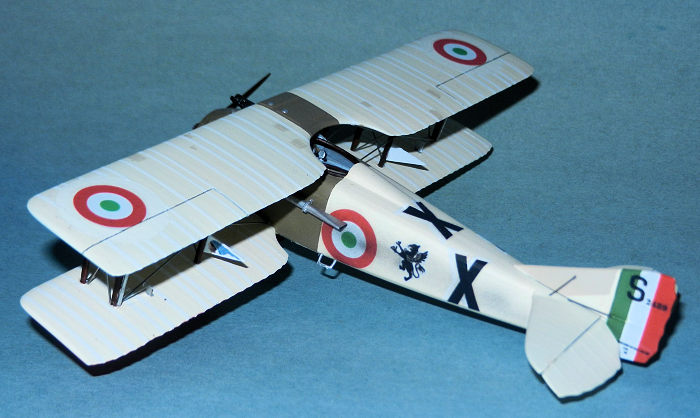 As the
decals on this kit are not for Italian planes, I decided to make my own. As I
decided to first try to paint the roundels and flag on the tail. Thus, I used
white Vallejo Primer for the entire plane, followed by Vallejo White for the
area where the roundels and rudder flag were positioned.
As the
decals on this kit are not for Italian planes, I decided to make my own. As I
decided to first try to paint the roundels and flag on the tail. Thus, I used
white Vallejo Primer for the entire plane, followed by Vallejo White for the
area where the roundels and rudder flag were positioned.
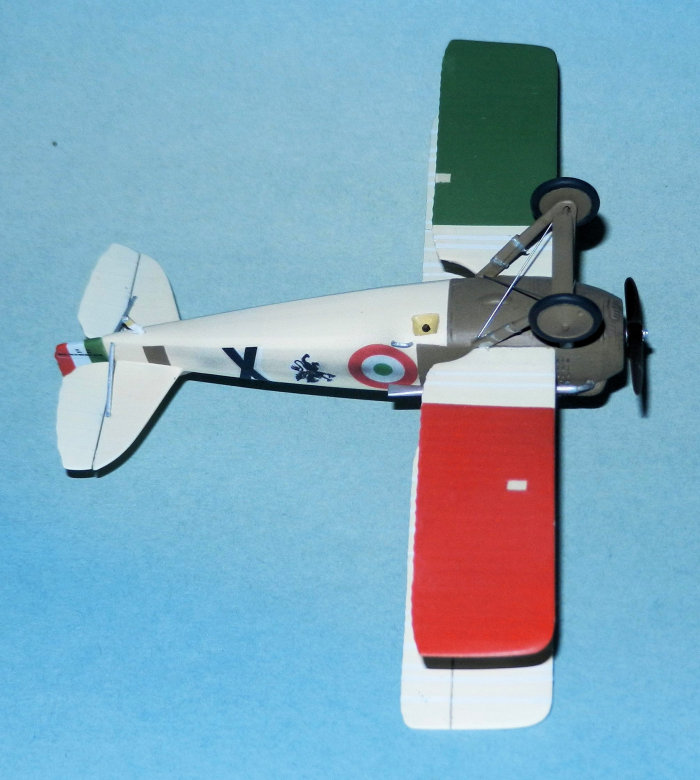
With a circle cutter I made the concentric circles for the roundels using Tamiya metered masking paper. Placing the smaller circles (white) and the white central band on the tail the entire model was give a coat of Vallejo Pale Sand 70.837. Next was a lighter shade of Pale Sand as the Italian Spads had the oversized top wing French roundels overpainted leaving a much smaller Italian roundel. The nose and landing gear were painted with 90:10 of Model Master Sand 4720 and Vallejo Sand Yellow 70.916 to represent the French colour known as Ripolin. Now it was turn to mask the Pale Sand surfaces and paint the outer roundels and tail portion with Vallejo Scarlet 70.817. For the Green (Vallejo Bright Green 70.833) a small hole had been curved out in the center of the masks for the white…my circle cutter did not allow me to go so small so I was forced to use a plastic template for circles and a very sharp new number 11 blade. The large portions for the Italian flag were painted under the lower wings leaving a couple of spots masked to represent repairs to the wings. The spine of the vertical tail was painted in a darker shade of Pale Sand.
When I removed all the masking circles there had been some bleeding and also some not so perfect circles. With patience I made retouches using the 4 colours needed…and sadly the brushed colours had more depth/intensity than those airbrushed. I was not happy at all with the results. Back to the drawing board….
I sanded off the roundels, applied fresh premier and white where needed because I had now decided to print my own Italian roundels (colours in the rudder where fine, no need to retouch anything there). With the wings painted again it was time to spray the kit with my replacement of Future: Quick Shine.
All decals had been printed in clear decal paper except for the prancing horse which required a white edge. Text for the legends on the rudder and the large black “X”s were typed after finding the correct font in the program I use to design decals. I really struggled to match the red and green with those I used for the rudder. What you see on the computer screen does not match what the printer does. Therefore, I had to try, fix, try again…until after testing around 15 different shades of green and red I ended up with very closely matching colours to those on the rudder and lower surfaces of the wings.
I started with the most conspicuous decals, those on the wings. Mistake…the spray I use to seal the ink make the roundels curl up. This made it very difficult to properly position them in the allocated round white areas. Using Set and Sol they really grabbed to the surface and finally sat down properly…it became very difficult to move them around. When I showed the pictures of the roundels to my perfectionist friend Fabian Vera he pointed out that these were not perfectly centered. In fact, he was correct…the roundels were somehow displaced to one side leaving a tiny wedge of white showing up. Furthermore, my centering of the light Pale Sand had not been correct and the Italian roundels were now partially placed on the ailerons which is incorrect.
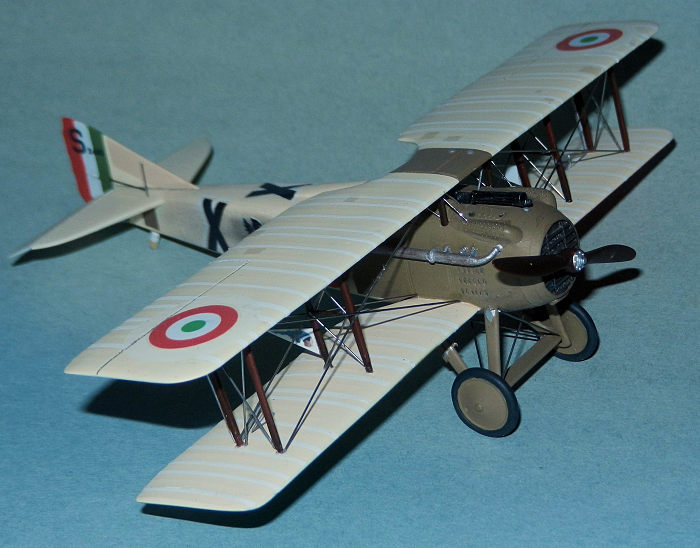 Frustrated
with this quite evident mistake I removed the decals with multiple washes of Sol
and a Q-tip…which eat part of the paint leaving an uneven surface. This was even
more frustrating…The entire top wing was left overnight in Super Clean to remove
all the paint and start all over again. With the wing clean and no paint left I
started the process all over again. This time the lighter shade of Pale Sand was
better centered. New decals were printed and applied on top of the wings…but
still a bit over the ailerons. Much better but not good enough. I decided to let
it go…
Frustrated
with this quite evident mistake I removed the decals with multiple washes of Sol
and a Q-tip…which eat part of the paint leaving an uneven surface. This was even
more frustrating…The entire top wing was left overnight in Super Clean to remove
all the paint and start all over again. With the wing clean and no paint left I
started the process all over again. This time the lighter shade of Pale Sand was
better centered. New decals were printed and applied on top of the wings…but
still a bit over the ailerons. Much better but not good enough. I decided to let
it go…
Small patches to repair the fabric on the wings were replicated using small pieces of a beige decal I made with the printer, cut to size. The white outline of the X was made with white decal paper and applied one by one. Finally, the white strips of reinforcement on the wings had to be added. I cut long strips of less than 1 mm width and painfully added them following the pattern seen in the Italian book. This took 3 sessions/days.
With the decals applied it was time to clean the excess of glue from the areas around them. And when I got to the top of the wings…to my horror the ink of the roundels started to wash away too!!! This time, the third with decals and fourth overall, I decided to leave the clear film on the wings (very thin anyways) instead of trying to pull them and damaging the paint like I had done some days before. Another set of decals was printed and attached (now I was more proficient managing the time in the water thus they were not curling as bad as during the first tries) and this time they were not on the ailerons…
The propeller and wing struts (that had fallen off from the top wing much earlier in the process while I was handling it) were painted Red Hull Vallejo 71.039. Pictures of Olivero by his plane show there were exhaust stains on the sides of the fuselage. Changing the nose and tip of my Badger 150 to the very fine ones and with very diluted black paint and low pressure I sprayed the exhaust stains…but in my rush to finish the project I didn’t mask the Ripolin areas. And because of this I also sprayed AHEAD of the exit of the exhausts…I carefully masked the fuselage leaving the Ripolin areas exposed and preparing more of this colour I over sprayed the nose. The screen on the nose was painted with washes of diluted black and once satisfied with the depth I dry brushed it with aluminum.
The model was covered with several very light layers Model Master flat clear. And now it was time to finish the self-inflicted torture…I mean…the model.
| FINAL CONSTRUCTION |
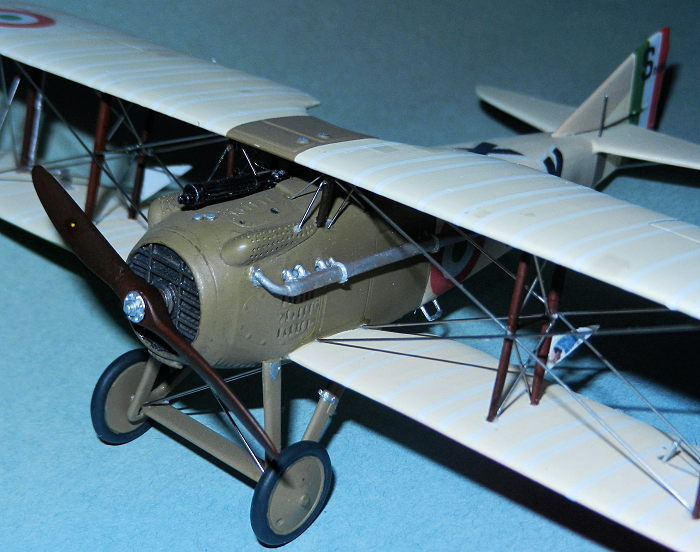 Having
drilled new holes lower on the nose the exhausts were added after
drybrushing them with Rust and painting with back the openings. The
windshield (vacuum formed) was carefully cut and added. I lost the PE
gunsight ring which turned out to be a good thing because Olivero’s plane
actually had a telescopic one. I had to scratch build this one using wires
of different gauges. The cabane struts were added to the fuselage and using
piano wire the struts were made. Some taps and details were picked up with
Aluminum or a black pencil (i.e. vents).
Having
drilled new holes lower on the nose the exhausts were added after
drybrushing them with Rust and painting with back the openings. The
windshield (vacuum formed) was carefully cut and added. I lost the PE
gunsight ring which turned out to be a good thing because Olivero’s plane
actually had a telescopic one. I had to scratch build this one using wires
of different gauges. The cabane struts were added to the fuselage and using
piano wire the struts were made. Some taps and details were picked up with
Aluminum or a black pencil (i.e. vents).
The machine gun was added after drybrushing it with aluminum. Elevators were glued in place along with the struts under the horizontal tail planes (painted in aluminum too).
I now glued the struts to the bottom portion of the wings and before the glue dried, I presented the top wing to them. After adjusting the position of the top wing there were some struts not properly touching the wings (result of these having snapped off during the previous stages of the build). I then used some thin strips of Tamiya tape to force the top and bottom wings to touch the struts. The following day (and fearing peeling off some decals on the wings) the tape was removed. No accidents and firm contact!
Next step in the nightmare: rigging. Starting with the front 4 ones of each wing (2 hours to attach!) the next day I got more proficient and added 12 of the main ones in the same time. And the 3rd night was finished with the last ones on the wings and those on the landing gear, tensor for the top of the tail horizontal surfaces and cables for the rudder at the base of the vertical tail surface.
I removed the foam from the cockpit, retouched some areas where the paint had found it way and added the seat belts previously painted in brown…having decided not top display it laying on the fuselage sides like the picture (eyes rolling…of course I had made my task more difficult than if I had added them much earlier…)
The step for the pilot was added, the camera box was painted with a mix of beige and yellow (camera is actually a gate from a clear sprue with the sides painted black and the center of the cylinder left in clear), a couple of “suns” from an Argentine flag from the spares represent the logo on the propeller which was then attached using cyano.
Tail skid was painted in Brown with the bottom (metallic) tip in aluminum and the top portion wrapped in a thin strip of white decal paper.
And the last step was to attach the Cabeza de Indio (Testa de Indiano) flags on the lower portion of the internal back struts. These I printed on white decal paper and attached to very thin Evergreeen triangles that were then glued in place. With this last trademark Olivero’s plane was complete.
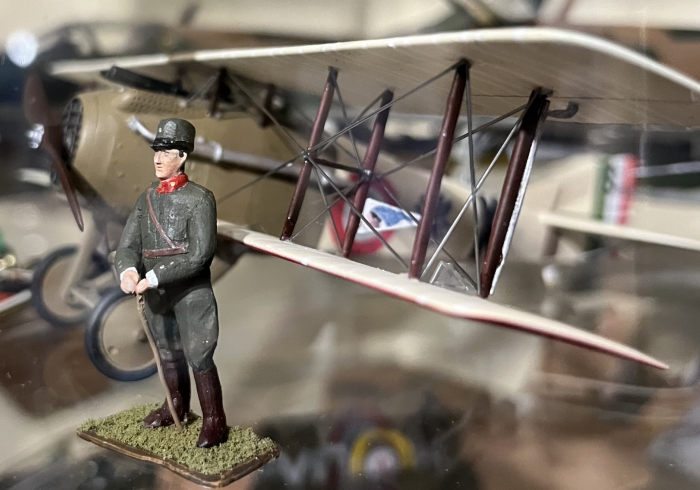
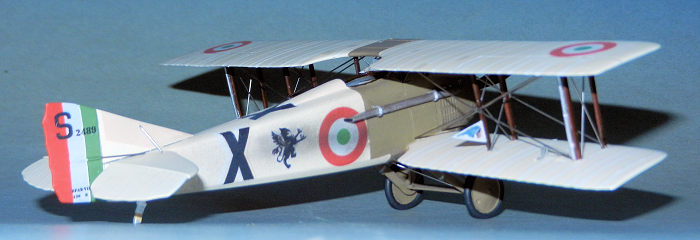 But I could
not leave it there. Why wouldn’t I further complicate myself? There are several
images of Olivero proudly showing off his plane and leaning on his fighter pilot
walking stick. Like I did with “Pincho” Weiss (see my Pulqui I at MM) I took a
late war German pilot from the Hasegawa 1/48 set and decided to modify it. For
this I had to reposition the arms, modify the boots, extend the cap making it
much higher and narrower, modify the jacket, add the belts and pockets (using
Tamiya silver self adhering foil), use a piece of wire to represent the walking
stick…It took me five days to go from a German WWII pilot to a WWI Italian one.
Needless to say putty, sanding, scrapping were needed. As the arms of the German
pilot are in his pockets I had to lengthen them with pieces of plastic to
position them ahead of the body and supported on the stick…The uniform was
painted Vallejo Dark Green 893 with touches of red, silver, gold, black and a
mix of rust and red hull for the belt. Flesh was painted using Model Master Skin
Tone Base Light 4601 and then drybrushed with sanded pastels in a darker skin
tone.
But I could
not leave it there. Why wouldn’t I further complicate myself? There are several
images of Olivero proudly showing off his plane and leaning on his fighter pilot
walking stick. Like I did with “Pincho” Weiss (see my Pulqui I at MM) I took a
late war German pilot from the Hasegawa 1/48 set and decided to modify it. For
this I had to reposition the arms, modify the boots, extend the cap making it
much higher and narrower, modify the jacket, add the belts and pockets (using
Tamiya silver self adhering foil), use a piece of wire to represent the walking
stick…It took me five days to go from a German WWII pilot to a WWI Italian one.
Needless to say putty, sanding, scrapping were needed. As the arms of the German
pilot are in his pockets I had to lengthen them with pieces of plastic to
position them ahead of the body and supported on the stick…The uniform was
painted Vallejo Dark Green 893 with touches of red, silver, gold, black and a
mix of rust and red hull for the belt. Flesh was painted using Model Master Skin
Tone Base Light 4601 and then drybrushed with sanded pastels in a darker skin
tone.
| CONCLUSIONS |
Had it not been for my self-inflicted torture the Special Hobby is an excellent petite but full of details kit. Leaving aside the time waiting for the book (a two month intermission during which I built the Pulqui I and the Accurate Dauntless) this project went from late November till mid March…that’s an indication of the troubles to convert the plane to that of the only known Argentine ace of WWI.
Dedicated to Gonzalo Ferrari Nicolay and Raul Diaz.
| REFERENCES |
Eduardo A Olivero by Juan Castelnuovo
Aviones enemigos a la vista…! (Enemy planes in sight!) by Eduardo Olivero (a book that focuses only on his wartime exploits)
Italian Spads at War! By G Alegi and P. Varriale
Wikipedia.it
With thanks to Vcom (Ret) Raul Diaz (VGM) and Gonzalo Ferrari Nicolay (Olivero’s great grand son and an old friend of mine)
1 May 2025
Copyright ModelingMadness.com. All rights reserved.
No reproduction in part or in whole without express permission. If you would like your product reviewed fairly and fairly quickly, please
contact
the editor
or see other details in the
Note to
Contributors.