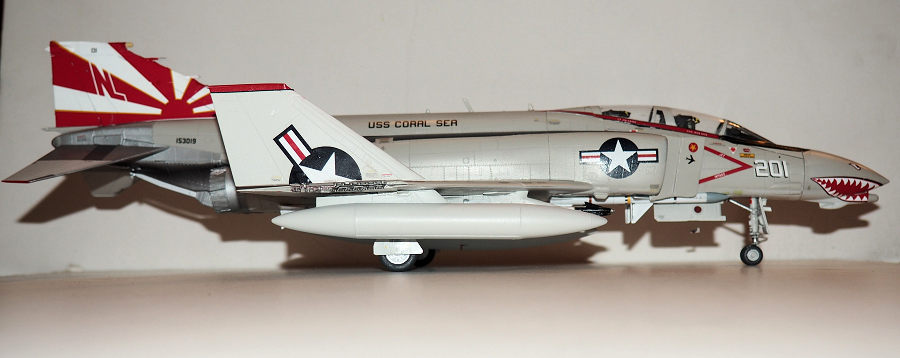
Tamiya 1/48 F-4B Phantom II
| KIT #: | 61121 |
| PRICE: |
$123.00 'used' |
| DECALS: | Three options |
| REVIEWER: | Mark Rossmann |
| NOTES: |
|
| HISTORY |
 Phantoms
reached the Fleet in 1961, initially assigned to the “The Be-Devilers”, VF-74.
By 1964 less than half of the US Navy’s fighter squadrons were equipped with the
F-4 Phantom. The Phantom II was the primary fighter bomber of the US Navy during
Vietnam War, from about 1968 onward, replacing the venerable F-8 Crusader.
Phantoms
reached the Fleet in 1961, initially assigned to the “The Be-Devilers”, VF-74.
By 1964 less than half of the US Navy’s fighter squadrons were equipped with the
F-4 Phantom. The Phantom II was the primary fighter bomber of the US Navy during
Vietnam War, from about 1968 onward, replacing the venerable F-8 Crusader.
The Phantom could not outmaneuver the Mig-17, 19 or 21 but it was a fearsome energy fighter, that used its thrust advantage from the twin J-79 turbojets to aggressively get out of many bad situations. Its combat record was not as formidable as it could have been, due to the lack of an internal gun and reliable missiles (the radar guided Sparrow being the least favorite missile behind the IR guided Sidewinder), along with crews lacking dogfighting experience and training.
Things changed when Top Gun was started by the US Navy in 1969. Many of these pilots contributed to a large portion of the MiG kills during Operation Linebacker and Linebacker II.
The Sundowners transitioned to the F-8 Crusader In 1961. The Sundowners flew F-8 Crusaders until December 1970, aboard the Kitty Hawk, Midway, Oriskany, Intrepid, Ticonderoga and Shangri–la. VF-111 scored a single kill, a Mig-21 on Sept 9, 1968. The unit suffered the highest combat losses, twelve, for any Crusader Navy or Marine squadron deployed to Vietnam. The next cruise, on USS Coral Sea was with the Phantom II, in 1971.
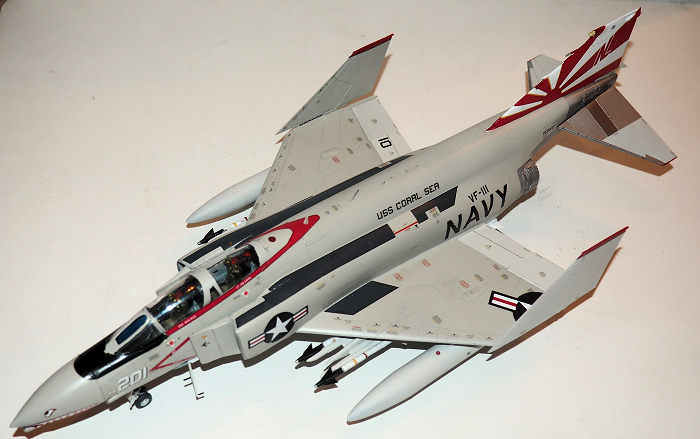
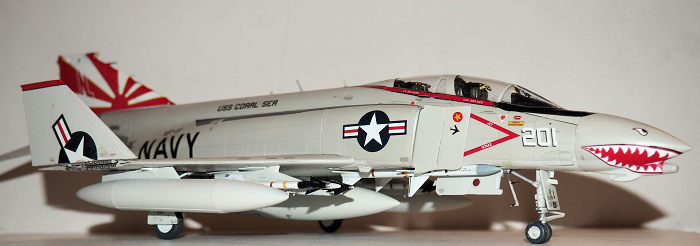
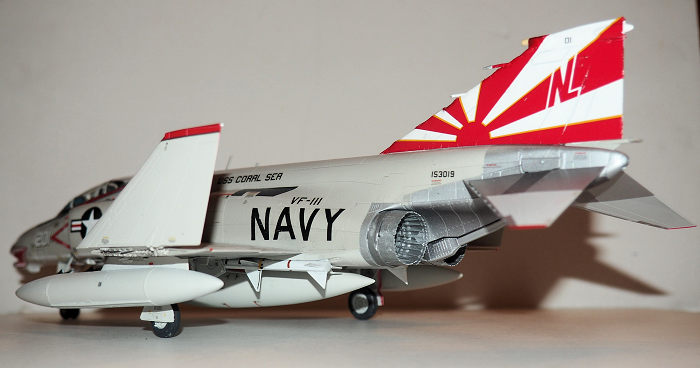
This build is the Sundowners Phantom from VF-111 aboard the USS Coral Sea. It was flown by Lt Gary Weigand and Lt (jg) Bill Freckleton, scoring a Mig-17 kill on March 6th 1972, using an AIM-9D missile. This was the first and only kill for VF-111 using the Phantom.
| THE KIT |
 Tamiya
introduced the 1/48 scale F-4B Phantom in 2021. It continues their
state-of-the-art design and engineering of model kits utilizing a sub-assembly
process.
Tamiya
introduced the 1/48 scale F-4B Phantom in 2021. It continues their
state-of-the-art design and engineering of model kits utilizing a sub-assembly
process.
There are three different Vietnam War era Mig Killers from VF-51, VF-111 and VF-161. Two complex stencil decals sheets, some of these are placed on at the sub-assembly time. Included is a canopy mask sheet, not precut.
Note1: Recommendation to get an aftermarket pre-cut sheet. Cutting Tamiya’s mask is time consuming and can produce ragged edges, use a new sharp blade.
There are two duplicate sprues for the weapons, air to air only, and fuel tanks. Close to 400 well detailed parts with almost no flash. (I at time question companies that need to have so many parts, where they could have been molded into a larger piece. My dexterity has problems at times. They need to K.I.S.S.) Poly-cap for the rear stabilizers as they are movable.
Options for: Open or closed canopies. Open or closed fuel probe. Folded or un-folded wings.
Two very detailed figures (pilot and RIO) with helmet decals with squadron emblems.
| CONSTRUCTION |
 The build
took about 3 months, with a 3-week road trip to the upper mid-west during this
time. It is important to follow the instructions building the sub-assemblies,
painting and decaling them at the build time. If you don’t and wait till the
end, it will be a difficult masking and painting process. Few seams to
sand/fill.
The build
took about 3 months, with a 3-week road trip to the upper mid-west during this
time. It is important to follow the instructions building the sub-assemblies,
painting and decaling them at the build time. If you don’t and wait till the
end, it will be a difficult masking and painting process. Few seams to
sand/fill.
Note2: When decaling the outer wing, folded or not, it must be attached to the main wing to get proper star and bar alignment.
Note3: Deviating from the build sequence, suggest adding drop tanks, missiles and communication antenna as the very last step.
| COLORS & MARKINGS |
 This
Sundowner Phantom, NL201, upon deployment return, was repainted to show it off
at NAS Miramar TOP GUN in 1972. Tamiya chose this paint scheme and decals.
This
Sundowner Phantom, NL201, upon deployment return, was repainted to show it off
at NAS Miramar TOP GUN in 1972. Tamiya chose this paint scheme and decals.
The kit decals were used as it depicts the same markings on board Coral Sea the day after the kill mission. Therefore, used the full stencil decals to provide the correct deployment markings.
Used the black decal in front of windscreen along with the red canopy striping which carries to behind the cockpit. Much easier, cleaner than masking and painting.
I followed the painting instructions by Tamiya with a few minor variations (Var):
Tamiya White Fine Surface Primer. All underside areas, missiles and the tail fin. This is a great primer coating, then eyeballed it and looked to be a very good toned down (Mat) white to use. (Var)
The following paints were used: AS-16 Light Grey – Upper areas. TS-8 Italian Red – Wing tips. TS-29 Semi-gloss black. TS-38 Gun Metal – for darker metal shades and exhaust area. (Var) TS-17 Gloss Aluminum – Lighter Metal shades, including tailhook, and leading edge of air intake. (Var) TS-26 Pure White – Tail Fin sprayed over top of White Surface Primer. (Var) TS-79 Semi-Gloss Clear – Final overcoat spray, not on clear canopy.
| CONCLUSIONS |
The Tamiya F-4B is a detailed kit, that was well thought out to hide seams and provide sub-assemblies to compartmentalize painting and building. It is a time-consuming build that requires careful reading of the instructions and following the build process, except my Note3 on final build step.
This would be a kit for experienced modelers, for a beginner a Monogram/Revell or Italeri kit would be good.
| REFERENCES |
Tamiya instruction sheet.
Osprey Combat Aircraft #30, “US Navy F-4 Phantom II MiG Killers 1972-1973. By Brad Edward & Peter Davies
Osprey Combat Aircraft #7, F-8 Crusader Units of the Vietnam War. By Peter Merskey
Squadron/Signal Publications, Air War over Southeast Asia 1971-1975. By Lou Drendel
A Reluctant Warrior. By Kenneth L Volker Ph. D. Captain, USNR (RET).
Excellent memoir of the Military Draft, Navy Phantom Pilot, life on a carrier and Top Gun. Capt. Volker flew in sister squadron VF-51, on the Coral Sea, during the 1972 deployment. Keneth Volker
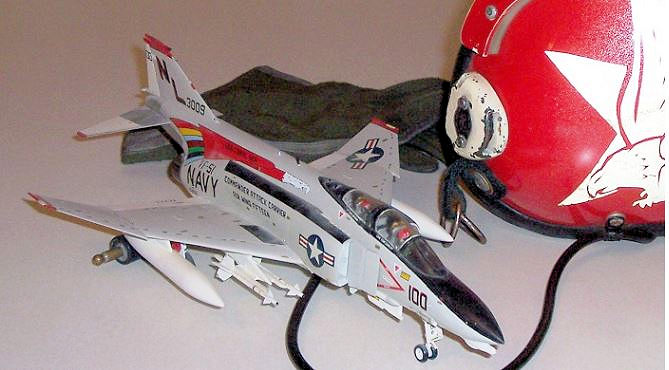
** The pic VF-51 Phantom was built in 1996, a 1/48 Hasegawa. Helmet is that of the author
6 January 2026 Copyright ModelingMadness.com. All rights reserved. No
reproduction in part or in whole without express permission. If you would like your product reviewed fairly and fairly quickly, please
contact the editor or see other details in the
Note to
Contributors.