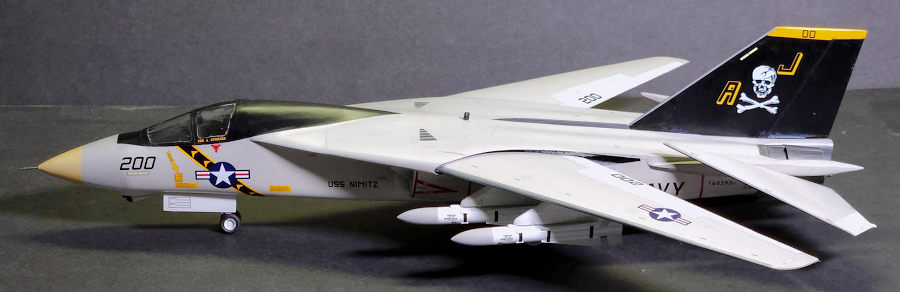
| KIT #: | 1674 |
| PRICE: | $ |
| DECALS: | One option |
| REVIEWER: | Chuck Horner |
| NOTES: | Fox 3 conversion set |
| HISTORY |
What-if’s models are fun to build, relying on your imagination and maybe even ignoring the physical laws of flight. What I have here is sort of a “What-if”. The Navy’s F-111B actually existed and almost went into production. If it had, it would have most likely negated the existence of the F-14.
In 1960, both the Navy and Air Force were independently developing new fighters. The Air Force needed a supersonic, low-level fighter-bomber to replace the F-105. The Navy needed an all-weather, fleet defense fighter with long-range radar and air-to-air missiles to match.
By the time the Kennedy administration took office in 1961, the Navy had issued a development contract to Douglas for the F6D Missileer, an enlarged F3D Skyknight, with straight wings, sub-sonic speed, side-by-side crew and utilizing the Eagle weapons system, which was the forerunner of the Phoenix.
Secretary of Defense, Robert McNamara, coming from his success as President of the Ford Motor Company, had seen the cost-saving results of developing one basic frame and body style, then adding minor changes to sell it under different car brands. Why couldn’t the military services do the same to save money?
It was obvious that the Navy straight-wing design could never be the Air Force’s supersonic bomber, so the Admirals were dragged kicking and screaming, “NOT INVENTED HERE!”, to the Air Force’s design table. They immediately began making design demands, hoping that they could kill the project and get back to designing real Navy planes. It didn’t work.
 General
Dynamics, the prime contractor for the F-111, had partnered with Grumman to
build the Naval version. Grumman not only brought a long history of Navy designs
to the table, but they had recently built the swing-wing, XF10F Jaguar. There
was a lot wrong with this plane and it didn’t go into production, but they got
the swing-wing right.
General
Dynamics, the prime contractor for the F-111, had partnered with Grumman to
build the Naval version. Grumman not only brought a long history of Navy designs
to the table, but they had recently built the swing-wing, XF10F Jaguar. There
was a lot wrong with this plane and it didn’t go into production, but they got
the swing-wing right.
The first flight of the Air Force F-111A was in December, 1964. Grumman got the first F-111B airborne in May, 1965.
By 1968, seven pre-production F-111B airframes were flying, with two more being built. Testing had shown many issues with both the F-111 design and the “B” in particular, but much of these had been solved. The “B” had even completed carrier suitability tests with ‘fixes” incorporated in the planned production aircraft.
The Navy Admirals continued to try to get the plane cancelled, siting weight problems (the F-14 ended up weighing about the same) and problems with the TF-30 engine (the Triple-Plow II intake fixed some of it and the F-14 used the same engine). Finally, they convinced Congress to withdraw funding and the F-111B was officially cancelled in July, 1968.
But what if it had gone into production….
| THE KIT |
As far as I know, the only out-of-box F-111B models were a 1/48 Aurora kit in 1966 and a 1/72 Revel kit in 1967. All others were conversions. About twenty years ago, I purchased the 1/48 scale Fox3 resin conversion set to use on the Academy F-111C. The ‘C’ had the long wings used on the ‘B’ (as well the FB-111).
This conversion consisted of the Navy nose, smaller main wheels, the tail hook housing and the extended tail cones. In addition, I had a set of exhaust nozzles from OZmods-ScaleDown.
At this point I moved into “What-If” territory by deciding to build the proposed production version with all of the changes incorporated. To add to this, I purchase a Furball decal sheet of early F-14 markings.
| CONSTRUCTION |
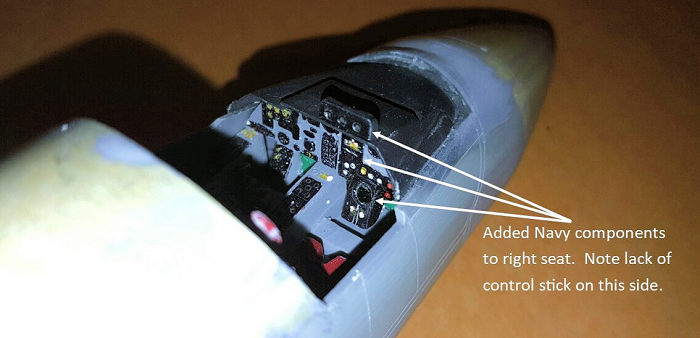
I started with the cockpit. The Academy cockpits are relatively simple and the instrument panel is pretty plan. On the other hand, the Hobby Boss kit not only has a good panel with raised features, but the kit has all of the different panels for the various F-111 types. I selected one that resembled the Navy panel. I still needed to add the large radar scope and control boxes to the right side. I also removed the flight controls from that seat.
 The Fox3’s
Navy nose is a solid resin block that simply replaces the kit nose which I cut
off at the indicated fuselage line. I added an IR sensor to the bottom, which
came from the Academy F-14 kit.
The Fox3’s
Navy nose is a solid resin block that simply replaces the kit nose which I cut
off at the indicated fuselage line. I added an IR sensor to the bottom, which
came from the Academy F-14 kit.
The Academy nose gear is wrong for all F-111’s. Besides not having a proper wheel well, the gear should be canted forward instead mounting vertical. The F-111B, on the other hand, was a vertical mount. I navalized it by added a heavier retract arm and the launch arm.
Moving towards the rear of the model, the production airplane would have used the final Triple Plow II intake design. Academy offers this in the kit as well as the earlier designs. Fox3 supplies the smaller Navy main wheels which replace the kit ones. I also cleaned off all of the sensor bumps on the vertical tail and added the cone-shaped “bumpers” from Fox3, to the back of the plane.
Fox3 supplies a very early tail-hook attach point, but looking at photos and drawings, this was evolving into more of an enclosed housing. I built this housing from sheet plastic around the Fox3 resin attach-point and used the kit tail hook.
I constructed the wings as per kit instructions. The kit has an elaborate internal structure that moves the two inner pylons on each wing, keeping them pointed forward as the wing sweeps. This system is not very strong and didn’t even last to the end of the build. I ended up just gluing the pylons in a fixed position so that they are only correct when the wing is at a medium sweep. The F-111B carried four Phoenix missiles on the wings and two in the internal bay. I used four Phoenixes from the Hasegawa Weapons set. The Academy kit does not have an open bay, having the internal swing-wing alignment anchor in the spot. I decided not to try and open it.
As an aside, the F-111B could return to the carrier with all six Phoenix missiles. The F-14, which also carried six, could land with only four due to the weight.
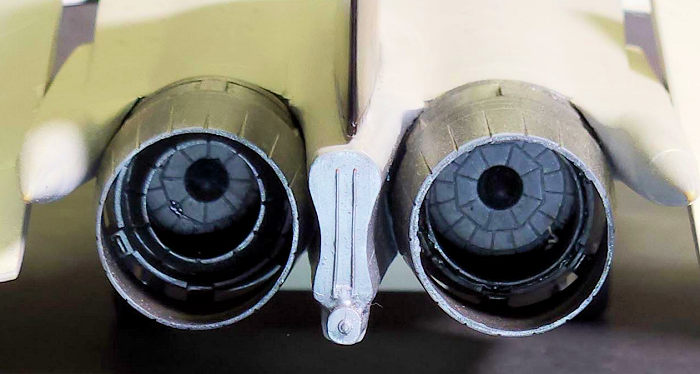 I had
previously purchased a set of exhaust nozzles from OZmods-Scale Down. The set
includes four nozzles, two with the internal irises open and two closed. The
normal F-111 shut-down procedure left one open and one closed due to loss of
hydric power from the second engine shut-down. I use one of each to replace the
kit exhaust.
I had
previously purchased a set of exhaust nozzles from OZmods-Scale Down. The set
includes four nozzles, two with the internal irises open and two closed. The
normal F-111 shut-down procedure left one open and one closed due to loss of
hydric power from the second engine shut-down. I use one of each to replace the
kit exhaust.
Finally, I tackled the most challenging part of the conversion. It was determined that on the production aircraft, the cockpit would be raised six inches and the wind screen would have a steeper angle for a better “over-the-nose” view by the pilots. I cheated on this a bit by simply tilting the entire canopy piece forward so that the rear was six scale-inches higher. This not only meant adding a shim to the cockpit sides but required a re-sculpturing of the entire rear turtle-back. This almost proved the undoing of the build.
I applied Miliput to the rear decking, building it up to the new canopy rear edge. I’m not sure if the stuff was just too old or I did something wrong, but the dried surface looked like craters on the moon! I tried applying another thin layer, but got the same results. I brushed on a couple of coats of Mr. Surface, which helped, but I finally ended up coating the entire turtle back with thick super glue. After spending several days sanding, applying more super glue and re-sanding, I achieve the finished look.
| COLORS & MARKINGS |
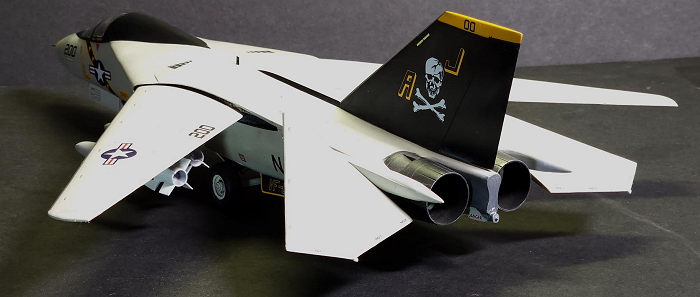 This is
where I really established a “What-If” aircraft. Since the F-111B would have
negated the existence of the F-14, I reasoned that it should carry early F-14
markings. I looked over the Furball Tomcats Part One decal set for markings that
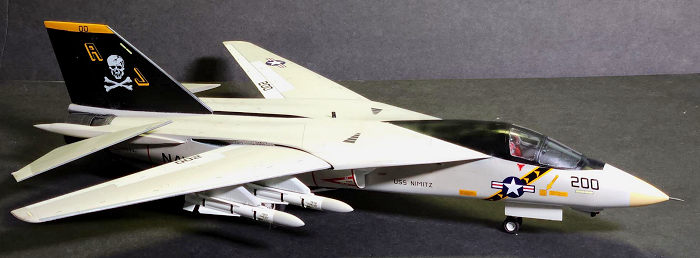
I could fit to the F-111B -- VF-84, USS Ninitz, fit the bill.
This is
where I really established a “What-If” aircraft. Since the F-111B would have
negated the existence of the F-14, I reasoned that it should carry early F-14
markings. I looked over the Furball Tomcats Part One decal set for markings that
I could fit to the F-111B -- VF-84, USS Ninitz, fit the bill.
I painted the model in the standard Navy gull gray and white scheme. The cockpit area, turtle back, and vertical tail are black. The Skull & Cross Bones on the vertical tail fit very well. I was presently surprised how well the black and yellow diagonal fuselage strip fit below the cockpit. I adjusted other markings to fit similar or alternate locations on the jet.
After applying a final clear semi-gloss coat, I called it done.
| CONCLUSIONS |
I took it to its first model contest and got a lot of very strange looks. At first, because of the markings, people just assumed it was an F-14, but after a second, third and fourth look, they really had no idea.
The F-111, after a somewhat tumultuous birthing experience, turned into an excellent combat aircraft that lasted in the Air Force inventory for thirty years and flew with the Australians for another ten. The F-111B was not really a failure. It was, from the beginning, a “Not-Invented-Here” project force on the Navy. It probably would have been successful in its original stand-off, fleet defense mission, but it was never going to be the dog fighter that the F-14 was.
Besides, Top Gun would have been pretty boring film to watch Maverick and Goose calmly discussing, in a level-flying plane, how they just shot down the enemy, sight-unseen, 100 miles away.
| REFERENCES |
Grumman Navy F-111B Swing Wing, Naval Fighters No. 41,
Tommy Thomason, Ginter Books,
Tailhook Topics Blog, October 4, 2009, Grumman F-111B, Tommy H. Thomason
2 March 2026
Copyright ModelingMadness.com. All rights reserved. No reproduction in part or in whole without express permission.
If you would like your product reviewed fairly and fairly quickly, please contact the editor or see other details in the Note to Contributors.