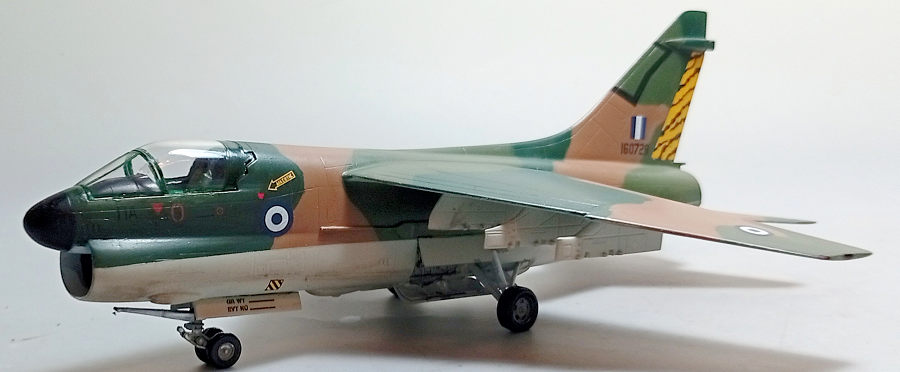
Italeri 1/72 A-7E Corsair II
| KIT #: | 1411 |
| PRICE: | 22 Euros |
| DECALS: | Four options |
| REVIEWER: | Spiros Pendedekas |
| NOTES: | ESCI tooling. Also released by AMT/ERTL |
| HISTORY |
Some aircraft earn admiration through their performance; others become legends through the lives they touch. The LTV A-7 Corsair II belongs firmly to the latter category. For almost four decades it served the Hellenic Air Force with unwavering dedication, becoming far more than an attack aircraft. It was a symbol of readiness, professionalism and quiet strength, earning the respect of pilots, technicians and aviation enthusiasts alike. Even today, its unmistakable silhouette evokes memories of an era when the Corsair faithfully guarded the skies of Greece.
Designed by Ling-Temco-Vought for the U.S. Navy, the A-7 Corsair II first flew in 1965 and quickly established itself as one of the most capable strike aircraft of its generation. Rather than pursuing outright speed, its designers focused on range, payload, endurance and precision. The result was an exceptionally stable and accurate attack platform, capable of carrying a formidable weapons load over long distances while operating in demanding conditions. These qualities would later make it an ideal choice for the Hellenic Air Force.
Greece selected the specially built A-7H together with the two-seat TA-7H, and the first aircraft arrived in 1975. Their introduction marked a major leap forward in the nation's strike capability. The first Greek Corsairs entered service with 340 Squadron "Fox" at Souda Air Base, soon followed by 345 Squadron "Tempest". In 1977, 347 Squadron "Perseus" was formed at Souda before relocating to Larissa, expanding the Corsair's presence within the Hellenic Air Force.
 Throughout
the following decades, the Corsair became the backbone of Greece's tactical
strike force. It participated in countless national and NATO exercises,
routinely flying demanding low-level missions over mountains, islands and the
endless blue waters of the Aegean. Although the aircraft never saw combat in
Greek service, it remained constantly ready, providing a powerful deterrent
during periods of regional tension.
Throughout
the following decades, the Corsair became the backbone of Greece's tactical
strike force. It participated in countless national and NATO exercises,
routinely flying demanding low-level missions over mountains, islands and the
endless blue waters of the Aegean. Although the aircraft never saw combat in
Greek service, it remained constantly ready, providing a powerful deterrent
during periods of regional tension.
During the early 1990s, Greece acquired additional A-7E and TA-7C aircraft from U.S. Navy stocks. These aircraft significantly strengthened the fleet and extended the Corsair's operational life well into the twenty-first century. As the Hellenic Air Force reorganized, the Corsair force gradually became concentrated at 116 Combat Wing, Araxos, where 336 Squadron "Olympus" and 340 Squadron "Fox" would carry the type proudly until its final days.
The Corsair possessed a character all its own. It lacked the sleek elegance of many supersonic fighters, yet its purposeful lines reflected an aircraft designed with a single objective: to accomplish its mission with absolute reliability. Pilots admired its predictable handling and remarkable stability during low-level attack missions, while maintenance crews appreciated its rugged construction and dependable systems. It was an honest aircraft—one that rewarded skill, inspired confidence and rarely disappointed those who depended upon it.
For anyone standing beside the runway, a Corsair departure was unforgettable. The deep rumble of the Allison TF41 engine would build into a thunderous roar before the aircraft lifted gracefully into the brilliant Mediterranean sky. Whether departing from Souda, Larissa or later Araxos, it was a sight—and a sound—that left a lasting impression on everyone fortunate enough to witness it.
On 17 October 2014, the Hellenic Air Force retired the A-7 Corsair II, bringing to a close one of the most remarkable careers in modern military aviation. Greece became the final operator of the type anywhere in the world, giving the Corsair a farewell worthy of its distinguished service.
Today, the Corsair lives on not only in museums and preserved airframes, but also in the memories of those who flew and maintained it, in the photographs that captured its unmistakable presence, and on the workbenches of scale modelers around the world. Every carefully built model pays tribute not merely to an aircraft, but to a machine that became an enduring symbol of the Hellenic Air Force. The A-7 Corsair II was more than aluminum and rivets—it was a loyal guardian of the Aegean, and its legend continues to inspire long after its final flight.
| THE KIT |
This is the 2018 Italeri release of the original 1988 ESCI. When first released, the ESCI A-7 Corsair II series represented a very modern kit for its time, offering a good combination of accuracy, detail and ease of construction. Although slightly less refined than the more complex Fujimi offering, the ESCI tooling had the advantage of being simpler and more enjoyable to build. It features fine engraved panel lines, reasonable surface detail and a convincing overall shape, making it still an attractive choice for a Corsair II model.
 The main
shortcomings are the rather shallow air intake and the somewhat simplified
landing gear, areas where the age of the tooling becomes apparent. Nevertheless,
the kit remains a solid and rewarding model, with the latest Italeri reissue
benefitting from nicely printed decals, adding further value to an already
enjoyable classic kit. For a more in-depth look at the kit’s contents, you may
look no further than our Editor’s preview, found in the ever growing MM
archives.
The main
shortcomings are the rather shallow air intake and the somewhat simplified
landing gear, areas where the age of the tooling becomes apparent. Nevertheless,
the kit remains a solid and rewarding model, with the latest Italeri reissue
benefitting from nicely printed decals, adding further value to an already
enjoyable classic kit. For a more in-depth look at the kit’s contents, you may
look no further than our Editor’s preview, found in the ever growing MM
archives.
The specific kit was won by my 11-year-old elder son in our small but beloved local scale modelling competition a couple of years ago. Being quite an A-7 aficionado, he could hardly wait and essentially threw the kit onto my workbench, insisting that we start building it together. He would take care of some of the basic tasks, while I would complete the rest.
From the outset, I was aiming for a straightforward, uncomplicated build - if such a thing really exists in our hobby. The idea was to keep things simple and enjoyable, without getting carried away with extra detailing or corrections.
| CONSTRUCTION |
 I started by
assembling the cockpit, which, together with the nose landing gear bay were then
trapped between the fuselage halves. Some 20 grams of fishing weights were also
secured in the area fore of the nose landing gear, to avoid tail sitting. Basic
cockpit colour was Tamiya XF-66 Light Gray, the stick grip and front anti glare
area were painted black, the seat cushion was painted olive drab. I used the kit
provided decals to represent the instrument panel and side consoles, while an
ejection handle was fabricated from stretched sprue, painted yellow/black.
I started by
assembling the cockpit, which, together with the nose landing gear bay were then
trapped between the fuselage halves. Some 20 grams of fishing weights were also
secured in the area fore of the nose landing gear, to avoid tail sitting. Basic
cockpit colour was Tamiya XF-66 Light Gray, the stick grip and front anti glare
area were painted black, the seat cushion was painted olive drab. I used the kit
provided decals to represent the instrument panel and side consoles, while an
ejection handle was fabricated from stretched sprue, painted yellow/black.
The wings were assembled next and attached to the fuselage, followed by the tailplanes. The two-piece intake lip was then fitted, together with the various external fairings, antennas and vents, several of which are characteristic of the later A-7E version.
This concluded the basic assembly, which proved to be a very pleasant experience. While not entirely trouble-free, the kit was straightforward to build, with only the usual attention required at the "usual" areas, such as the wing roots, the wing halves mating surfaces and so on. Extra care was needed when assembling the two-piece intake lip, as this prominent feature would have greatly benefited from being molded as a single part. After a couple of filling and sanding rounds, the bird was ready for the paint shop!
| COLORS & MARKINGS |
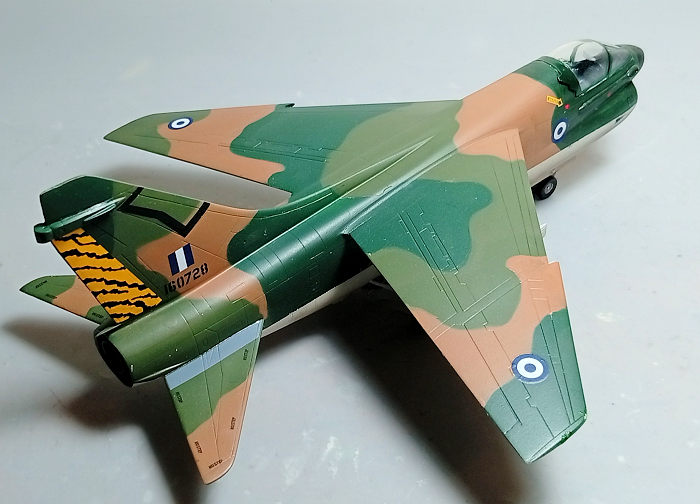
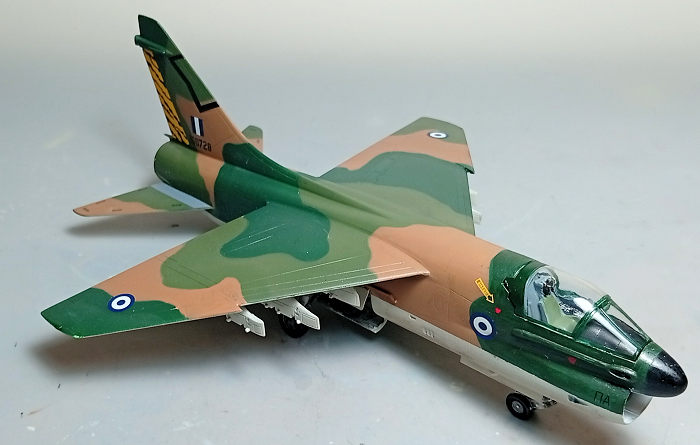
Hellenic Air Force A-7 Corsairs wore the distinctive Southeast Asia (Vietnam) camouflage scheme throughout their operational service. To reproduce the upper surface camouflage, I used Model Master 2116, Humbrol 117 and Humbrol 128 for the dark green, medium green and tan colors, respectively. The Model Master 2116, however, was not the most effective choice, as it has a noticeable bluish tint that appears somewhat unnatural compared with the actual shade. Nevertheless, I decided to proceed with it and continue the build using this color.
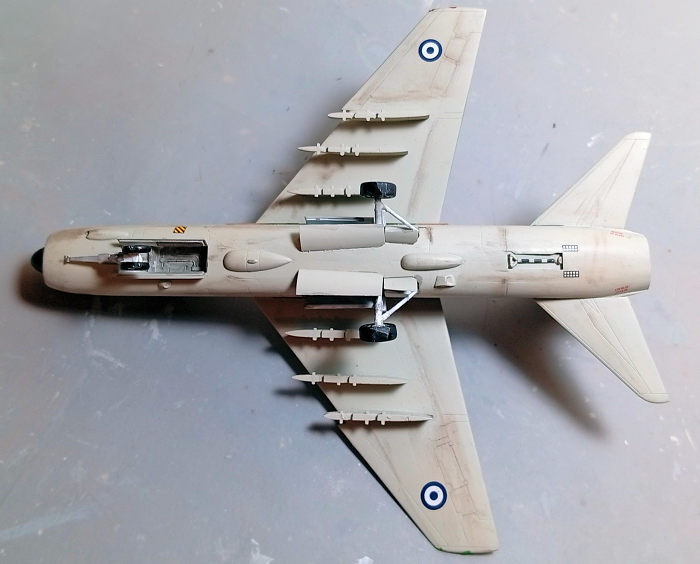
For the demarcation lines, I used thin strings of tack, aiming my airbrush somewhat vertically close to them, to achieve a tight yet subtly feathered edge. Once the upper camouflage had been completed, it was masked and, after the underwing pylons were attached, the entire underside, together with the landing gear doors, was then sprayed with Humbrol 28 Camouflage Grey.
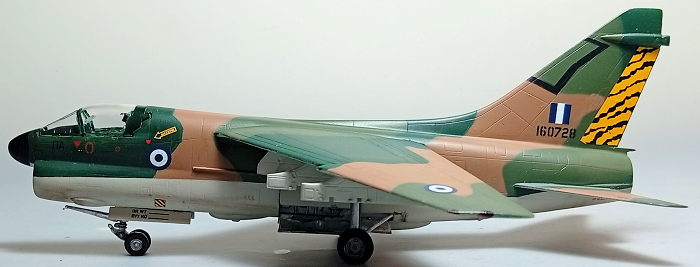 The nose was
finally painted black, together with the intake face, the latter helping to
create a greater sense of depth in the shallow intake opening. A coat of Future
prepared the bird for decals.
The nose was
finally painted black, together with the intake face, the latter helping to
create a greater sense of depth in the shallow intake opening. A coat of Future
prepared the bird for decals.
I was ready to proceed to decaling, when I noticed that something was not quite right. Not changing the habits of a lifetime, in one of my not so rare moments of carelessness, I had completely forgotten to add the external piping on both sides of the fuselage, as well as the refuelling probe. The latter was less an omission than a misjudgment. I had subconsciously approached the build as if I were modelling an A-7H, whereas the aircraft I was actually depicting was an A-7E, which was equipped with a refuelling probe. It was a small but important detail that I had overlooked until it was almost too late.
What would have been a quick and effortless job before painting had now turned into a tedious and delicate process, accompanied by the inevitable stream of colourful language familiar to most modellers… Nevertheless, everything was eventually fitted in place and carefully hand-painted, with the A-7 now proudly heading to the decal shop…
I used the kit decals to depict a 335 squadron machine, distinguished by its striking tiger-striped rudder. The Hobby Boss decals performed beautifully. Colour density and registration were excellent, they detached easily from the backing paper, settled well over the surface detail and responded flawlessly during application. A final coat of Future sealed everything in place and provided a smooth, uniform finish.
| FINAL CONSTRUCTION |
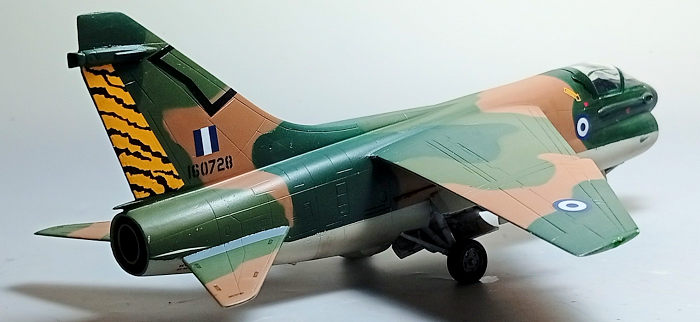 The landing
gear was assembled and attached in position. Despite some initial concerns, the
fit proved to be very good and positive. All parts, including the gear bays,
door innards, and the landing gear components themselves, including wheel rims,
were painted white. Tires were painted black, while the oleos were highlighted
with a fine-tip silver pen. The main wheels and, to a lesser extent, the nose
ones, were tad filed to look weighted.
The landing
gear was assembled and attached in position. Despite some initial concerns, the
fit proved to be very good and positive. All parts, including the gear bays,
door innards, and the landing gear components themselves, including wheel rims,
were painted white. Tires were painted black, while the oleos were highlighted
with a fine-tip silver pen. The main wheels and, to a lesser extent, the nose
ones, were tad filed to look weighted.
The good looking exhaust pipe was painted with Mr. Hobby Burnt Iron, then inserted and glued in position. The surrounding area was finished in Humbrol 81 Zinc Chromate.
The transparencies had their well defined frames hand painted and attached in place. Fit was excellent for the windscreen but so-so for the canopy. Being in a rush to complete the model in a very short time, I did not fill the gaps with white glue, which is my usual method. As a result, the looks in those areas are highly compromised. Finally, Blobs of red and green clear paints represented the wingtip lights, before calling the Hellenic Corsair done!
| CONCLUSIONS |
Nearly four decades after its original release, the old ESCI A-7 Corsair II - now wearing Italeri's attractive 2018 packaging - continues to prove that a good kit never truly grows old. Yes, modern toolings offer finer detail, deeper intakes and more sophisticated engineering, but they cannot take away the charm of this classic. It remains an honest, well-designed kit that captures the unmistakable character of the Corsair and provides a thoroughly enjoyable, stress-free building experience.
The attractive new box art
and the beautifully printed decals breathe fresh life into this veteran tooling,
while the sensible engineering and fine engraved surface detail remind us why
the kit earned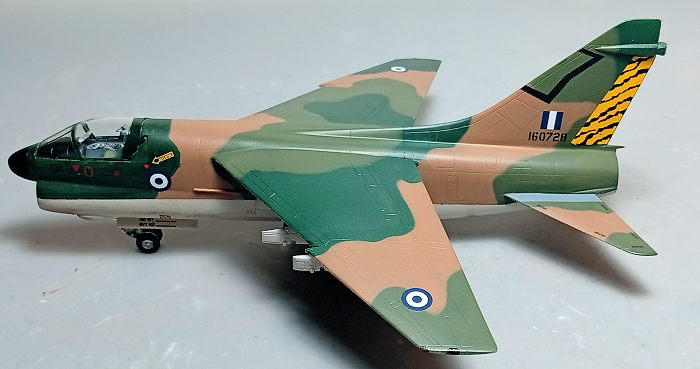 such a good reputation when it first appeared, asking for a little extra care
around a few areas. The most noticeable compromise is the shallow air intake,
but even this is not a major obstacle. The kit simply asks you to accept this
limitation - or, alternatively, to make use of the supplied intake cover, which
provides a practical and realistic solution.
such a good reputation when it first appeared, asking for a little extra care
around a few areas. The most noticeable compromise is the shallow air intake,
but even this is not a major obstacle. The kit simply asks you to accept this
limitation - or, alternatively, to make use of the supplied intake cover, which
provides a practical and realistic solution.
For me, however, this build became much more than simply assembling another model. This particular kit was won by my eldest son in a small local modeling competition a few years ago. An enthusiastic A-7 admirer, he could hardly wait to place it on my workbench and insist that we build it together. He happily took care of many of the basic tasks while I handled the more demanding ones, and somewhere between glue, paint and sanding sticks, another special memory was created. Those are the moments that remind us that our hobby is about far more than plastic parts and paint—it is about sharing time, knowledge and passion across generations.
Would I recommend this kit? Without hesitation, yes. Not because it is the newest or the most detailed Corsair available, but because it is one of those timeless kits that simply feels right. It builds into an impressive replica, offers an enjoyable journey from the first part to the last decal, and carries with it a nostalgia that many modelers will immediately recognize.
After all, scale modeling is not always about chasing the latest release or the highest parts count. Sometimes, opening the box of a well-loved classic, enjoying its uncomplicated nature and sharing the experience with someone you love is all the reminder we need of why we started building models in the first place. And for that reason alone, this old Italeri/ESCI Corsair II remains a kit well worth building.
Happy Modeling!
Spiros Pendedekas
23 July 2026
Copyright ModelingMadness.com. All rights reserved. No reproduction in part or in whole without express permission.
If you would like your product reviewed fairly and fairly quickly, please contact the editor or see other details in the Note to Contributors.