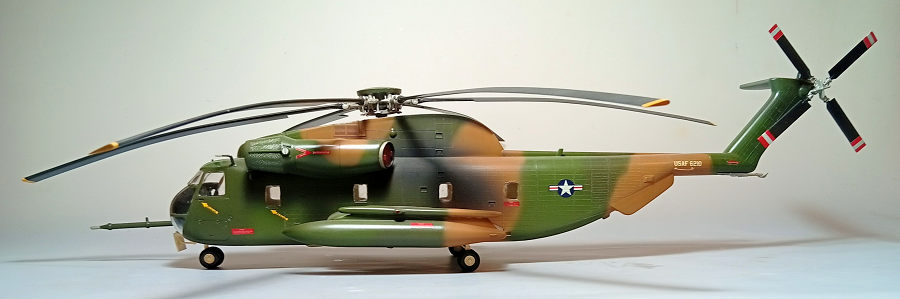
Revell 1/48 HH-53C Jolly Green
| KIT #: | 4498 |
| PRICE: | 29 Euros when new |
| DECALS: | Ten options |
| REVIEWER: | Spiros Pendedekas |
| NOTES: | Converted from the German CH-53G to a USAF HH-53C Jolly Green Giant. |
| HISTORY |
The first call came just after midnight.
At first, it was little more than a whisper buried beneath the hiss of radio static. A few broken words. A call sign. Coordinates that faded in and out as though the jungle itself were trying to swallow the transmission.
Then, silence.
Somewhere over North Vietnam, an American pilot was alone.
His aircraft was gone, its burning wreckage hidden somewhere beyond the black silhouette of the mountains. He had survived the ejection, but survival was only the beginning. Beneath him stretched an endless sea of jungle, a world of unfamiliar sounds, unseen dangers and shadows that seemed to move whenever he turned his head. He had a radio, a fading signal and one desperate hope: that someone had heard him.
Someone had.
At a distant airbase, the crew of an HH-53C Super Jolly Green Giant was already preparing for the mission. There was little conversation. Men checked equipment, secured their gear and went through the familiar rituals that preceded every flight into danger. They knew what they were being asked to do. They also knew that the helicopter, for all its size and power, could not make them invulnerable.
The engines came alive with a deep, gathering roar. The great rotor began to turn, slowly at first, then faster, until the entire machine seemed to tremble with barely contained energy. Beneath its dark silhouette hung the external fuel tanks that would help carry it across the vast distances of hostile territory. Along its nose, the refuelling probe waited for the moment when the helicopter might need the help of another aircraft to continue its journey.
Then the Green Giant lifted into the night.
Ahead lay the darkness.
The flight seemed endless. Below, mountains and jungle passed beneath the helicopter like a vast, black ocean. The crew listened to their radios, watched their instruments and searched the darkness for any sign that might lead them to the missing airman. Every transmission mattered. Every minute mattered. Somewhere out there, a man was waiting, and the distance between hope and despair was measured in fuel, time and the endurance of the men flying the machine.
Far from the search area, an HC-130 tanker was waiting.
T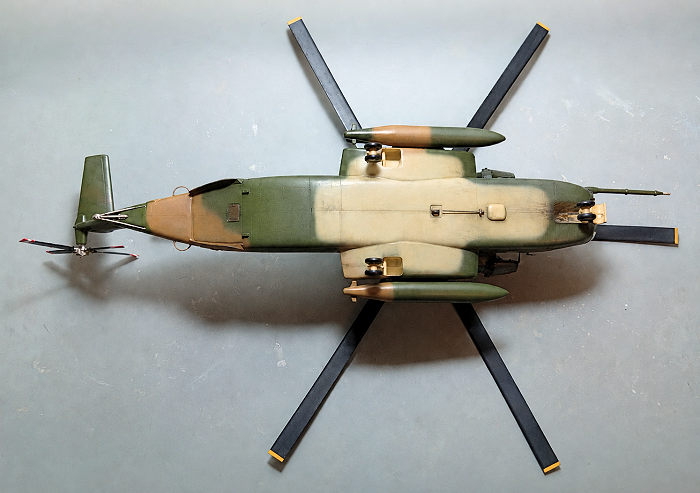 he
rendezvous was a demanding operation in itself. Two large aircraft had to find
each other in the darkness and maintain their positions while the helicopter
approached the trailing refuelling hose. The HH-53C's probe was extended,
reaching forward into the slipstream. For a moment, the entire world seemed to
narrow to a single point of contact.
Then came the connection.
Fuel began to flow.
The helicopter drank in the precious liquid that would carry it farther into the night and, eventually, bring it home. The tanker crew held their course while the Super Jolly Green Giant took on the fuel it needed. Neither crew could afford a lapse in concentration. Out here, even a routine procedure demanded absolute precision.
At last, the aircraft separated, and the HH-53C turned towards the mountains.
The radio crackled again.
This time, the voice was clearer. A bearing. A correction. A brief transmission from the man they had come to find.
The crew began to close in.
Then they saw it: a faint light, appearing and disappearing beneath the trees.
For several seconds, nobody spoke.
The pilot brought the helicopter around. The crew watched the darkness, searching for movement, for a signal, for confirmation that the light was not a trap or a trick of the imagination. The rotor wash began to stir the treetops as the great machine descended towards the clearing.
The crew worked quickly. There was no time for celebration, no room for ceremony. A figure emerged from the darkness, exhausted and unsteady, moving towards the waiting helicopter. Hands reached out. Someone shouted instructions. The airman was brought aboard.
For a moment, he could do nothing but stare at the men who had come for him.
He had spent hours wondering whether anyone would find him. Now he was inside a helicopter whose engines were roaring once more, surrounded by men whose faces he could barely see.
One of them gave him a reassuring nod.
They were going home.
As the HH-53C climbed away from the jungle, the darkness below revealed nothing of the danger they had left behind. The mountains swallowed the last traces of the clearing, and the radio fell quiet again. Ahead lay the long flight back, with its instruments, its calculations and its unending watch over the night.
The Green Giant continued westward, carrying its precious passenger towards safety.
For the men aboard, it was another mission completed. There would be other nights, other calls for help, other flights into places where the odds were uncertain and the outcome unknown. They would go because that was their task, and because somewhere, someone might be waiting.
Somewhere beneath the vast Vietnamese sky, another radio might soon begin to whisper.
The great helicopter would be ready.
| THE KIT |
 This
is a vintage kit, representing Revell's early-1980s tooling and reissued in 1993
as the CH-53G UN version. Despite its age, it remains the only option for
building a twin-engine CH-53-family helicopter in this scale. Academy's
offerings represent the three-engine version, so Revell's kit occupies a rather
special place for anyone wishing to add one of these impressive machines to
their collection.
It is a good kit by all means, although it naturally shows its age. The level of detail does not quite meet the standards of the most elaborate modern releases, but the overall external representation is particularly convincing, and there is plenty here to provide a very acceptable starting point for an impressive model. The shape looks right, the molding is generally nice, and the extensive rivet detail gives the surface a convincing appearance.
Should you wish to have a closer look at the contents of the box, a more detailed preview can be found in our ever-growing Modeling Madness archives.
The particular boxing reviewed here was marketed as a UN-operated German CH-53G, offering two white United Nations marking options. I purchased it for €29 from a beloved hobby and toy shop in Chalkida, which has since closed its doors. I have always enjoyed hunting down vintage kits, and I actually bought both boxes that were available at the time.
lthough the kit was intended to produce a German CH-53G, I decided to take a different route. I had long wanted to build an HH-53C Super Jolly Green Giant, and the box contained all the necessary components. With a search through my decal dungeon, I felt that a Vietnam-era USAF rescue helicopter was well within reach.
| CONSTRUCTION |
I started by assembling the cockpit, attaching the various components to the cockpit floor, which is one piece with the cargo floor. The basic cockpit colour was a medium gray, while the instrument panel and stick grips were painted black. I picked out the instruments with silver dry-brushing and added a few red, yellow and white details to represent the various knobs and controls.
The seats received the same grsy treatment for their frames, while the cushions were painted olive drab. The molded-on seat belts were carefully picked out in a lighter green shade. I did not go much further with the cockpit, since not a great deal would be visible through the canopy once everything was assembled.
 The
side windows were installed in the fuselage halves, and I then trapped the
assembled interior and the main shaft between them. I was not entirely sure
whether nose weight would be necessary, but I decided not to take any chances.
Approximately 40 grams of fishing weights were secured in the forward fuselage,
in a position where they would remain hidden. Better safe than sorry, especially
with a model of this size!
I opted to display the rear ramp closed. Apart from giving the finished model a cleaner appearance, this decision saved me a considerable amount of work on the cargo compartment. I simply painted the interior dark green, was I deemed quite sufficient for the effect I wanted.
The two sponsons were assembled and attached to the fuselage, followed by the two engine assemblies. I used the meshed engine intakes, which were appropriate for the version I was building. I also used the very nice exhaust covers to blank the somewhat blank areas, which I painted red. The rear stabilizer was then installed, and the main airframe began to take on the unmistakable appearance of a Super Jolly Green Giant.
I also decided to use the distinctive external fuel tanks. These were assembled complete with their pylons, but I left them off the model until after painting to make painting easier.
The landing gear required a slightly different approach. Normally, the gear would be trapped between the sponson halves during assembly. However, I was concerned that installing it so early would leave the legs vulnerable to accidental damage during the remaining construction. I therefore chose to fit the landing gear later, carefully working the components into position and adjusting things here and there until everything sat properly.
With the principal components assembled, I turned to the seams. The overall fit was acceptable and construction was relatively straightforward, although naturally this was no Tamiya-style shake-and-bake experience. A few joints needed attention with filler and sanding. Nothing was especially troublesome, however, and after the usual cleaning-up work and masking of the windows, the airframe was ready for the paint shop.
| COLORS & MARKINGS |
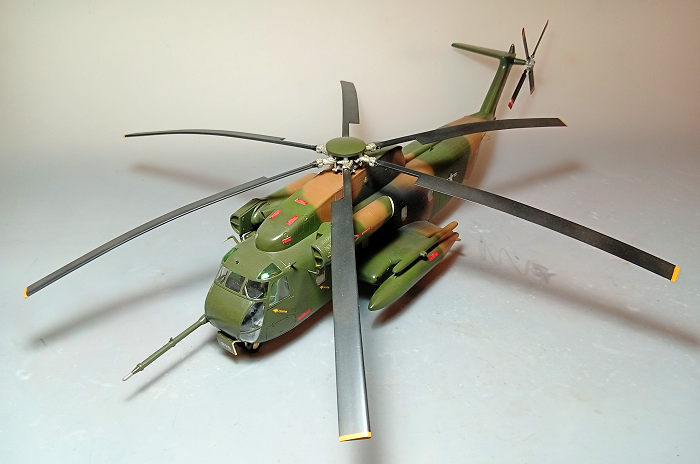 The
inspiration for the colour scheme was the familiar Vietnam-era camouflage worn
by USAF rescue helicopters. I wanted to capture the appearance of a working
aircraft rather than produce an immaculate display piece, while keeping the
finish reasonably restrained.
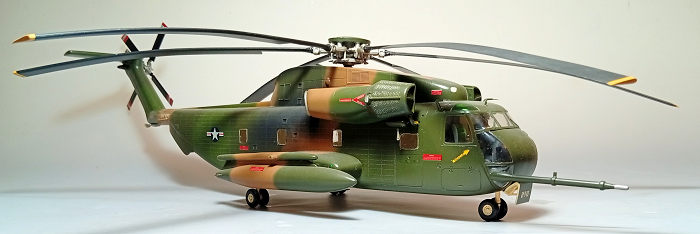
I began by painting the undersides with Humbrol 28, Camouflage Grey. After allowing the paint to dry, I applied the upper camouflage freehand, using Humbrol 116 for Dark Green, 117 for the lighter green and 118 for the tan areas. The assembled external tanks were likewise painted.
Working with finer airbrush settings allowed me to achieve relatively tight camouflage demarcations without resorting to elaborate masking. The result was not intended to reproduce every detail of a particular airframe, but to evoke the characteristic appearance of an HH-53C operating in Southeast Asia.
Once the camouflage had dried, I applied a coat of Future to prepare the surfaces for the decals.
As the kit's original markings were intended for a German CH-53G in United Nations service, they were not suitable for my conversion. I therefore went through my decal dungeon and used a selection of leftover markings and stencils, along with a few of the kit's stencils, to give the model a Vietnam-era USAF appearance. I cannot claim that every marking is precisely correct for a particular HH-53C, but the overall result looked convincing enough to me, and I was happy to proceed.
| FINAL CONSTRUCTION |
With the main camouflage completed, I returned to the landing gear and the smaller components that would bring the model to life. The landing gear was painted and fitted in position, taking care not to damage the surrounding areas. All landing gear parts, bays and wheel rims were painted white and the tires were painted black. With the landing gear finally in place, the big helicopter stood proudly on its feet. The external tanks were attched at this time, as well.
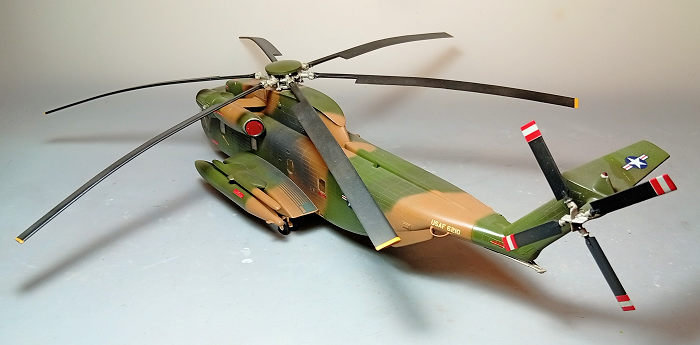
Next came the distinctive main rotor. The hub was assembled separately, with a dark green hub cover and a steel-colored hub, while the blades were painted black with yellow tips.
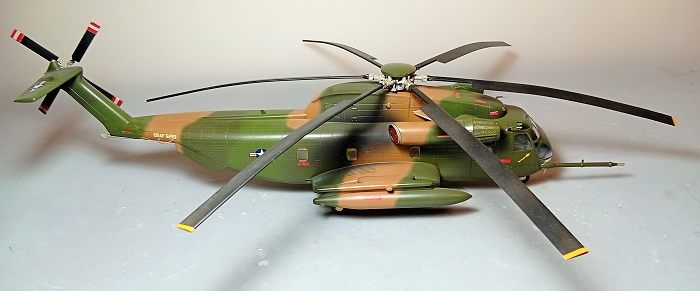 As
mentioned in my preview, the kit's rotor blades lack the characteristic droop
seen on the real helicopter when parked. I decided to do something about it. I
placed the blades in hot water and carefully bent them by hand to achieve a more
natural appearance. I must confess that this was a rather hair-raising process:
there is always the risk of bending too far, producing an uneven result or
damaging the plastic altogether. Fortunately, patience prevailed, and the blades
ended up with a reasonably convincing droop. The completed rotor assembly was
then attached to the model.
The tail rotor was assembled and painted in a similar fashion, with a steel hub and black blades, while I used the kit supplied decals for the tips, before being installed in position.
The distinctive aerial-refuelling probe was another important feature of my conversion. It was assembled separately, painted to match the surrounding fuselage area, and given an aluminium tip before being attached in position. Along with the external fuel tanks, it helped give the model the characteristic appearance of an HH-53C equipped for long-range rescue operations.
Time for some weathering! My main contribution was to reproduce the characteristic staining caused by the engine exhausts. Using the airbrush, I applied light and dark smoke shades along the exhaust-gas paths, building up the familiar black deposits on both sides of the fuselage. I then used pastels in various shades of dark brown and black to add dirt, soot and general operational grime in selected areas.
Apart from some more aggressive approach to the undersides, I tried not to overdo things with weathering. A working rescue helicopter in Vietnam would certainly show signs of use, but I wanted the weathering to complement the model rather than overwhelm it. Finally, a satin clear coat brought everything together and gave the bird its final finish.
The canopy, with its nicely defined frames, was carefully hand-painted and attached in position. This completed the transparent parts of the model and gave the cockpit its final appearance. Blobs of red and green clear paint represented the navigation lights. With the remaining small external details checked, the Green Giant was done.
| CONCLUSIONS |
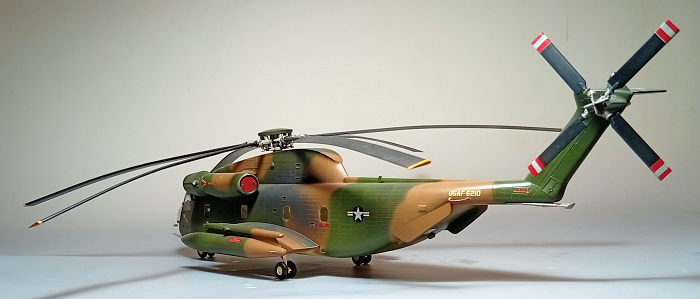 It
is absolutely wonderful that Revell gave us such an impressive and imposing
helicopter kit as early as in the early 1980s. It remains the only option for a
twin-engine CH-53-family helicopter in this scale, while Academy's offerings
represent the three-engine variant.
Of course, the kit is somewhat outdated by 2020s standards. The interior is basic, and the detail cannot compete with the most elaborate modern releases. Nevertheless, the overall shape looks convincing, the molding is very nice, and the extensive rivet detail is particularly effective. The transparencies are nicely done, and the detail provided is quite acceptable in the key areas. The instructions are straightforward, too. The few decals I used from the kit sheet behaved very well, albeit being more than 30 years old and their backing paper was yellowed.
The fit is generally acceptable, but some filling and sanding should be expected. The size of the model and the need to handle its large components also make it a project better suited to an average modeller or above, rather than an absolute beginner.
Later incarnations of the kit have continued to appear from Revell, with newer parts intended to accommodate subsequent versions and at generally sensible prices. That makes the kit well worth considering if you want to add a CH-53 to your collection.
My conversion to an HH-53C required some extra research, but it was a rewarding project. The finished model has the presence that one would expect from such a large helicopter, and the Vietnam camouflage and weathering give it plenty of character.
So, do not be put off by the somewhat dated tooling. This is a very decent kit that can still produce a fantastic model. Give it a little care, add some patience and imagination, and you will be rewarded with an imposing Green Giant that looks right at home in any helicopter collection.
There was another reason why I chose to turn this old Revell kit into a Vietnam-era Jolly Green Giant. Somewhere along the way, the model became more than a building project. The distinctive shape of the helicopter, its external fuel tanks and its aerial-refuelling probe brought to mind the dangerous night missions flown over Vietnam, and I found myself imagining the men who depended on these formidable machines. Before I knew it, a story had begun to take shape.
Decades later, a modeller sits at his workbench, studying the shape of the same formidable machine. The long fuselage, the massive rotor, the external fuel tanks and the refuelling probe are reproduced in miniature, each detail carefully assembled and painted. The helicopter stands motionless, silent beneath the workshop lights.
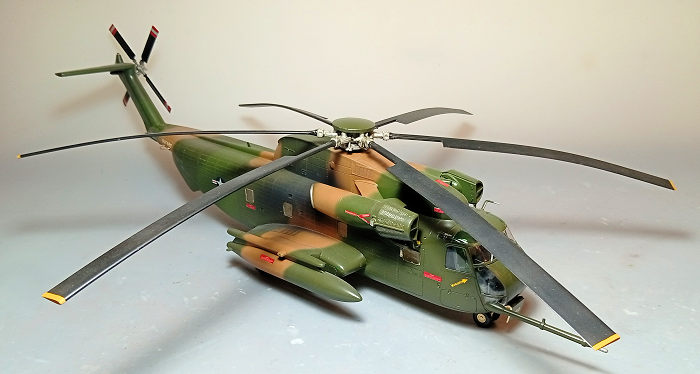 There is no jungle around it now. No radio static, no desperate voice calling
through the darkness, no crew waiting for the signal that will send them towards
danger.
Yet the story remains.
For the men who flew the HH-53C Super Jolly Green Giant, those great rotor blades once turned above hostile mountains and endless forests. They carried fuel, equipment and rescue crews into places where every minute mattered. They brought exhausted men out of the darkness, returning them to their comrades and to the possibility of going home.
The model on the workbench cannot reproduce the fear of the man waiting below, or the concentration of the crew searching above him. It cannot recreate the noise, the danger or the extraordinary relief of seeing the rescue helicopter arrive.
But perhaps it does not need to.
Sometimes, a model represents more than an aircraft. It represents the people who flew it, the men who waited for it, and the moments when hope arrived in the shape of a great machine emerging from the darkness.
Somewhere, in the depths of that imagined Vietnamese night, a radio is still whispering.
Someone is still waiting.
The Green Giant is on its way.
Happy Modeling!
23 November 2026
Copyright ModelingMadness.com. All rights reserved. No reproduction in part or in whole without express permission.
If you would like your product reviewed fairly and fairly quickly, please contact the editor or see other details in the Note to Contributors.