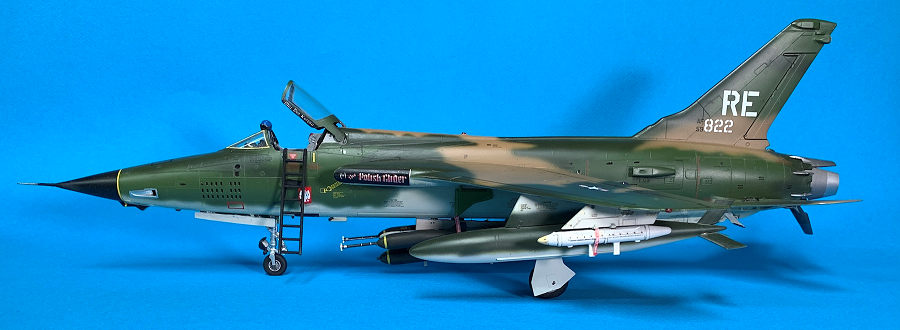
Monogram 1/48 F-105D Thunderchief
| KIT #: | 5812 |
| PRICE: | $20-30.00 |
| DECALS: | One option |
| REVIEWER: | Blair Stewart |
| NOTES: | Restoration of damaged model built in 1985 |
| HISTORY |
The Republic F-105 Thunderchief is an American fighter-bomber that served with the United States Air Force from 1958 to 1984. Capable of Mach 2, it conducted most strike bombing missions during the early years of the Vietnam War. It was originally designed as a single-seat, nuclear-attack aircraft; a two-seat “Wild Weasel” version was later developed for the specialized suppression of enemy air defenses(SEAD) role against surface-to-air missile sites. The F-105 was affectionately referred to as "Thud, Thunderthud, Lead Sled, Ultra-Hog and Squat Bomber” by its crews. Republic produced a total of 833 aircraft before it ended production. The F-105 is the only American aircraft to have been removed from combat due to high loss rates.
 The
F-105 began as a follow-on to the Mach 1 North American F-100 Super Sabre
and as a desire to improve on the performance of the Republic F-84F
Thunderstreak. But under the leadership of Alexander Kartveli – the
principal designer of the P-47 Thunderbolt - the Republic “improvement
program soon blossomed into an entirely new design. In March of 1952,
Republic submitted the design to the Department of Defense, and in the fall
of 1952, DoD awarded Republic a contract for tooling and engineering.
Although the F-105 design called for air-to-air missiles and an internal
rotary cannon, Republic tailored its design to high-speed low-altitude
penetration carrying a single nuclear weapon in an internal bomb bay.
The
F-105 began as a follow-on to the Mach 1 North American F-100 Super Sabre
and as a desire to improve on the performance of the Republic F-84F
Thunderstreak. But under the leadership of Alexander Kartveli – the
principal designer of the P-47 Thunderbolt - the Republic “improvement
program soon blossomed into an entirely new design. In March of 1952,
Republic submitted the design to the Department of Defense, and in the fall
of 1952, DoD awarded Republic a contract for tooling and engineering.
Although the F-105 design called for air-to-air missiles and an internal
rotary cannon, Republic tailored its design to high-speed low-altitude
penetration carrying a single nuclear weapon in an internal bomb bay.
First flown in 1955, the Thunderchief entered service in 1958. In early 1964, nine F-105Bs were supplied to the Air Force Thunderbirds air demonstration squadron at Nellis AFB, Nevada. The Thunderbirds used the aircraft for only a few months, losing one that broke in half during a demonstration at Hamilton AFB, CA on May 9, 1964 (the Thunderbirds reverted to using the F-100 after this accident).
The single-engine F-105 could deliver a bomb load greater than some American heavy bombers of World War II, including the Boeing B-17 Flying Fortress and the Consolidated B-24 Liberator. No other fighter aircraft in the USAF inventory could match the F-105s bomb load. As a result, the F-105 was one of the primary attack aircraft of the Vietnam War, with over 20,000 Thunderchief sorties flown.
 At the
zenith of “Operation Rolling Thunder,” the F-105 was mainly used to “go
downtown” (pilot slang for missions into the heart of Route Package Six). On
these missions, the F-105’s primary load consisted of six 750 lb. bombs on a
centerline multiple ejector rack (MER), 450-gallon fuel tanks on the inboard
wing stations, and electronic countermeasures (ECM) pods on the outboard
stations.
At the
zenith of “Operation Rolling Thunder,” the F-105 was mainly used to “go
downtown” (pilot slang for missions into the heart of Route Package Six). On
these missions, the F-105’s primary load consisted of six 750 lb. bombs on a
centerline multiple ejector rack (MER), 450-gallon fuel tanks on the inboard
wing stations, and electronic countermeasures (ECM) pods on the outboard
stations.
Due to its powerful Pratt and Whitney J-75 engine and sleek, area-rule fuselage design, the Thud could reach supersonic speeds at low altitude without the pilot even knowing it (as demonstrated by a flight of four F-105Ds that broke the sound barrier over the US Air Force Academy in May of 1968, blowing out every window in the Academy’s dining hall and heavily damaging windows in one dormitory and the gymnasium. I was fortunate to have witnessed this event, and luckily no one was hurt in the process).
During the Vietnam conflict, the single-seat F-105D was the primary aircraft delivering heavy bomb loads against a variety of military targets. Meanwhile, the two-seat F-105F and F-105G Wild Weasel variants became the first dedicated SEAD platforms, fighting against the Soviet-built S-75 Dvina (SA-2 Guideline) surface-to-air missiles. Two Wild Weasel pilots were awarded the Medal of Honor for attacking North Vietnamese surface-to-air missile sites, with one shooting down two MiG-17s the same day. The dangerous missions often required them to be the "first in, last out", suppressing enemy air defenses while strike aircraft accomplished their missions and then left the area.
Out of the 833 produced, 382 aircraft were lost, including 62 operational (non-combat) losses. Although less agile than smaller MiG fighters, USAF F-105s were credited with 27.5 kills.
| THE KIT |
 The
Monogram F-105D - first released in 1985 - was amongst a plethora of 1/48
scale aircraft that Monogram released in the eighties. The kit followed
Monogram’s earlier 1982 release of the F-105G (kit No. 5806). Molded in
olive plastic, the kit contained 85 parts plus two clear plastic parts.
Typical of the kits in those days, the panel lines were raised engravings. A
neat inclusion in the kit is the external stores, consisting of: a pair of
450-gallon drop tanks with integrally-molded pylons to be installed at
stations 2 and 4; separate pylons along with a pair of Mk 82 500-lb bombs
with ‘daisy cutter’ fuse extenders to mount to the outboard stations; and a
correct centerline pylon with an integral multiple ejector rack, along with
six M-117 750-pounders.
The
Monogram F-105D - first released in 1985 - was amongst a plethora of 1/48
scale aircraft that Monogram released in the eighties. The kit followed
Monogram’s earlier 1982 release of the F-105G (kit No. 5806). Molded in
olive plastic, the kit contained 85 parts plus two clear plastic parts.
Typical of the kits in those days, the panel lines were raised engravings. A
neat inclusion in the kit is the external stores, consisting of: a pair of
450-gallon drop tanks with integrally-molded pylons to be installed at
stations 2 and 4; separate pylons along with a pair of Mk 82 500-lb bombs
with ‘daisy cutter’ fuse extenders to mount to the outboard stations; and a
correct centerline pylon with an integral multiple ejector rack, along with
six M-117 750-pounders.
For a detailed description of what’s in the box, you can check out Roger Jackson's build here on Modeling Madness.
| CONSTRUCTION |
As mentioned in the title and opening table, this is a “restoration” of a kit I first built in 1985. After completing the kit, I proudly displayed it in my work office for over 25 years. When I retired, I foolishly crammed the model along with other models into some cardboard moving boxes and then stored those boxes in an outdoor shed, hoping later to figure out where to put all the “stuff” I had accumulated in 35 years of working. As often happens, I forgot about these boxes and went on with my life. Recently, however, I decided to do something with this collection of things, including the models that I had carelessly packed in the boxes. As one would expect, I had to toss several of the models as they just didn’t survive the careless move. But I did manage to save a badly broken Monogram 1/48th scale F-105F, which I had reviewed on Modeling Madness some years ago, as well as the F-105D. I was also careful to gather as many of the pieces associated with both F-105s and put them in a Ziplock bag, anticipating that someday I would try to “fix” one or both these models.
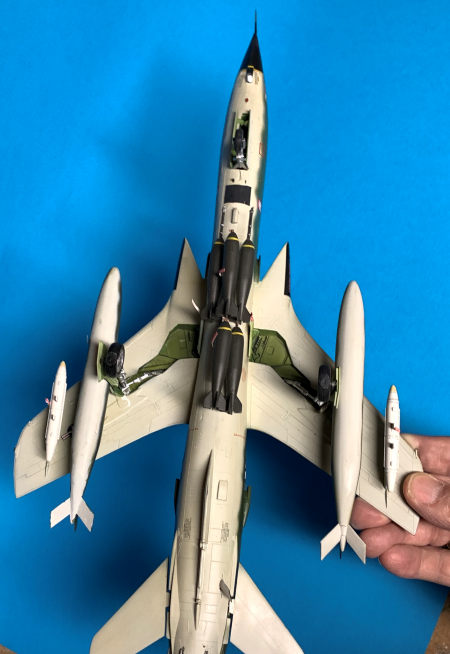 That day
finally came to attempt a restoration, and I began by surveying what had to be
done. First, the F-105F was NOT recoverable, as I had somehow managed to lose
some key parts. But it did have several intact parts (e.g., speed brake petals;
landing gear; tires; landing gear braces; landing gear doors; etc.) that could
be cannibalized and used for restoring the F-105D.
That day
finally came to attempt a restoration, and I began by surveying what had to be
done. First, the F-105F was NOT recoverable, as I had somehow managed to lose
some key parts. But it did have several intact parts (e.g., speed brake petals;
landing gear; tires; landing gear braces; landing gear doors; etc.) that could
be cannibalized and used for restoring the F-105D.
The F-105D damage consisted of all three of the landing gear broken off; the nose pitot tube broken off; canopy and windscreen off; all external stores broken off; the right horizontal stabilizer broken off; and all landing gear doors broken off or missing. In addition, one of the main gear struts was broken in half and the other had the wheel broken off.
I inventoried what parts I had to restore the broken parts and/or replace parts that were missing from the F-105D with some from the F-105F. From the F-105F, I plan to use one main landing gear, two speed brake petals and the nose gear well doors.
Before reassembling the model, I needed to clean several years of grime and dust off it. I washed it in soap and water and then took a wet Q-tip and swabbed the crevices that the soap and water had missed. Q-tips were also very useful in cleaning both the inside and outside surfaces of the canopy and windscreen and the cockpit.
I then moved to reattaching parts to the fuselage and wings. I decided to use metal pins made from paperclips to attach as many broken items as possible to insure they would be strong enough to survive moving the finished model around. First, I used a pin vise to drill a hole to pin the horizontal stabilizer to the rear fuselage. I first secured a length of paperclip in the stabilizer and then clipped it off with small diagonal cutters to an appropriate length. I secured the pin in the stabilizer with gel super glue. Once that dried, I attached the stabilizer to the fuselage using the gel super glue.
I then moved to the landing gear. These are quite “spindly” and fragile, so they need to be reattached using metal pins and super glue. Before pinning and gluing them, I reattached the landing gear doors to the main gear. If you are going to build this kit, make note of the fragile landing gear and be careful when moving the model around. At least one company – Scale Aircraft Conversions (SAC) – makes metal replacement landing gear for both the Monogram and Hobbyboss F-105s, so this might be an option for you.
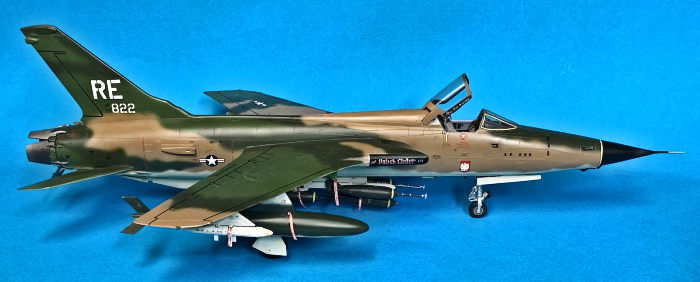 Next came
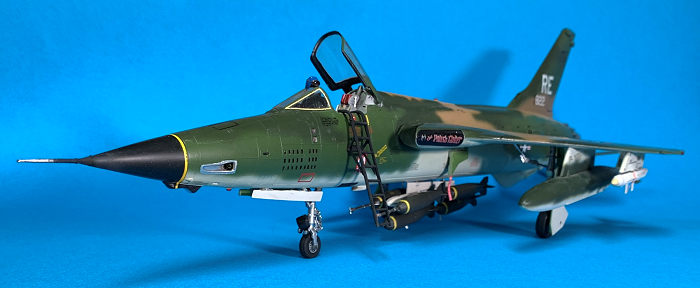
the external stores. For the centerline MER, I was fortunate that four of the
six 750 lb. bombs had remained on the MER. For the two bombs needing
reattachment, I scraped old paint and glue off the bomb and MER attachment
points and then reglued them in place using plastic cement (note: it is critical
to scrape the old glue and any paint off when regluing parts!). Once the bombs
were set on the MER, I drilled two holes in the rack that would attach it to the
bottom of the fuselage. Before attaching the MER, I added some paper “remove
before flight” tags from the parts stash. I attached these using clear gel Tacky
Glue. Once the MER was completed, I super glued it to the fuselage. I used the
same techniques to reattach the drop tank pylons and the outboard pylons loaded
with the ECM pods. All received “remove before flight” tags prior to
reattachment to the wings.
Next came
the external stores. For the centerline MER, I was fortunate that four of the
six 750 lb. bombs had remained on the MER. For the two bombs needing
reattachment, I scraped old paint and glue off the bomb and MER attachment
points and then reglued them in place using plastic cement (note: it is critical
to scrape the old glue and any paint off when regluing parts!). Once the bombs
were set on the MER, I drilled two holes in the rack that would attach it to the
bottom of the fuselage. Before attaching the MER, I added some paper “remove
before flight” tags from the parts stash. I attached these using clear gel Tacky
Glue. Once the MER was completed, I super glued it to the fuselage. I used the
same techniques to reattach the drop tank pylons and the outboard pylons loaded
with the ECM pods. All received “remove before flight” tags prior to
reattachment to the wings.
I reattached the front windscreen and canopy using tacky glue. The final part was the nose pitot tube. I should have pinned it to the nose cone, but I got lazy (the pin would be extremely small), so I just scraped the plastic and used plastic cement (no doubt, this part will be the first to break off the model at some point in the future!).
| COLORS & MARKINGS |
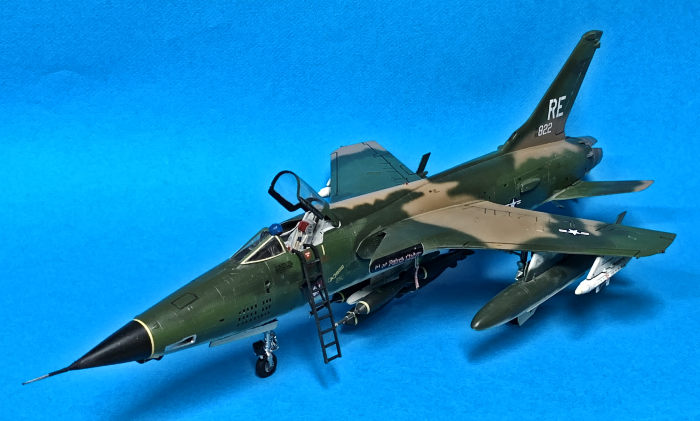 Once
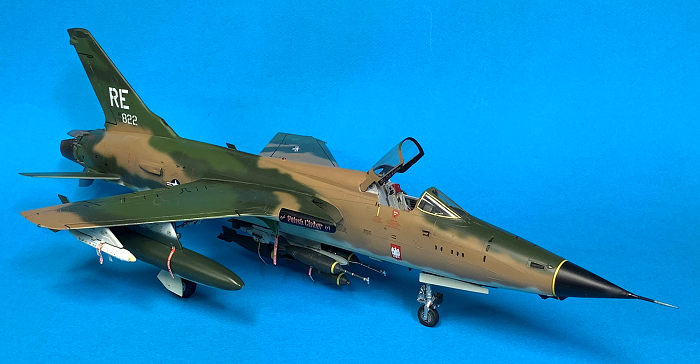
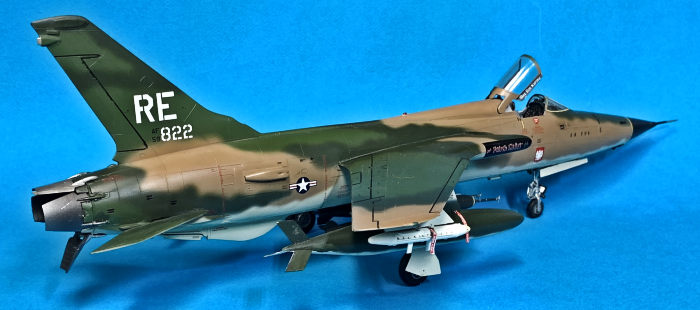
cleaned up, the standard Vietnam-era camouflage paint scheme came back to life.
Originally, I had free-handed the camo pattern using Floquil SEA FS paints, and
they reappeared as if they were hot out of the airbrush.
Once
cleaned up, the standard Vietnam-era camouflage paint scheme came back to life.
Originally, I had free-handed the camo pattern using Floquil SEA FS paints, and
they reappeared as if they were hot out of the airbrush.
I had applied the original kit decals, which were for Major Don Kutyna’s “Polish Glider” of the 44th Tactical Fighter Squadron, 355th Tactical Fighter Wing, operating out of Takhli RTAB in 1970. (Major Kutyna went on to have a long Air Force career and ended up as a four-star general in command of NORAD, US Space Command, and Air Force Space Command at Peterson AFB, CO).
To pose the model, I attached a boarding ladder (this one is black, and although the majority of Vietnam era boarding ladders were yellow, I have found pictures of black ladders from the period being used for crew egress from F-105s). I also attached a pilot’s helmet to the top of the front windscreen.
| CONCLUSIONS |
There you have it: restoration of a model built some 40 years ago, roughly boxed up, and “stored for dead” for 10 or so years. I am somewhat pleased with the results and glad that I didn’t just toss the model like I did some of the others in the moving boxes. Although some reviewers claim the Monogram F-105D has shape, accuracy and fit problems, I think it was and still is a decent replica of the F-105D and still worth the current $20-30 auction site price.
| REFERENCES |
Drendel, Lou, “F-105 Thunderchief in Action,” Squadron/Signal Publications, Warren Michigan, 1974.
Kinzey, Bert, “F-105 Thunderchief in Detail and Scale,” Aero Publishers, Inc., Fallbrook, CA, 1982.
Archer, Robert, “The Republic F-105 Thunderchief,” Aero Publishers, Inc., Fallbrook, CA, 1969.
6 October 2025
Back to the Previews Index Page
Back to the Previews Index Page