| KIT #: | 521 |
| PRICE: | $20.00 when new |
| DECALS: | Two options |
| REVIEWER: | Spiros Pendedekas |
| NOTES: | Kalfakis decals 48/1 |
| HISTORY |
The Northrop F-5A
Freedom Fighter holds a very special place in the history of the Hellenic Air
Force. Although small, lightweight, and relatively simple compared to many
contemporary fighters of its era, the F-5A became one of the most recognizable
and beloved aircraft ever to wear Greek markings. For decades, it served
faithfully as an interceptor, advanced trainer, and day fighter, proving that
effectiveness in combat aviation was not always defined by size or
sophistication. In Greek service, the F-5A earned a reputation for reliability,
agility, and ease of maintenance, characteristics that made it particularly
valuable during a critical period of modernization for the Hellenic Air Force.
Greece became the first European nation to operate the F-5A when the initial
deliveries arrived in 1965 through the American Military Assistance Program
under NATO cooperation. The first batch consisted of 55 F-5A aircraft, allowing
the 341 and later the 343 Day Interception Squadrons to achieve operational
status. In 1970, the fleet was further strengthened with the delivery of 17
RF-5A reconnaissance variants. During the following years, Greece supplemented
its Freedom Fighter force through additional acquisitions from allied countries.
In 1975, ten former Iranian aircraft were o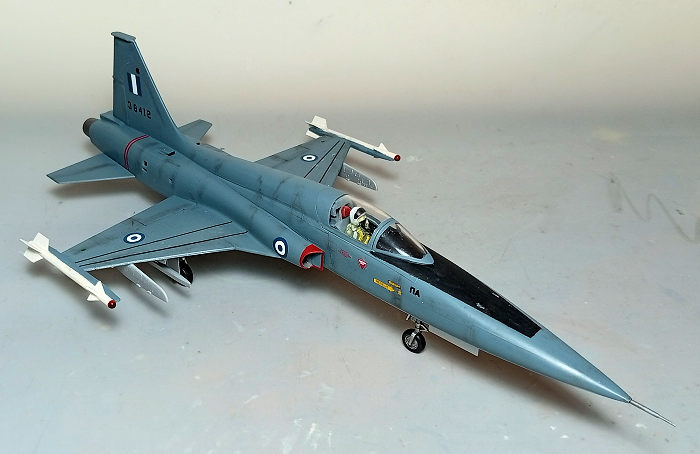 btained,
followed shortly afterward by additional aircraft from Jordan. Further
reinforcements arrived in 1986 from Norway, while in 1991 Greece acquired
Dutch-built Canadair NF-5A Freedom Fighter aircraft from the Netherlands.
Altogether, the Hellenic Air Force eventually operated well over one hundred F-5
family aircraft, making the type one of the most important and long-serving
fighters in modern Greek aviation history.
btained,
followed shortly afterward by additional aircraft from Jordan. Further
reinforcements arrived in 1986 from Norway, while in 1991 Greece acquired
Dutch-built Canadair NF-5A Freedom Fighter aircraft from the Netherlands.
Altogether, the Hellenic Air Force eventually operated well over one hundred F-5
family aircraft, making the type one of the most important and long-serving
fighters in modern Greek aviation history.
Within the Hellenic Air Force, the F-5A equipped several squadrons and quickly
became a familiar sight over the Greek mainland and the Aegean Sea. Greek pilots
appreciated the aircraft for its responsive handling and forgiving flight
characteristics. Despite its modest size, the F-5A was capable of reaching
speeds above Mach 1 and could perform remarkably well in close-range aerial
combat. Many pilots considered it one of the purest “pilot’s aircraft” ever
flown by the Hellenic Air Force. Its simplicity also meant high operational
availability, an important factor during years when maintaining readiness was
absolutely essential.
One of the most iconic aspects of the Greek F-5A fleet was its variety of
camouflage schemes and squadron markings. Among these, the distinctive
blue-toned “Aegean Blue” camouflage became especially admired by modelers and
aviation photographers alike. This scheme gave the aircraft a uniquely Hellenic
identity, perfectly suited to the bright Mediterranean environment and the deep
blue colors of the Aegean skies. Combined with weathering from operational use
and the harsh Greek climate, many Greek F-5As developed a worn but highly
characterful appearance that remains popular among scale model builders today.
The aircraft also played an important role in pilot training and transition.
Generations of Greek fighter pilots gained valuable experience on the F-5A
before progressing to more advanced aircraft such as the McDonnell Douglas F-4
Phantom II and later the General Dynamics F-16 Fighting Falcon.
 Even as
newer fighters entered service, the F-5A continued to serve with distinction
thanks to its low operating cost and dependable performance. For many veterans
of the Hellenic Air Force, the Freedom Fighter represented an era in which
flying skill and tactical awareness mattered as much as advanced avionics.
Even as
newer fighters entered service, the F-5A continued to serve with distinction
thanks to its low operating cost and dependable performance. For many veterans
of the Hellenic Air Force, the Freedom Fighter represented an era in which
flying skill and tactical awareness mattered as much as advanced avionics.
By the time the F-5A was eventually retired from Greek service, it had already
secured its legacy as one of the most respected aircraft in Hellenic aviation
history. Though overshadowed internationally by larger and more technologically
advanced fighters, the Freedom Fighter proved itself through decades of reliable
service. In Greece especially, the aircraft became far more than simply another
NATO fighter; it became a symbol of an important transitional period for the
Hellenic Air Force and a machine remembered with genuine affection by pilots,
ground crews, historians, and aviation enthusiasts.
Today, surviving Greek F-5As preserved in museums or displayed as gate guardians
continue to attract attention from aviation fans around the world. Their elegant
design, operational history, and unmistakable Greek camouflage schemes make them
enduring favorites within the scale modeling community. Building a model of a
Greek F-5A, particularly in the famous GM blue camouflage, is therefore more
than just recreating an aircraft in miniature — it is a tribute to a fighter
that served Greece faithfully for many years and became an enduring icon of the
Hellenic skies.
| THE KIT |
 This is the
ancient 1966 Hawk mold. The kit has been reboxed 11 times in total by Hawk,
Testors and Italeri, the last reissue having taken place in 1998. This is
clearly an older and more simplistic tooling of the early Northrop F-5A Freedom
Fighter, with basic detail especially in the cockpit and landing gear areas.
Still, for its age, it captures the overall shape of the aircraft very well and
remains a solid, enjoyable kit that many modelers still appreciate today,
despite newer and more refined offerings such as those from Kinetic.
This is the
ancient 1966 Hawk mold. The kit has been reboxed 11 times in total by Hawk,
Testors and Italeri, the last reissue having taken place in 1998. This is
clearly an older and more simplistic tooling of the early Northrop F-5A Freedom
Fighter, with basic detail especially in the cockpit and landing gear areas.
Still, for its age, it captures the overall shape of the aircraft very well and
remains a solid, enjoyable kit that many modelers still appreciate today,
despite newer and more refined offerings such as those from Kinetic.
The specific copy is the Testors 1992 reboxing and was bought at around the mid
00s from an Athens hobby shop. Should you wish to have a more in-depth look at
its contents, you may read its preview found
in the ever growing MM archives.
| CONSTRUCTION |
Opting for a practically
out of the box build, I started by trapping the instrument panel, the canopy
hinge and the nose gear between the fuselage halves. Not risking the possibility
of tail sitting (albeit I believe none needed) I nevertheless secured around
20grams of fishing weights in the nose. Due to the non-existing cockpit, I
painted all innards black, save the aft of the headrest rear panel, which I
painted Tamiya XF-66 Light Grey, with the same shade used to paint the totally
simplistic seat frame - its headrest painted red. The front coaming was also
painted black. I used the nice instrument decal, where I randomly pinned a few
red and yellow dots, to simulate “switches and stuff”. Since no gunsight was
provided, I fabricated one from some leftover clear sprue.
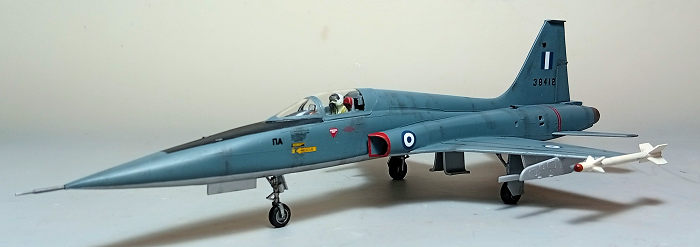 A good
approach to somehow lessen the impression of cockpit sparseness and seat
absolutely basic looks is to use the relatively good looking pilot figure
provided and that’s what I did. His suit was painted medium green, his boots,
visor and oxygen mask black, his helmet white, his seat belts “linen”, his
gloves light grey, his face a “flesh” (whatever that might be) shade, while his
buckles were highlighted with a fine tip silver pen. No joystick was provided
whatsoever, so a spare one (from a Monogram F-105 - sorry purists) was attached.
A good
approach to somehow lessen the impression of cockpit sparseness and seat
absolutely basic looks is to use the relatively good looking pilot figure
provided and that’s what I did. His suit was painted medium green, his boots,
visor and oxygen mask black, his helmet white, his seat belts “linen”, his
gloves light grey, his face a “flesh” (whatever that might be) shade, while his
buckles were highlighted with a fine tip silver pen. No joystick was provided
whatsoever, so a spare one (from a Monogram F-105 - sorry purists) was attached.
The 2-piece intakes were next attached, followed by the one piece wing. Since I
was opting for a running engine with pilot in, I attached the air brake in
“retracted” position (it droops upon engine shutdown). Next all six pylons were
attached, followed by the aft-top located auxiliary air inlets.
This concluded basic assembly, which was straightforward and, I have to say,
very pleasant, due to the low parts count and good fit - not all “simple” kits
build easily. Since I was going for an all silver underside, including wheel
bays, door innards and the landing gear itself, I attached all above items to
make life easier. After (not too much really) filing and sanding, I took the
bird to the paint shop.
| COLORS & MARKINGS |
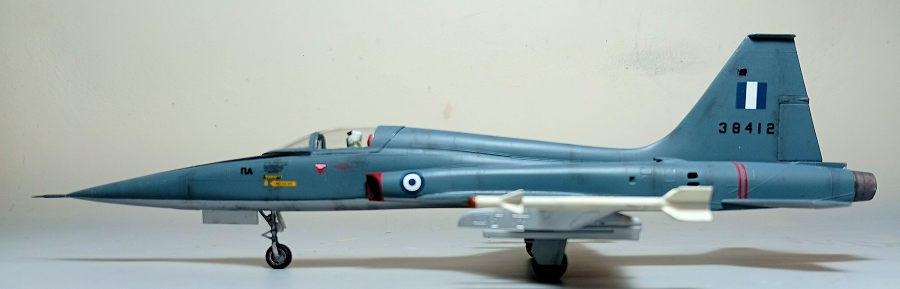
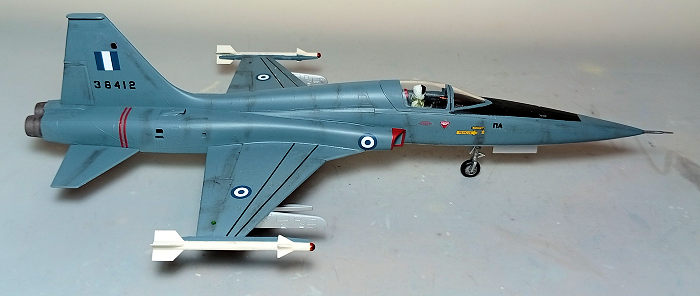 Opting for
the distinctive Aegean Blue scheme, I first gave the topsides a coat of Hu144
Intermediate Blue, followed by masking and painting black the front anti-glare
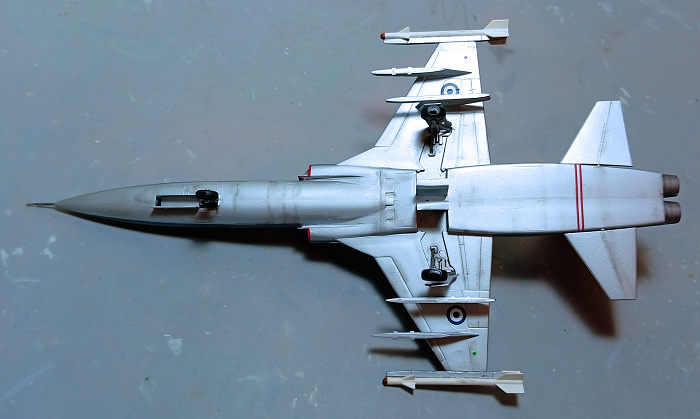
area. I then sprayed all undersides with my trusty Hu11 Silver, while the intake
lips were painted red, using net pictures as reference. A coat of Future
preparing the model for decaling.
Opting for
the distinctive Aegean Blue scheme, I first gave the topsides a coat of Hu144
Intermediate Blue, followed by masking and painting black the front anti-glare
area. I then sprayed all undersides with my trusty Hu11 Silver, while the intake
lips were painted red, using net pictures as reference. A coat of Future
preparing the model for decaling.
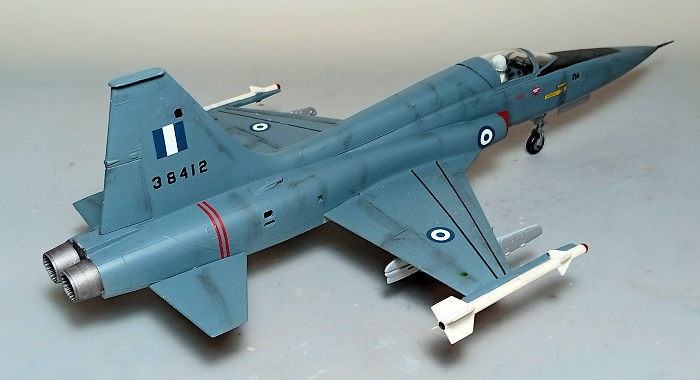
For the insignia I used the fantastic but OOP for good Kalfakis 48/1 decal
sheet, while for the stencilling I used the kit decals, which behaved very well,
despite being 30 years old. A coat of Future sealed the decals.
| CONSTRUCTION CONTINUES |
I attached the main
wheels (the nosewheel is one-piece with the leg), followed by the dragged doors.
Rims were painted silver on the outside and gunmetal on the inner side and tyres
were painted black. All wheels were lightly filed, to look weighted. The
stabilizers were next butt fitted in position - no need to glue them. The dual
exhaust was painted Mr Hobby Burnt Iron and attached in position. Since the
exhausts were shallow, I painted their inner flat bottoms flat black, to give a
perception of depth.
Since this was supposed to be in air-to-air configuration, I attached the
provided sidewinders at the wingtip rails. They were painted white with a blob
of Humbrol clear yellow on their noses, to simulate the infra-red heads. Their
rears were drilled and painted black inside, to simulate their tiny exhausts.
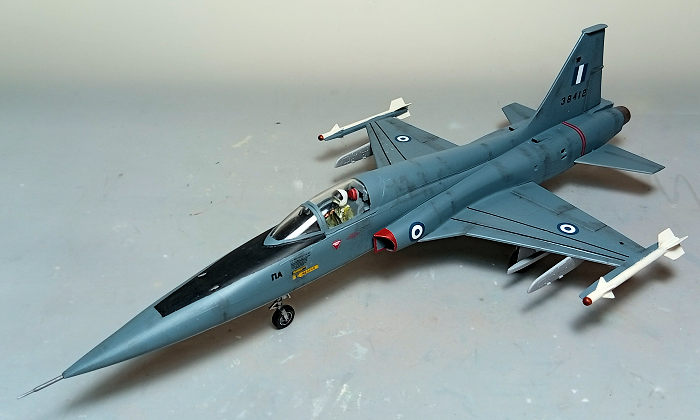 I was about
to start weathering the plane, when I felt something was missing. Indeed, I
forgot to attach the nose guns. Since the kit does not provide housings on the
nose, I drilled two holes at the corresponding places and used suitably cut
needle pieces to simulate the barrels.
I was about
to start weathering the plane, when I felt something was missing. Indeed, I
forgot to attach the nose guns. Since the kit does not provide housings on the
nose, I drilled two holes at the corresponding places and used suitably cut
needle pieces to simulate the barrels.
Time for some weathering. Now, one can never weather enough a Greek F-5, as
those planes were workhorses intensively used during operationally demanding
times. Assisted by net pics, I went modest, applying brown and black dry pastels
at all “expected” areas where dirt and grime might reside. The landing gear area
received a black wash as well. A final flat coat gave the bird its final hue.
The transparencies had their well defined frames hand painted and attached, with
fit being very good. The pitot tube was painted gunmetal and attached (too lazy
to go for the white and yellow striped one…). Blobs of red and green clear paint
were used to simulate the various lights, before calling the Aegean Beauty done!
| CONCLUSIONS |
This is clearly an old and simplistic mold for the
“A” series F-5: the detail level is barely acceptable, especially at the key
areas of cockpit and landing gear. If you want a modern and detailed F-5A, you
may look no further than the Kinetic offering.
That said, it’s hard not to be impressed by this old 1966 mold, especially once
you start building it. It raises a fair question: how does such an ancient tool
still enjoy such strong demand among modeling enthusiasts? The answer seems to
lie in something quite fundamental: the overall shape of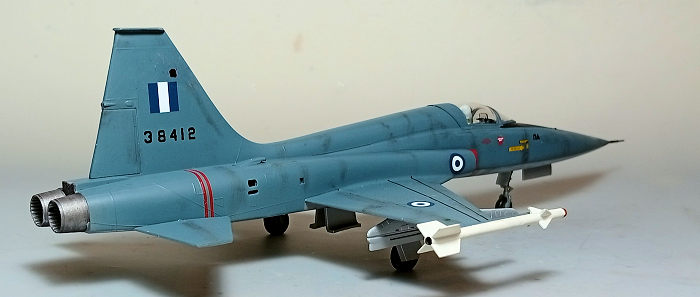 the F-5 is captured with remarkable accuracy, even by modern standards, and that
alone is deeply satisfying when you see it come together in plastic. Beyond
that, the kit is simply pleasant to build: fit is generally good, engineering is
straightforward and the whole process feels smooth rather than frustrating,
which is not always a given with older (and some newer…) molds.
the F-5 is captured with remarkable accuracy, even by modern standards, and that
alone is deeply satisfying when you see it come together in plastic. Beyond
that, the kit is simply pleasant to build: fit is generally good, engineering is
straightforward and the whole process feels smooth rather than frustrating,
which is not always a given with older (and some newer…) molds.
It becomes one of those builds you genuinely enjoy sitting down with. It stands
on its own, yet also invites you in if you want more - aftermarket,
scratchbuilding, endless ways to push detail further depending on time, skill,
and budget. It sits in a sweet spot: not hyper-detailed like the modern Kinetic
kit, but satisfying as a pure, hands-on build with real room for personal touch
and improvement.
It’s also not easy to find these days, but when it does appear, it can usually
be picked up at quite an affordable price. Taking all of that into account, if
you are looking for a straightforward, enjoyable build with a surprisingly
accurate overall shape, and you are not overly concerned about missing fine
detail or modern “bells and whistles,” then this kit is absolutely for you. Give
it a try, you may find it comes together in a very satisfying, almost old-school
way, packaged in a simple but genuinely rewarding experience.
Happy Modeling!
December 2006
Copyright ModelingMadness.com. All rights reserved. No reproduction in part or in whole without express permission from the editor.
If you would like your product reviewed fairly and fairly quickly, please contact the editor or see other details in the Note to Contributors.