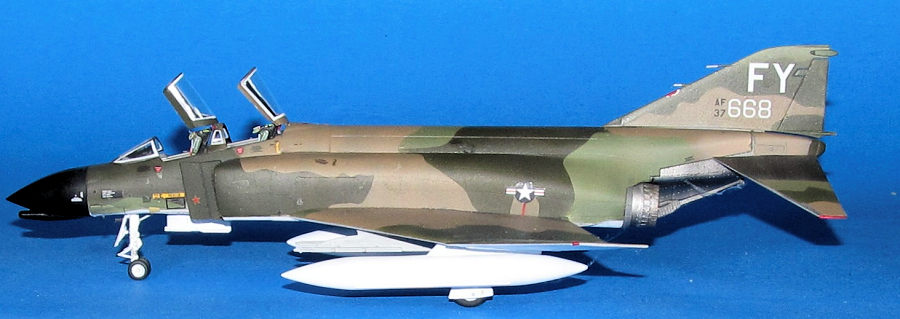
Fine Molds 1/72 F-4C 'Wolfpack 1967'
| KIT #: | 72846 |
| PRICE: | $27.00 (in Japan) |
| DECALS: | Four options |
| REVIEWER: | Dan Lee |
| NOTES: | Kelik 3D decals and Top Notch Vinyl Camouflage Masks |
| HISTORY |
Robin Olds was born of USAF royalty in 1922. His dad was a former aide to General Billy Mitchell and later became a Major General (who died in 1943) while Robin knew personally Carl Spaatz and other USAAC/USAAF notables. Robin became a football player of note in high school and was offered various football scholarships, but turned them down to go to a West Point prep school. In 1939, he tried to join up with the RCAF but was stopped by his dad. Instead he went to West Point as part of the Class of 1944 who graduated early in 1943 as the need for officers was dire. Robin joined as an “Air” Cadet.
Robin was assigned to the 434th Fighter Squadron of the 479th Fighter Group where he would become a double ace in both the P-38 (five kills) and P-51 (8 kills) during WW2 and rise to the rank of Major by the age of 22. His planes were nicknamed “Scat” after his West Point roommate who washed out of flight training due to color blindness and was killed in action in Germany as an infantry company commander in early 1945.
 When Robin
returned to the US, he was assigned to be an assistant coach of the West Point
Football team, but he didn't mesh with those who resented his youth and many
combat decorations. Instead Robin found he would begin taking on the role as a
bureaucratic iconoclast which he would resent. The Post War years would be mixed
for Robin Olds. He helped form the first USAF jet demonstration team and command
RAF No 1 Squadron (the first American to) as part of an exchange with the RAF.
He would also miss the Korean War despite repeated requests, find himself
shuffled into Pentagon and staff roles, nearly resign and wrote several papers
on the lack of tactical air training/conventional weapons that would come back
to haunt the US war effort in Vietnam.
When Robin
returned to the US, he was assigned to be an assistant coach of the West Point
Football team, but he didn't mesh with those who resented his youth and many
combat decorations. Instead Robin found he would begin taking on the role as a
bureaucratic iconoclast which he would resent. The Post War years would be mixed
for Robin Olds. He helped form the first USAF jet demonstration team and command
RAF No 1 Squadron (the first American to) as part of an exchange with the RAF.
He would also miss the Korean War despite repeated requests, find himself
shuffled into Pentagon and staff roles, nearly resign and wrote several papers
on the lack of tactical air training/conventional weapons that would come back
to haunt the US war effort in Vietnam.
Robin took command of the 81st TFW at Brentwaters RAF in 1963 and remained there till mid 1965 when he apparently angered the USAFE leadership by forming a demonstration flying team without prior authorization. It was at Brentwaters where he worked with Chappie James as part of his command team. Colonel Olds remained in the USAF doghouse till mid 1966 when he was assigned to become commander of the 8th TFW. When he first showed up, he found a unit lacking in the aggression department as well training in combat operations. One of the things he was all about was leading from the front so he demanded to be treated as a junior pilot till he could earn the role of being a flight leader in Phantoms and demanded more aggressive tactics (unlike their previous commander.) The command team he organized was one of the best in the Vietnam War as it included Chappie James and Vermont Garrison. It was because of them, the 8th TFW was soon renamed “The Wolfpack.”
 Robin Olds
with his staff organized Operation Bolo, a deception plan to knock out the
VNAF's force of Mig-21s which had been harassing F-105 fighter-bomber streams
with the aerial version of hit and run attacks in late 1966. On Jan 2, 1967 F-4C
Phantoms flew as if they were F-105s with the same ECM pods and call signs while
in actuality they were ready for a dogfight with Mig-21s. Bolo would destroy
almost half the VNAF's Mig-21 fleet and keep them out of the fight for a couple
of months as the Vietnamese tried to figure out what went wrong. Robin Olds
would get a Mig-21 kill during Bolo.
Robin Olds
with his staff organized Operation Bolo, a deception plan to knock out the
VNAF's force of Mig-21s which had been harassing F-105 fighter-bomber streams
with the aerial version of hit and run attacks in late 1966. On Jan 2, 1967 F-4C
Phantoms flew as if they were F-105s with the same ECM pods and call signs while
in actuality they were ready for a dogfight with Mig-21s. Bolo would destroy
almost half the VNAF's Mig-21 fleet and keep them out of the fight for a couple
of months as the Vietnamese tried to figure out what went wrong. Robin Olds
would get a Mig-21 kill during Bolo.
Later on, he would end up with three more Migs (two coming on the same day after he lost his wingman.) Robin stated he didn't want to get a fifth Mig because he didn't want to give up his fighter wing (and that his main job was providing close air support.)
Eventually, Robin was transferred back to the States and flew his final “official” combat mission in Sept of 1967. Upon meeting the USAF Chief of Staff, he was ordered to shave off his famous handlebar moustache which was his unofficial middle finger to the USAF establishment.
Robin Olds would end up upsetting senior USAF commanders in 1971 when he was blunt in his assessment of USAF air fighting capabilities (ie: not good.) During Operation Linebacker One and Two, the USAF would get a roughly 1:1 kill ratio while the USN and USMC who learned via TopGun got a much more favorable kill ratio against the Vietnamese. In part because of these issues, Robin Olds would retire in 1973 as a Brigadier General.
| THE KIT |
It needs no real introduction. Our editor previewed this kit and I agree with his glowing assessment.
| CONSTRUCTION |
It all began with the cockpit. I sprayed on dark gull grey into the interior parts of the cockpit and let it dry before I used the Kelik 3D decal set for the interior details as I had pretty good results with their F-4E set. Same as with the F-4E, I used one of CA glue or white glue to keep the 3D decals on depending if the decal really needed to stick like those on vertical surfaces like the IPs and the vertical consoles.
I then glued the cockpit parts together, leaving off all the small parts that I have a tendency break/lose.
 Next I
tackled the intakes and exhaust pipes. These parts were first painted (flat
white for the intakes, silver for the intake fans and burnt metal for the jet
exhausts, tubes and flame holders) then glued together. I then painted the
interior of the outer intake parts. Flat white for most of the interior except
for portion next to the leading edge of the intake entrance which had to be
painted the exterior camo color. Unlike the last Fine Molds F-4, I was careful
to trim and adjust the outside intakes so that they were more flat and meant
less sanding/filling to make everything line up. I still had some gaps, but it
didn't require as much sanding/filling. I glued on the rest of the fuselage
parts as well as the tail minus the stabilizers and exhausts.
Next I
tackled the intakes and exhaust pipes. These parts were first painted (flat
white for the intakes, silver for the intake fans and burnt metal for the jet
exhausts, tubes and flame holders) then glued together. I then painted the
interior of the outer intake parts. Flat white for most of the interior except
for portion next to the leading edge of the intake entrance which had to be
painted the exterior camo color. Unlike the last Fine Molds F-4, I was careful
to trim and adjust the outside intakes so that they were more flat and meant
less sanding/filling to make everything line up. I still had some gaps, but it
didn't require as much sanding/filling. I glued on the rest of the fuselage
parts as well as the tail minus the stabilizers and exhausts.
The wings were very easy to assemble. I only had to fill and sand a portion of the leading edge (can I say how much I really like how Fine Molds engineered the parts so that there are very few places you need to fill/sand?)
Lastly, I assembled the landing gear (sans wheels) and the various doors to prep them for painting. At this point, I took the model to the basement paint shop.
| COLORS & MARKINGS |
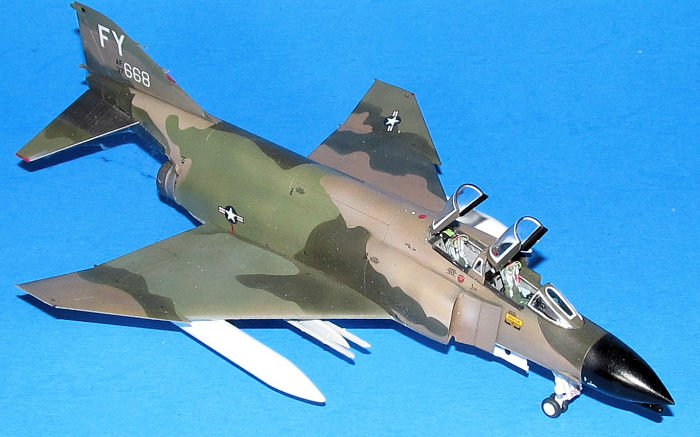
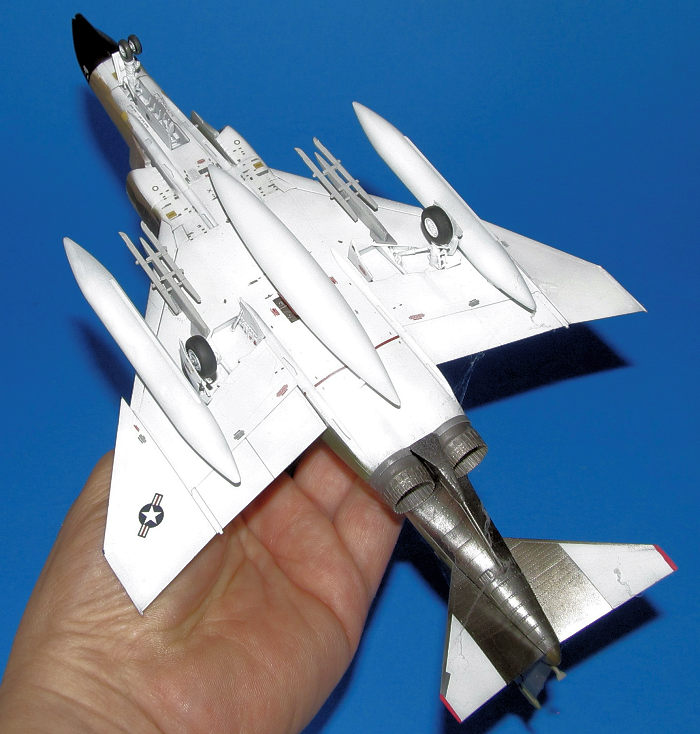
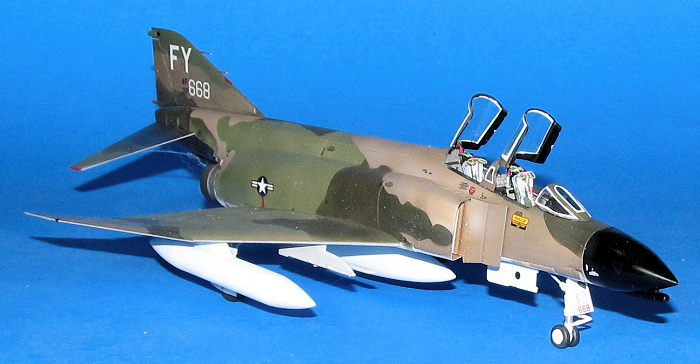
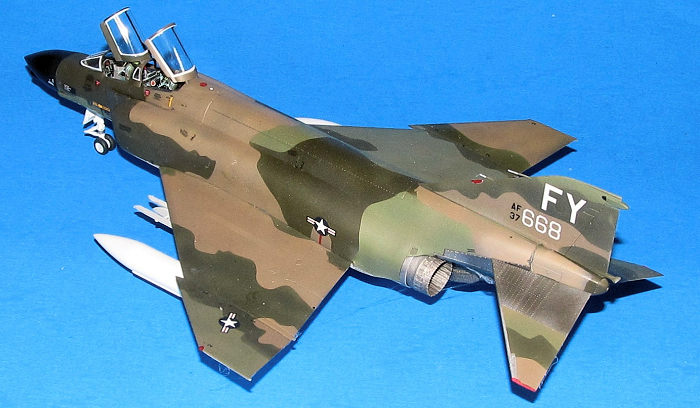
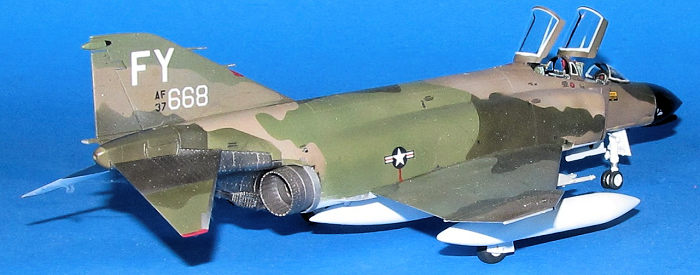
Flamingo 01 was painted insignia white on the bottom and SEA camouflage on the top. I first sprayed on Badger Stynylrez black primer on the fuselage subassembly and wings subassembly (lightly sanded with various grades of sandpaper to remove all the grit and oopsies) then I sprayed squiggles of white and grey to provide some faint contrast in the paint for the black basing. Next I used vinyl masks from Top Notch (which are also reuseable) for each paint of the SEA Scheme (all Vallejo air paints.) They worked out really well as I didn't have to do the usual retouches I did in the past. Next I masked off the nose and sprayed it Gunze H2 gloss black.
While that was drying, I painted the stabs and canopy as per the masking diagram. I tried to make my own masks for the canopy sealant, but to be honest that didn't turn out the way I wanted as I made the canopy sealant overscale and it doesn't look as good as I hoped it would. Live and learn as they say. I used Vallejo off white for the color.
 At this
point, all the small parts including landing gear, the wheel well doors, the
wheels etc were painted as per the Fine Mold painting guide.
At this
point, all the small parts including landing gear, the wheel well doors, the
wheels etc were painted as per the Fine Mold painting guide.
I didn't care if Flamingo 01 (F-4C with one Mig kill star) has been done to death because I wanted to build a Robin Olds Phantom for myself. The Fine Molds decals and stencils are really good. I like the fact that they grouped a lot of the numerous F-4 stencils into a bigger combo decal which works for those of us with diminishing eyesight and not as much patience as we may have had before. I used Microsol and Microset to get the decals to snuggle to the gloss coat without much issue.
I didn't want to make Flamingo 01 look too worn out. I figured I would keep it looking relatively clean as being the Wing King and unit hero's regular plane that the maintenance crews would be extra careful on the cleaning and maintenance. I used Flory Model's wash for most of the grime. What makes Flory Models wash unique is that it is a non toxic mix of clay and water for those of us worried about using enamel washes and/or oil paints. I used the grime and grey wash for the model, wiped it down with a slightly damp rag. I recommend it as it is less fragile than the watercolor was I've used for a while.
The model was then sealed in Vallejo Flat coat.
| FINAL CONSTRUCTION |
 I added the
completed ejection seats and the painted canopy parts to the main fuselage. Next
I glued the landing gear parts together and added them to the wheel wells.
Unlike the F-4E I built a while ago, I made sure that the main landing gear were
lined up and that the glue was cured before resting the model on its wheels to
avoid having bow legged landing gear.
I added the
completed ejection seats and the painted canopy parts to the main fuselage. Next
I glued the landing gear parts together and added them to the wheel wells.
Unlike the F-4E I built a while ago, I made sure that the main landing gear were
lined up and that the glue was cured before resting the model on its wheels to
avoid having bow legged landing gear.
The various painted and decaled pylons, fuel tanks and painted small parts were glued in place using CA glue and aligned just before the CA glue cured.
Voila, I finally completed Flamingo 01.
| CONCLUSIONS |
I had a lot of fun building this kit. It's ease of construction meant I spent more time painting. I learned from my own mistakes building the F-4E kit what not to do especially in regards to the intake trunking and the main landing gear. It's definitely worth the extra price for me because of the ease of build and the excellent engineering.
The only thing I'd change if I could would be to make the seals around the canopy clear section thinner and less pronounced, but it's hard to accomplish and basically you only get one shot.
I apologize for the photos as it has been a while since I actually built the F-4C so some spiderwebs are noticeable in the photos. (I have a soft makeup brush you can borrow. Ed)
19 June 2025 Copyright ModelingMadness.com. All rights reserved. No
reproduction in part or in whole without express permission from the editor. If you would like your product reviewed fairly and
fairly quickly, please
contact
the editor or see other details in the
Note to
Contributors.