| KIT #: | 01325 |
| PRICE: | 3.00 euros |
| DECALS: | One option |
| REVIEWER: | Spiros Pendedekas |
| NOTES: |
| HISTORY |
The Chengdu J-7 has its origins in one of the most interesting chapters of Chinese aviation history. In the early 1960s, China obtained the Soviet MiG-21F-13 and an agreement was reached for its production in China. However, the rapidly deteriorating Sino-Soviet relationship brought Soviet technical assistance to an end before the complete documentation had been transferred. Chinese engineers were consequently left to reconstruct and develop the aircraft with incomplete information. The first J-7s were therefore closely related to the MiG-21F-13, but the subsequent development of the family became increasingly indigenous.
The J-7II was a major improvement over the early J-7. Development began in the mid-1970s and the prototype made its first flight on December 30, 1978. Among its most important improvements were the more powerful WP-7B engine, a new Chinese ejection seat, a rear-hinged jettisonable canopy, increased fuel capacity through the use of a 720-liter centerline tank, and relocation of the braking parachute to the base of the fin. The aircraft also carried two 30 mm cannon, making it a considerably more mature fighter than the earliest Chinese-built versions.
The J-7II became one of the principal production versions of the Chinese fighter family, with production continuing into the 1980s. It also formed the basis for export aircraft carrying the F-7 designation. These aircraft found customers in a number of countries, helping turn what had originally been a Chinese attempt to reproduce the MiG-21 into a successful indigenous fighter family. The F-7 would subsequently evolve through numerous versions, some incorporating substantially improved avionics and other Western technology, but the J-7II/F-7II remains one of the fundamental members of the family.
| THE KIT |
 Trumpeter's
1/72 F-7II is one of those little kits that immediately reminds us that a model
does not have to be complicated to be enjoyable. The tooling dates from 1998,
when Trumpeter introduced its new-tool F-7 in 1/144 scale. A few years earlier
the company had also produced a new-tool 1/144 MiG-21, but the F-7 represented a
different tooling. The particular F-7 tooling subsequently appeared in two other
editions, with one of them representing an aerobatic-team aircraft. These kits
are regularly reboxed, with the later releases naturally benefiting from fresher
production. My example is the 2022 F-7II edition.
Trumpeter's
1/72 F-7II is one of those little kits that immediately reminds us that a model
does not have to be complicated to be enjoyable. The tooling dates from 1998,
when Trumpeter introduced its new-tool F-7 in 1/144 scale. A few years earlier
the company had also produced a new-tool 1/144 MiG-21, but the F-7 represented a
different tooling. The particular F-7 tooling subsequently appeared in two other
editions, with one of them representing an aerobatic-team aircraft. These kits
are regularly reboxed, with the later releases naturally benefiting from fresher
production. My example is the 2022 F-7II edition.
The kit was very kindly donated by one of our now regular contributors and much-loved hobby shops in Greece, which offered five copies to our local club so that they could be given to youngsters entering the hobby through the seminars we organize.
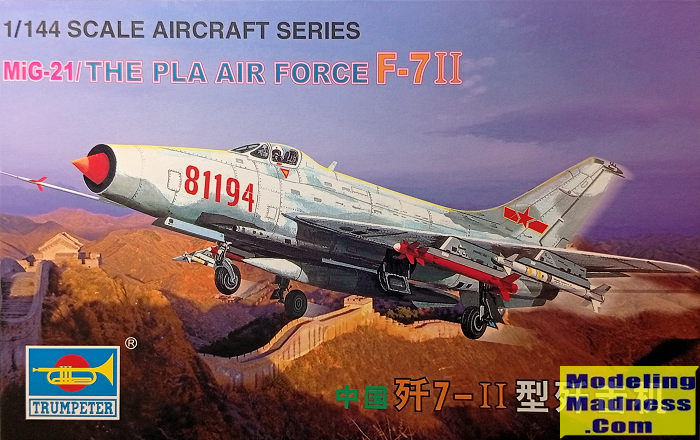
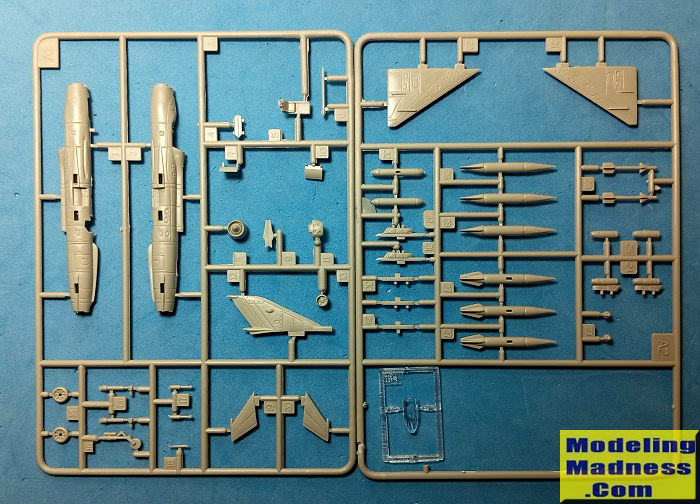
Inside the small, good-quality top-opening box, featuring a Chinese F-7 gracefully taking off, we find approximately 45 light-grey styrene parts.neatly arranged in two box-sized sprues. Molding is nice and crisp, with no flash evident on my example. The engraved panel lines are on the heavy side, something that is not uncommon with smaller-scale kits, remaining understandable considering both the scale and, especially, the price of the kit. The overall shapes look accurate and convincing for the scale.
The cockpit is extremely basic, consisting essentially of a seat and a molded-on floor. There is obviously not a great deal to see through the small canopy, but a suitable pilot figure would certainly add some life to the area. The nose profile is quite acceptable, while the exhaust nozzle is somewhat simplistic. The landing gear is also quite acceptable for the scale.
Trumpeter provides a useful selection of underwing stores, including three external fuel tanks, two air-to-air missiles and two rocket pods, giving the modeller quite a few possibilities for the final configuration.
The one-piece canopy is nicely molded and clear. Instructions are provided on a single A4 sheet, incorporating a sprue map and a very simple two-step construction sequence. Despite being extremely brief, the instructions are quite clear and there is little doubt about what goes where. No color callouts are provided, either during construction or for the overall aircraft, so some independent research will certainly be useful before reaching for the paint.
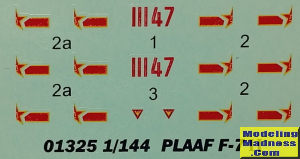 Only one
decal option is included, representing a Chinese F-7II. The decals themselves
are nicely printed and should be quite adequate for the purpose.
Only one
decal option is included, representing a Chinese F-7II. The decals themselves
are nicely printed and should be quite adequate for the purpose.
Construction is about as straightforward as one could wish for. The instructions first have you trap the seat and the exhaust nozzle between the two fuselage halves. The nose section is then added, followed by the wings, horizontal stabilizers and fin, quickly producing the basic aircraft.
One thing worth mentioning is that no nose weight is specified in the instructions. I would definitely recommend adding some ballast to the front of the fuselage, however, to make sure the completed model does not become a tail-sitter. It is a small precaution and well worth taking before closing everything up.
The landing gear comes next. If the aircraft is to be displayed with its undercarriage extended, the relevant gear doors have to be separated, after which the various underwing stores can be attached. Finally, the one-piece canopy is fitted and the model is essentially finished.
That is really it. This is a very simple construction sequence and one that should cause absolutely no problems, even for the inexperienced modeller. It is exactly the sort of kit that can be taken from the box to a completed model without turning the process into an exercise in problem-solving.
| CONCLUSIONS |
Trumpeter's little F-7II is definitely an easygoing and unpretentious kit. It offers a decent level of detail for such a small scale, clean molding, engraved panel lines and a useful selection of underwing stores. Nothing here is particularly sophisticated, but then again, this kit never pretends to be anything other than a simple and inexpensive representation of an interesting aircraft.
The panel lines are somewhat heavy, as is sometimes the case with smaller-scale kits, but the overall molding is crisp and clean. The decals are nicely printed, the canopy is good, and the construction is so straightforward that even a complete beginner should be able to enjoy putting the model together. For the experienced modeller, meanwhile, it offers the possibility of a very quick and relaxing little project. Give it 15 or 30 minutes and you can have the basic model together; spend a little more time on it, and there is no reason why it cannot become a very presentable miniature.
Then there is the €3 price. At that level, there is really very little one can reasonably ask for. This is not a kit designed to compete with the latest state-of-the-art offerings, nor does it need to. Its charm lies precisely in its simplicity.
For me, though, this particular F-7II has acquired an extra significance. Several examples were kindly donated to our local club so that we can give them to youngsters discovering scale modelling through our seminars. In that role, the kit is almost perfect. It is inexpensive, uncomplicated, quick to build and, most importantly, rewarding. A youngster can open the box, put the little aircraft together and very soon have something that actually looks like a fighter sitting in front of them. That first completed model can be a surprisingly important moment.
So, yes, this is a simple kit. It is also a cheap kit. But it is a good little kit for what it sets out to be, and certainly one worth tackling. More than that, this particular F-7II reminds us of something I think is rather important in our hobby: sometimes the value of a model has very little to do with its price or its level of detail. Sometimes it is simply about the pleasure of building it—and, even better, about putting a kit into the hands of a youngster and perhaps helping to create the next modeller. For that reason alone, this little Trumpeter F-7II has a special place with me.
Happy Modeling!
Spiros Pendedekas
October 2026 Copyright ModelingMadness.com. All rights reserved. No
reproduction in part or in whole without express permission. If you would like your product reviewed fairly and fairly quickly, please
contact
the editor or see other details in the
Note to
Contributors.