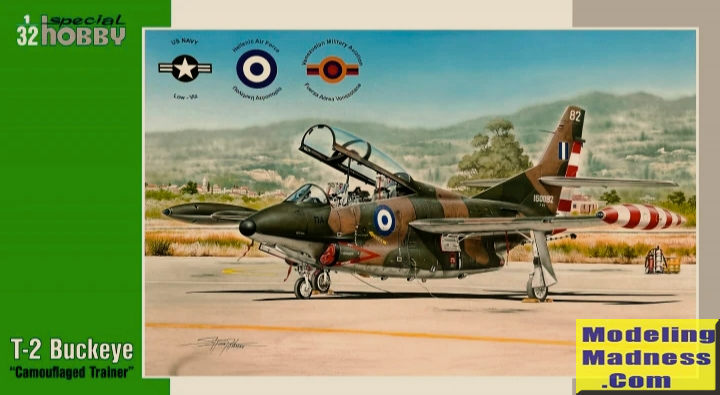
Special Hobby 1/32 T-2E Buckeye
| KIT #: | SH32059 |
| PRICE: | 35 Euros on sale |
| DECALS: | Five options |
| REVIEWER: | Spiros Pendedekas |
| NOTES: |
'Camouflaged Trainer' boxing |
| HISTORY |
The North American T-2 Buckeye was designed in the mid-1950s as a dedicated jet trainer for the U.S. Navy, intended to bridge the gap between basic flying training and the more demanding world of carrier-based jet operations. North American Aviation won the competition with a design that drew on experience from earlier aircraft, and the prototype YT2J-1 made its first flight on January 31, 1958. The aircraft entered U.S. Navy service in 1959 and went on to become one of the Navy's most successful jet trainers.
The Buckeye evolved through several versions, with the T-2C, powered by two General Electric J85 turbojets, becoming the definitive U.S. Navy version. Export versions followed, including the T-2D for Venezuela and the T-2E for Greece.
Greece received 40 T-2Es beginning in 1976, and the aircraft became an important part of the Hellenic Air Force's advanced jet-training system, serving for decades with the training squadrons at Kalamata AFB. For many Greek pilots, the T-2E was an important step on the road to becoming a fighter pilot. Rugged, straightforward and well suited to its role, the Buckeye became a familiar sight in Greek skies and holds a special place in Greek aviation history.
| THE KIT |
 Special Hobby released
their new-tool 1/32 T-2 Buckeye in 2014, offered in two versions: the American
"Red-and-white Trainer" and the “Camouflaged Trainer”, featuring Greek,
Venezuelan, and US aggressor schemes. We may assume that these 1/32 kits evolved
from Special Hobby's earlier 1/48 T-2 family, released in 2009, but with
considerably less reliance on resin, total omission of the photo-etched parts,
and with injected, rather than vacuformed canopies.
Special Hobby released
their new-tool 1/32 T-2 Buckeye in 2014, offered in two versions: the American
"Red-and-white Trainer" and the “Camouflaged Trainer”, featuring Greek,
Venezuelan, and US aggressor schemes. We may assume that these 1/32 kits evolved
from Special Hobby's earlier 1/48 T-2 family, released in 2009, but with
considerably less reliance on resin, total omission of the photo-etched parts,
and with injected, rather than vacuformed canopies.
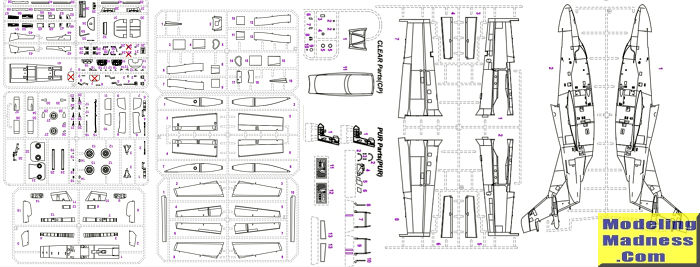
There is no photo-etched fret in the box, as Special Hobby has chosen to mold virtually all of the smaller detail parts in styrene and, for the same reason, polyurethane resin content has also been greatly reduced, consisting mainly of the ejection seats and just a couple of other small parts. In other words, the majority of the detailing is now provided in conventional styrene. For many modelers, this makes the kit a much more straightforward and enjoyable proposition.
The particular boxing previewed here is the "Camouflaged Trainer" edition, containing American aggressor, Greek and Venezuelan schemes. I bought it from one of my now-beloved Greek internet hobby shops at a very special offer that I simply could not refuse!
The kit comes in a superb-quality, large top-opening box, something Special Hobby has been treating us to lately. The beautiful box art, by artist Standa Hájek, depicts a Greek T-2E trainer gracefully sitting on the flight line, immediately setting the mood for what is inside.
Upon opening the box, I was greeted by 156 light- to medium-gray styrene parts, very nicely arranged on no less than eight sprues. The molding is nice and crisp, and I didn't notice any flash anywhere. Panel lines are finely recessed and appear to be placed correctly, while all the parts seem easy enough to locate.
There are also around 15 polyurethane parts, most of them dealing with the two ejection seats, which are very nicely cast, along with a couple of cockpit components and a few small details for the landing gear. In my opinion, the limited use of polyurethane really adds to the quality and detailing of the kit without making the build unnecessarily complicated. This is a welcome change from some earlier Special Hobby kits, including their 1/48 T-2, where the extensive use of resin, albeit nicely cast, could sometimes make construction a little more demanding.
The cockpit is wonderfully appointed and contains practically everything a modeler could wish for. All the small parts, instruments and switches are nicely represented, with raised detail throughout. A set of instrument decals is also provided, allowing those who prefer this approach to add an extra touch of realism. Overall, the cockpit is beautifully done and should be more than satisfying for most modelers.
The landing gear is equally nicely done, with all the various components provided to reproduce the complex and busy appearance of the real aircraft. Another particularly nice feature is the treatment of the engine intakes and exhausts. These include the compressor and turbine faces, together with internal ducts. The ducts are two-piece affairs, so there will inevitably be a little seam cleanup to take care of, but the overall result is really very convincing.
All the main aerodynamic surfaces are provided separately, including the flaps, ailerons, elevators and rudder, which adds considerably to the appearance of the finished model. The flaps can be posed either deployed or in the neutral position and feature some very nice internal detailing. The other control surfaces are intended to remain in their neutral positions, which is the normal stance of the T-2 when parked.
The distinctive wing-mounted tanks are also very well represented, with excellent shape and detailing. The transparencies are well molded and look crystal clear straight from the box.
The instructions come in the form of a beautifully produced, high-quality, 20-page, color-printed booklet. It includes a nice aircraft profile, a short history of the T-2, a useful sprue map and a color chart, with the construction broken down into 39 clear, straightforward and logically arranged steps. Color call-outs are provided throughout where needed.
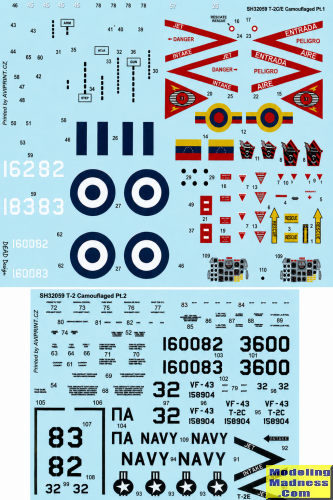 Five very nice marking
options are included: two Greek, one Venezuelan and two U.S. aggressor
aircraft. Color shades are provided in Gunze codes, FS numbers and in generic
form. The decals are beautifully printed, with sharp colors, excellent
registration and good color density. They look very promising and should perform
well. A comprehensive selection of maintenance stencils is also provided, adding
that extra touch of realism to the finished model.
Five very nice marking
options are included: two Greek, one Venezuelan and two U.S. aggressor
aircraft. Color shades are provided in Gunze codes, FS numbers and in generic
form. The decals are beautifully printed, with sharp colors, excellent
registration and good color density. They look very promising and should perform
well. A comprehensive selection of maintenance stencils is also provided, adding
that extra touch of realism to the finished model.
The instructions have you tackle the cockpit first, and quite a few steps are devoted to this area. My advice is to spend as much time as you can here, because the cockpit will be a prominent feature of the finished T-2 and all that lovely detail will really show once the model is completed.
The intakes, exhausts and nose gear bay are then assembled, bbefore all these subassemblies— including the cockpit—eventually being trapped between the two fuselage halves. The instructions do not mention adding any weight to the nose to prevent the model from becoming a tail-sitter, and I am not entirely sure whether it is actually necessary. Personally, I would probably add some, just to be on the safe side—better safe than sorry!
The wings and tailplanes are then assembled, together with all their control surfaces, which, as mentioned above, are separately molded. The distinctive lower belly flat section is then attached to the fuselage, followed by the air intakes front parts and a few additional details, including the arresting hook and other small components.
Landing gear comes next, and my advice here is also to take your time. The level of detail provided is high, and the more care you put into this area, the more that detail will show on the finished model. Next come the assembly and attachment of the distinctive wing tanks, followed by the transparencies, bringing the construction to an end.
| CONCLUSIONS |
This is clearly another superb kit from Special Hobby. If you want a T-2 Buckeye in 1/32, this is the only game in town, but even without that consideration, this is simply an excellent kit. The shapes and proportions of the parts appear accurate, molding is excellent, panel lines are finely recessed, overall detailing is superb, transparencies are beautifully clear, instructions are excellent, and the decals look fantastic.
I also really have to comment on Special Hobby's decision to rely mostly on styrene in this larger-scale edition, leaving resin for just a few parts where it really makes sense. The beautifully cast ejection seats, in particular, are very welcome, and I think most of us will be more than happy with this approach.
This is a "high-end limited-run" kit in nature, meaning paying attention to the latter in order to achieve the former. It is clearly not one I would recommend to a beginner, as there are quite a few parts to assemble, including a fair number of small components, and plenty of detail that needs to be handled with care. It does not appear to be an especially difficult build, but it certainly demands some experience, patience and careful handling. Of course, how everything actually comes together will be shown when the kit reaches the workbench, but from what I can see in the box, there is every reason to be optimistic.
I have always liked Special Hobby kits, particularly because they are willing to tackle subjects that are perhaps a little less mainstream—subjects that other manufacturers often overlook. This T-2E is another fine example of that philosophy. Coupled with the excellent molding, nice details, attractive selection of markings and good price, this is definitely a kit worth tackling if you want a big, impressive Buckeye sitting proudly on your shelves.
Happy Modeling!
Spiros Pendedekas
Copyright ModelingMadness.com. All rights reserved. No reproduction in part or in whole without express permission.
If you would like your product reviewed fairly and fairly quickly, please contact the editor or see other details in the Note to Contributors.