Revell 1/48 CH-53G
|
KIT #: |
4498 |
|
PRICE: |
20.00 Euros when new |
|
DECALS: |
Two options |
|
REVIEWER: |
Spiros Pendedekas |
|
NOTES: |
UN boxing |
The Sikorsky CH-53 Sea Stallion was developed in the early 1960s to
meet the United States Marine Corps' requirement for a heavy-lift transport
helicopter capable of moving troops, equipment and supplies in support of
amphibious operations. Designed by Sikorsky Aircraft as the S-65, the
helicopter made its first flight on 14 October 1964. Its powerful
twin-engine arrangement, six-bladed main rotor and spacious cargo cabin gave
it an impressive lifting capability, allowing it to transport substantial
loads internally or carry them as underslung cargo.
West Germany became one of the first international customers for the
Sea Stallion, selecting the helicopter to replace its ageing Sikorsky H-34
fleet. The resulting CH-53G was adapted to German requirements, with the
first aircraft flying in 1969 and deliveries to the German Army beginning in
1972. Of the 112 helicopters acquired, the first two were manufactured in
the United States, while the remaining 110 were produced under licence in
West Germany. The CH-53G subsequently became one of the principal workhorses
of German Army aviation, undertaking tactical transport, resupply, casualty
evacuation and heavy-equipment transport missions.
Throughout its long career, the CH-53G demonstrated considerable
versatility, serving in Germany and supporting international operations,
including deployments in the Balkans. Its ability to transport personnel and
supplies into difficult terrain also made it valuable in humanitarian
assistance and disaster-relief operations. Among the more distinctive
appearances of the German Sea Stallion was its white United Nations scheme,
with prominent blue UN markings, for international peacekeeping duties. This
gave the otherwise military-looking helicopter a very different appearance
and provided modellers with an attractive alternative to the familiar German
Army finishes.
 Revell
introduced its new-tool 1/48 CH-53G in 1981, and what an impressive release
it must have been for its time! Who would have imagined that such a large
and imposing helicopter could be reproduced in styrene with so much of its
characteristic shape and surface detail? Even today, this remains a
spectacular kit, and its size alone makes it an impressive addition to any
helicopter collection. Over the years, Revell has reboxed it many times,
covering various German and American versions and offering modellers several
different possibilities from the same basic tooling.
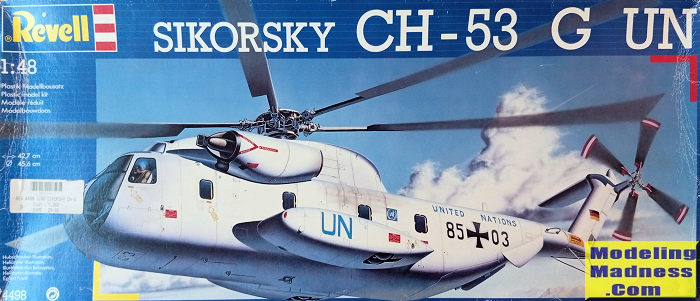
The example reviewed here is the 1993 boxing, featuring the United
Nations version. I bought mine around 2003–2004 from one of my beloved hobby
and toy shops in my hometown of Chalkida, sadly now closed. The price was
more than sensible. In fact, the shop had two examples in stock, and I did
not hesitate to buy both, obtaining an even better price. Hunting for
classic, vintage and discontinued kits has always been one of my favourite
aspects of this hobby, and finding such a substantial kit at that price was
an opportunity I simply could not pass up.
The kit comes in Revell's familiar long, top-opening box, which is a
little on the flimsy side. The box art, by Egbert Friedl, is particularly
attractive, depicting a United Nations-marked CH-53G in a scene that nicely
captures the presence and scale of this impressive helicopter. It is the
sort of artwork that immediately makes you want to open the box and see what
awaits inside.
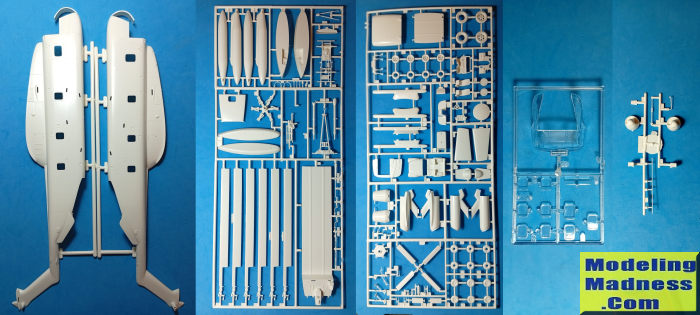
Once opened, the box reveals approximately 120 white styrene parts.
The two fuselage halves are molded separately, while the remaining
components are nicely distributed across two large sprues. A smaller sprue
also caters for the non-meshed intakes and a few other bits. The molding
naturally reflects the technology and practices of the early 1980s, but it
is surprisingly crisp, with very little flash apparent on the examples
examined. The external details are raised, as one would expect from a kit of
this vintage, while the extensive rivet detail is particularly noteworthy.
These rivets are prominent but convincing, adding character to the surface
and giving the model a realistic representation of the real helicopter's
skin. For anyone who appreciates classic molding techniques, this is one of
the kit's most appealing features.
The cockpit is not extensively detailed, but it provides all the
basic components needed for a convincing representation. The instrument
panel features raised instruments that can be brought to life with careful
painting and a little dry-brushing, while the seats are perfectly acceptable
for the scale and age of the kit. The cargo compartment is more basic,
consisting principally of a well-represented floor without detailed
sidewalls. This is adequate if the rear ramp is closed, but anyone wishing
to display it open will find an opportunity for additional detailing. A few
carefully selected additions to the interior sidewalls would make the
otherwise rather empty cargo area considerably more convincing.
The main rotor hub and blades are well represented, as is the tail
rotor. One small point worth mentioning is that the main rotor blades do not
reproduce the characteristic downward droop often seen when a real
helicopter is parked. Modellers wishing to capture that familiar appearance
will therefore have to consider how best to reproduce it themselves. The
engine assemblies are also reasonably well done for the period. The kit
provides alternative intake arrangements, with mesh and non-mesh options.
The mesh is represented by solid plastic with molded corrugations rather
than open mesh, but careful painting and dry-brushing should produce a
believable result.
The landing gear and its associated components are similarly
straightforward without being overly elaborate. They should look quite
convincing once assembled and painted, although anyone seeking a more
detailed replica may wish to improve some of the smaller components.
Transparencies are crystal clear and appear well molded, although
their precise fit will need to be established during assembly.
One particularly welcome feature is the range of additional
components supplied. Although this boxing focuses on the German CH-53G in
United Nations service, the kit also includes external fuel tanks and a
refuelling probe, allowing alternative configurations to be considered. A
Jeep and a 105 mm Jowitzer are included as well, providing the possibility
of an interesting diorama. These additional items are especially useful
because they offer more than one way to present the finished model and make
good use of the helicopter's substantial cargo capacity.
The instructions are typical of Revell's early-1990s production,
concentrating on the assembly sequence and providing a colour chart with
painting references where applicable. Construction is divided into 16 clear
and concise steps, making the process easy to follow. The instructions are
not burdened with unnecessary complications, and an average modeller should
have little difficulty understanding the sequence.
 Two
white United Nations schemes are provided. The decals are nicely printed and
look very attractive on the sheet, with the prominent UN markings being
particularly important to the finished appearance. However, this is a 1993
boxing, and the decals are now several decades old. Their appearance is
encouraging, but their backing paper is severely yelowed: I would recommend
testing a spare decal before committing to the main markings. Depending on
their condition, an appropriate decal-setting solution or replacement
markings may be worth considering.
Construction begins with the main rotor assembly, although there is
no reason why this cannot be left until a later stage of the build. I would
normally start with the cockpit and the cargo-compartment floor, painting
and detailing the interior before trapping these components between the
fuselage halves. Before closing the fuselage, the side windows must also be
installed from the inside, so some careful planning and dry-fitting will be
worthwhile. No nose weight is mentioned, and I am not sure if any is needed.
Once the fuselage is assembled, attention turns to the rear loading
ramp, which can be positioned open or closed. The closed option is naturally
the simpler one, while an open ramp offers a good view into the cargo
compartment. In the latter case, I would recommend adding some extra detail
to the sidewalls to make the interior look less bare. Alternatively, the
modeller could take advantage of the included vehicle and Howitzer to create
a more interesting cargo display, although the basic interior will still
benefit from a little additional work.
The engine assemblies are then constructed and attached, with the
modeller choosing the appropriate intake arrangement for the intended
version. The tail surfaces, tail skid and various smaller components,
including antennas, follow. The tail rotor, landing-gear bays, sponsons and
landing gear are subsequently assembled and fitted, before the remaining
clear parts are installed. As always with a large helicopter, careful
dry-fitting is advisable, particularly around the fuselage joints and the
transparencies, where a little preparation can save considerable work later.
The main rotor assembly can be completed whenever convenient and
fitted towards the end of construction. The external fuel tanks, refuelling
probe and other optional details should be selected according to the
particular configuration being modelled.
This is certainly not a shake-and-bake kit, but neither does it
appear unnecessarily complicated. For a helicopter of this size and
complexity, the parts count is quite reasonable, and the assembly sequence
is logical. It is not a kit I would recommend to a complete beginner, but an
average modeller with some experience of larger aircraft should be able to
tackle it successfully.
It is wonderful that Revell decided to bring the CH-53G to the
modelling world in 1981. Even after all these years, this remains an
impressive kit and, to my knowledge, still the only option for anyone
wanting to build a twin-engine CH-53 in 1/48 scale (the newer Academy mold
is a different version).
The molding is good, the overall shape and surface detail make an
excellent impression, and the extensive rivet detail adds considerably to
the finished model's appearance. The cockpit, engines, rotor hubs and
landing gear are all adequately represented for a kit of this age, while the
clear parts and straightforward instructions are further advantages. The
cargo compartment is rather basic, and the raised external details may not
appeal to everyone, but neither issue detracts significantly from the kit's
overall appeal.
The additional equipment is a welcome bonus, offering scope for
alternative configurations and interesting diorama possibilities. The decals
are beautifully printed, although their age means that their condition
should be checked before use.
I paid less than 29 euros for mine back in 2003–2004, which made it
a good bargain. Even today, the kit remains an attractive proposition, and
the various reboxings provide opportunities to find a version that suits
your interests. With its impressive size, distinctive shape and considerable
potential for further detailing, the Revell CH-53G is a classic that has
aged remarkably well.
Highly recommended for the average and above modeller. If you enjoy
large helicopters and appreciate the character of classic kits, this one
deserves serious consideration.
Happy Modeling!
Spiros Pendedekas
November 2026
Copyright ModelingMadness.com. All rights reserved. No
reproduction in part or in whole without express permission.
If you would like your product reviewed fairly and fairly quickly, please
contact the editor
or see other details in the
Note to
Contributors.
Back to the Main Page
Back to the Review
Index Page
Back to the Previews Index Page
 Revell
introduced its new-tool 1/48 CH-53G in 1981, and what an impressive release
it must have been for its time! Who would have imagined that such a large
and imposing helicopter could be reproduced in styrene with so much of its
characteristic shape and surface detail? Even today, this remains a
spectacular kit, and its size alone makes it an impressive addition to any
helicopter collection. Over the years, Revell has reboxed it many times,
covering various German and American versions and offering modellers several
different possibilities from the same basic tooling.