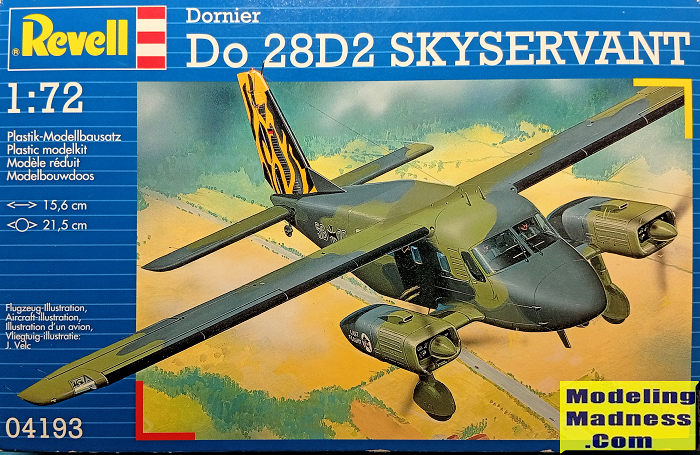
Revell 1/72 Do-28 Skyservant
| KIT #: | 04193 |
| PRICE: | €10.00 when new |
| DECALS: | One option |
| REVIEWER: | Spiros Pendedekas |
| NOTES: | 1974 Matchbox tooling |
| HISTORY |
The Dornier Do 28 was developed in the late 1950s as a rugged, twin-engined utility aircraft intended to provide reliable short-field performance and economical operation. Designed by Dornier Flugzeugbau, it was essentially a larger, more capable development of the company's successful Do 27. The prototype Do 28A first flew in 1959, powered by two Lycoming engines, and the aircraft quickly established itself as a practical machine for military, government, and civilian operators.
The Do 28 was particularly well suited to operations from short and unimproved airstrips. Its distinctive high-wing configuration, fixed landing gear and twin engines mounted on the wing gave it excellent low-speed handling and considerable versatility. Various versions followed, including the Do 28A and B, with progressively more powerful engines and other improvements. The type saw extensive service with the West German Bundeswehr, which used it for transport, liaison, observation and general utility duties, while numerous examples were exported to air forces and civilian operators around the world.
One of the most recognizable versions was the Do 28D Skyservant, introduced during the 1960s and considerably redesigned to provide greater payload and improved performance. The Skyservant became a particularly successful utility aircraft, serving with military and civilian operators for decades. Its ability to carry personnel and equipment into relatively primitive airfields, combined with its STOL capabilities and rugged construction, made the Do 28 a true workhorse and one of Dornier's best-known post-war utility designs.
| THE KIT |
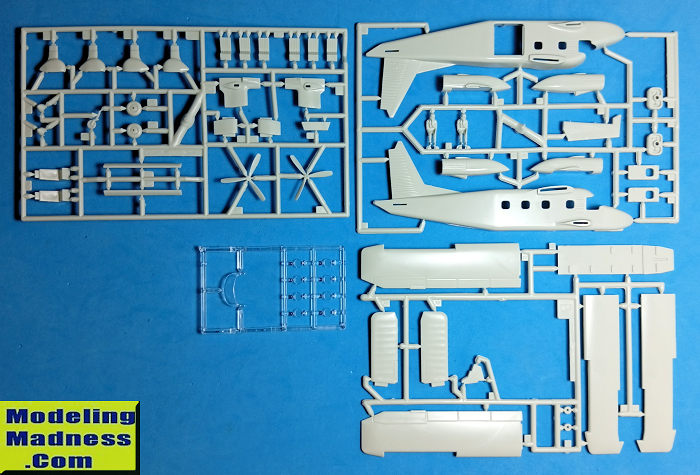 This
is a reboxing of the 1974 Matchbox 1/72 Dornier 28 Skyservant kit. Matchbox
originally released the kit in 1974 and continued to box it regularly until the
company was taken over by Revell, which subsequently continued to reissue the
kit with different decal schemes. The specific kit reviewed here is the (final
so far) 2008 boxing, and it comes in the familiar small, side-opening Revell
blue box. The box carries very attractive artwork by artist Jaroslav Velc,
depicting the Skyservant gracefully flying.
Upon opening the box, I was greeted by 49 light-gray styrene parts, neatly arranged on three sprues. The molding is very much reminiscent of a Matchbox kit, including the somewhat shiny plastic. However, the characteristic deep trench-like panel lines found on many Matchbox kits are fortunately not present here, apart from the rather prominent representation of the hinges and boundaries of the moving surfaces. This is certainly not a bad thing, and overall the kit makes a rather nice presentation. Parts are clean with minimum flash, while general shapes and proportions look correct to my eye, and the distinctive appearance of the Skyservant is captured quite convincingly.
The interior is not particularly elaborate; including an instrument panel, pilot seats and passenger seats. No control yokes are included, but a nice decal is provided for the instrument panel. Two pilots are also included and can be fitted into the cockpit. These figures should help considerably in adding some life to the otherwise rather basic interior.
The entry doors are provided as separate parts, so theoretically they can both be displayed open. This is an interesting option, although if both doors are left open, the rather sparse cabin interior will become visible. The adventurous modeler may therefore wish to add some additional cabin detail.
The engines, another very characteristic feature of the Skyservant, are represented adequately. Only the front faces are provided, but I think they are quite adequate for the scale and for a kit of this origin. The propellers are nicely done, while the fabric representation on the elevators is also quite well represented. Separate slats are provided as well.
Transparencies ate thick, but well molded and clear. The side windows are designed to be attached externally, which I like a lot. The transparencies can, of course, be left until later in the construction depending on the modeler's preferred method.
The instructions are very nicely produced in the typical Revell style of the 2000s. They come in the form of an eight-page A4 booklet containing a photograph of the completed model, a short history of the type, a sprue map, a color chart, with the construction sequence spread over 15 clear and concise steps. Color callouts are provided throughout.
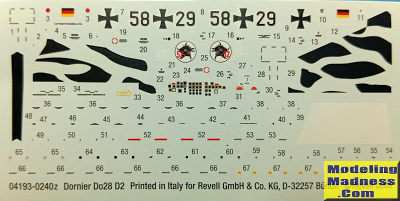 Only one
color scheme is provided, representing a highly decorated Bundeswehr Luftwaffe
aircraft, AG 52 58+29, July 1993, Leck. The colors are given in Revell codes,
generic names and, in some cases, FS or RAL numbers.
The decals are beautifully printed, seemingly by Cartograf, and they look to be in excellent condition despite being almost 20 years old. They appear crisp and well registered, and the colorful markings should add considerably to the finished model.
Construction begins with the interior, which is then sandwiched between the fuselage halves. The windscreen and side windows are then installed, but they might be left off for later stages, if so desired. The side doors are finally attached.
The next stages deal with the two engine faces and propellers, followed by assembly of the distinctive engine nacelles and the small portions of the wings. These subassemblies are then attached to the fuselage. This is probably the one area where some care is required, because there might be no particularly practical way to paint the area in between after attaching the wings, so some planning of the painting sequence will be necessary.
The engine faces are subsequently attached in position, followed by the outer wing sections, tailplanes and rudder. The landing gear is then assembled and fitted, followed by a few small parts.
Overall, the construction looks pleasantly straightforward. There are no complicated assemblies or engineering surprises, and with a little planning of the painting sequence, this should be an enjoyable and relaxing build.
| CONCLUSIONS |
This is a lovely little kit. It is, of course, a vintage kit and makes no attempt to compete with the highly detailed and sophisticated 1/72 offerings we are accustomed to seeing today. And honestly, it does not need to. There is something rather sweet and charming about this old Matchbox tooling, and the Revell reboxing gives us a very nice opportunity to build a Dornier Do 28 Skyservant without having to spend a fortune.
The shapes and proportions look accurate to my eye, the cockpit and cabin interior are not too elaborate, but, nevertheless, passable, and although the overall level of detail is average, it is perfectly acceptable for a kit of this age and character. The engines, propellers, flying surfaces and other details are all adequately represented, while very little of the interior will actually be visible once the fuselage is closed.
The construction itself is quite straightforward and should present no particular difficulties. Indeed, this is a kit that could easily be tackled by a novice modeler and, with a little care, could result in a beautiful model. It would make a particularly nice introduction to modeling for a youngster, too: the subject is unusual and attractive, the parts count is manageable, and the construction does not appear intimidating. A young modeler could easily tackle this kit and come up with a very pleasing result.
The only point that deserves some planning ahead is the area between the engines and the fuselage. Access for painting can become rather difficult once the wing and engine assemblies are in place, so a little forethought here will save some frustration later. Apart from that, there is nothing here that should discourage even the less experienced modeler.
There are very few alternatives for a 1/72 Dornier Do 28 Skyservant. Apart from some resin offerings, such as those from Lift Here/AirCast Resin, which are also relatively simple in their execution, this Matchbox/Revell kit remains a particularly attractive way of putting this interesting aircraft into the collection. And at the sort of price for which it was originally available, around 10 Euros in 2008, it was certainly excellent value.
So, yes, this is a sweet little kit, and one that I enjoyed looking at very much. It has the charm of a vintage model without suffering from the exaggerated trench-like panel lines that characterized some of the old Matchbox offerings. It captures the distinctive appearance of the Skyservant nicely, it is uncomplicated to build, and it can be turned into a very attractive little model with relatively little effort.
So, Revell, perhaps it is about time to bring this beauty back. Almost two decades have now passed since this particular 2008 reboxing, and the Do 28 Skyservant deserves another appearance on the shelves. For anyone interested in unusual aircraft, vintage kits, or simply looking for a relaxing and enjoyable build, this one is certainly worth having.
Note: your editor built this kit some 10 years ago. Here is a link if you are interested.
Happy Modeling!
October 2026
Copyright ModelingMadness.com. All rights reserved. No reproduction in part or in whole without express permission.
If you would like your product reviewed fairly and fairly quickly, please contact the editor or see other details in the Note to Contributors.