| KIT #: | K 48117 |
| PRICE: | 45 Euros |
| DECALS: | Nine options |
| REVIEWER: | Spiros Pendedekas |
| NOTES: | Kit also covers the F-5B and SF-5B versions |
| HISTORY |
The Northrop F-5B was developed as the two-seat trainer and combat version of the F-5A Freedom Fighter, itself the result of Northrop's privately funded N-156 fighter project. The concept behind the F-5 was simple but highly effective: produce a small, supersonic and inexpensive fighter that could be supplied to friendly nations through the U.S. Military Assistance Program. Although the F-5 was developed alongside the T-38 Talon, the two aircraft were designed for different purposes, with the F-5 retaining the rugged features and weapons capability required of a combat aircraft.
The need for a two-seat version was recognized from the beginning. The resulting F-5B retained most of the F-5A's airframe and combat capability but incorporated a second cockpit in tandem. The nose was redesigned to accommodate the additional crew station, while the two internal 20 mm cannons of the F-5A were deleted. Despite this, the F-5B remained capable of carrying essentially the same external weapons load as the single-seat aircraft, allowing it to perform both advanced training and operational missions.
The first F-5B made its maiden flight on February 24, 1964. Remarkably, the two-seat aircraft entered service ahead of the single-seat F-5A. It was accepted by the USAF in March and declared operational on April 30, 1964, with the 4441st Combat Crew Training Squadron at Williams Air Force Base, Arizona. Its principal task was to train pilots and maintenance personnel from the countries receiving F-5s under the American Military Assistance Program.
The F-5B quickly became an important part of the international F-5 program. Its combination of simplicity, low operating cost, good performance and ease of maintenance made it particularly attractive to air forces that needed a capable supersonic fighter without the expense and complexity of contemporary frontline types.
Production continued alongside the F-5A, with approximately 200 F-5Bs built by Northrop. Production of the first-generation F-5 family continued into the 1970s, before the considerably redesigned F-5E/F Tiger II took over the production line.
The distinction is important: the F-5B is not a two-seat F-5E. It belongs to the original Freedom Fighter generation and shares the basic configuration of the F-5A. The later F-5F Tiger II was derived from the F-5E and incorporated a larger airframe, more powerful engines and major aerodynamic and avionics changes.
| THE KIT |
 Kinetic
introduced its F-5A family in 2012 with the single-seat F-5A, followed by the
two-seat F-5B in 2013. The company returned to the F-5 family in 2020, releasing
the Canadian CF-5A and Dutch NF-5A, together with other versions. These were
followed by the corresponding two-seat NF-5B and CF-5B, and finally, in 2023, by
the long-awaited dedicated reconnaissance RF-5A.
Kinetic
introduced its F-5A family in 2012 with the single-seat F-5A, followed by the
two-seat F-5B in 2013. The company returned to the F-5 family in 2020, releasing
the Canadian CF-5A and Dutch NF-5A, together with other versions. These were
followed by the corresponding two-seat NF-5B and CF-5B, and finally, in 2023, by
the long-awaited dedicated reconnaissance RF-5A.
Kinetic designed the entire family in a highly modular manner. Most of the basic sprues are common between the various versions, with additional dedicated sprues providing the parts necessary for the single-seat, two-seat or reconnaissance configurations. From a manufacturing point of view, this is an efficient approach, allowing the company to obtain several different kits from a common tooling base. For the modeler, however, there is a small price to pay: the modular breakdown means that some of the fuselage sections are divided into separate parts and subsequently joined together, inevitably creating a few seams that will require attention during construction.
Kinetic has also shown that it listens to modelers' feedback. When their F-5 line was initially introduced, the wingtip tanks were molded identical, despite the actual tanks being handed. From the 2020 toolings and onwards, Kinetic corrected this detail by adding the appropriate tank parts on the E sprue. It is a relatively small improvement, but one that demonstrates that the company does pay attention to comments and criticism from the modeling community.
This particular kit also has a special place in my collection. It was a gift from George Blair, a fellow modeler and a very good friend from Texas, USA. Such gifts always add an extra dimension to a model, and this one will therefore be particularly enjoyable to build.
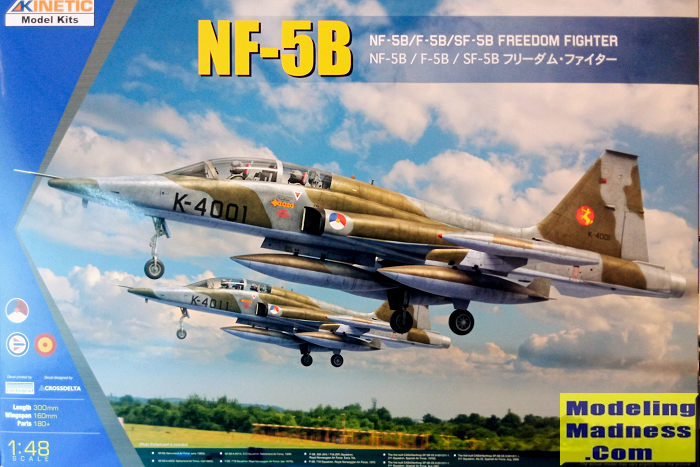
The kit comes in a wide but rather thin side-opening box. Unfortunately, the box itself is somewhat flimsy, and the side-opening arrangement does not inspire much confidence when handling or storing the kit. A subject as attractive as the NF-5B arguably deserves somewhat better packaging. Nevertheless, what is printed on the box is certainly impressive. The artwork by artist Antonis Karidis is excellent, depicting a pair of Dutch NF-5Bs gracefully taking off and giving the box a very dynamic appearance.
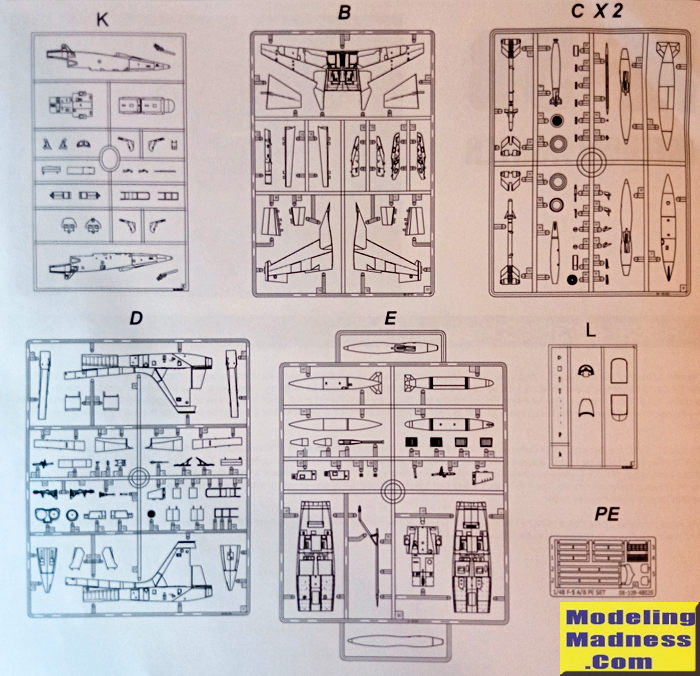
Inside, I found no fewer than 171 parts, neatly arranged in six sprues of light-grey styrene. Five are common to the various Kinetic F-5 versions, while the sixth contains the components specific to the two-seat front fuselage of the F-5B. This is a relatively compact arrangement considering the number of variants that can be produced from the tooling.
The molding is nice and crisp, with no flash evident on the parts. Panel lines are finely engraved appear to have been placed in the correct locations. As with my RF-5A review, I will leave the detailed question of dimensional and shape accuracy to those with the expertise and references to make such judgments, but at first inspection everything certainly looks convincing to me. The surface detail is restrained and appropriate for the petite Northrop fighter, and overall the kit gives a very good first impression.
The cockpit is acceptable without being overly elaborate, but it is perfectly adequate for the character of the kit and its scale. The instrument panels and consoles are sufficiently represented, while the ejection seats are also quite well done, providing a good level of detail.
The landing gear is very well done, again without being over-engineered. The parts have enough detail and definition to look convincing once assembled, while remaining perfectly appropriate for a 1/48 scale kit of this type. The wheel wells also feature believable molded detail that should look quite convincing under paint and weathering.
The engine intakes are particularly nice, being sufficiently deep and terminating in compressor faces. This is a very welcome feature, as it gives them a convincing appearance when viewed from the front. As is usually the case with this type of construction, however, you will have to deal with some inevitable seams where the intake halves are joined. It is simply one of those things that comes with the territory and the sensible price tag—you cannot have everything in life!
The exhausts are also nicely done and feature sufficient depth to look believable and realistic. The wings are well represented, while the airbrake housing features molded-on detail that adds some welcome visual interest. Separate slats and flaps are provided as well. This is certainly not a bad feature and gives the modeler some options for displaying the aircraft, although it is worth remembering that F-5s would normally be parked with their flying surfaces in the neutral position (and the airbrake drooped at a roughly 45° angle). Some care should therefore be taken when deciding how to display them if historical accuracy is the goal.
Two nicely reproduced crew ladders are included, providing an opportunity to give the finished model a more dynamic appearance and, especially, a more convincing diorama feel.
The kit provides an extensive selection of external stores, allowing the modeler to equip the aircraft according to the particular machine and references being followed. These include two types of Sidewinder missiles, the characteristic F-5 tip tanks supplied as a correctly paired set, Mk.82 bombs, underwing fuel tanks and rocket pods. It is a generous selection that provides plenty of possibilities for different configurations.
The transparencies are well molded and suitably clear, with no particular surprises here. They should respond well to careful masking and painting and provide a clean finish to the completed aircraft.
A PE fret is also provided, with some of its parts to be used on the specific version.
The instructions are typically Kinetic: functional, clear and sufficient for the task. They come in a 20-page, black-and-white A4 booklet containing a short history of the type, a sprue map, a color chart and the construction sequence spread over 14 steps. The instructions are clear and reasonably concise. One could perhaps argue that the construction sequence could have been divided into a few more, simpler steps, but even as presented, an average modeler should have no difficulty following them. Color callouts are provided for Ammo Mig, Vallejo, Mr. Color, Tamiya, Humbrol, as well as generic colors.
 Although
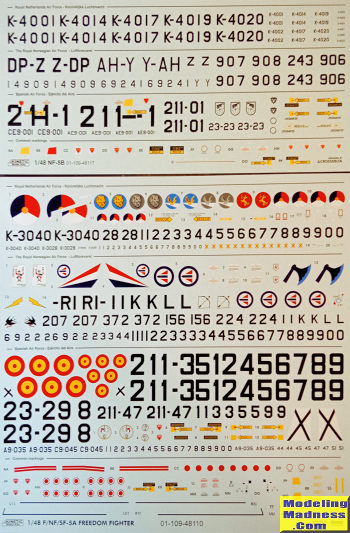
nine complete decal options are presented in the instructions, covering three
Dutch, three Norwegian and three Spanish Air Force aircraft, by combining the
various decal numbers, no fewer than 14 schemes can be built. Furthermore, with
some careful mix-and-matching of the various markings, even more possibilities
might be created. Two beautifully printed decal sheets, produced by
Cartograf, contain everything required for the different options. They should
perform beautifully and add considerably to the overall value of the kit. The
decal sheet really shines and adds considerably to the appeal of the kit.
Although
nine complete decal options are presented in the instructions, covering three
Dutch, three Norwegian and three Spanish Air Force aircraft, by combining the
various decal numbers, no fewer than 14 schemes can be built. Furthermore, with
some careful mix-and-matching of the various markings, even more possibilities
might be created. Two beautifully printed decal sheets, produced by
Cartograf, contain everything required for the different options. They should
perform beautifully and add considerably to the overall value of the kit. The
decal sheet really shines and adds considerably to the appeal of the kit.
The build begins with the cockpit, which is assembled together with the nose landing-gear bay. The nose landing gear is then dealt with according to the instructions, with the assembly being trapped inside the front fuselage half. It is not entirely clear whether the nose gear absolutely has to be installed at this stage or whether an experienced modeler could safely leave it until later. No nose weight is specified in the instructions either. Whether it is actually required is something that should be checked during construction and, as always with a model of this configuration, it is better to do some research and be safe rather than sorry.
The intake assemblies are then constructed and attached, completing the front fuselage section. The rear fuselage halves follow, incorporating the various additional panels, some of which are specific to the kit versions. The exhaust pipes are then installed, followed by the slats and ailerons. As mentioned earlier, these would normally be in the neutral position on a parked aircraft, so the modeler should consult references before deciding to display them deflected.
The wing is assembled separately and is subsequently joined to the lower rear fuselage section. This is followed by the lower front fuselage, and it is at this point that the construction becomes more demanding. Bringing together the various lower fuselage components and, ultimately, mating the front and rear fuselage sections requires some care. There have been reports of fit issues in this area, so patience is definitely required. Careful test-fitting, some judicious adjustment and taking your time should pay dividends here.
Once the main fuselage assembly is complete, the elevators are attached at the rear, followed by the air brake, landing gear, pylons and the chosen external stores. The build is then essentially complete.
Overall, the construction is not overly complicated, but it certainly has a degree of complexity. The multiple inserts, the division of the fuselage into separate front and rear sections, and the additional panels and parts all require the modeler to pay attention to how everything comes together. The instruction sequence is logical and quite good, although it can certainly be modified according to individual preferences and experience. For example, the instructions would have the windscreen attached relatively early in the construction, but you leave it until much later in the build to make painting and handling easier.
This is therefore clearly not a kit aimed at the beginner. It is much better suited to an average modeler, and especially an experienced one, who is comfortable with complex assemblies and willing to spend some time test-fitting and dealing with potentially challenging mating surfaces.
None of these issues should be considered deal-breakers, however. With patience and careful construction, the Kinetic F-5B should reward the modeler with a very impressive representation of the distinctive two-seat Freedom Fighter.
| CONCLUSIONS |
Kinetic’s 1/48 NF-5B is a very welcome kit, filling a long-standing gap in the 1/48 scale market. At last, we have a modern, nicely molded and well-detailed representation of the elegant two-seat Freedom Fighter, and it is a subject that was certainly deserving of such treatment.
The kit makes a very good overall impression. The shapes and surface contours look accurate to my eye, the molding is crisp and clean, and the engraved surface detail is restrained and convincing. Detail throughout the kit is above average and, in many areas, quite good indeed. The cockpit, landing gear, wheel wells, intakes and exhausts all provide more than enough detail to produce an impressive model straight from the box. The transparencies are also well done, while the instructions, although not perfect, are clear, logical and certainly adequate for the task.
The decals are another strong point. The Cartograf-printed sheets are beautifully produced and provide a particularly generous selection of markings. With nine options presented in the instructions and the possibility of combining markings to create even more schemes, the decal offering considerably enhances the appeal of the kit.
I also particularly welcome Kinetic’s correction of the wingtip fuel tanks in this and subsequent releases. The provision of the correctly paired left- and right-hand tanks is a small but important detail, and one that had been pointed out by modelers. It is nice to see that Kinetic listened to the feedback and incorporated the correction into the later tooling.
The only real reservation concerns the construction. The multiple inserts and the modular breakdown of the fuselage inevitably introduce several seams that will require attention, particularly around the front and rear fuselage sections and some of the intake assemblies. This is certainly not a kit I would recommend to a beginner. An average modeler, however, and especially an experienced one, should have no serious problems tackling it, provided that sufficient attention is paid to test-fitting, alignment and dealing with the inevitable seams.
Once those remarks are tackled, the reward is a very attractive 1/48 NF-5B that looks every bit the part. Considering what is offered in the box, I also find the €45 price perfectly reasonable.
All in all, this is a great kit of a very appealing aircraft and one that successfully fills a void that had existed for far too long. It may require a little more care during construction than some simpler kits, but nothing here should put off the average or experienced modeler.
For anyone with a soft spot for the little Northrop fighter—or simply looking for a distinctive two-seat jet for the 1/48 collection—this NF-5B is definitely a kit worth tackling.
Happy Modeling
September 2026
Copyright ModelingMadness.com. All rights reserved. No reproduction in part or in whole without express permission.
If you would like your product reviewed fairly and fairly quickly, please contact the editor or see other details in the Note to Contributors.