| KIT #: | 1282 |
| PRICE: | $50.00 |
| DECALS: | Two options |
| REVIEWER: | Spiros Pendedekas |
| NOTES: | AMT tooling |
| HISTORY |
The North American XB-70 Valkyrie was one of the most ambitious aircraft projects of the Cold War. Conceived in the late 1950s as a high-altitude, high-speed strategic bomber, it was designed to cruise at around Mach 3 at an altitude of approximately 70,000 feet. The enormous aircraft featured a distinctive delta wing, six powerful General Electric J93 turbojet engines, and movable outer wing panels that could be lowered during high-speed flight to make use of compression lift. The result was an aircraft that looked less like a conventional bomber and more like something from the future.
The original plan called for the XB-70 to become the B-70, a production strategic bomber capable of penetrating Soviet airspace at extreme speed and altitude. However, the rapid development of surface-to-air missiles and increasingly capable Soviet interceptors made the concept far less attractive. The bomber program was eventually cancelled, leaving only two prototype aircraft. The first, AV-1, made its maiden flight on September 21, 1964, while the second, AV-2, followed in 1965. Despite the cancellation of the production aircraft, the Valkyrie remained an extraordinary flying research laboratory.
The two prototypes subsequently became involved in NASA and U.S. Air Force research into high-speed flight, particularly the problems associated with sustained Mach 3 operation. Sadly, on June 8, 1966, AV-2 was destroyed in a mid-air collision with an F-104 Starfighter during a formation photo shoot, killing pilot Al White and co-pilot Carl Cross. The surviving AV-1 continued flying until 1969 and is now preserved at the National Museum of the United States Air Force in Dayton, Ohio. Although only two Valkyries were ever completed, the XB-70 remains one of the most spectacular—and unmistakable—aircraft ever to emerge from the American Cold War era.
| THE KIT |
 When
we first heard that AMT had decided to produce the XB-70 Valkyrie in 1/72
scale, the decision itself was fantastic. The modeling world had been
waiting a long time for a Valkyrie in this scale, and the arrival of a 1/72
kit of this extraordinary aircraft was certainly something to celebrate. AMT
released its tooling in 1995, followed by another reboxing a couple of years
later, before Italeri acquired the molds in the early 2000s. Italeri has
subsequently reboxed the kit two more times, with the latest issue appearing
in 2022. The tooling itself has remained unchanged throughout its various
incarnations.
When
we first heard that AMT had decided to produce the XB-70 Valkyrie in 1/72
scale, the decision itself was fantastic. The modeling world had been
waiting a long time for a Valkyrie in this scale, and the arrival of a 1/72
kit of this extraordinary aircraft was certainly something to celebrate. AMT
released its tooling in 1995, followed by another reboxing a couple of years
later, before Italeri acquired the molds in the early 2000s. Italeri has
subsequently reboxed the kit two more times, with the latest issue appearing
in 2022. The tooling itself has remained unchanged throughout its various
incarnations.
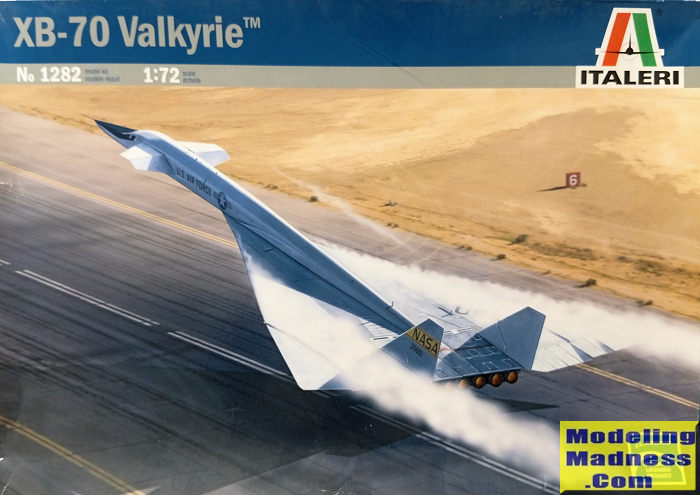
The particular kit previewed here is the 2008 Italeri reboxing, which comes in a large, top-opening but relatively flimsy box. The box art is very attractive, depicting one of the prototypes gracefully taking off, with the characteristic vortices forming around its wing sections.
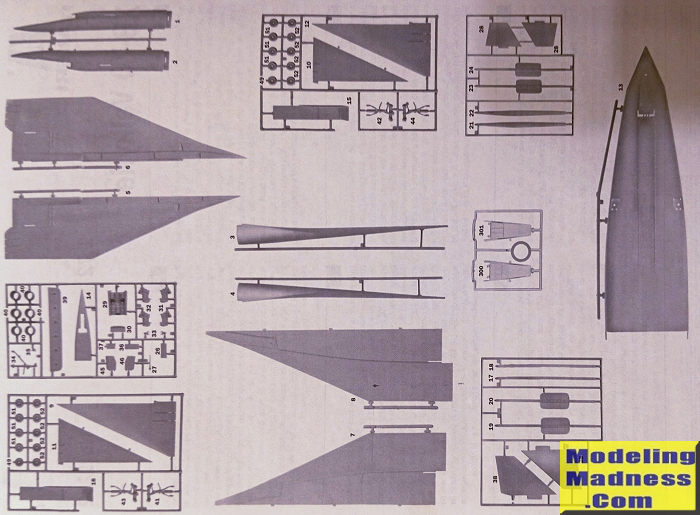
Opening the box, the first thing that strikes you is the sheer size of the parts. There are just 76 light-gray styrene parts, but some of them are absolutely enormous. I was particularly pleased to find the parts molded in light gray rather than white, as used in some other reboxings, since I personally find gray styrene considerably easier to work with.
The molding is relatively crisp, and I found no significant flash on the parts, suggesting that the tooling has been treated reasonably well over the years. Surface detail is a mixture of engraved and raised panel lines, with most of the engraved detail fownd on the lower fuselage part, being quite prominent. The detail is certainly not state-of-the-art, but it is acceptable for a tooling of this age and gives the large model plenty of visual interest.
Reflecting its 1995 origins, the cockpit is reasonably represented for the scale, consisting of the cockpit tub, seats, control yokes and instrument panel. Decals are provided for the instruments, which is an adequate solution considering how little of the cockpit will ultimately be visible through the canopy. It is not an elaborate cockpit, but realistically, there is little reason to spend enormous amounts of time there.
The landing gear is similarly adequate. The main components are reasonably represented, but the wheel wells and their doors lack internal detailing, giving the area a rather simplistic appearance. The intake interiors are reasonably done, with sufficient depth, although they naturally do not reproduce the complete depth of the real aircraft's enormous intake system. The exhausts are also on the simplified side and are another area where an ambitious modeler could add some extra detail.
The structural parts are, of course, where this kit becomes particularly interesting. They are huge—really huge—and the engineering reflects the unusual shape and size of the real aircraft. Rather than breaking the model into a multitude of smaller components, AMT used a relatively small number of very large pieces. This keeps the parts count remarkably low, but it also means that mating those large components together becomes an important part of the build.
I noticed some warping on several of the larger parts, something that will inevitably make assembly more challenging. However, there are only so many ways to engineer a 1/72 scale model of such a large and complex aircraft, and AMT's approach is understandable. In any case, the low parts count should not be mistaken for a necessarily easy build.
The clear parts are nicely molded and crystal clear. Particularly welcome is the provision of two different canopies. The Valkyrie utilized a revolutionary variable-geometry design, featuring a movable outer windshield and ramp assembly, shifting positions between subsonic and supersonic flight to balance the pilot's visibility requirements with extreme aerodynamic demands. The kit provides both options,, which is a nice touch and gives the modeler the opportunity to display the Valkyrie in either of its characteristic configurations.
The instructions are typical of Italeri's presentation and are very nicely printed. They come in the form of an A4-sized leaflet and include a short history of the type, a sprue map, a color chart and the construction sequence spread over ten steps. Color call-outs are provided wherever necessary, making the instructions easy enough to follow.
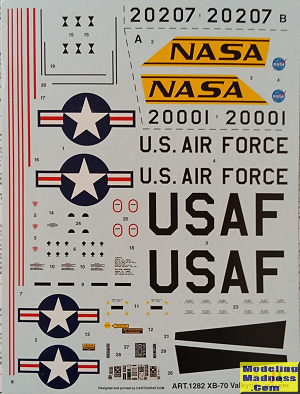 Two
marking options are included, representing the two prototypes, and the
decals are one of the highlights of the package. Beautifully printed by
Cartograf, they are sharp, well registered and should add considerably to
the appearance of the finished model. As with many Italeri reboxings, these
excellent decals are a genuine bonus and add appreciable value to what is
essentially an older tooling.
Two
marking options are included, representing the two prototypes, and the
decals are one of the highlights of the package. Beautifully printed by
Cartograf, they are sharp, well registered and should add considerably to
the appearance of the finished model. As with many Italeri reboxings, these
excellent decals are a genuine bonus and add appreciable value to what is
essentially an older tooling.
The construction sequence is quite straightforward on paper. The cockpit is assembled first, followed by the landing gear components. The cockpit is then fitted between the fuselage parts, with the intake inner walls added on either side of the front fuselage. No nose weight is nentioned, and I am not sure if any is needed.
The wings are subsequently assembled, followed by the rear fuselage section, with the intake walls fitted at the front and the exhaust components at the rear. The completed rear fuselage assembly is then brought together with the large wing components.
The front fuselage is next mated to the main assembly, followed by the distinctive outer wing sections, which can be positioned either lowered or straight. The vertical fins and canards are then added, followed by the landing gear and canopy, completing what appears to be a relatively uncomplicated sequence. In practice, however, the large dimensions of the parts mean that careful dry-fitting and patient alignment will be essential.
The build may initially sound straightforward, and in terms of parts count it certainly is. The challenge lies elsewhere. Bringing several enormous components together while maintaining correct alignment can be demanding, and reports from modelers who have built the kit indicate that fit can be troublesome. This is therefore a kit where patience, careful dry-fitting and some modeling experience will be more important than the relatively modest number of parts might suggest.
| CONCLUSIONS |
There is something rather special about having a huge 1/72 XB-70 Valkyrie on the shelf, and for that alone AMT deserves considerable credit for undertaking such an ambitious project back in 1995. Producing an aircraft of this size and complexity in 1/72 scale was no small undertaking, and the fact that the tooling has survived through numerous reboxings and remains available today is certainly good news for the modeler.
The kit itself is not bad at all. Its detail is admittedly average in places and somewhat simplistic in others, with the landing gear, exhausts and, to a lesser extent, the cockpit being the most obvious areas where additional work could improve the finished model. Some of the structural areas could also benefit from refinement. Nevertheless, the overall representation is quite acceptable, and the kit is generally regarded as an accurate representation of the Valkyrie. As always, I will leave the finer points of accuracy to those with considerably more expertise on the XB-70 than I have.
What cannot be disputed, however, is the presence of the finished model. It is big, imposing and absolutely spectacular. Even built straight from the box, this is the sort of model that immediately attracts attention. Add to that the very good instructions and the excellent Cartograf decals, and the package becomes even more appealing. At around $50, the price is also quite reasonable for such a large 1/72 scale model.
The main reservation is the fit. I have not personally built this particular kit, but the modeling reports are fairly consistent in warning that bringing the large components together can be challenging. Consequently, this is certainly not a kit I would recommend to a beginner. An average towards experienced modeler, however, should be perfectly capable of tackling it, provided he or she approaches the build with patience and does not try to rush those big assemblies into place.
That brings us back to the main attraction: there is a 1/72 XB-70 Valkyrie in the first place. For all its age and its shortcomings, this kit gives us the opportunity to put one of the most extraordinary aircraft ever built on the display shelf in a very impressive scale. At a sensible price, with good decals and perfectly respectable overall detail, it remains a very worthwhile project.
It may require some work, but the reward is a model that is every bit as spectacular as the real Valkyrie was. If you have a fascination for this remarkable aircraft, this is definitely a kit worth tackling.
Happy Modeling!
July 2014
Copyright ModelingMadness.com. All rights reserved. No reproduction in part or in whole without express permission.
If you would like your product reviewed fairly and quickly, please contact the editor or see other details in the Note to Contributors.