Hasegawa 1/72 Shin Meiwa PS-1
| KIT #: | 04008 |
| PRICE: | 40 Euros |
| DECALS: | Two options |
| REVIEWER: | Spiros Pendedekas |
| NOTES: |
1975 tooling |
| HISTORY |
The story of the Shin Meiwa PS-1 began in post-war Japan, when Shin Meiwa — a company with roots going back to the famous Kawanishi flying-boat manufacturer — got back into serious aircraft development. During the 1950s and early 1960s, the company put a lot of effort into developing a flying boat that could operate from rough seas, something conventional flying boats struggled with. One of the biggest steps in this work was the experimental UF-XS, which introduced several revolutionary ideas, including boundary-layer control and clever systems for reducing spray during takeoff and landing. These technologies eventually led to an aircraft unlike almost anything else flying at the time.
In 1966, the Japanese Maritime Self-Defense Force selected Shin Meiwa to turn the concept into an operational anti-submarine aircraft. The resulting prototype was designated PX-S, while the company's internal designation was SS-2. The first aircraft flew on 5 October 1967, followed by a second prototype in 1968. The design was later ordered into production as the PS-1, with the first production aircraft entering service in the early 1970s. In total, 23 PS-1s were built. The aircraft was a true flying boat, carrying its own beaching equipment instead of conventional landing gear, and was designed specifically for anti-submarine warfare. Its impressive STOL performance and ability to operate from fairly rough water made it one of the most remarkable maritime aircraft of its era.
The PS-1 was not the end of the story. The JMSDF soon wanted an aircraft that could carry out search-and-rescue missions while also operating from normal runways. Shin Meiwa therefore developed the SS-2A, which became the US-1. This was a true amphibian, fitted with retractable tricycle landing gear and redesigned for search-and-rescue rather than anti-submarine warfare. The first US-1 flew in 1974 and entered service in 1975; six US-1s were built, followed by 14 improved US-1As, giving a total of 20 aircraft in the US-1/US-1A family. The US-1A introduced more powerful engines and improved equipment, while keeping the extraordinary STOL and water-operating abilities of its predecessor. Eventually, the concept developed into the much more advanced ShinMaywa US-2, bringing the remarkable Shin Meiwa amphibian family into the modern era. The PS-1 itself stayed in Japanese service until 1989, while the last US-1A was retired in 2017.
| THE KIT |
 In 1975, Hasegawa released
this spectacular 1/72 scale kit, covering a subject that even today you would
hardly expect to see in styrene. The kit has been reboxed regularly over the
years, with the most recent reboxing appearing in 2026. Over time, some extra
parts have been added to improve the finer details and include items such as
antennas and other small fittings.
In 1975, Hasegawa released
this spectacular 1/72 scale kit, covering a subject that even today you would
hardly expect to see in styrene. The kit has been reboxed regularly over the
years, with the most recent reboxing appearing in 2026. Over time, some extra
parts have been added to improve the finer details and include items such as
antennas and other small fittings.
The specific kit reviewed here seems to be from the late 1980s, although I cannot say exactly which year with complete certainty. Hasegawa used basically the same boxing throughout the late 1970s and much of the 1980s, without clearly identifying the specific production edition on the box. I bought this example, forgotten on one of my beloved hobby shop's shelves in Athens around 2020, for what seemed like a very reasonable price for such an unusual and increasingly hard-to-find kit.
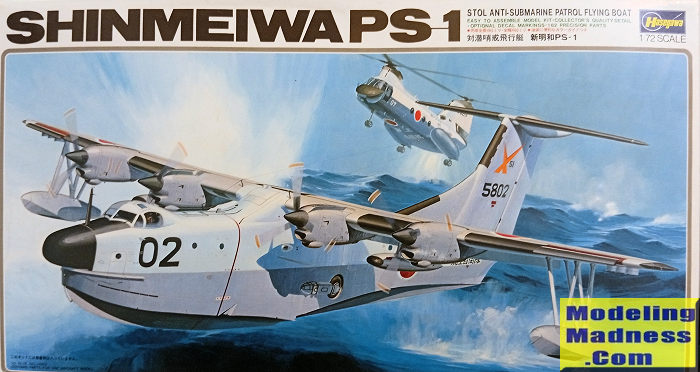
The kit comes in Hasegawa's familiar old-style, top-opening box. It is quite a large box and, as usual, is good quality. The artwork is by the legendary Shigeo Koike and shows PS-1 aircraft 02 lifting gracefully from the water — an image that immediately captures the unusual character of this remarkable Japanese flying boat.
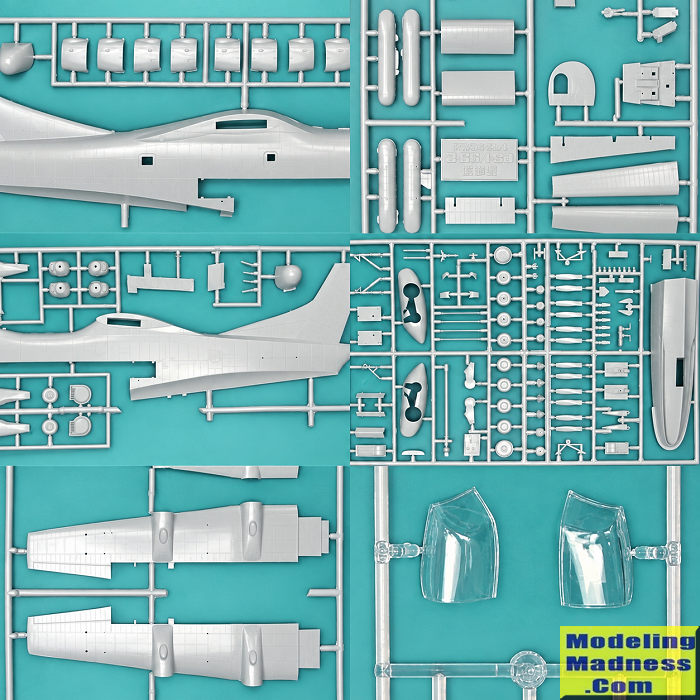
Opening the box reveals around 170 light-gray styrene parts arranged on five sprues. The molding is very much typical of Hasegawa kits from the 1970s, with fairly hard plastic and mostly raised surface detail. The mold is quite good and, remarkably for its age, almost flash-free, with only the occasional minor imperfection that is easy to clean up. Considering how old the tooling is, the molds are in surprisingly good shape. Hasegawa has always had a reputation for looking after its molds, and this kit is a good example of that.
The kit's engineering is fairly straightforward, especially considering the size of the finished model and the complicated shape of the Shin Meiwa's hull. The fuselage is split into left and right sections, while the central forward part of the hull is a separate component, possibly to make fitting the nose gear bay easier.
One especially interesting feature of this release is that the tooling lets you build both the PS-1 flying-boat configuration and the amphibious US-1-type configuration, with the appropriate landing-gear parts included in the kit. That makes it more versatile than the title might initially suggest.
The overall detail is, understandably for a kit of this age, fairly basic. The cockpit includes two control yokes, an instrument panel, two simplified seats, a central console and a rear bulkhead. Two pilots are included to fill the space and bring it to life a little. There really isn't much more to it, but very little can be seen through the relatively small cockpit windows once the model is finished. You can add extra detail if you want, but it probably will not make a huge difference to the completed model.
The landing gear is reasonably well represented, with the kit letting you build either configuration. The PS-1 gets its beaching arrangement, while the amphibious version receives the more substantial retractable landing gear needed for runway operations.
The engines are also reasonably represented without being especially detailed. They are certainly good enough for the scale, particularly since very little will be visible behind the propellers. The three-bladed propellers are nicely done and should look convincing once assembled. The kit also includes separate flaps, along with various maritime equipment such as torpedoes and the searchlight.
The wings are nicely molded, as are the floats, and the overall engineering of the main components is quite simple. The clear parts are reasonably well molded, although one feature seems rather puzzling to me: the main canopy is split into separate left- and right-hand sections instead of being supplied as one piece. Personally, I would have preferred a single-piece canopy, both to make assembly easier and to avoid an unnecessary seam in such a noticeable area.
The instructions are sufficient and very much in keeping with Hasegawa's old-school style. They come as a black-and-white, 10-page booklet, starting with a short history of the aircraft and then moving through no fewer than 25 construction steps. The drawings are clear and concise, with useful written instructions included in the individual steps. Color references, painting instructions and decal-placement diagrams appear toward the end. Overall, the instructions are perfectly usable and, despite their age, should not cause any real problems. Color references are given using Federal Standard FS numbers, along with generic color descriptions.
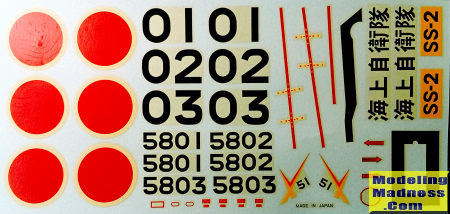 Two finishing options are
included in this boxing, representing the two configurations offered by the kit
— the PS-1 seaplane and the amphibious version. The decals are well printed, but
unfortunately my example had suffered badly from age. The carrier film had
yellowed quite a bit, making the sheet look rather old.
Two finishing options are
included in this boxing, representing the two configurations offered by the kit
— the PS-1 seaplane and the amphibious version. The decals are well printed, but
unfortunately my example had suffered badly from age. The carrier film had
yellowed quite a bit, making the sheet look rather old.
I have therefore turned to the traditional modeler's solution: the Greek sun. The decal sheet will be carefully taped beside a window, with the hope that a long spell in the sunlight will help reduce the yellowing before the decals are needed. Whether the Greek sun will work its magic remains to be seen!
The instructions start with the cockpit assembly and then move through a series of sub-assemblies. The landing gear is built at this stage, with the modeler choosing the correct parts for whichever configuration is being built. The same goes for the mission-specific items, including the searchlight and torpedoes. The flaps are then assembled and remain movable, while the engines and their three-bladed propellers are also built as separate sub-assemblies.
The nose landing gear is then fitted into its bay in the forward hull section. The main landing-gear bays are attached from inside the fuselage halves, after which the fuselage halves are joined, trapping the cockpit between them. The hull is then fitted underneath, with the rudder also being enclosed during this stage.
Interestingly, the instructions do not mention adding nose weight. Given the size and layout of the model, I would definitely add some weight inside the forward hull. The landing gear looks strong enough, but a little extra weight would be a sensible precaution — better safe than sorry.
The wings are assembled next, trapping the movable flaps between the upper and lower sections. The floats are built separately and then attached to the wings. The wings are then fitted to the fuselage, followed by the assembly and installation of the tail. Depending on the chosen configuration, the appropriate landing-gear arrangement is selected, with the amphibious version receiving its more substantial gear and related extensions.
It should be stressed that this is only one possible assembly sequence. The instructions provide a logical order, but you are free to change the order of several assemblies to suit your preferred way of working. For example, the wings could be attached to the fuselage before fitting the engines, floats or other external parts, while the landing gear could easily be left until the final stages. There is enough flexibility here to organize the build however you like.
The assembly is not completely simple, but it is not complicated either. Considering the aircraft's huge size and the dimensions of many of its parts, the engineering is surprisingly straightforward. Once you take the size of the parts out of the equation, I would rate the overall construction as average in complexity rather than particularly demanding. An average modeler should be able to tackle this impressive flying boat without running into anything beyond the usual challenges of building a large aircraft model.
| CONCLUSIONS |
This is clearly a nice kit. In fact, I would go as far as calling it a great kit — not because it uses the most advanced modeling technology available today, but because of what it represents. I honestly doubt we will ever see the Shin Meiwa PS-1 molded in styrene again. It is such an unusual subject, despite the aircraft itself being one of the most impressive flying boats ever built, that simply seeing it offered as a mainstream injection-molded kit is remarkable. And perhaps it is no coincidence that Hasegawa, a Japanese company, had the vision to tackle such an unusual subject.
Of course, we have to remember that this is a product of the 1970s. The surface detail is a little soft, and key areas, such as the cockpit, engines and landing gear, are not especially detailed by today's standards. At the same time, though, the kit is far from simplistic. The basic shapes are well captured, the engineering is surprisingly straightforward for such a large aircraft, and it is perfectly possible to build a very impressive model straight from the box. I know this from personal experience, having built the kit myself in the past, and I remember being genuinely impressed by the finished result.
It is also great that Hasegawa has continued to bring this unusual kit back over the years, keeping the Shin Meiwa available to new generations of modelers. I have not come across a large range of dedicated aftermarket products for it, although that does not necessarily mean nothing exists. Some 3D-printed accessories may well be available today for anyone wanting to take the model further, so this is definitely worth looking into.
Prices naturally vary depending on the release and its availability, but around €60 seems like a reasonable guide for some of the more recent issues. Certain later releases also include extra parts intended to add detail or represent different configurations. Even so, I still think the kit offers very good value for money. Quite simply, this is the way to build a 1/72 Shin Meiwa flying boat in styrene, and that alone makes it special.
For me, the Hasegawa Shin Meiwa PS-1 is one of those kits that reminds us why this hobby is so fascinating. It is not perfect, it is not modern, and it definitely shows its age — but it represents an extraordinary aircraft, an extraordinary piece of Japanese aviation history, and an equally extraordinary decision by Hasegawa to put such an unusual subject into a model box. And for that, this old kit deserves a place in any collection of unusual and memorable aircraft models.
Happy Modeling!
September 2026
Copyright ModelingMadness.com. All rights reserved. No
reproduction in part or in whole without express permission. If you would like your product reviewed fairly and fairly quickly, please
contact the editor or see other details in the
Note to
Contributors.