Hasegawa 1/72 F-4EJ Phantom II
| KIT #: | 00331 |
| PRICE: | 11 Euros |
| DECALS: | Four options |
| REVIEWER: | Spiros Pendedekas |
| NOTES: | Older second generation tooling |
| HISTORY |
The McDonnell Douglas F-4 Phantom II needs little introduction to anyone with an interest in post-war military aviation. Originally developed for the U.S. Navy as a long-range, carrier-based interceptor, the Phantom quickly evolved into one of the most versatile and successful combat aircraft of the Cold War. Its combination of enormous power, speed, range, a powerful radar, two-man crew and heavy weapons load made it suitable for a remarkably wide variety of missions. Although it was originally conceived primarily as an air-to-air fighter, the Phantom went on to serve as an interceptor, fighter-bomber, reconnaissance aircraft and, in later years, a sophisticated multirole platform. It was operated by numerous air forces around the world and became particularly famous during the Vietnam War, where both the U.S. Navy and U.S. Air Force employed it extensively.
The Phantom's success was not simply a consequence of its performance. It was also an aircraft that could be adapted to very different operational requirements. The F-4E, developed for the U.S. Air Force, introduced an internal M61 Vulcan 20mm cannon and incorporated a number of improvements over earlier versions. It was this version that attracted Japanese interest during the late 1960s. At the time, the Japan Air Self-Defense Force (JASDF) was looking for a successor to its F-104J Starfighters and F-86F Sabres. Japan required a modern aircraft capable of defending its extensive airspace and, particularly, of conducting all-weather interception. In November 1968, the F-4E was selected as Japan's next major fighter, and in January 1969 the Japanese government approved the domestic production of 104 aircraft.
The Japanese aircraft was designated F-4EJ and, although closely related to the American F-4E, it was not simply an F-4E painted in Japanese markings. The aircraft was specifically adapted to Japanese requirements. Equipment considered unnecessary for the JASDF's intended interceptor role was removed, while a data-link system was incorporated to improve its integration into Japan's air-defense network. The aircraft was built under license in Japan, with Mitsubishi Heavy Industries playing the central role in domestic production. A total of 140 F-4EJs were eventually produced, with production continuing until fiscal year 1981. The first aircraft were assembled with considerable assistance from the United States, while Japanese industry progressively assumed a greater share of production.
The F-4EJ entered JASDF service during the early 1970s, at a time when Japan's air-defense system was becoming increasingly sophisticated. The first F-4EJ squadron, 301 Squadron, was formed at Hyakuri in October 1973, while 302 Squadron began operating the type from Chitose the following year. The Phantom's arrival represented a major step forward over the preceding generation of Japanese fighters. With its powerful radar, two-man crew, high speed and all-weather capability, the F-4EJ was particularly well suited to the demanding interceptor mission. By the mid-1970s, additional Phantom squadrons were being established, including 303 Squadron at Komatsu in 1976 and subsequently other units as the type became the backbone of Japan's fighter-interceptor force.
There was also an important difference between the Japanese Phantom and many of its American counterparts. The F-4EJ was deliberately optimized around Japan's defensive requirements rather than the expeditionary combat role for which American Phantoms had become famous in Vietnam. The aircraft therefore became a familiar sight in the Japanese air-defense system, conducting training and airspace-interception duties rather than the combat missions associated with the U.S. Phantom. Alongside the F-4EJ, Japan also operated the RF-4E reconnaissance version, giving the Phantom family an important second role within the JASDF. Hyakuri eventually became particularly associated with both fighter and reconnaissance Phantoms.
The story did not end with the original F-4EJ. By the late 1980s, despite the Phantom's excellent basic design, advances in radar, avionics, weapons and air-combat tactics meant that modernization was necessary if the aircraft was to remain effective. Japan therefore embarked on an extensive upgrade program, resulting in the F-4EJ Kai ("Kai" meaning modified). The modernization included a new radar and fire-control system, improved navigation and communications equipment, a modernized central computer and HUD, and compatibility with newer weapons. The upgraded aircraft also gained improved capabilities against low-flying targets and substantially greater overall combat effectiveness. The F-4EJ Kai thus gave the venerable Phantom a remarkably long second career.
And remarkably long it was. The F-4EJ had entered Japanese service in the early 1970s, yet some of the aircraft continued flying for almost another five decades. During those years, Japanese Phantoms served with numerous fighter squadrons and became a familiar feature of Japanese air bases and airshows. Squadrons moved between bases and converted to newer types, while the Phantom itself continued to receive upgrades and modifications. The type's longevity was a testimony not only to the original design but also to Japan's ability to maintain and modernize a complex combat aircraft over an exceptionally long service life.
Eventually, however, even the Phantom's remarkable career had to come to an end. The JASDF began replacing its remaining F-4EJ Kai aircraft with the F-35A, and the final operational F-4s were retired in fiscal year 2020. The last F-4EJ Kai aircraft operated by 301 Squadron made their farewell appearances during 2020, bringing to a close almost half a century of Japanese Phantom operations. The Phantom had protected Japanese airspace for almost 50 years.
The Japanese F-4EJ therefore occupies a rather special place in Phantom history. It was born from an American design, but adapted to a very specific national requirement and subsequently manufactured, operated and extensively modernized in Japan. From the first F-4EJs of the early 1970s to the highly upgraded F-4EJ Kais of the 21st century, the Phantom became one of the defining aircraft of the JASDF. For a generation of Japanese pilots and aviation enthusiasts, the long, powerful shape of the Phantom, with its distinctive Japanese markings and unmistakable twin exhausts, became synonymous with the defense of Japan's skies.
| THE KIT |
 The
Hasegawa 1/72 Phantom family has a fascinating history of its own, having
evolved through several generations of toolings and an almost bewildering
number of boxings over the decades. The story begins in 1966, when Hasegawa
introduced its first 1/72 Phantom, the JS-011 F-4C. These early kits
represented Hasegawa's first generation of Phantom tooling and, as one might
expect from a kit of that age, featured raised panel lines, very thick
plastic and an extremely basic cockpit. By today's standards, they are
rather rudimentary and, in several respects, quite inaccurate. Nevertheless,
the molds proved remarkably useful, being modified and adapted to produce
other Phantom versions, including the F-4J and British F-4K/M. During the
1970s, the same basic tooling continued to appear in different boxings,
including B- and D-series releases.
The second generation appeared in 1972 and represented a considerable improvement. Hasegawa concentrated particularly on the "long-nose" Phantom family, introducing new tooling for the F-4EJ (JS-080) and F-4E (JS-085). These kits were still characterized by raised panel lines and relatively simple detailing, but they were considerably better representations of the Phantom than their predecessors. They also proved to be extremely durable products commercially. Hasegawa continued to reissue them throughout the 1970s, 1980s and beyond, with the tooling being modified or adapted when necessary to cover additional variants. One particularly interesting development came in 1984, when the tooling was modified to produce the German F-4F. Thus, what began as a 1970s-generation kit remained in the company's catalog long after newer Phantom tooling had appeared.
Then came the third generation — and a completely different philosophy. In 1990 Hasegawa introduced an entirely new F-4J, kit No. 04101, featuring recessed panel lines, much sharper surface detail and a far more sophisticated approach to the cockpit and airframe construction. Rather than creating a completely separate set of molds for every Phantom variant, Hasegawa designed the new family around a highly modular tooling concept. Interchangeable sections were incorporated into areas such as the nose, cockpit, vertical fin and wings, allowing different Phantom versions to be produced from a common basic tooling system. This was an exceptionally productive approach, and over the following three decades Hasegawa would exploit it to produce a huge number of Phantom boxings covering virtually every major version, from the F-4B/N and F-4C/D through the F-4E and reconnaissance RF-4, to specialized versions such as the Japanese F-4EJ Kai.
The result is one of the most extensive Phantom families ever produced in injection-molded plastic. Hasegawa's Phantom kits have been boxed and reboxed what seems like a gazillion times, often with different markings, decals and minor changes to the contents. And here is where our particular kit becomes rather interesting. The appearance of a late boxing does not necessarily mean that the model inside represents Hasegawa's latest tooling. The second-generation F-4E/F-4EJ tooling continued to be reissued alongside the much newer third-generation Phantom family, with later releases retaining the older raised-panel-line molds. The particular example reviewed here is the 2008 reissue, making it a rather interesting survivor from Hasegawa's earlier Phantom lineage.
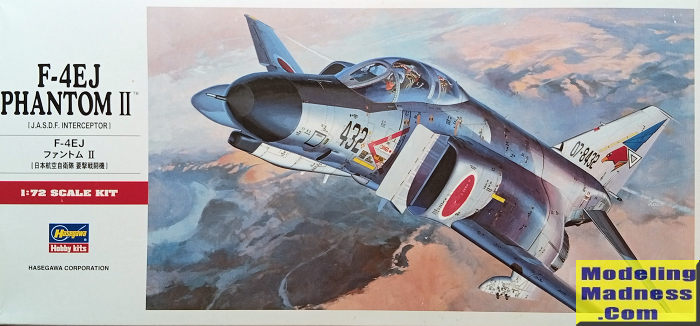
I acquired this particular boxing in 2025 from one of my now-beloved internet hobby shops, at a very sensible price of only 11 Euros. For that money, there was certainly little reason to complain. The kit comes in Hasegawa's familiar top-opening box, relatively compact. As always with Hasegawa, the box itself is of excellent quality and feels considerably more substantial than its modest dimensions might suggest. The artwork depicts a Japanese F-4EJ, serial 432, gracefully climbing through the sky.
It should be emphasized once again that this is the second-generation tooling, dating from the early 1970s, rather than the later all-new Phantom family. This is important because, at first glance, the 2008 date on the box might easily lead one to assume that the kit represents Hasegawa's more modern approach. It does not. What we have here is essentially a veteran set of molds enjoying yet another lease of life — and, considering the age of the tooling, there is something rather charming about that.
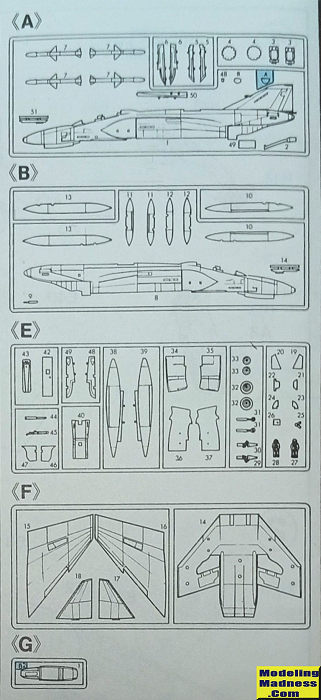
Opening the box revealed 65 light-gray plastic parts, neatly arranged on four sprues. The molding is quite crisp and relatively clean with little flash, indicating that these old molds have been well maintained, holding up the test of time. Panel lines are mostly raised, with a few recessed panel lines, mostly in moving surfaces.
Cockpit is definitely simplified. Including only the cockpit tub with some generic side consoles, simplistic seats, and I couldn't spot any instrument panel. Two pilots are also included, so I think it's a must to attach them there to blank some of the cockpit sparseness.
Landing gear is also averagely done, containing only the basic detail, and the same can be said for the intakes and exhausts, offering barely sufficient depth, and I suggest their ends should be painted black to disguise the shallowness.
Regarding the underside stores, external tanks are provided together with four Sparrows, and should you wish to arm your F-4 with bombs or missiles, you should purchase them separately from the Aircraft in Action series by Hasegawa.
The canopy is well molded and clear. Instructions are done in the old Hasegawa style, but still nicely done, coming in the form of a pamphlet containing a photo of a completed model, a short history of the type, a sprue map, a color chart and a loading diagram. The construction is spread in six clear and concise steps, with color callouts provided where applicable.
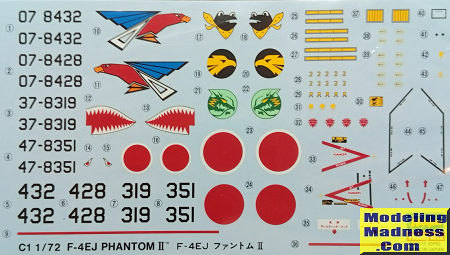 Four
1980 Japan Air Self-Defense Force schemes are provided:
-301 Sqn., 5 AW, 07-8428, Nyutabaru AB
-302 Sqn., 2 AW, 07-8432, Chitose AB
-303 Sqn., 6 AW, 47-8351, Komatsu AB
-306 Sqn., 6 AW, 37-8319, Komatsu AB.
All carry the distinctive gray over white camo. Shades are given in Gunze codes and in generic form. The decals in my example were printed no earlier than 2014 (!), featuring very good color registration, with the white being white and not ivory. Decals are really wonderful and should contribute a lot to the overall appearance of the kit.
Construction begins, as one might expect, with the cockpit, which is assembled first, with the pilots mounted on their seats and the cockpit tub installed in the nose-wheel-well area. The complete assembly is then trapped between the two fuselage halves.
My strong advice here is to use the supplied pilots. Unless you are prepared to considerably improve the cockpit yourself, the interior is simply too sparse to leave empty. The figures will fill the rather bare cockpit quite effectively, especially once the canopy is closed. Alternatively, this is one of those areas where the enthusiastic modeler could spend some time adding detail, but that rather defeats the simple and straightforward nature of the kit.
The distinctive M61 Vulcan cannon is then attached to the front of the fuselage, followed by assembly and installation of the intakes. The wings come next, followed by the stabilators. The upper fuselage spine panel is then installed, bringing the basic airframe together quite quickly.
The canopy follows. The instructions call for it to be installed during the main construction sequence, but there is no reason why the modeler cannot leave it off until the end of the build. The landing gear is then assembled and attached in position, followed by the external stores. With these fitted, the Phantom is essentially complete.
That is really the beauty of this kit. Construction is simple, straightforward and pleasantly uncomplicated. There are not dozens of tiny parts, complex multi-part assemblies or elaborate engineering tricks to slow things down. For an experienced modeler, this should make for a relaxing build, while for a beginner it provides a very approachable introduction to the Phantom.
| CONCLUSIONS |
This is Hasegawa's second-generation 1/72 F-4 Phantom tooling, and that fact has to be kept in mind when evaluating it. The company has subsequently produced a much more advanced third-generation Phantom family, with recessed panel lines, considerably better cockpit and undercarriage detail, more sophisticated engineering and much greater overall fidelity. Consequently, if your intention is simply to build the most detailed Hasegawa 1/72 Phantom available, this is not the tooling to choose. The third-generation family occupies that position within Hasegawa's Phantom range.
That, however, does not make this an inherently bad kit. Far from it. What we have here is a simple, somewhat basic but fundamentally sound Phantom with good overall shape, clean molding, straightforward construction and relatively few parts. The cockpit and landing gear are simplistic, the intakes and exhausts are shallow, and the raised panel lines clearly identify the kit as a product of another era. But the basic ingredients are all there, and the finished model should still look unmistakably like an F-4 Phantom.
Indeed, the simplicity may be precisely what attracts some modelers. A beginner could tackle this kit without being overwhelmed, while an experienced modeler could treat it as a relaxing weekend project. The supplied pilot figures help hide the sparse cockpit, while the four marking options and particularly nice decals give the finished model considerable visual appeal.
Of course, you could spend a considerable amount of money on aftermarket accessories, improving the cockpit, landing gear, exhausts, intakes and other areas where the kit falls short. But then another question naturally arises: is it worth investing heavily in aftermarket parts — and potentially carrying out surgery on the old airframe — when Hasegawa itself offers a considerably better Phantom tooling, or when there are other excellent F-4 kits on the market?
That is really the dilemma with this kit. It is not the latest and greatest Phantom, and Hasegawa has itself moved on from this tooling. But if you find one at a sensible price, there is absolutely no reason not to tackle it. At 11 Euros, as my example cost me, and with surprisingly fresh decals, it represents a very inexpensive way of putting a Japanese Phantom on the shelf, and it should provide an uncomplicated and enjoyable build.
So, while this old Hasegawa Phantom may have been surpassed by newer tooling, it should not be dismissed. It has good bones, a long and rather fascinating history, and the simplicity that modern kits sometimes seem determined to eliminate. In its own manner, it remains a nice little kit — straightforward, pleasant to build and definitely worth tackling if you happen to find one at the right price.
Happy Modeling!
October 2026
Copyright ModelingMadness.com. All rights reserved. No reproduction in part or in whole without express permission.
If you would like your product reviewed fairly and fairly quickly, please contact the editor or see other details in the Note to Contributors.