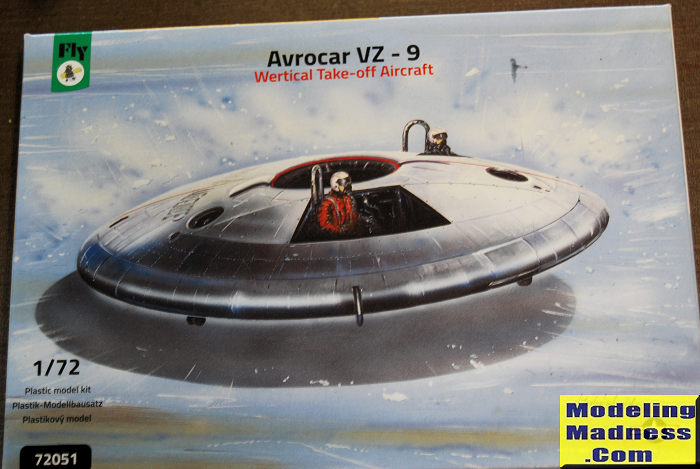
Fly Models 1/72 Avrocar VZ-9
| KIT #: | 72051 |
| PRICE: | $ |
| DECALS: | One option |
| REVIEWER: | Christopher Campbell |
| NOTES: | 2019 release |
| HISTORY |
There is so much that one could say about the Avrocar, though unfortunately, little of it is favorable. It was an idea that might have looked good on paper. However, in practice, at least with the technology of the time, it was ultimately flawed and doomed to failure.
Conceived at Avro Canada by designer John “Jack” Frost, whose resume included the DeHavilland Swallow prior to his move to Canada, the Avrocar was intended to operate as a VTOL aircraft using Coanda Effect. The U.S. became interested in the project after a visit to review the new Avro CF-100 “Canuck” twin jet fighter in which Frost also had a significant hand.
There was interest in the Avrocar both from the U.S. Air Force and The U.S. Army. It was proposed that such an aircraft could be used somewhat like a high performance helicopter, as speeds and altitudes were forecast far beyond those of contemporary rotary winged aircraft. The Army had an interest in using them for scouting, much like flying jeeps.
There was initially considerable enthusiasm for the project and others that it might spawn. While the Avrocar was to be operated at lower altitudes and speeds, Frost had plans for improved, larger aircraft that were to be, at least in theory, capable of Mach 3.5 and altitudes exceeding 100,000 feet. Why not? It was a genuine flying saucer, after all.
True, it was radical in every way. It was certainly an interesting concept. However, when put into practice, the theory did not work.
The Avrocar was powered by three Continental J-69-T9 turbojets powering a central “turborotor” at the center of the disc which would produce thrust when its one-hundred-twenty-four blades. This would provide lift. Control was a different matter entirely.
The Avrocar immediately began to show problems when testing began. It was unstable, wobbling as it flew in ground effect. Ground effect also seemed the only place that it could fly. When attempts were made to increase altitude there was what was described as a “tree trunk” effect when it eventually pitch over after the thrust column became ineffective or an attempt was made to transition to horizontal flight.
Attempted solutions to the Avrocar’s handling woes including included drilling holes in the bottom of the aircraft to help produce a more stable ground cushion. There was also perimeter focusing ring added in an attempt to improved control. Nothing worked, however.
No matter what modification had been made, the Avrocar was unstable at speeds exceeding thirty knots. It could barely operate in ground effect. It was, for all of its promise, a flawed design and a failure.
Two years of testing ended in 1961 with little to show for it. Better versions were being proposed with greater thrust potential on paper. Still, the plug was ultimately pulled on the program.
One surviving Avrocar eventually becoming a museum piece at the United States Air Force Museum in Dayton, Ohio. Another is under restoration at the Army Transportation Museum in Fort Eustis, Virginia. A replica is on displayed in Canada at the Royal Aviation Museum of Western Canada, Winnipeg, Manitoba. Your editor saw one when he visited Fort Eustis in 1999.
| THE KIT |
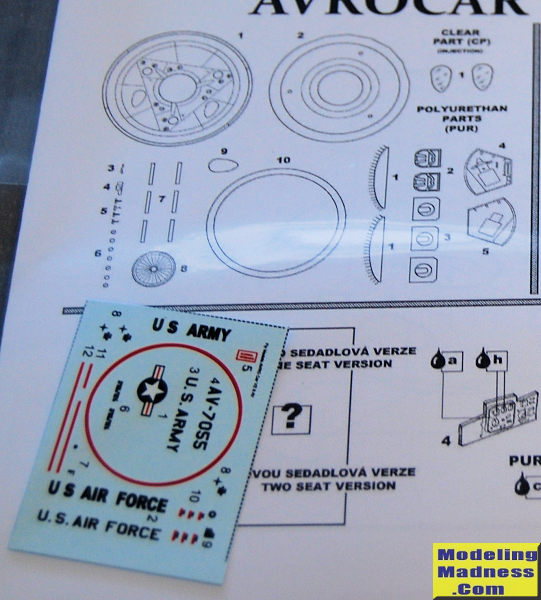 First
released by Fly models in 2013, this kit has seen a number of rereleases, mostly
quite fanciful. (More about that later.) It is crisply molded in beige plastic
and detail seems to be well done for the scale.
First
released by Fly models in 2013, this kit has seen a number of rereleases, mostly
quite fanciful. (More about that later.) It is crisply molded in beige plastic
and detail seems to be well done for the scale.
Parts include the upper and lower saucer halves, cockpit tubs which have appropriate detailing for their scale. This of course includes seats, control sticks, and cockpit wall detail. Also included is a well rendered turbine wheel that will be seen at the center of the Avrocar.
There are, naturally, in this scale some smaller, possibly somewhat fiddly pieces. These mainly comprise its tiny landing gear, though there are a few other bits as well. Clear injection molded canopy bubbles are also included, appropriate for most of the test examples, though it was at times flown without these.
Decals vary depending upon the release. I had one of the initial 2013 releases that I traded to someone for something. That one featured the standard markings used on the test examples. A subsequent “what if” release featured markings for an “operational” U.S. Army example along with a “bazooka.” (Presumably a recoilless rifle.) It also featured markings for Canadian, Polish, West German, Czechoslovakian, Iranian, and Japanese aircraft.
There have been multiple additional releases around the theme of air racers. Scalemates appears to show eight different boxings in this Racer X series, each featuring a markings for a single hypothetical air racer. This proved to be a problem for me, as when I went looking to replaced the Avrocar model that I had traded away, the only versions that I could find on the market were these air racers and I was interested in building one of the test aircraft. However, in 2019 Fly released it once again with the decals for the test article. This was what I picked up just a few months ago when I went looking for one again.
| CONCLUSIONS |
Fly Models Avrocar appears to be kit that any modeler with some 1/72 experience would have little trouble building. I would recommend it to anyone who likes the unusual; especially Cold War oddities such as this. It is on my short list, so I will likely very likely be featuring it in a build up review soon.
| REFERENCES |
https://en.wikipedia.org/wiki/Avro_Canada_VZ-9_Avrocar
https://en.wikipedia.org/wiki/John_Carver_Meadows_Frost
https://www.scalemates.com/kits/fly-72051-avrocar-vz-9--1226775
Christopher Campbell
June 2026
Copyright ModelingMadness.com. All rights reserved. No reproduction in part or in whole without express permission from the editor.
If you would like your product reviewed fairly and fairly quickly, please contact the editor or see other details in the Note to Contributors.