Two Bobs 1/48 T-2C Buckeye
| KIT #: | 48-002 |
| PRICE: | $60.00 when new |
| DECALS: | Five options |
| REVIEWER: | Spiros Pendedekas |
| NOTES: | MPM tooling |
| HISTORY |
The North American T-2 Buckeye was one of those aircraft that never needed to be glamorous to become important. Designed in the 1950s to serve as an intermediate jet trainer for the United States Navy, the Buckeye was intended to bridge the gap between basic flight training and the much more demanding world of operational jet aircraft. With its straight wings, broad fuselage, and unmistakably purposeful appearance, it may not have possessed the sleek looks of a fighter, but for generations of naval aviators it was an essential step on the road to the fleet.
The first Buckeyes entered service in the early 1960s, initially powered by a single Westinghouse J34 engine. The T-2B followed with two Pratt & Whitney J60 turbojets, providing a significant improvement in performance and reliability. The definitive T-2C appeared in the late 1960s, powered by two General Electric J85 engines. This combination gave the Buckeye the performance required for advanced training while retaining the qualities that made it such a useful and forgiving instructional aircraft. The T-2C subsequently became the principal version of the type in U.S. Navy service.
For almost five decades, the Buckeye formed an important part of the U.S. Navy's training system. Thousands of student naval aviators passed through its cockpit, learning the fundamentals of jet handling, navigation, formation flying, carrier procedures, and the demanding transition to high-performance aircraft. It was very much a working airplane: familiar, dependable, and hard-working rather than spectacular. The T-2 was also operated outside the United States, including by Venezuela and Greece, demonstrating the soundness and versatility of North American's design. Greece acquired the T-2E, a development closely related to the T-2C, in the 1970s.
Eventually, the Buckeye's long career began to draw to a close as the newer T-45 Goshawk took over the Navy's advanced jet-training role. Nevertheless, the T-2C remains a particularly memorable aircraft for anyone interested in naval aviation. It represents an era when the transition from propeller-driven trainers to jets was still a major part of a young pilot's training, and when a relatively simple, straight-winged aircraft could quietly prepare aviators for some of the most demanding flying in the world.
| THE KIT |
 The
modeling world was quite excited in 2009 when Two Bobs came with a 1/48 scale
T-2 Buckeye. Prior to that, only a few vacform kits were available in this
scale, so the arrival of a new T-2 in 1/48 was certainly welcome. The first
edition featured the 2009 IPMS National Convention anniversary markings and was
previewed by our Editor, whereas the second edition catered for some other
colorful markings, including American, Venezuelan, and Greek. This is the kit I
will preview.
The kit was handed to me as a gift by a beloved friend and a member of our local club, who, sadly, is no longer with us. That naturally makes this particular model especially meaningful to me.
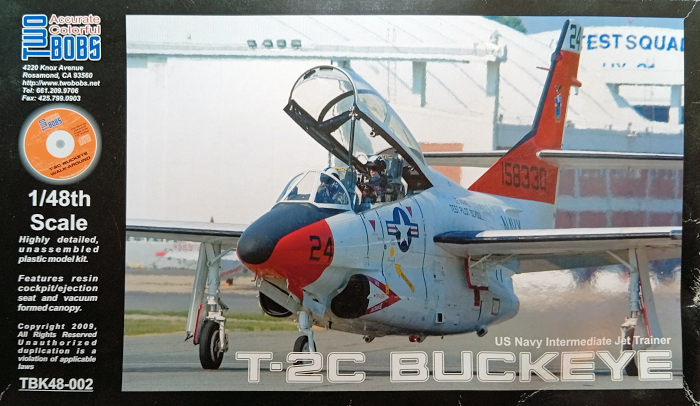
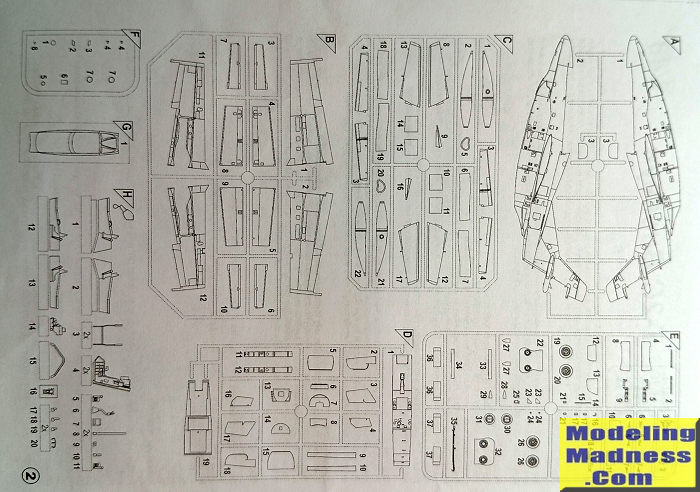
It comes in a medium-to-large-sized, top-opening box of relatively good quality, depicting a U.S. Navy example taxiing. Upon opening the box, I was greeted by 109 light-gray styrene parts, nicely arranged in five sprues. Molding is very good and sharp, and I noticed no flash within any of the parts. Panel lines are finely engraved and look to be in the correct places. As our Editor has noted, there are some injector stubs behind some parts, and some of them must definitely be removed in order not to cause problems during assembly.
There is also a selection of nicely cast polyurethane resin parts tackling various areas of the build, mainly around the cockpit, including two very nicely done ejection seats and some other smaller items.
The cockpit is well elaborated, combining styrene and polyurethane resin parts. It is quite good straight out of the box, and even with an open canopy it can stand very well on its own.
The landing gear is also very well done and is based solely on styrene parts, apart from a couple of resin hinges, which is also a good thing. The landing gear bays are reasonably well detailed and should look good even straight out of the box. A couple of oleos have to be made from stretched sprue, however, this may not be something every modeler will be comfortable with.
Full intake trunking is provided, as well as exhaust ducts, including compressor and tirbine faces. These are entirely based on styrene parts, with the only drawback being that the modeler has to deal with the inevitable seams where the duct halves are joined.
All moving surfaces, are separately provided. When sitting on the ground, a T-2 would normally have these surfaces mostly in their neutral positions, but their separate nature gives the modeler some dynamic posing options if desired. Of course, this also adds to the complexity of the build.
The fuselage consists of left and right halves with a separate lower section. This arrangement is expected to cause some issues during assembly and will require some care and dry-fitting. The characteristic wingtip tanks are also nicely provided.
The transparencies are vacuform, with two canopies provided. Though almost 20 years have passed, they are still in excellent condition, with no yellowing whatsoever. They are nice and clear and appear to be of good quality. The downside, of course, is that not everybody is comfortable working with vacuform parts. Having two canopies supplied is certainly welcome, particularly if the modeler wishes to pose one open.
The instructions come in the form of an eight-page A5 booklet, typical of the earlier MPM style. They include a short history of the type, a sprue map, and construction spread over 31 steps. These are relatively clear, concise, and followable by the reasonably experienced builder, which is where the kit is aimed nevertheless. No color callouts are provided, which is a real minus, especially back then. Today, with the later reincarnations of the kit by Special Hobby, the fantastic new Special Hobby instructions can be downloaded and consulted for the appropriate colors.
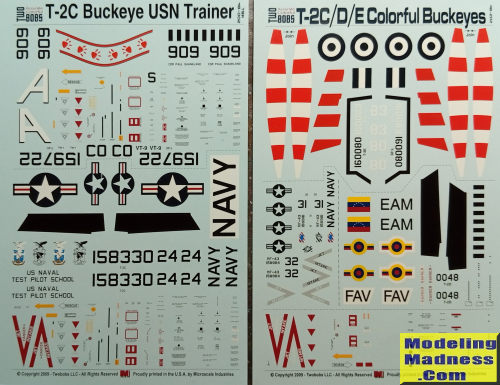 Five schemes
are provided: two classic white-and-orange U.S. Navy schemes, one very
attractive U.S. Navy aggressor scheme, a very nice Venezuelan white-and-orange
scheme, and, of course, the distinctive Vietnam camouflage scheme representing
the Greek T-2. All five schemes are really nice and interesting.
The decals are wonderfully printed by Microscale. They are well egistered, remain in excellent condition, and should be expected to work very nicely. Of course, only actual application will tell how they behave after all these years.
The instructions first call for assembly of the cockpit. Pay a little attention here, because quite a lot of resin and styrene parts have to be attached together. Next come the intakes, exhausts, and nose landing gear bay, with all of these components, including the cockpit, trapped between the fuselage halves.
Ten grams of weight are advised in the nose to prevent the model from sitting on its tail. I would add a little more just to be safe. Better safe than sorry.
The various aerodynamic surfaces are then assembled. Be sure to remove all the injection stubs carefully, as these can cause fit problems if left in place. The wings are assembled next, trapping the side walls of the main landing gear bays between them. They are next joined to the fuselage.
The ventral section is then attached underneath the fuselage, followed by the intake front sections and various other components, including the arresting hook and additional fuselage details. Some patience will definitely be required here.
The flaps are then attached to the main wings, with the option of posing them extended or retracted, followed by the rest of the moving surfaces. As mentioned earlier, their normal position on a parked aircraft would usually be "all neutral", but the modeler can decide how to pose them.
The landing gear is next assembled and attached, followed by the characteristic wingtip tanks. The very nice ejection seats are then installed in the cockpit. The build is finished with a few small bits and the canopy, which can be posed open or closed. If you decide to pose it open, careful cutting will be required. Fortunately, two canopies are provided.
This results in a build that is definitely complex. It is not an easygoing kit, and the complexity comes not only from the resin parts but also from the way the parts are broken down and the overall engineering of the model. It demands a careful approach from the modeler. The kit has a reputation for not being an easy build, but I am sure that an experienced modeler can tackle it successfully and come up with a fantastic result.
| CONCLUSIONS |
It is really wonderful that we do have a 1/48 T-2 Buckeye, and Two Bobs and MPM must be congratulated for bringing such a kit to the modeling world in 2009, at a time when no other 1/48 injected mixed-media T-2 kit was really available, something true also nowadays, with the Special Hobby incarnation being still the only option. That makes this an interesting release both as a modeling subject and as a piece of 1/48 scale kit history.
There is plenty to like here. The molding is very good and sharp, with no flash, and the panel lines are finely engraved. The resin components add useful detail, particularly in the cockpit, while the landing gear, intake and exhaust arrangements, and landing gear bays are all well represented. The five decal options are colorful and interesting, and the Microscale decals are beautifully printed.
Out of the box, a very detailed and imposing T-2 can emerge. The price for this level of detail, however, is complexity. The combination of styrene and polyurethane parts, the separately provided aerodynamic surfaces, the fuselage engineering, the intake and exhaust assemblies, and the vacuform canopy all require patience and careful modeling.
The original instructions could certainly have benefited from color callouts, but this has subsequently been addressed by the later Special Hobby releases. The kit evolved under Special Hobby with improved instructions, additional parts, a more detailed cockpit incorporating photo-etched components, extra cockpit decals, and, finally, an injected canopy. The latter is a very big plus and removes one of the more demanding aspects of the original Two Bobs kit.
The Special Hobby incarnations have also been available at very reasonable prices lately, making them an attractive choice for anyone looking specifically to build a T-2. The original Two Bobs release consequently occupies a somewhat different place today. It still offers very nice decals and marking options, but it has also become a kit for collectors.
So, if you find one, you can certainly keep it as a collector's item, or you can take the plunge and build it, taking into account everything discussed above. Either way, a fantastic and very imposing T-2 Buckeye can emerge.
For me, this is what makes the original Two Bobs release particularly interesting. It was an early attempt to give the 1/48 modeling community a proper mixed-media T-2 Buckeye, and it remains a fascinating package nearly two decades later. It may ask for some patience, but give it the care it deserves and a beautiful, detailed, and very imposing Buckeye can be the reward.
Happy Modeling!
October 2026 Copyright ModelingMadness.com. All rights reserved. No
reproduction in part or in whole without express permission. If you would like your product reviewed fairly and fairly quickly, please
contact
the editor or see other details in the
Note to
Contributors.