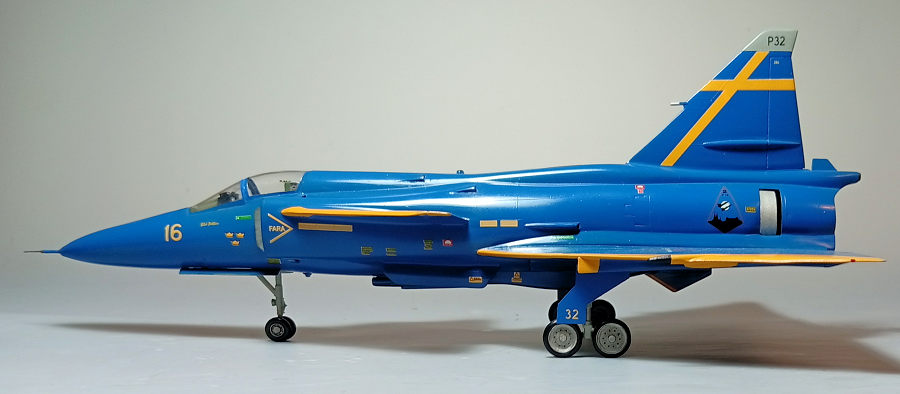
Airfix 1/48 JA.37 Viggen
| KIT #: | 07107 |
| PRICE: | 25 Euros |
| DECALS: | Two options |
| REVIEWER: | Spiros Pendedekas |
| NOTES: | Reboxed ESCI kit |
| HISTORY |
There are airplanes that are born to disappear. Their colors are chosen not for beauty, but for survival, designed to merge with forests and rocks, like the endless Scandinavian landscape. The Saab Viggen was one of them. When the Swedish Air Force introduced its famous splinter camouflage in 1974, the Viggen acquired one of the most distinctive schemes ever seen on a combat aircraft: sharp, irregular shapes of green and brown that broke up its outline against the forests, rocks and roads of Sweden. For years, this was the natural appearance of the Viggen, and even the JA 37 fighters wore the pattern before many later received the lighter grey scheme.
By the beginning of the new millennium, however, the world of the Viggen was changing. The Cold War had ended, newer aircraft were taking its place, and at F 16 Uppsala the future was bringing the closure of the 2nd and 3rd Squadrons. Among the aircraft there was JA 37 number 37432, another Viggen nearing the end of its career. It had spent years being exactly what it had been designed to be: a fast and powerful Swedish fighter, ready for a war that fortunately never came. Soon, it might simply become another retired aircraft.
 Then the technicians decided that
perhaps it deserved something more.
The idea was simple and, at the same time, completely unusual. They would give the aircraft a new color before the end. Not grey. Not the familiar green-and-brown splinter camouflage. Blue. The work was carried out by the technical personnel in their own time, using civilian, water-based blue paint applied with ordinary rollers. The old camouflage disappeared beneath the new finish, and the aircraft gradually became something nobody at F 16 had ever seen before.
A blue Viggen.
Blue was chosen because it was the official color of the 2nd Squadron, and the aircraft was soon given the name Blå Petter, or Blue Peter. “Petter” was the Swedish phonetic name for the letter P, the sixteenth letter of the alphabet, a small reference to F 16.
The result was spectacular. The unmistakable shape of the Viggen remained — the great delta wing, the small canards, the tall fin and the powerful engine — but the aircraft that had spent most of its life trying to disappear into the Swedish landscape was now impossible to overlook.
In 2001, Sweden celebrated the seventy-fifth anniversary of its Air Force, and Blå Petter made its public debut at Uppsala. The aircraft quickly became one of the stars of the celebrations, attracting the attention of aviation enthusiasts and modelers alike.
Inside the cockpit, however, nothing had changed. The canopy closed, the engine started, and the familiar sound of the Viggen rolled across the airfield. The blue fighter taxied toward the runway, accelerated and climbed into the Swedish sky. For an aircraft that had spent its life trying not to be noticed, it had never been more visible.
The unusual paint would eventually determine the aircraft's fate. Being civilian, water-based paint, it was not intended to withstand prolonged exposure to the elements, and the blue finish proved vulnerable to rain and harsh weather. The aircraft was eventually withdrawn from flight and preserved indoors, where Blå Petter remains a memorable reminder of the final years of the Viggen era.
For a machine built for war, it was a rather fitting final chapter. It did not disappear quietly. Instead, it became one of the most recognizable Viggens of all.
| THE KIT |
 This is the 2002 Airfix boxing of the
venerable 1/48 Saab Viggen, using the old Esci tooling. It is very
much a kit of its era and, naturally, cannot compete with the latest
and greatest Viggen offerings on the market today in terms of detail
and, perhaps, accuracy. Nevertheless, it remains a solid and
straightforward kit, with a respectable parts count and the promise
of an uncomplicated and enjoyable construction.
I remember discovering this particular Airfix boxing back in the mid-2000s, in one of my beloved Athens hobby shops. What immediately caught my attention was, of course, the blue aircraft on the box. I had always admired the spectacular Swedish splinter camouflage, but the idea of building a blue Viggen seemed much more approachable. The splinter scheme was certainly impressive, but it also promised a considerable amount of masking and painting. The blue Blå Petter, on the other hand, looked both striking and relatively straightforward to reproduce.
So I grabbed the box and took it home.
I built the kit at the time and enjoyed it, and it remained with me for many years. More recently, I decided to return to the model, refurbish it, improve a few areas and bring it up to the standard I wanted. In many ways, this made the project rather enjoyable all over again, combining an old kit with a subject that has always had a special visual appeal.
If you would like to take a closer look at the kit and explore its contents in greater detail, you can find an in-depth look at it in the ever-growing MM archives.
| CONSTRUCTION |
I started construction by following the instructions and assembling the cockpit, which is, by today's standards, rather Spartan. I made use of the useful instrument decals to represent the instruments on both the main instrument panel and the side console. The basic cockpit color was Light Ghost Gray, Humbrol 127, while the coaming was painted black at the rear and olive drab on its forward section, possibly representing the protective blanket fitted there on the real aircraft.
The seat received a little more
attention. Its framing was painted silver, while the rear cushion
was finished in olive drab and the upper cushion in a lighter green
shade. The ejection handles were picked out in the familiar
yellow-and-black, while the molded-on seat belts were represented by
a linen shade painting.With these additions, the cockpit was
essentially complete. It is certainly simple comp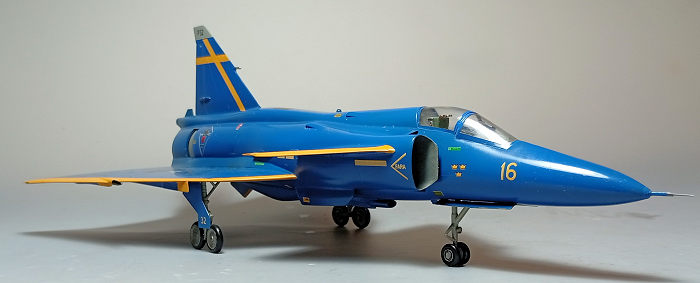 ared with what we
expect from modern kits, but once assembled and painted, it looks
quite acceptable, especially under the closed canopy.
The completed cockpit, together with the exhaust liner and the exhaust petals, which are molded in the closed position, were then trapped between the two fuselage halves, bringing the basic structure of the Viggen together. The intakes were next assembled and attached to the fuselage. After being painted aluminum on their interior surfaces, they were fitted into position. The large wings followed, going together without any particular difficulty, and were then joined to the fuselage. The distinctive canards were added next, followed by the vertical fin. Only then I checked the balance of the model and, despite not being mentioned at the instructions, I decided to trap around 30 grams of fishing weights in the nose, before securing it to the fuselage, gradually giving the model the unmistakable Viggen appearance.
A few more details were then added, including the distinctive ventral gun housing, the intake supporting frames and other small bits, bringing the basic model to completion. Overall, the fit was definitely not Tamiya, but neither was it particularly troublesome. There were several gaps and seams at the usual joints that required attention, but nothing beyond what could be handled with some patience. After a couple of rounds of filling and sanding, the Viggen was finally ready for the paint shop.
| COLORS & MARKINGS |
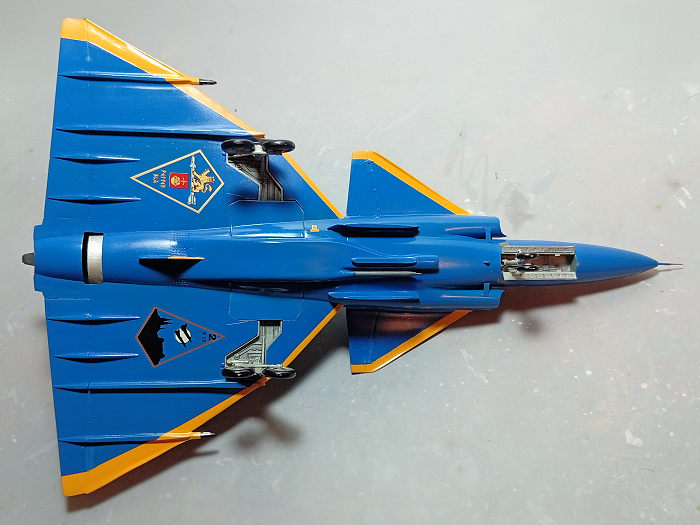
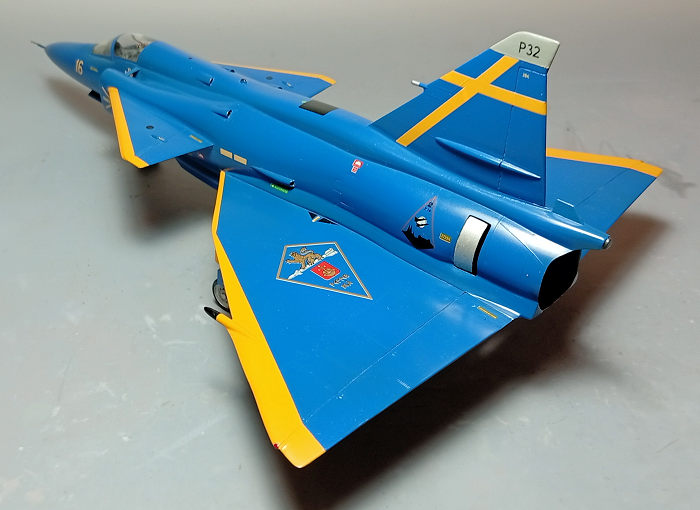
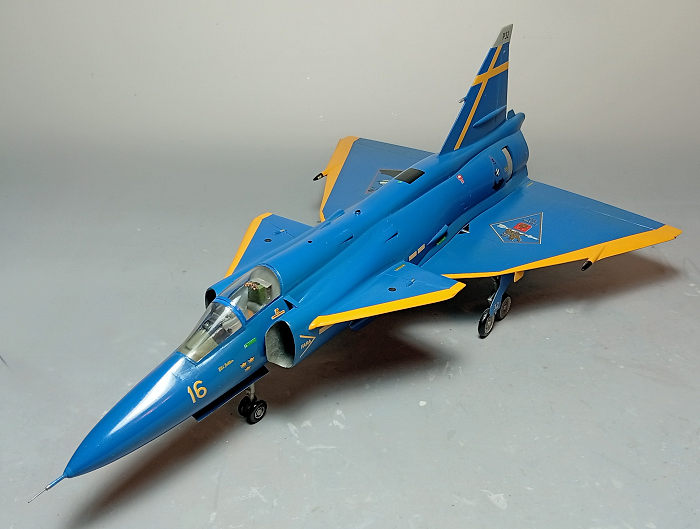 The complete model was first painted
in Humbrol 14 French Blue, which dried to a lovely blue shade and
provided the characteristic appearance of Blå Petter. The wing and
canard leading edges were then masked and painted Humbrol 69 Yellow.
This required a few applications, as yellow is one of those colors
that needs a little patience to achieve an acceptable finish.The fin
top was subsequently painted in Humbrol 127 Light Gray, following
the appearance of the real aircraft, with a coat of Future preparing
the bird for decals.
I used the kit decals, which behaved very well during application. Though not perfectly registered, they were certainly good enough to produce the distinctive appearance of Blå Petter.
A coat of Future sealed everything.
| FINAL BITS |
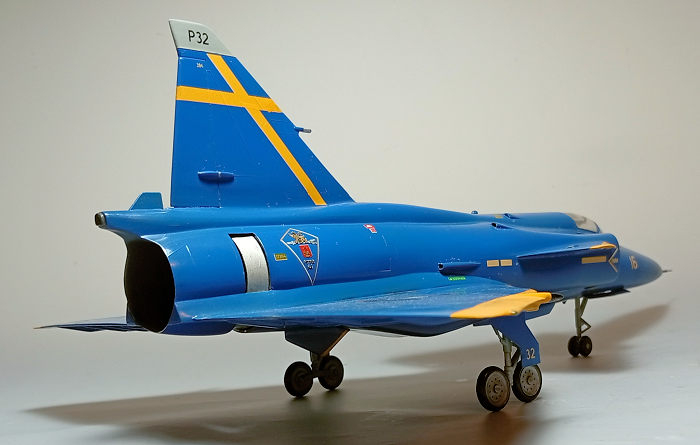 The landing gear was assembled and
installed, with the basic gear components receiving their
appropriate colors. The gear legs and doors were painted light gray,
the oleos silver, while the wheels received aluminum rims and black
tires.
For obvious reasons, I decided not to apply any weathering. Blå Petter was kept in pristine condition during its special career, and adding the usual dirt, exhaust staining or fading would have been inappropriate for this particular subject. A final satin coat brought everything together and gave the model its final appearance.
The transparenvies had their well defined frames hand painted and were then carefully attached in position, with fit being positive. The front pitot tube was carefully painted and installed, followed by the ventral gun, together with the remaining small details that gradually brought the model to completion. The wingtip lights were represented with small blobs of clear red and green paint, adding that final little touch of color to the otherwise very clean finish.
| CONCLUSIONS |
This is certainly not the latest and greatest Viggen kit available today. The tooling dates back to the Esci era, and it shows in several areas, particularly in the cockpit, landing gear and some of the finer details. Modern offerings have naturally moved the standard forward considerably, providing far more refined parts, sharper detail and improved accuracy.
But that is not really the point of this kit.
The old Airfix/Esci Viggen remains an
uncomplicated and enjoyable model to build. It is a little rough
around the edges, and the fit requires some attention, but no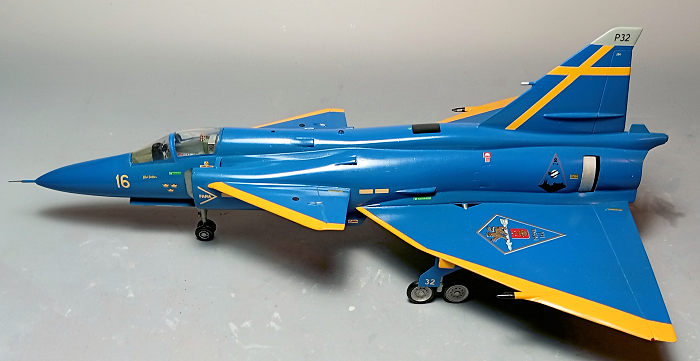 thing
is particularly intimidating. A few rounds of filling and sanding
are all that are needed to turn it into a respectable representation
of the unmistakable Swedish fighter. The relatively simple
construction also makes it a solid candidate for a relaxed project,
especially when found at a reasonable price.
Of course, if maximum detail is what you are after, the newer Tarangus/Special Hobby Viggen is now the obvious modern alternative, with a far more sophisticated approach to the subject. But it also belongs to an entirely different generation of tooling, and it should not make us forget what the old Esci kit achieved when it first appeared.
I have a particular affection for this one because I first built it many years ago, after spotting that wonderful blue aircraft on the Airfix box in one of my favorite Athens hobby shops. Coming back to it years later, refurbishing it and giving it a little extra attention reminded me why I had bought it in the first place. Sometimes a kit does not have to be perfect to be enjoyable.
That, ultimately, is where this old Viggen fits. It is not the most detailed, the most accurate or the most sophisticated kit on the market, but it is an easy-going, honest kit that can still produce a very attractive model with a little care.
For a subject as spectacular as Blå Petter, that is certainly good enough.
Happy Modeling!
2 November 2026
Copyright ModelingMadness.com.
All rights reserved. No reproduction in part or in whole without express
permission from the editor. If you would like your product reviewed fairly and fairly quickly, please
contact the editor
or see other details in the
Note to
Contributors. Back to the Main Page
Back to the Review
Index Page
Back to the Previews Index Page