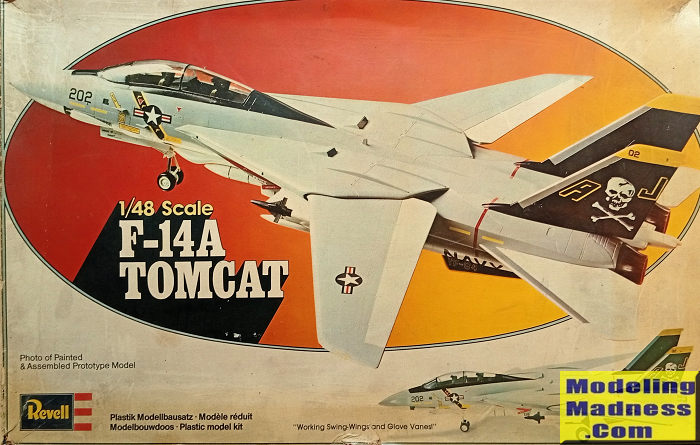
Revell 1/48 F-14A Tomcat
| KIT #: | H-291 |
| PRICE: | $ |
| DECALS: | One option |
| REVIEWER: | Spiros Pendedekas |
| NOTES: | 1978 Revell tooling (not Monogram kit) |
| HISTORY |
The Grumman F-14 Tomcat is an American
carrier-capable supersonic, twin-engine, tandem two-seat, twin-tail,
all-weather-capable variable-sweep wing fighter aircraft. The Tomcat was
developed for the United States Navy's Naval Fighter Experimental (VFX) program
after the collapse of the General Dynamics-Grumman F-111B project. A large and
well-equipped fighter, the F-14 was the first of the American Teen Series
fighters, which were designed incorporating air combat experience against
smaller, more maneuverable MiG fighters during the Vietnam War.
The F-14 first flew on 21 December 1970 and made its first deployment in 1974
with the U.S. Navy aboard the aircraft carrier USS Enterprise, replacing the
McDonnell Douglas F-4 Phantom II. The F-14 served as the U.S. Navy's primary
maritime air superiority fighter, fleet defense interceptor, and tactical aerial
reconnaissance platform into the 2000s. The Low Altitude Navigation and
Targeting Infrared for Night (LANTIRN) pod system was added in the 1990s and the
Tomcat began performing precision ground-attack missions. The Tomcat was retired
by the U.S. Navy on 22 September 2006, supplanted by the Boeing F/A-18E/F Super
Hornet. Several retired F-14s have been put on display across the United States.
Having been exported to Pahlavi Iran under the Western-aligned Shah Mohammad
Reza Pahlavi in 1976, F-14s were used as land-based interceptors by the Imperial
Iranian Air Force. Following the Iranian Revolution in 1979, the Islamic
Republic of Iran Air Force used them during the Iran–Iraq War. Iran claimed
their F-14s shot down at least 160 Iraqi aircraft during the war (with 55 of
these confirmed), while 16 Tomcats were lost, including seven losses to
accidents.
| THE KIT |
 Revell
came in 1978 with its 1/48 F-14A, issued three years before Monogram (which was
a different company at that time) issued its own, more detailed 1/48 Tomcat. In
1986 the two companies merged, so the now Revell-Monogram company logically
marketed the more advanced Monogram mold. So, these two molds are different and
must not be confused.
Revell
came in 1978 with its 1/48 F-14A, issued three years before Monogram (which was
a different company at that time) issued its own, more detailed 1/48 Tomcat. In
1986 the two companies merged, so the now Revell-Monogram company logically
marketed the more advanced Monogram mold. So, these two molds are different and
must not be confused.
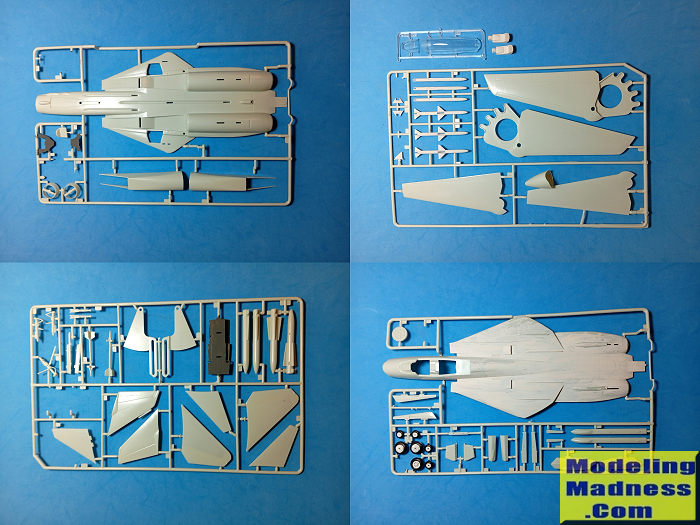
The specific kit is the original 1978 pure Revell tooling, belonging to a
deceased, beloved local club member and was handed to me by his wife. For the
size of the model, the kit comes in a surprisingly small, good quality (but
beaten by time), top opening box, carrying a box art of a finished model. Upon
opening the box, I was greeted by just 80 light grey styrene parts arranged in
four equally sized sprues that barely fit in the box. The kit had been merely
started, with almost all parts still attached to the sprues.
Molding is old school, with the plastic itself being shiny and hard. Apart from
some mold separation lines, no flash is apparent. Panel lines are a combination
of raised and engraved. Cockpit is minimalistic, containing only two instrument
panels and two ultra simplistic seats. Instruments and side consoles are
represented by average looking decals. At least, Revell could have provided two
crew figures to blank the emptiness.
Landing gear is also simplistic (towards toyish), with no detail in the main
bays and minimal depth on the nose bay. Same for the exhausts, which are
simplistic and shallow and for the intake trunking which is totally void. The
wings are geared and include working canards that extended once the wings
retracted (a nice touch, though, to my understanding, this feature was deleted
in reality and the canards were wired shut). Two Phoenix, two Sidewinders and
three Sparrows are included, all simple looking.
 Transparencies
are at least well molded and clear. Apart from not providing color shades
throughout the build but for the final scheme, instructions are otherwise well
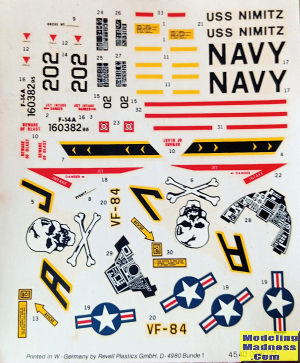
done, coming in the form of a 8-page b/w booklet. Construction is nicely spread
in 67 simple and concise steps, with around one third of them dealing with
different options (gear up or down and the like). Only one scheme is catered
for, the classic #202 “Jolly Rogers” bird. Color shades are provided in Revell
codes and in generic form. Decals, reasonably printed back then, badly show
their almost 50yo age, being very yellowed. At least they are not cracked, so
taping them on a window facing the strong Greek sun might give them a chance…
Transparencies
are at least well molded and clear. Apart from not providing color shades
throughout the build but for the final scheme, instructions are otherwise well
done, coming in the form of a 8-page b/w booklet. Construction is nicely spread
in 67 simple and concise steps, with around one third of them dealing with
different options (gear up or down and the like). Only one scheme is catered
for, the classic #202 “Jolly Rogers” bird. Color shades are provided in Revell
codes and in generic form. Decals, reasonably printed back then, badly show
their almost 50yo age, being very yellowed. At least they are not cracked, so
taping them on a window facing the strong Greek sun might give them a chance…
Instructions want you to first assemble the interior, the wings, the elevators
and, together with the canards and the exhaust faces, trap them between the
fuselage halves. The intakes are next attached, followed by the ventral strakes,
the rudders, the exhausts and the nose. No front weight is mentioned and, I
believe, none needed. Landing gear installation is next, followed by the
ordnance and, finally, the canopy (which is positionable), ending a simple and
straightforward looking build.
| CONCLUSIONS |
The fact that Revell discontinued this kit and
marketed the Monogram one soon after merging with Monogram says it all: this is
clearly an old school, simplistic mold, with the overall detail reminiscent of
an average 1/72 kit. While passable in terms of molding, basic shapes of parts,
surface details and clear parts rendition, cockpit is spartan, landing gear is
void of details (with the parts leaning towards the toy-ish side), intakes are
empty and exhausts are oversimplified. The fact that only one decal scheme is
provided is only a theoretical minus, as few would attempt using those 50yo
decals.
That said, there is nothing really wrong in putting this Revell mold together
and coming up with a reasonable representation of a quarter scale Tomcat. Though
simply engineered and with the construction definitely looking straightforward,
one can only really tell about its ease of construction upon building it. Very
scarce to find nowadays, but I noticed a couple on the net priced quite low.
Happy Modeling!
Spiros Pendedekas
June 2026
Copyright ModelingMadness.com. All rights reserved. No reproduction in part or in whole without express permission.
If you would like your product reviewed fairly and fairly quickly, please contact the editor or see other details in the Note to Contributors.