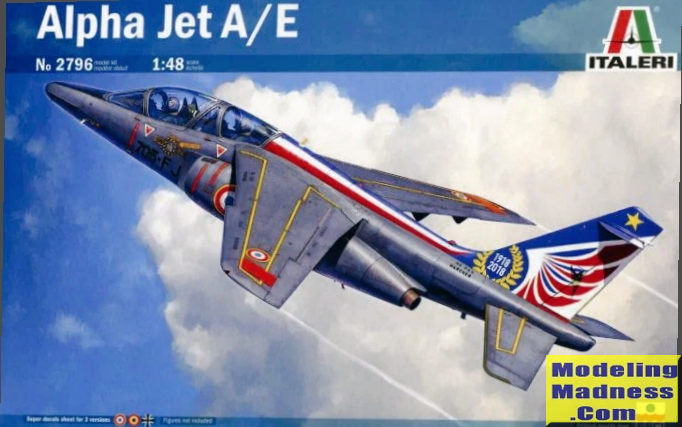
| KIT #: | 2796 |
| PRICE: | 25 Euros |
| DECALS: | Three options |
| REVIEWER: | Spiros Pendedekas |
| NOTES: | ESCI tooling |
| HISTORY |
The Dassault-Breguet/Dornier Alpha Jet was developed during the late 1960s as a joint French-German project to produce a modern twin-engine jet trainer. Both nations were looking for a successor to their aging Fouga Magister and Lockheed T-33 fleets, although their operational requirements eventually diverged. France concentrated on an advanced training aircraft, while Germany wanted an aircraft capable of both training and tactical ground-support missions.
The resulting Alpha Jet was a compact, tandem-seat aircraft powered by two SNECMA-Turbomeca Larzac turbofans. The prototype made its first flight on October 26, 1973, and testing demonstrated the aircraft's excellent handling qualities and maneuverability. The differing national requirements resulted in two principal versions: the French Alpha Jet E (École), optimized for training, and the German Alpha Jet A (Appui Tactique), intended for tactical support.
The French version entered service in 1979, followed by the German aircraft in 1980. The Alpha Jet subsequently achieved considerable export success, serving with numerous air forces around the world. A total of 512 aircraft were produced. The type also became particularly famous in France after being selected as the aircraft of the Patrouille de France aerobatic team in 1981.
Compact, reliable, maneuverable, and relatively economical to operate, the Alpha Jet enjoyed a remarkably long career and became one of Europe's most successful jet trainers of the Cold War era.
| THE KIT |
 This
is yet another venerable ESCI mold. ESCI originally released its 1/48 Alpha Jet
in 1980, and the tooling has survived remarkably well over the decades,
appearing in several reboxings before eventually finding its way into Italeri's
extensive collection of former ESCI molds. Italeri reissued the kit as #2796 in
2019, which is the subject of this preview.
This
is yet another venerable ESCI mold. ESCI originally released its 1/48 Alpha Jet
in 1980, and the tooling has survived remarkably well over the decades,
appearing in several reboxings before eventually finding its way into Italeri's
extensive collection of former ESCI molds. Italeri reissued the kit as #2796 in
2019, which is the subject of this preview.
My example was purchased from an Athens hobby shop in 2022 at what seemed to be a reasonable price. It comes in one of Italeri's familiar high-quality, but side-opening boxes. Personally, I always prefer a top-opening box, which is considerably more convenient when storing and handling a kit during construction. The box art, however, is really wonderful, depicting an Alpha Jet in an attractive French commemorative scheme. It certainly makes a good first impression.
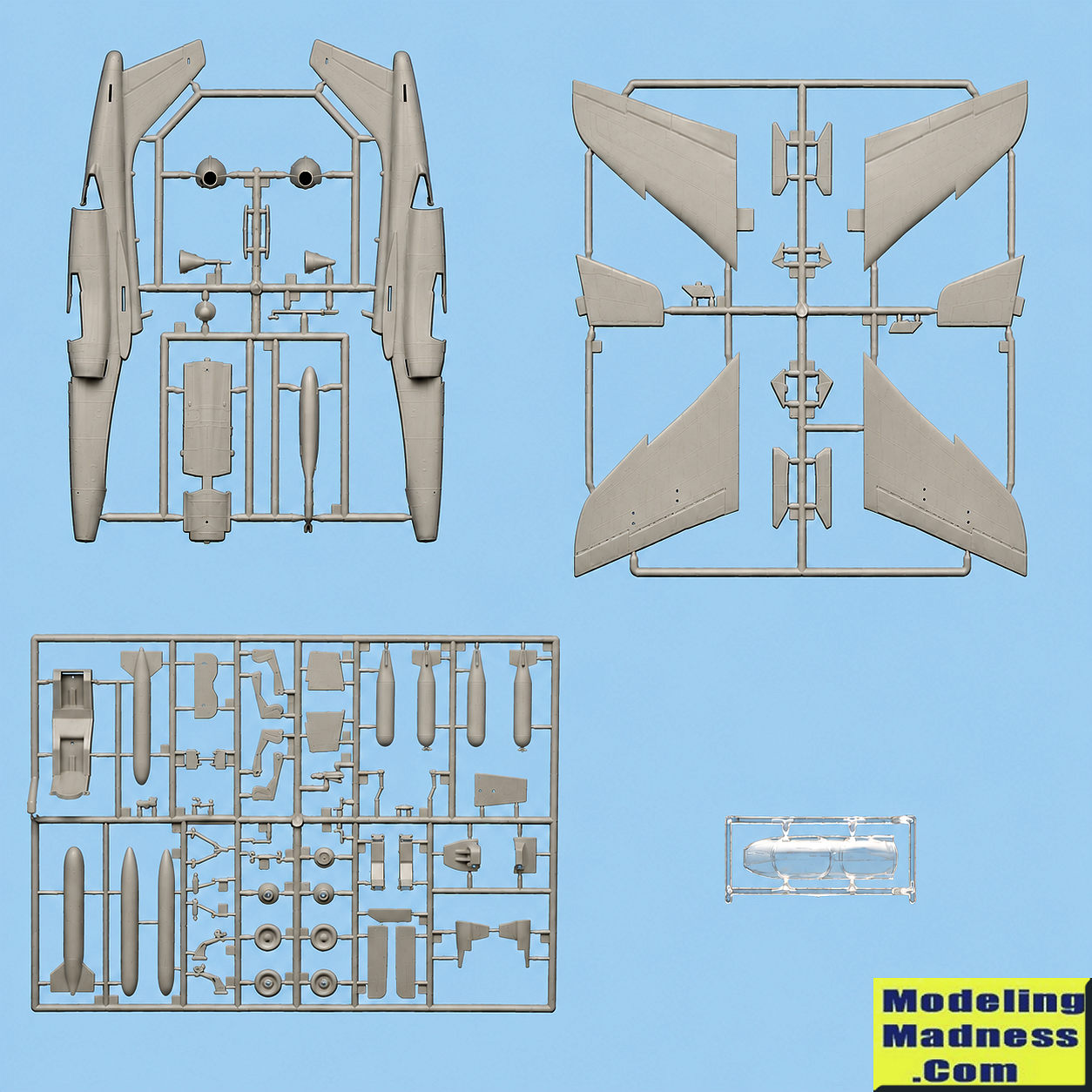
Inside the box we find 76 light-gray styrene parts nicely arranged on three sprues. Considering that the tooling dates from 1980, the molding is surprisingly good. The molds have clearly been looked after, and there is relatively little flash. Panel lines are, of course, raised all over and at the correct places. Naturally, the finesse cannot compete with a modern 1/48 tooling, but the overall quality is quite respectable for a kit of this vintage.
The cockpit is adequately represented, although it is inevitably somewhat simplistic by today's standards. The instrument panels and side consoles are represented by decals, while seat belts are also provided as decals - a nice touch. The ejection seats appear somewhat oversized, and I agree with the reports concerning their dimensions. The modeler can either accept them as supplied, replace them with resin aftermarket seats, or modify the kit parts by carefully performing some surgery and shortening them. While the cockpit is adequate for a closed-canopy model, anyone intending to display the canopy open will probably want to add some extra detail.
The landing gear is acceptable but, again, does not possess the finesse of more modern toolings. The same applies to the engine intakes and exhausts. They are adequately represented rather than spectacular, although the exhaust assemblies are actually quite nicely done. Two different nose options are included, allowing the modeler to represent the different Alpha Jet versions.
The kit's greatest strength becomes apparent when looking at the overall airframe. The external shape looks very accurate and, to my eye, captures the characteristic lines and proportions of the Alpha Jet extremely well. For an older tooling, this is a significant advantage.
The clear parts are another positive point. They are nicely molded, crystal clear, and should make an excellent contribution to the finished model, particularly if the canopy is displayed closed.
Italeri's instructions are excellent. They are color printed and include a short history of the aircraft, a sprues map, a color chart, and the construction sequence. Construction is divided into five main stages, which are further broken down into smaller sub-steps, with the differences between the different versions clearly indicated. Color callouts are provided throughout. Everything is presented concisely and logically, and even a relatively inexperienced modeler should have little difficulty following them.
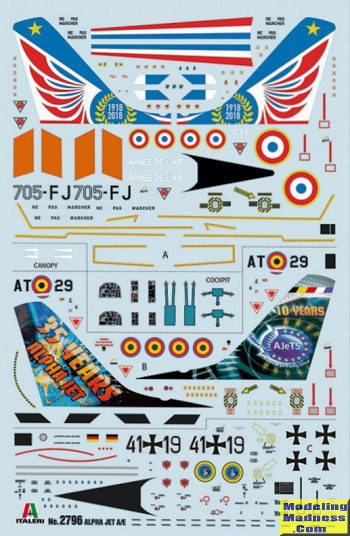 Three marking
options are supplied: a commemorative Belgian aircraft, a commemorative French
aircraft, and a German version. The decals are beautifully printed, as is
normally the case with Italeri. Registration is excellent, colors are sharp, and
they should work very well. The sheet is one of the strongest features of the
kit and should add considerably to the appearance of the completed model.
Three marking
options are supplied: a commemorative Belgian aircraft, a commemorative French
aircraft, and a German version. The decals are beautifully printed, as is
normally the case with Italeri. Registration is excellent, colors are sharp, and
they should work very well. The sheet is one of the strongest features of the
kit and should add considerably to the appearance of the completed model.
The construction sequence is quite straightforward. The cockpit, main and nose landing gear are first assembled and consequently trapped between the fuselage halves. I did not notice any specific instruction concerning nose weight, so this is something I strongly recommend checking before beginning construction, as I would be surprised if none is needed. The distinctive lower fuselage section is then attached, followed by installation of the wings and tailplanes.
The wing pylons are added next, together with the nicely represented exhaust assemblies. The following stage deals with the external stores and includes the option of installing the central gun for the appropriate C version. Various landing gear doors and smaller external components are then fitted, followed by the remaining cockpit details. Finally, the clear parts are attached, bringing the construction to an end.
Looking at the instructions, there appear to be no major traps or unnecessarily complicated construction sequences. The kit looks like it should be a pleasant and relatively trouble-free build.
| CONCLUSIONS |
There is no question that this is a dated kit. It is, however, also a classic in its own right, and I think it should be judged with that in mind.
The molding is quite good, especially considering the age of the tooling, and Italeri has clearly taken good care of the molds. The panel lines are raised, as one would expect from a tooling of this period, but they are at the right places and, personally, I do not consider them a problem. The overall level of detail ranges from average to good rather than exceptional. The cockpit, landing gear, intakes, and other components are all acceptable, but none of them will impress a modeler accustomed to the latest generation of 1/48 kits.
The real strength of this kit is the overall shape of the aircraft. The Esci Alpha Jet looks right, and that is a very important quality. The proportions and characteristic lines of the aircraft are very well captured, making this a particularly attractive option for anyone who values accuracy of the basic airframe over an abundance of surface detail.
The clear parts are excellent, the instructions are among the best features of the kit, and the decals are outstanding. With some additional work in the cockpit and attention to the ejection seats, a very respectable Alpha Jet can certainly emerge straight from the box.
Of course, there are more modern alternatives. The Kinetic Alpha Jet is a much more sophisticated and detailed kit and represents the obvious choice for the modeler looking for the latest and greatest. However, it is also generally regarded as a more demanding build, with some reported issues concerning the shape of the rear fuselage and the fit of the canopy, which is said to be somewhat narrower than the surrounding fuselage. These are not necessarily serious problems, but they are worth keeping in mind.
There is also the PJ Productions resin Alpha Jet, which is a very different proposition. It is a highly regarded and accurate kit, but it is considerably more difficult to find, more expensive, and naturally presents the additional challenges associated with working with resin. It is certainly not the easiest route to an Alpha Jet.
This leaves the Italeri kit with some very strong arguments in its favor. It is the simplest of the three options, it is comparatively easy to build, it has a very good overall shape, and it is less expensive. The level of detail is its main weakness, but that can be improved by the experienced modeler with some aftermarket items and a little extra work.
In the end, it comes down largely to price and expectations. If you want the most sophisticated and highly detailed Alpha Jet available, the Kinetic offering is probably the way to go. If you want a very accurate but much more specialized resin kit and can find one at a sensible price, the PJ Productions offering is certainly worth considering.
But if the Italeri kit can be found at a good price, it is a very good buy for what it offers. The accurate overall shape, straightforward construction, excellent instructions, crystal-clear transparencies, and especially the wonderful decal sheet make it an attractive package.
This may be an old kit, but it still has plenty going for it. It will not satisfy the modeler demanding every possible modern refinement straight from the box, but for someone looking for an enjoyable and relatively uncomplicated 1/48 Alpha Jet with a very good basic shape, the Italeri kit remains a kit worth tackling.
Happy Modeling!
September 2026
Copyright ModelingMadness.com. All rights reserved. No reproduction in part or in whole without express permission.
If you would like your product reviewed fairly and fairly quickly, please contact the editor or see other details in the Note to Contributors.