The Dassault Mirage 2000 is a French-designed, single-engine,
delta-wing multirole fighter developed by Dassault Aviation in the late
1970s and introduced into service in the 1980s as a successor to the
Mirage III family. Renowned for its sleek aerodynamic design and high
agility, the Mirage 2000 combines advanced fly-by-wire controls with a
powerful turbofan engine, enabling excellent performance in both
air-to-air and air-to-ground missions. It has been widely exported and
adapted into multiple variants, including interception, strike, and
nuclear delivery roles, serving in several air forces around the world.
Its reliability, versatility, and continuous upgrades have allowed it to
remain operationally relevant well into the 21st century, making it one
of the most successful European combat aircraft of its generation.
 Heller
came in 1982 with its new tool single seater Mirage 2000, followed, via
addition of new parts, by the dual seater a couple of years later. Both
kits have then been reboxed almost 40 times ever since (either as
standalone kits or “model sets”), including reissues by Humbrol, Airfix
(both being sister companies for a while), Testors and AeroMaster. The
preview kit is the 2023 single seater tooling, reissued by the “new”
Heller, after being acquired by Glow2B. Once Heller’s German distributor
and former subsidiary, Glow2B, led by Heinz Engstfeld, evolved into a
major player in the hobby industry before acquiring the brand during its
financial difficulties, bringing the story full circle by placing the
historic French name in the hands of a long-time partner.
Heller
came in 1982 with its new tool single seater Mirage 2000, followed, via
addition of new parts, by the dual seater a couple of years later. Both
kits have then been reboxed almost 40 times ever since (either as
standalone kits or “model sets”), including reissues by Humbrol, Airfix
(both being sister companies for a while), Testors and AeroMaster. The
preview kit is the 2023 single seater tooling, reissued by the “new”
Heller, after being acquired by Glow2B. Once Heller’s German distributor
and former subsidiary, Glow2B, led by Heinz Engstfeld, evolved into a
major player in the hobby industry before acquiring the brand during its
financial difficulties, bringing the story full circle by placing the
historic French name in the hands of a long-time partner.
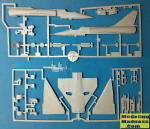
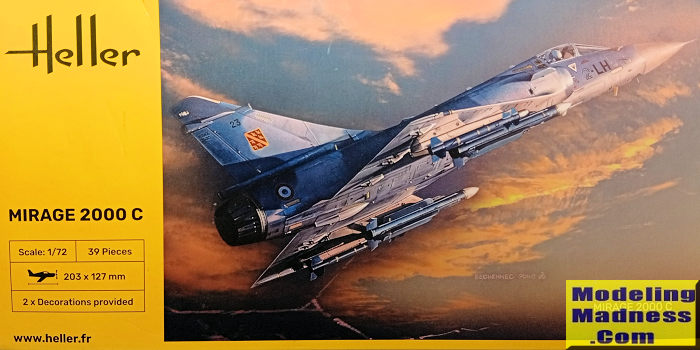
The kit comes in a good quality top opening box, carrying an attractive
classic box art by artist Daniel Bechennec, depicting EC 3/2 Alsace’s
2-LH machine as it stood in 1991. Upon opening the box, I was greeted
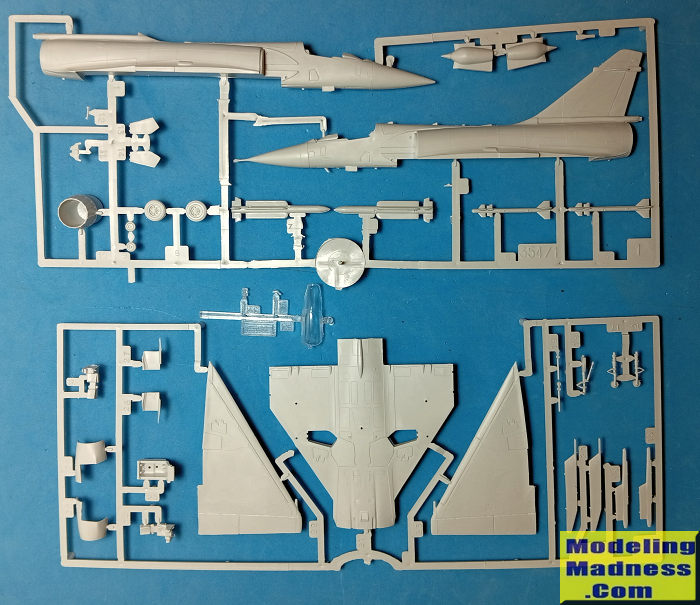
with 36 light gray styrene parts arranged in two sprues, which are
wrapped in a black soft crepe paper so they don’t rub against each
other. Molding presents some flash and a few ejector pin marks here and
there, not that difficult to clean up (the molds are well over four
decades old). One good thing I noticed is that the plastic itself is
thoroughly harder than the super soft type Heller used to treat us the
last two decades or so, and now you don’t have to worry that much for
that scale-thickness main gear leg buckling over time.
Overall shapes of parts are very accurate. Panel lines, though raised,
are finely done and at the correct places. Cockpit detail is average,
containing a flat instrument panel, an acceptable seat and a stick. Same
mixed feelings for the landing gear, where you have good looking gear
legs and wheels, but bays devoid of any detail. The exhaust nozzle is
acceptable, as are the intakes, which feature some depth. Weapons
include two R550 Magic II and two R530 air to air missiles, an outfit
typically carried in the 90s. I wouldn’t mind at all if the small extra
sprue included in the two seater versions, containing the also typically
carried distinctive centerline drop tank, the refueling probe and a few
other bits was also included in this kit.
The transparencies, protected in a separate nylon bag, are well molded
and clear. Instructions, essentially an improved version of the old
ones, are nice, coming in the form of a 8-page A4 color booklet,
containing a short history of the type, a color chart, with the
construction spread in 5 clear and concise steps and color callouts
given where needed.
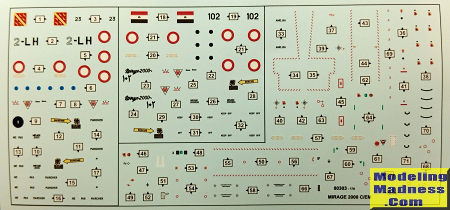 Two
nice schemes are provided, the same as in older boxings, for a French
and an Egyptian machine. Colors are given in Humbrol codes and in
generic form. What has vastly improved from those older boxings is the
quality of the decal sheet, which is now superbly printed and in
register. Bravo Heller/Glow2B!
Two
nice schemes are provided, the same as in older boxings, for a French
and an Egyptian machine. Colors are given in Humbrol codes and in
generic form. What has vastly improved from those older boxings is the
quality of the decal sheet, which is now superbly printed and in
register. Bravo Heller/Glow2B!
Instructions want you to first assemble the cockpit and trap it between
the fuselage halves. Be sure to secure at least 10 grams of weight in
the front, to avoid tail sitting. The intakes are then assembled and
attached. Take your time here, in order to align everything. The nose
landing gear is to be attached then, but I would attach it at end
stages.
The wings are next, where you have to attach the lower half to the
fuselage, followed by the upper halves. This is another area that will
need your attention, in order to obtain a good overall fit. The exhaust
nozzle is next, followed by the canopy, the landing gear and the
external stores. Having built this kit many times, I can say that
construction is quick but definitely needs attention in certain areas,
in order to obtain a good fit.
Though elderly, this is still a decent kit: those 40yo molds still
provide acceptable sprues without too much flash, panel lines are raised
but finely done and at the correct places, shapes of parts are accurate,
overall detail is, possibly expectedly, average, including the key areas
of cockpit, landing gear, intakes and exhaust, transparencies are well
done, the upgraded instructions are nice and the decals are superb. All
these are attractively packaged and offered at a good, very sensible
price.
Out of the box an accurately shaped and decently detailed Mirage 2000
can emerge. The build itself is uncomplicated, so even a beginner can
tackle it, with some attention needed in a few areas, in order to make
those parts from the 40yo molds fit well.
The other options for a 1/72 Mirage 2000 are the more or less similarly
priced Italeri kit (which has engraved panel lines, fits well, has more
weapon options but has accuracy issues) and the more than twice as
expensive Modelsvit offering, which is the latest, greatest and, in many
ways, the definitive 1/72 Mirage 2000 kit. So, your options are clear.
A final word regarding Heller’s resurrection: it’s really great that
Glow2B has acquired Heller and offers its (much beloved and sought after
by many) toolings with maintained molds, nice packaging, upgraded
instructions, superb decals and, equally importantly, low prices. In
this respect, this Mirage 2000C is definitely a kit worth tackling.
Happy Modeling!
 Heller
came in 1982 with its new tool single seater Mirage 2000, followed, via
addition of new parts, by the dual seater a couple of years later. Both
kits have then been reboxed almost 40 times ever since (either as
standalone kits or “model sets”), including reissues by Humbrol, Airfix
(both being sister companies for a while), Testors and AeroMaster. The
preview kit is the 2023 single seater tooling, reissued by the “new”
Heller, after being acquired by Glow2B. Once Heller’s German distributor
and former subsidiary, Glow2B, led by Heinz Engstfeld, evolved into a
major player in the hobby industry before acquiring the brand during its
financial difficulties, bringing the story full circle by placing the
historic French name in the hands of a long-time partner.
Heller
came in 1982 with its new tool single seater Mirage 2000, followed, via
addition of new parts, by the dual seater a couple of years later. Both
kits have then been reboxed almost 40 times ever since (either as
standalone kits or “model sets”), including reissues by Humbrol, Airfix
(both being sister companies for a while), Testors and AeroMaster. The
preview kit is the 2023 single seater tooling, reissued by the “new”
Heller, after being acquired by Glow2B. Once Heller’s German distributor
and former subsidiary, Glow2B, led by Heinz Engstfeld, evolved into a
major player in the hobby industry before acquiring the brand during its
financial difficulties, bringing the story full circle by placing the
historic French name in the hands of a long-time partner.