| KIT #: | 07107 |
| PRICE: | 25 Euros |
| DECALS: | Two options |
| REVIEWER: | Spiros Pendedekas |
| NOTES: | Reboxed ESCI kit |
| HISTORY |
The Saab 37 Viggen was one of the most distinctive and technically ambitious combat aircraft of the Cold War. Developed by Saab for the Swedish Air Force, it was designed around Sweden's unique requirement for an aircraft capable of operating from short road bases and dispersed airfields. Its unusual configuration, combining a large delta wing with foreplanes, or canards, gave the Viggen excellent short-field performance, while its powerful engine and thrust reverser allowed it to operate from Sweden's network of improvised runways.
The prototype first flew on February 8, 1967, and the first production aircraft entered Swedish Air Force service in 1971. The Viggen was produced in several specialized versions, including the AJ 37 attack aircraft, SF 37 and SH 37 reconnaissance variants, and the SK 37 two-seat trainer. The ultimate fighter version was the JA 37, developed as an all-weather interceptor for the Swedish air-defense system.
The JA 37 featured a more powerful RM8B engine, revised avionics and radar, a taller fin, a modified airframe and a distinctive under-fuselage gun installation. The first production JA 37 flew in 1977, and the type entered operational service in 1979. It remained one of the most capable European fighters of its era and continued in Swedish service until the gradual introduction of the Saab JAS 39 Gripen.
The camouflage that made the Viggen famous was itself highly distinctive: the angular Swedish “splinter” pattern, consisting of carefully defined areas of green, dark green, tan and gray. The pattern was not randomly applied but followed a standardized design, making the aircraft immediately recognizable and providing a particularly challenging subject for modelers.
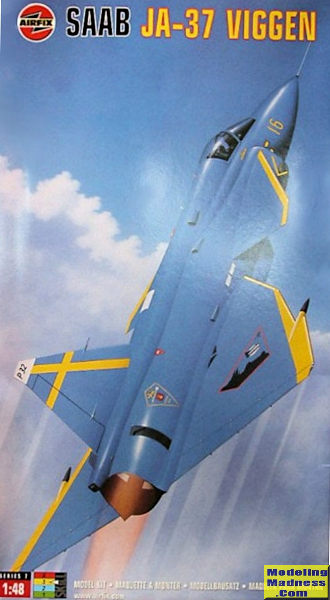
One of the most famous Viggens was JA 37D serial 37432, better known as “Blå Petter.” The aircraft was delivered to F 16 Wing at Uppsala and later received its spectacular blue-and-yellow commemorative finish. It became one of the stars of the 2001 Uppsala Airshow and, with its striking colors, transformed the already unusual Viggen into one of the most recognizable Swedish military aircraft.
| THE KIT |
 The
Esci Viggen was first issued as a completely new tooling in 1978, quite
remarkably, and certainly a daring step for the time. A 1/48 scale model of such
a large and relatively exotic aircraft was an ambitious choice for a company in
the late 1970s, and the kit remains an interesting example of Esci's willingness
to tackle subjects that were far from mainstream.
The
Esci Viggen was first issued as a completely new tooling in 1978, quite
remarkably, and certainly a daring step for the time. A 1/48 scale model of such
a large and relatively exotic aircraft was an ambitious choice for a company in
the late 1970s, and the kit remains an interesting example of Esci's willingness
to tackle subjects that were far from mainstream.
Around 1980, the tooling received additional parts to represent the improved JA version, the dedicated interceptor development of the original AJ 37. Since then, these venerable molds have enjoyed a remarkably long second life, appearing in several different boxes. The kit was subsequently reboxed by ERTL, following its acquisition of Esci, by Airfix and, after 2018, the tooling appeared again under Italeri, which had acquired the Esci molds. It has also been reboxed by Platz, in several interesting versions. These old Esci molds have certainly had a long and productive career.
The particular example previewed here is the 2002 Airfix release, which I bought around 2003–04 from one of my usual, and then much-loved, Athens hobby shops.
It was during the days when my modeling club used to organize our Saturday strolls around Athens. From my hometown, Athens was about an hour's drive, but the trip was always worth it. At the time, almost 80% of the modeling shops in Athens were scattered along one particular street, which we affectionately called "The Modeling Road". We would start at one shop and slowly make our way to another, browsing the shelves, discussing kits and new releases, and, of course, trying to resist the temptation to buy something at every stop!
Those Saturday trips are among the memories of the hobby that I look back on with particular fondness. The old hobby shops, the smell of the place, the conversations with fellow modelers and shop owners, and the excitement of discovering something unexpected on a shelf created an atmosphere that I still miss. This Viggen is therefore not simply another old kit from my collection; it also brings back a small but very enjoyable piece of those days.
The kit comes in the familiar classic Airfix top-opening box, a style also used by Heller on many of its releases back then. The box features attractive artwork depicting the commemorative blue Viggen, "Blå Petter,” gracefully flying overhead.
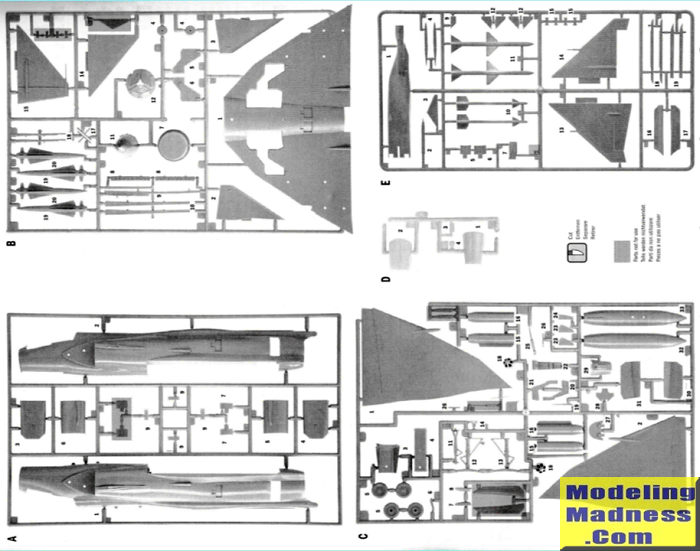
Inside are 107 light-gray parts, neatly arranged on four sprues. The molding immediately reveals the kit's Esci origins. Panel lines are raised throughout and somewhat soft. There is some flash present, but, fortunately, it is not excessive and should be relatively easy to clean up during preparation of the parts.
The cockpit is decidedly Spartan by today's standards, containing little more than the basic features found in the real aircraft. The ejection seat is average-looking and somewhat generic, while the instrument panel and side consoles are represented by decals. These are nevertheless nicely printed and should produce an acceptable result for those looking for a straightforward build.
The same approach is evident in the landing gear. It is adequately represented, but offers little in the way of refinement. There is no detail inside the wheel wells, while the gear doors and their hinges are also rather plain.
The engine intakes are shallow, as is the exhaust. The latter features the thrust-reverser petals molded in closed position. If you want to display them in the open position, you will need to carefully cut the individual petals, reposition and glue them separately.
Parts are supplied for both the AJ 37 and JA 37 configurations, so careful checking of references is recommended before deciding which arrangement to use. A selection of ordnance is provided, including Sidewinders, RB 71 Skyflash missiles, two RB 05 missiles, two rocket pods and a centerline tank. Again, because the kit contains parts applicable to different Viggen versions, references should be consulted to establish the correct configuration for the aircraft being modeled.
Transparencies are somewhat thick, but are otherwise reasonably well molded and clear. The instructions are well done, typical of Airfix releases of the period, and come in the form of an A4, eight-page booklet. They include a short history of the type and a construction sequence spread over 20 clear and concise steps, with color callouts provided where applicable.
 Two Swedish
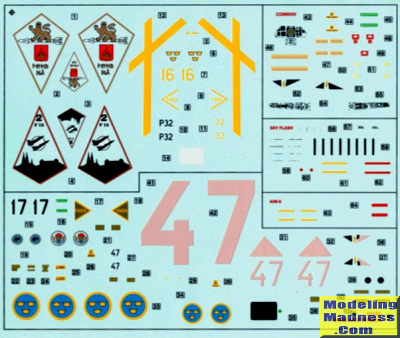
Air Force JA 37 marking options are provided:
Two Swedish
Air Force JA 37 marking options are provided:
F 16 P32, August 2001, Uppsala Airshow – Uppsala “Blå Petter
F 17 Q47, 1999 – Kallinge
The decals are well printed and, considering that they are now more than twenty years old, appear to be in remarkably good condition. Printing is reasonably sharp and the colors appear well registered. Airfix decals of this period, as well as some contemporary Heller sheets, could sometimes suffer from poor color registration, but this particular sheet looks considerably better than some of its contemporaries. Assuming they have been stored properly, they should still prove quite usable. As always with older decals, however, I would recommend testing an unused decal first.
Construction begins with assembly of the cockpit, which is then trapped between the fuselage halves together with the exhaust assembly. As mentioned above, particular attention should be paid to the afterburner and thrust-reverser petals if an open configuration is desired, as some cutting and individual positioning will be necessary. The intakes are incorporated into the fuselage assembly, followed by installation of the air brakes and nose cone. Interestingly, no nose weight is specifically called out. Personally I would probably add some weight just in case.
Various smaller fuselage details are then attached before moving on to the wings. The large delta wings are assembled and fitted to the fuselage, followed by the characteristic canards and the specific gun installation of the JA 37. Landing gear comes next, followed by the various external details fitted beneath the fuselage and wings, including the pylons. Assembly and installation of the fin follows, and finally the canopy completes the construction.
Overall, the build sequence looks simple and straightforward, and there is nothing particularly intimidating about the construction. The inclusion of parts for the AJ 37 as well as the JA 37 also gives the experienced modeler some scope for checking references and producing another configuration from the tooling.
| CONCLUSIONS |
This is definitely a classic kit, and an old kit in practically every respect—and it shows. That does not mean, however, that it is not a good kit. On the contrary, I think it remains a decent and enjoyable representation of the Viggen, especially when its age and price are taken into consideration.
The external shape certainly looks like a Viggen, and the finished model will be unmistakably recognizable as Saab's spectacular Swedish fighter. There have been reports of various shape and dimensional inaccuracies in the kit, and these should be acknowledged. I am certainly not a Viggen expert, so I will leave the detailed assessment of these points to those with greater expertise. For the average modeler, however, the overall impression is convincing.
The detail is very much average by today's standards. The cockpit is basic, the landing gear and wheel wells are not highly detailed, and the intakes and exhaust are simplified. The thrust-reverser petals in particular will require some extra work if the model is to be displayed with the reverser open. Nevertheless, none of these areas is disastrously basic, and they can be improved by an experienced modeler if desired.
The instructions are clear and easy to follow, the transparencies are perfectly usable, the decals are surprisingly good considering their age, and the kit offers a straightforward and relatively uncomplicated building experience.
Of course, there is now the much more modern Tarangus/Special Hobby Viggen, which represents the latest generation of tooling and offers substantially more detail and possibilities. That kit is naturally the better choice for the modeler looking for maximum accuracy and refinement. But it also comes at a considerably different price point, and even newer kits are not necessarily free from criticism or reported inaccuracies.
This puts the old Airfix/Esci Viggen in a rather interesting position. The tooling has survived for decades and continues to appear in new boxes, including recent Italeri releases with some very attractive decal options. There is clearly still a market for it.
Ultimately, that is the important point. If you don't mind the somewhat simplified detail—and perhaps even enjoy the straightforward nature of an older kit—this Viggen is still a model worth tackling. An experienced modeler can certainly take his time, add some refinement where desired and turn these venerable Esci molds into a very attractive representation of one of the most fascinating aircraft of the Cold War.
Considering its reasonable price, distinctive subject, attractive marking options and relatively simple construction, the old Airfix Viggen remains a very attractive package. It may no longer be the most sophisticated Viggen on the market, but it is still a classic—and sometimes, that is more than enough reason to build one.
Happy Modeling
September 2026
Copyright ModelingMadness.com. All rights reserved. No reproduction in part or in whole without express permission from the editor.
If you would like your product reviewed fairly and fairly quickly, please contact the editor or see other details in the Note to Contributors.