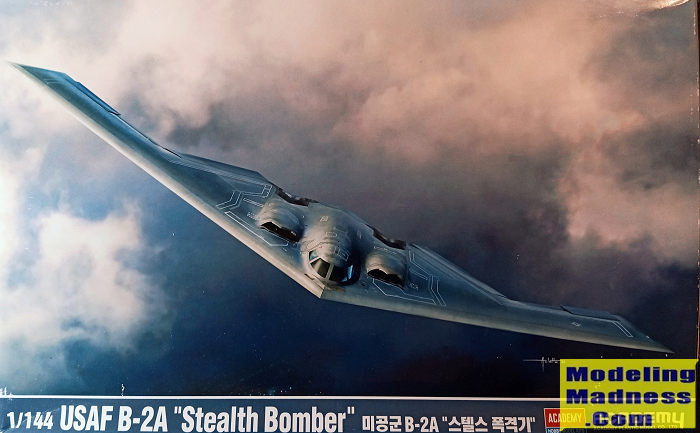
Academy 1/144 B-2A
| KIT #: | 12645 |
| PRICE: | 20.00 Euros on sale |
| DECALS: | Five options |
| REVIEWER: | Spiros Pendedekas |
| NOTES: |
| HISTORY |
The Northrop B-2 Spirit was developed during the late 1970s and early 1980s as the United States Air Force's answer to the need for a long-range bomber capable of penetrating increasingly sophisticated enemy air defenses. Designed around a flying-wing configuration, the B-2 combined advanced aerodynamic design, radar-absorbing materials and other low-observable technologies to achieve an unprecedented degree of stealth while retaining a substantial weapons payload. Development began in 1981, with the first aircraft publicly unveiled at Palmdale, California, in November 1988. The B-2 made its first flight on July 17, 1989.
Originally, a much larger fleet was planned, but the end of the Cold War and the enormous cost of the program led to dramatic reductions. Ultimately, only 21 B-2s were completed, including the prototype/test aircraft, which was subsequently brought up to operational standard. The first production aircraft, Spirit of Missouri, was delivered in December 1993, and the type achieved Initial Operational Capability in 1997, with Whiteman Air Force Base, Missouri, becoming its sole operational base.
The B-2 made its combat debut during Operation Allied Force over Kosovo in 1999, conducting long-range missions from the United States against targets in Serbia. It subsequently participated in Operations Enduring Freedom and Iraqi Freedom, demonstrating its unique combination of intercontinental range, stealth and precision-strike capability.
Despite its very small fleet and extraordinary cost, the B-2A Spirit has remained one of the most distinctive and technologically advanced aircraft ever operated by the USAF. Its flying-wing configuration, low observability and ability to carry both conventional and nuclear weapons have made the Spirit an icon of modern strategic air power.
| THE KIT |
 The
first B-2 kit in 1/144 scale was released by Monogram in 1991. It was
essentially a Snap-Tite kit, with a reportedly accurate external shape, but
naturally aimed at easy construction and consequently rather simplistic
detailing. This was followed by the Zhengdefu kits, later reboxed by Kitech
around the first years of the 2000s decade. These were definitely simplistic
offerings. AMP entered the scene in 2019 with a very nice limited-run mold,
but in 2025 Academy decided to release a completely new-tool,
state-of-the-art, mainstream 1/144 B-2—the kit we are reviewing here.
The
first B-2 kit in 1/144 scale was released by Monogram in 1991. It was
essentially a Snap-Tite kit, with a reportedly accurate external shape, but
naturally aimed at easy construction and consequently rather simplistic
detailing. This was followed by the Zhengdefu kits, later reboxed by Kitech
around the first years of the 2000s decade. These were definitely simplistic
offerings. AMP entered the scene in 2019 with a very nice limited-run mold,
but in 2025 Academy decided to release a completely new-tool,
state-of-the-art, mainstream 1/144 B-2—the kit we are reviewing here.
The kit was purchased in 2026 from a beloved, now online-only Greek hobby shop, at the almost unbelievable price of just €20. The kit comes in a large, top-opening, and, as we have come to expect from Academy, excellent quality box, featuring dramatic box art by artist Vincenzo Auletta, depicting a B-2 gracefully banking.
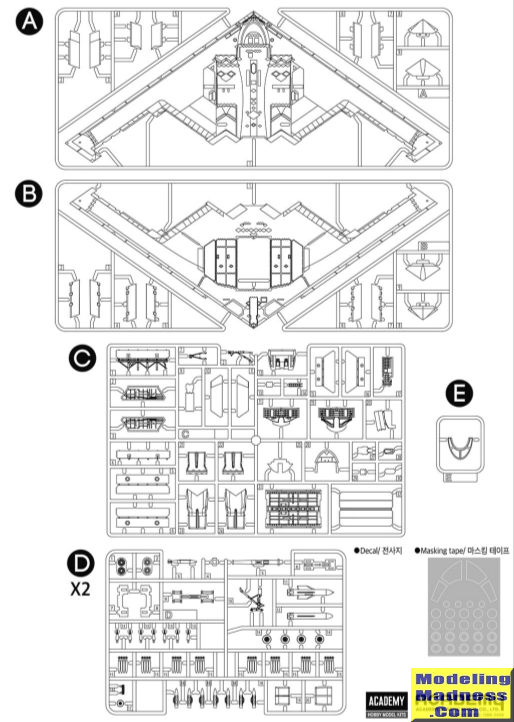
Upon opening the box, I was greeted by approximately 130 medium-gray styrene parts, nicely packed, as is the norm with Academy. The parts are well arranged in five sprues and, from the very beginning, it is obvious that the molding is truly state of the art. The panel lines are beautifully recessed, the seams are located in sensible places, and there is absolutely no flash whatsoever.
The main fuselage and wings are beautifully molded as two large upper and lower halves, with the wings incorporated into the fuselage sections. For a flying-wing aircraft such as the B-2, this seems very much the way to go, avoiding unnecessary joints and allowing the distinctive planform of the aircraft to be represented in large, clean pieces. The shapes of the parts look totally convincing, although, as always, I will leave the final verdict on accuracy to the B-2 Experten—I am certainly not one of them!
The various flying surfaces are also very nicely handled, separately provided, while the outboard control surfaces are molded separately as well, allowing them to be posed split open. This gives the modeler some welcome flexibility when deciding how to display the finished aircraft.
The cockpit is provided as a simple three-piece affair, consisting of the lower floor, containing the seats and consoles, upper section and rear bulkhead. It is not particularly elaborate, but, truth be told, very little can be seen through the small windows. Apart from perhaps adding seat belts to the seats, I don't think anything else is really necessary here. What is provided is perfectly adequate for the scale.
On the other hand, the visible landing gear is beautifully rendered. The gear legs are finely represented, while the gear bays and door interiors feature convincing internal detail. The bomb bay is equally impressive and is nicely rendered, offering a wide array of weapons typically carried by the B-2, together with the characteristic rotary launcher mechanism. This is an area where the modeler can really spend some time if he wishes, and the effort should certainly be visible on the completed model.
Another feature I particularly liked is the treatment of the engine intakes and exhausts. These are very nicely done, with convincing ducting and compressor and turbine faces. The only usual price to pay is the unavoidable center seam when joining the upper and lower fuct halves. But, as I always say in such situations, we can't have everything in life! In any case, the finished assemblies are beautifully rendered.
A nice entry hatch/crew ladder is also included, together with a visible or covered inflight refueling receptacle.
The canopy is provided as a single piece and is crystal clear and crisp. Academy also supplies a useful set of masks for the small cockpit windows and the wheels, which is a very welcome touch at this scale.
The instructions are very nicely produced in Academy's typical modern style. The eight-page pamphlet contains a complete sprue map, a color chart, with the construction sequence spread over 13 clear and concise steps. The diagrams are very well arranged and clearly indicate the differences between the various configurations, including the in-flight and on-the-ground positions. The instructions also contain useful reference drawings showing how the various components should look once assembled, which is particularly helpful when dealing with the internal structures. Color callouts are provided throughout where required.
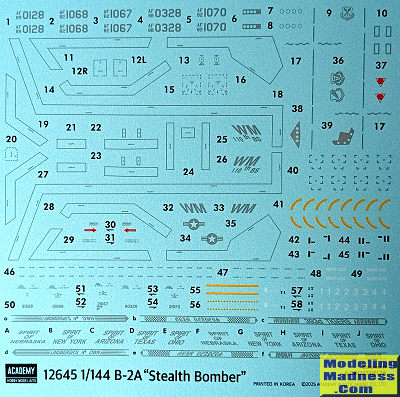 The
painting and marking instructions are supplied on a separate color-printed
sheet and offer five different aircraft:
The
painting and marking instructions are supplied on a separate color-printed
sheet and offer five different aircraft:
- 82-1070, Spirit of Ohio — 2020
- 82-1068, Spirit of New York — 2022
- 89-0128, Spirit of Nebraska — 2023
- 88-0328, Spirit of Texas — 2023
- 82-1067, Spirit of Arizona — 2024
All five aircraft are finished in the characteristic overall FS36118 dark gray scheme. Color references are provided in Humbrol, Gunze, Mr. Color, LifeColor, Testors/Model Master, Revell, Vallejo and AK codes, as well as in generic form.
The decal sheet is beautifully printed, with excellent color density and all the stenciling necessary to produce a highly detailed B-2. The printing is exceptionally sharp for the scale. However, the decals are very thin, so some care will be required during application. Personally, I would consider applying a coat of liquid decal film before using them, especially if you are not accustomed to working with extremely thin decals.
Academy's instructions begin with assembly of the cockpit, followed by the engine intakes and exhausts. These assemblies are then attached to the upper fuselage/wing section. The bomb bay is tackled next, and this is probably where the modeler can spend the most time. Academy provides a wide variety of loading options, allowing you to create a very elaborately detailed bomb bay. There is plenty of work to be done here, and every bit of effort will definitely show.
The bomb bay and wheel wells are next attached to the lower fuselage and wing section, followed by the tail and the refueling receptacle panel. The latter can be represented either exposed or covered. The various bomb bay doors are then installed, again with the option of representing them in either the open or closed position. The flying control surfaces are next, and this is followed by assembly and installation of the landing gear and crew entry hatch.
The final steps deal with the remaining doors and allow the modeler to finish the aircraft with everything closed up for a clean, in-flight configuration if desired.
Overall, the construction looks relatively uncomplicated and straightforward. There is no particular complexity evident in the assembly, with the bomb bay being the only area where the modeler is likely to spend a considerable amount of time—and that is perfectly normal for a kit offering this level of detail. Some care will naturally be required when handling and attaching the numerous small parts, like the individual weapons in the bomb bay and the delicate landing-gear components. Nevertheless, this looks to be a very manageable build with no obvious traps or major complications.
| CONCLUSIONS |
This is clearly a fantastic kit and, by all means, looks to be the definitive 1/144 B-2 Spirit. Academy has produced a completely mainstream offering that combines excellent molding, very good detail and a straightforward construction sequence into a package that is difficult to fault.
The parts are beautifully molded, the surface detail is crisp and convincing, and the level of detail is more than sufficient in every area that will remain visible on the finished model. The landing gear, wheel wells, engine areas and, particularly, the bomb bay are all very nicely rendered. The crystal-clear transparency is another strong point.
There are also plenty of useful options. The bomb bay and landing gear doors can be displayed open or closed, while the refueling receptacle can likewise be represented in either position. The various flying control surfaces are provided separately, giving the modeler some additional flexibility in how the finished aircraft is presented.
Construction looks straightforward enough that even a relatively inexperienced modeler should be able to tackle the kit without too much difficulty. Some care will naturally be required with the numerous small parts, particularly around the landing gear and the individual weapons in the bomb bay, but there is nothing here that appears unnecessarily complicated.
Then there is the scale itself. The B-2 is a surprisingly attractive subject in 1/144. It remains large enough to show off its distinctive flying-wing shape and all that lovely surface detail, while being small enough to fit comfortably into most display cases. In fact, I think the scale suits the Spirit particularly well.
Compared with the earlier Zhengdefu/Kitech and Monogram offerings, this Academy kit is simply miles ahead in terms of molding quality and detail. The limited-run AMP offering is also reportedly a very detailed kit, but its limited-run nature may make it a less accessible proposition for some modelers. Academy, by contrast, gives us all that detail in a modern, mainstream kit.
The decals are beautifully printed and comprehensive, although they are very thin and will require some care during application. This is hardly a deal-breaker, especially considering the overall quality of the package.
Finally, there is the price. I was fortunate enough to obtain my example for the almost unbelievable price of €20, although I am certainly not suggesting that everyone will be able to find it for that amount. Even at something in the region of $30–35, however, I would still consider this an excellent deal for what is offered.
So, there is really little more to say. Academy has produced a winner here. Beautifully molded, highly detailed, straightforward to build, packed with options and available in a very attractive scale, this is a kit that I can wholeheartedly recommend.
If you have been waiting for a definitive 1/144 B-2 Spirit, I think your wait is finally over.
Happy Modeling!
October 2026 Copyright ModelingMadness.com. All rights reserved. No
reproduction in part or in whole without express permission from the editor.
If you would like your product reviewed fairly and fairly quickly, please contact the editor or see other details in the Note to Contributors.