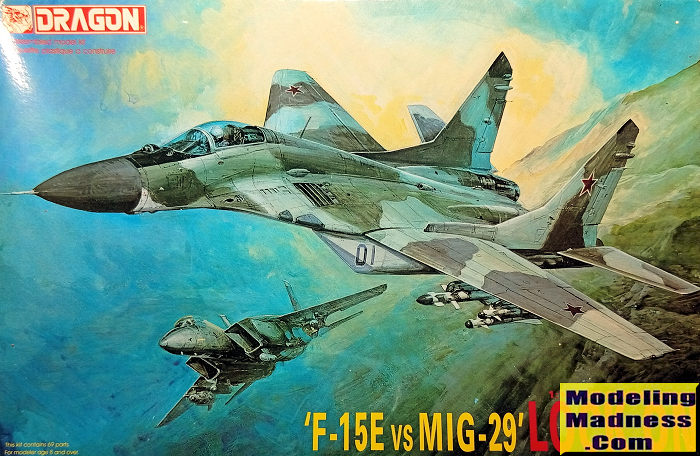
Dragon 1/144 F-15E vs MiG-29
| KIT #: | 4002 |
| PRICE: | $ |
| DECALS: | One option |
| REVIEWER: | Spiros Pendedekas |
| NOTES: | Lock On series |
| HISTORY |
The mid-to-late 1980s were among the tensest years of the Cold War, with NATO and Warsaw Pact air forces facing each other across Europe and both sides introducing increasingly capable new-generation fighters. On one side was the American F-15 Eagle, already established as one of the West's premier air-superiority fighters; on the other was the Soviet MiG-29, a compact and highly maneuverable fighter designed to challenge the latest NATO aircraft.
The MiG-29 had already entered Soviet service by the early 1980s, while the F-15E represented a later development of the Eagle, combining the air-superiority capabilities of the F-15 with a substantial ground-attack capability. The F-15E first flew in 1986 and entered operational service toward the end of the decade.
Consequently, a meeting between an F-15E and a MiG-29 in the mid-1980s is an irresistible scenario. Had the two aircraft found themselves facing each other over the skies of a divided Europe, the encounter would have brought together two very different approaches to fighter design.
The F-15E, with its powerful radar, twin engines, considerable size and long-range capabilities, would have had advantages in detection, energy and weapons employment. The smaller MiG-29, meanwhile, also twin-engined, was designed with excellent maneuverability and close-range combat capability in mind. Should the engagement have progressed beyond the initial missile exchange and into a visual dogfight, the characteristics of the two aircraft would have produced a fascinating contest of speed, energy, positioning and maneuverability.
This is precisely the sort of imaginary encounter that Dragon's “Lock On” series sought to capture: two contemporary fighters, armed and ready, meeting in the same piece of sky. It is not a depiction of an actual historical engagement, but rather a small-scale snapshot of the Cold War's ultimate fighter-versus-fighter confrontation.
| THE KIT |
 In
the late 1980s, Dragon released a very nice series of 1/144 scale modern
fighters, among them the F-15E and MiG-29. Apart from marketing the two aircraft
separately, Dragon also decided to bring them together in a single boxing,
depicting a possible encounter—or “Lock-on,” as the series was called. It was a
clever and rather appealing idea, turning two otherwise separate kits into a
small aerial confrontation.
This particular kit was a gift from my good friend, our Frank Spahr, when we met in Germany in the summer of 2026. In fact, Frank gave it to my sons, who are also interested in modeling, which makes this particular example rather more special to me. Today, the kit has become a much sought-after collector's item.
The kit comes in a small-to-medium-sized, top-opening box of excellent quality, as good as it gets from Dragon, featuring attractive artwork of the F-15 and MiG-29 meeting in the air.
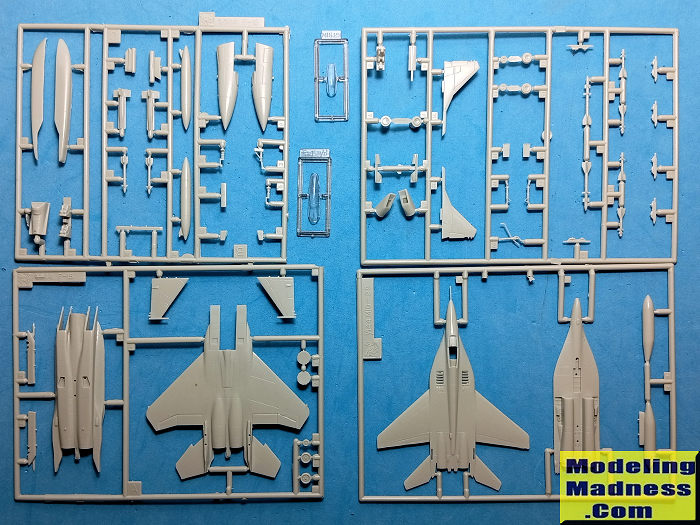
Inside are two complete kits: one 1/144 MiG-29 and one 1/144 F-15E. The F-15E comprises 30 parts, while the MiG-29 consists of 35 parts. Molding is first class, and I did not notice any flash whatsoever. Panel lines are engraved and generally well defined, although they are a tad on the heavy side. Still, this was quite normal and expected for kits of this vintage, particularly in such a small scale.
The general shapes of both aircraft look correct, with the compromises one would naturally expect in 1/144 scale. Cockpit details are simplified, of course, but the pilots are molded together with the seats, producing a surprisingly busy appearance in this small scale. For the scale and the intended purpose of the kit, I find this more than adequate.
The landing gear is also simplified, but again, this is perfectly normal for a kit of this size. The components are nevertheless quite nicely done and sufficiently convincing for the scale without becoming too elaborate. Of course, landing gear detail matters if you resist the temptation to build these two aircraft in flight!
Both aircraft are well armed with missiles and external fuel tanks, giving them a very busy appearance and making them look ready to face each other. The intake and exhaust areas are sufficiently represented for the scale.
The transparencies are nicely molded. They have a somewhat beige or golden tint, which may not be entirely puristic, but personally I have no problem with it. In fact, I think the tint adds considerably to the dramatic appearance of the finished models and suits the “Lock On” concept rather well.
The instructions are presented on a fold-out leaflet and are quite nicely done. They include a short description of the hypothetical scenario, brief historical information on the two types, an exploded-view parts breakdown, a color chart and construction sequences for each aircraft. Color callouts are provided throughout.
The construction is presented in only two main steps for each aircraft, so the instructions are somewhat dense, particularly for a complete beginner or a child. Nevertheless, everything is sufficiently clear and can be worked out without any real problems. I would certainly have preferred a few more construction stages, but considering the simplicity of the kits, this is not a serious drawback.
One scheme is provided for each aircraft, with the Soviet MiG-29 decaling using an amount of individual numbers, allowing some flexibility in their application, while the F-15E receives its own complete set of markings.
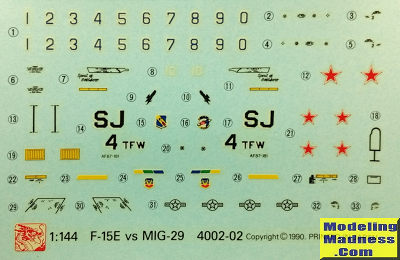 The
decals are printed in Japan and are very nicely done, with sharp printing and
good registration. Considering that they are now almost 40 years old, they look
remarkably usable. Naturally, only actual application will tell whether they
remain fully serviceable after all these years.
Construction of the F-15E starts by trapping the cockpit and pilot between the front fuselage halves, followed by joining the upper and lower rear fuselage sections, which incorporate the wings, then bring the front and rear sections together. The landing gear, exhausts, wing tanks, missiles and canopy are then added, bringing the model to completion.
The MiG-29 follows a similarly straightforward approach. The cockpit and pilot are trapped between the upper and lower forward fuselage sections, with the wings incorporated into the main assembly. The fins, exhausts, fuel tank, landing gear and various missiles are then added to complete the aircraft.
Both models should prove quite simple and straightforward to build, making them particularly suitable for beginners and younger modelers. I have not actually built these examples, so I cannot comment definitively on the fit. Some Dragon kits from this period could occasionally present fitting problems, but there is nothing in the parts breakdown here that suggests any serious difficulties.
The MiG-29 in particular should be a very easy build. The F-15E may require a little more care in bringing the rear fuselage and nose sections together. Dragon was clearly looking to maximize the use of the molds and provide different nose arrangements for its F-15 variants, so some care may be required in these areas. Nevertheless, any such problems should be quite manageable, especially considering the small size of the model.
| CONCLUSIONS |
This is a sweet kit—and a particularly nice combination of two aircraft. Dragon deserves credit for bringing modern 1/144 scale fighters to modelers at a time when this scale was still much less common than it is today. Kits like this would have been especially attractive to younger modelers and beginners, offering simple construction, modest parts counts and very little demand for display space.
The overall detail is very good for the scale, the molding is excellent and the engraved detail is perfectly adequate. The cockpits are understandably simple, but the molded pilots and seats give them enough life, while the weapons and external tanks make both aircraft look suitably busy. The transparencies are nicely done, and even the slightly tinted appearance does not bother me.
The instructions are useful, if a little condensed, and the decals are exceptionally well printed for their age. There is a possibility of some minor fit challenges with the F-15E, but nothing that should present a serious obstacle to the casual modeler—or even a child with a little help.
But there is another reason why this particular kit means something to me. It was a wonderful gift from my good friend, our Frank Spahr, given to my sons when we met in Germany.
This kit has now become a genuine collector's item. If you are lucky enough to find one, you should be prepared to pay something in the region of €30–40, which is certainly a long way from the sensibly priced little kit it once was.
I am therefore trying to resist the ultimate temptation to put this one away in my own collection as a collector's piece. But I keep coming back to one simple rule: every kit deserves to be built. This one will definitely get its chance. I intend to build it together with my sons, almost certainly in wheels-up configuration, and, if everything works out, mount both aircraft on a common base in a maneuvering “lock-on” pose. With the F-15E and MiG-29 facing each other in mid-air, the result should be nothing short of spectacular—and, more importantly, it will give this little Dragon boxing exactly the kind of life it was designed to have.
Happy Modeling!
October 2026
Copyright ModelingMadness.com. All rights reserved. No reproduction in part or in whole without express permssion from the editor.
If you would like your product reviewed fairly and fairly quickly, please contact the editor or see other details in the Note to Contributors.