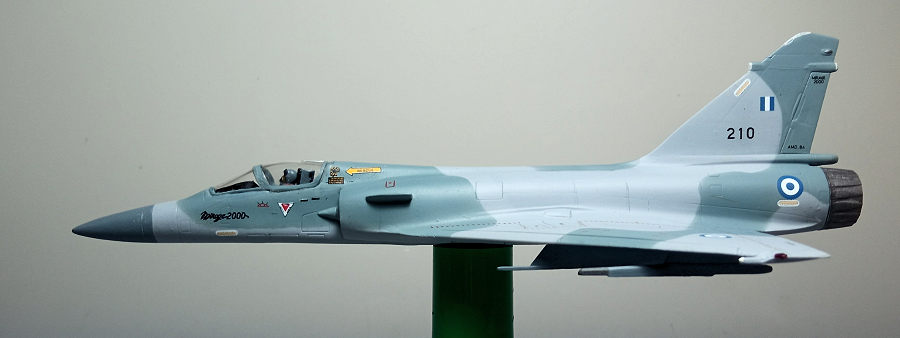
Heller 1/72 Mirage 2000EG
| KIT #: | ? |
| PRICE: | $ |
| DECALS: | |
| REVIEWER: | Spiros Pendedekas |
| NOTES: | Stand model, modified from a dual seater missing-parts kit - Kalfakis 72/1 decal sheet used |
| HISTORY |
The sea was calm that evening near Skyros Island, almost too calm, like a sheet of dark glass stretching into the horizon. The lights along the runway shimmered faintly, steady and reassuring, the kind of sight every pilot longs for after a demanding flight. Somewhere out there, cutting through the night sky, was a young Greek man who had chased that sight since he was a boy. His name was Dimitrios Stratakias.
He had grown up in Chalkida, not far from the sea. As a child, he would look up whenever he heard the distant roar of jet engines, searching the sky until he found the tiny silhouette of an aircraft slicing through the blue. To others, it was just a passing sound. To him, it was a calling.
Years later, that calling took him to the Hellenic Air Force Academy. It was 1989 when he first walked through its gates, young, determined, and carrying that quiet fire that marks those who dream of the sky. The training was unforgiving. Days blurred into nights, and nights into early mornings filled with study, discipline, and the relentless pursuit of precision. Many faltered. Some walked away. But Dimitrios endured.
 By 1993, he
graduated as a Second Lieutenant, ready to take his place among Greece’s
military aviators. Not long after, he would earn the rank of First Lieutenant
and something even more coveted: a seat in the cockpit of the Dassault Mirage
2000.
By 1993, he
graduated as a Second Lieutenant, ready to take his place among Greece’s
military aviators. Not long after, he would earn the rank of First Lieutenant
and something even more coveted: a seat in the cockpit of the Dassault Mirage
2000.
The Mirage was not just an aircraft. It was a machine that demanded respect. Fast, precise and unforgiving of mistakes, it rewarded only those who mastered it completely. Dimitrios embraced it. He trained, flew and refined his skills until the aircraft felt like an extension of himself.
He was assigned to the 332 Squadron, one of the two elite units operating the Mirage 2000. From Tanagra AFB, he flew missions over the Aegean, a region as beautiful as it was demanding. The skies there were unpredictable, the winds shifting, the light playing tricks over the endless blue of sea and sky. Still, he loved it. Flying could never be routine, not really. Even the simplest mission carried risks. But for those who lived for the sky, it was a life worth choosing.
On the night of September 30, 1997, Dimitrios was into what should have been just another mission. The kind pilots perform countless times. The kind that doesn’t make history. His Mirage 2000, tail number 210, cut through the darkness as he approached Skyros for touch and go landing. Night landings over the sea are among the most deceptive tasks a pilot can face. Without clear visual references, the horizon can disappear. The difference between sea and sky becomes almost impossible to distinguish. Lights, whether from the runway or from fishing boats, can distort depth and distance.
Below him, scattered across the water, were the lights of fishing vessels. Small, flickering, irregular. Ahead of him, the runway lights. Steady, aligned, guiding. But in that fragile moment where perception meets reality, even the smallest confusion can become fatal. Something went wrong.
Perhaps the lights blended. Perhaps the sea rose invisibly to meet him. Perhaps the approach angle shifted just enough to escape correction. In aviation, accidents are rarely caused by a single mistake. They are chains of moments, tiny, almost invisible links that suddenly connect. The Mirage descended. Too low. Too soon.
Instead of touching down on the runway, the aircraft struck the water just short of it. A not too violent, but, still, unforgiving impact. The sea that had looked so calm moments before became a trap of force and darkness. The aircraft, almost intact, began to sink.
Inside the cockpit, time collapsed into milliseconds. Training, instinct, survival, all converged in a desperate attempt to escape. But fate can be cruel in the smallest details. Upon opening the canopy, his flotation gear, the life-saving equipment meant to protect him, activated in a way that trapped him within the confines of the cockpit. The sea closed over the aircraft. Silence followed. He was 27 years old.
 News travels
quickly in the world of aviation. Faster still when it carries loss. At Tanagra
AFB, in Chalkida, across the ranks of the Hellenic Air Force, the absence was
felt immediately. A pilot was gone. A humble colleague. A friend. A son of
Greece who had taken to the skies and never returned. But in aviation, tragedy
rarely leaves things unchanged.
News travels
quickly in the world of aviation. Faster still when it carries loss. At Tanagra
AFB, in Chalkida, across the ranks of the Hellenic Air Force, the absence was
felt immediately. A pilot was gone. A humble colleague. A friend. A son of
Greece who had taken to the skies and never returned. But in aviation, tragedy
rarely leaves things unchanged.
The accident prompted changes, quiet, technical, but vital. Improvements were made to pilot equipment usage. Escape systems were re-evaluated. Procedures were revisited. Lessons were written, studied, and passed on. In this way, Dimitrios continued to fly. Not in the sky, but in the safety of those who came after him.
Yet, the story did not end there. In the months that followed, something remarkable, almost unbelievable, took place. His aircraft, Mirage 2000 serial number 210, was recovered from the sea. Against the odds, despite the salt water, the impact and the time submerged, it was not written off forever. Instead, it was repaired, restored and returned to flying condition.
In the world of military aviation, this is extraordinarily rare. Aircraft lost at sea, especially after such an accident, are almost always gone for good. But this Mirage defied that fate. It became one of the very few known cases worldwide where the pilot was lost, yet the aircraft survived and flew again.
Among those who knew its story, the aircraft earned a nickname, spoken with a mix of dark humor and quiet respect: “The Submarine.” It was an obvious name. But behind it lay something deeper. Every time it took to the skies again, it carried not just metal and systems, but memory.
Back in Chalkida, Dimitrios name did not fade. A park bears it. A street carries it. People walk past these places every day, some knowing, some not, but the name remains, anchored in memory like a fixed point in the shifting currents of time.
There is something about pilots. They live between worlds, the earth below and the sky above. They accept risks most would never consider, not out of recklessness, but out of purpose. Every takeoff is a quiet agreement with uncertainty. Every landing, a small victory.
Sometimes, the sky keeps them. But sometimes, it gives something back. A machine that rose again from the depths and a story that refuses to be forgotten. On that night over Skyros, the sea was calm and the runway lights were waiting. The mission was almost complete. Almost.
In that narrow space between “almost” and “safe,” a life was lost - but a legacy was born.
Blue skies, Dimitrios!
| THE KIT |
 Heller 1/72
Mirage 2000 family originated in 1981 and has been with us ever since, either in
single seater or dual seater versions. Though dated and superseded by the modern
Modelsvit offerings, they are still solid kits, offered in good prices, that can
provide decent representations of the graceful delta wing French fighter. For an
in depth look at their contents, you may read their previews in the ever growing
MM archives.
Heller 1/72
Mirage 2000 family originated in 1981 and has been with us ever since, either in
single seater or dual seater versions. Though dated and superseded by the modern
Modelsvit offerings, they are still solid kits, offered in good prices, that can
provide decent representations of the graceful delta wing French fighter. For an
in depth look at their contents, you may read their previews in the ever growing
MM archives.
The specific kit came in
a bag and was earned by one of my sons during my local club’s annual ceremony.
Upon opening the bag, I found two large sprues corresponding to the dual seater
version. So far so good. However, the smaller sprue containing the dual seater
cockpit, the centerline drop tank and some other bits was missing. Moreover, the
supplied canopy was for the single seater version. The fact that no decals or
instructions were provided seemed of a lesser significance, compared with the
missing parts saga.
Definitely, not willing to let my son down, as he is a Mirage 2000 aficionado,
wanting “his earned kit built” and, just for the sake of it, I took a daring
decision to modify the dual seater fuselage to a single seater, using leftover
sprue pieces from my spares and go for a, somewhat simplistic, stand model in
flying status.
| CONSTRUCTION |
I first joined the fuselage halves, trapping the single seater cockpit in between. This took some twerking, as the fuselage halves are designed to receive the dual cockpit (which was missing). Basic cockpit color was Tamiya XF-66 gray, while the instrument panel and its top coaming were painted black. A leftover instrument decal was used, which would nevertheless hardly be seen with a pilot in and a closed canopy. The seat received the same cockpit basic color, with its head cushion painted black and the lower cushions olive drab. The pilot (from my spares), had dark green suit, olive drab seat belts, gray helmet and oxygen hose, black goggles, “flesh” face and red scarf.
I continued by attaching
the underside wing half to the fuselage, followed by the upper halves. The
3-piece intakes were next. Since I was opting for a flying Mirage, the gear
doors were attached in closed position,
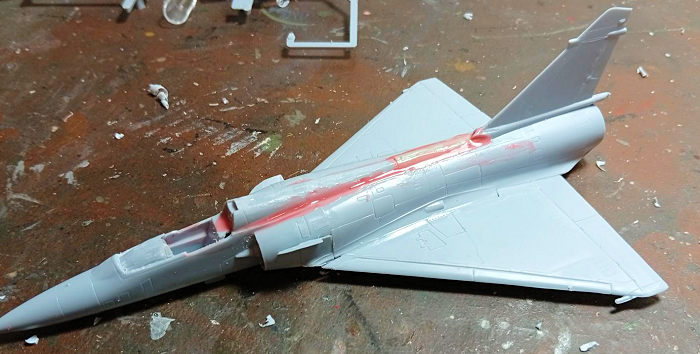 something
not too easy, as the kit is basically designed for gear down position. This
ended basic model assembly. Fit was adequate, needing its attention here and
there, but nothing the average modeler cannot handle. Now came the most complex
part of the build, which was to modify the dual seater fuselage to a single
seater.
something
not too easy, as the kit is basically designed for gear down position. This
ended basic model assembly. Fit was adequate, needing its attention here and
there, but nothing the average modeler cannot handle. Now came the most complex
part of the build, which was to modify the dual seater fuselage to a single
seater.
I started by carefully sawing off the top spine, up to the point that it meets the fin. I then reattached the sawn spine forward, just aft of the cockpit. This was not easy, as the spine was barely touching the wider cutout openings and I used liquefied styrene to build up a solid joint.
By moving the spine forward, I was left with a gap at the rear section. To address this, I used a suitably sized half section from a spare torpedo, roughly trimmed until it matched the opening. The remaining gaps were filled using liquefied styrene, which helped both to close the seams and reinforce the structure.
The area was then gradually sanded into shape, guided by available reference photos. Several rounds of filling and sanding were required before I was satisfied with the finish. Once that stage was complete, I installed the two small canards, which I had to scratch-build since the originals (molded together with the intakes) were lost during the earlier modification work.
With that done, the bird headed to the paint shop!
| COLORS & MARKINGS |
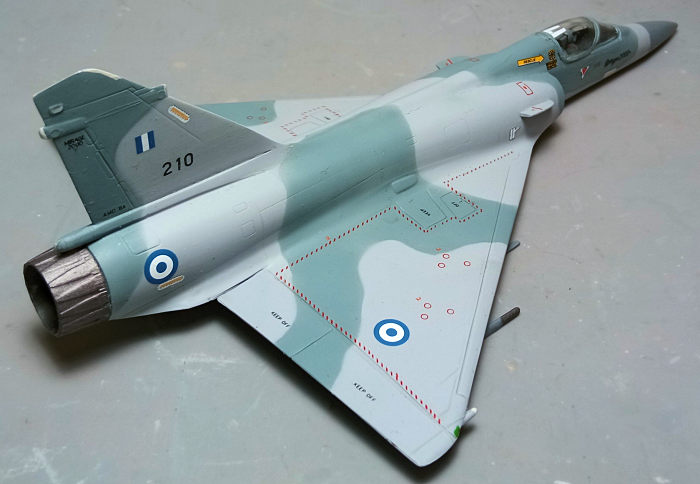
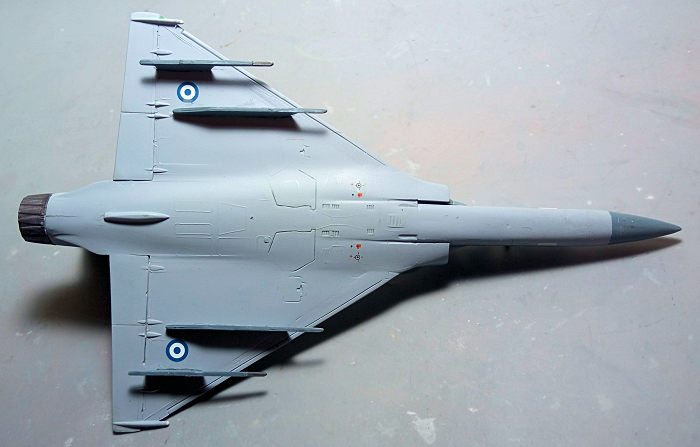 I first
sprayed the complete model with the basic light gray shade, for which I used a
home brewed recipe, coming close to Hu127 Light Ghost Gray. I then applied Hu145
to the topsides for the blue/gray shade, using strings of tak, in order to come
up with tight, yet not dead hard demarcation lines. For the nose cone I used
tamiya XF-66 Light Gray, with a coat of Future preparing the bird for decaling.
I first
sprayed the complete model with the basic light gray shade, for which I used a
home brewed recipe, coming close to Hu127 Light Ghost Gray. I then applied Hu145
to the topsides for the blue/gray shade, using strings of tak, in order to come
up with tight, yet not dead hard demarcation lines. For the nose cone I used
tamiya XF-66 Light Gray, with a coat of Future preparing the bird for decaling.
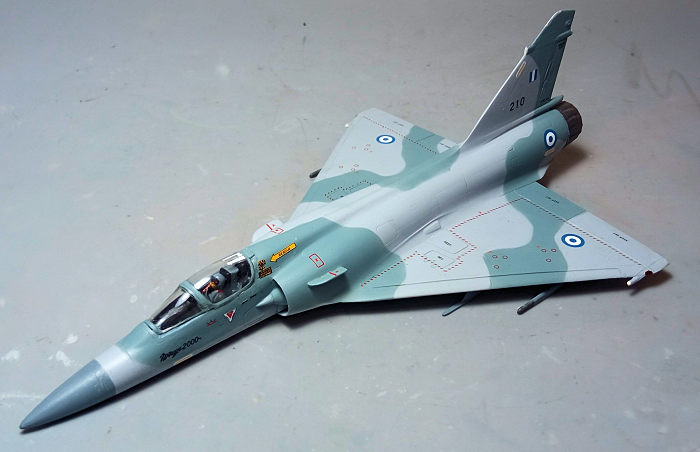
Opting to depict Lt Dimitrios Stratakias #210 machine which he flew that fateful night, I used Greek insignia from the (excellent but long OOP, almost definitely for good) Kalfakis 72/1 “Mixed Vintage & Modern Hellenic Air Force Insignia” decal sheet. For the stencils, I used one of many leftover Heller decal sheets from my decal dungeon (and those being the “older” style Heller decals, meant not that well registered). A coat of Future sealed the decals.
| FINAL CONSTRUCTION |
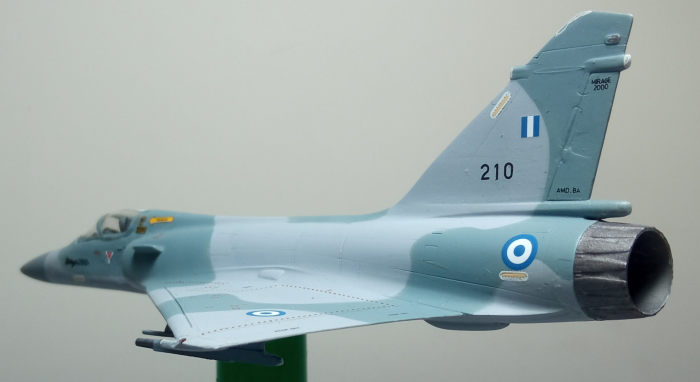 The four
underwing pylons were painted Tamiya XF-66 light gray and attached in position.
The outer ones had their fronts painted gunmetal. The various dielectric antenna
covers were painted “linen”. No weathering was applied, since the machine was
almost new when the incident happened. A flat coat gave the bird its final hue.
The four
underwing pylons were painted Tamiya XF-66 light gray and attached in position.
The outer ones had their fronts painted gunmetal. The various dielectric antenna
covers were painted “linen”. No weathering was applied, since the machine was
almost new when the incident happened. A flat coat gave the bird its final hue.
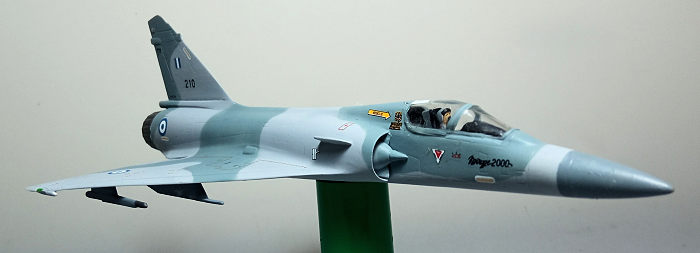
The canopy had its frames hand painted and attached in position. Fit was absolutely off, as it was designed for the single seater version and not for a modified dual seater, as was my case. I still tried to fair the gaps with white glue with equally poor results. My son preferred not to have a mounting hole opened beneath the model, so it is displayed without a base (and my son can play easier with it).
The fin-located position light was rendered by highlighting the area with a fine tip silver pen. Blobs of red and green clear paint were used to replicate the wingtip lights, before calling the Mirage 2000 done!
| CONCLUSIONS |
Building the specific model was a combination of challenge and sort of a mini adventure, as I attempted to convert a dual-seater fuselage into a single-seater configuration. The final result is probably only average, but I am not dissatisfied with it, since, what mattered most, was that I managed to complete the modification through improvisation, using whatever materials and tools I had at hand.
The standard Heller 1/72 dual seater Mirage 2000N (where the model originated from), while not any more amongst the most detailed and definitely superseded by the 2023 Modelsvit offering, is still a decent kit, offered at a good price, that can yield to an equally decent representation of the dual seater French Delta Lady.
"Dedicated to the loving memory of Lt Dimitrios Stratakias - missed more than words can say."
Happy Modeling!
Spiros Pendedekas
23 April 2026 Copyright ModelingMadness.com. All rights reserved. No
reproduction in part or in whole without express permssion from the editor.
If you would like your product reviewed fairly and fairly quickly, please
contact
the editor or see other details in the
Note to
Contributors.