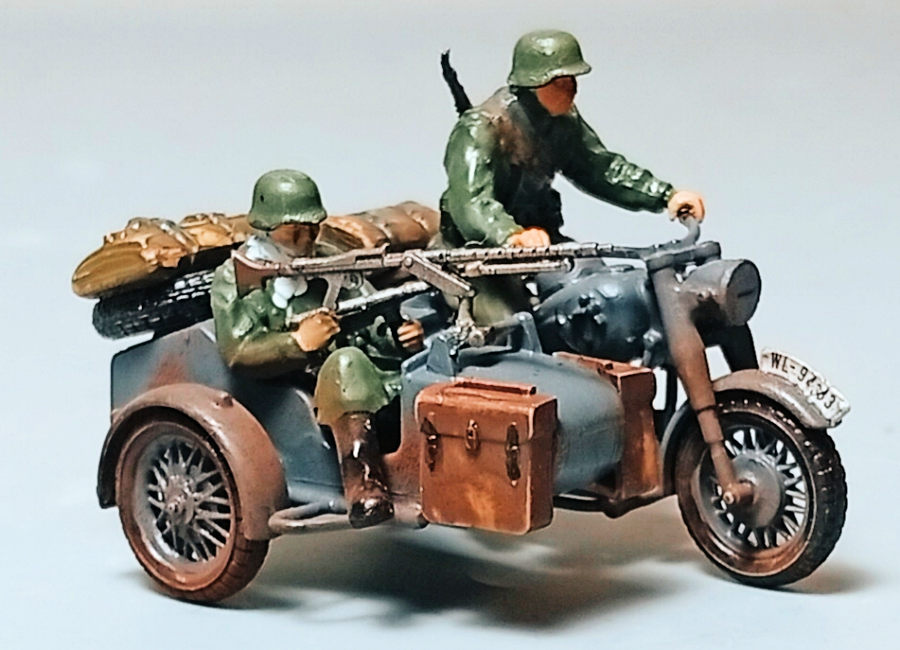
Tamiya 1/35 BMW R75
| KIT #: | 32578 |
| PRICE: | 12 Euros |
| DECALS: | Two options |
| REVIEWER: | Spiros Pendedekas |
| NOTES: |
| HISTORY |
THE ROAD THROUGH THE RAIN
The BMW had been running badly since dawn.
Friedrich knew the machine well enough to recognize every change in its voice,
and that morning there was a faint metallic note beneath the familiar rhythm of
the 745 cc flat-twin. It was nothing serious, he thought, although Karl had
already decided that the motorcycle was finished and that they were both going
to die somewhere in the forest.
"You said that yesterday," Friedrich reminded him.
"Yesterday I was being optimistic."
Friedrich smiled. "You said the engine was finished."
"I said it sounded finished. There is a difference."
"There is a very large difference."
Karl shrugged from the sidecar. "If we survive this morning, I'll explain it to
you."
The BMW R75 moved steadily along the muddy track. They were returning from a
forward position after delivering documents that had been urgently requested,
and the journey back promised to be considerably more difficult than the journey
out. Rain had fallen for several days, turning the forest roads into deep mud
and filling the ruts with brown water. The occasional shell crater or fallen
tree forced Friedrich to pick his way carefully between the obstacles.
Yet the R75 was built for precisely this kind of work. Its horizontally opposed
745 cc twin-cylinder engine produced around 26 horsepower, while its unusual
drivetrain allowed power to be transmitted to the sidecar wheel as well as the
rear wheel. With its low gearing, reverse gear and robust construction, the
combination could negotiate ground that would have stopped an ordinary
motorcycle. Friedrich knew every part of it almost instinctively. He knew when
to let the engine pull and when to give it more throttle, when to keep moving
and when to stop before the mud swallowed them.
They had been riding for several hours when Karl suddenly shouted, "Stop!"
Friedrich braked and turned around.
Karl pointed toward a small clearing. "Coffee."
"We don't have coffee."
"Then stop anyway. I wanted to look at the view."
"There is no view."
"Exactly. I wanted to make sure."
Friedrich laughed despite himself and stopped beneath a large tree. They ate the
last of their bread and checked the motorcycle. Karl inspected the rear wheel
while Friedrich wiped mud from the controls.
For a few minutes the war seemed distant. They were young men, after all, and
the absurdity of their situation occasionally broke through the seriousness of
their orders. Karl looked at the BMW.
"When this is over, I'm never riding one of these again."
"Good."
"Why?"
"Because I'm taking this one home."
Karl stared at him. "Your wife will throw you out."
"I'll sleep in the sidecar."
"She'll throw the sidecar out too."
They laughed, and then they continued.
The weather had deteriorated again, and the road that had been difficult in
daylight seemed almost impossible after dark. Their orders had been completed,
but there was still a long way to go, and Friedrich was becoming increasingly
concerned about the worsening weather.
They were halfway back when they heard something in the distance.
At first it sounded like artillery.
Then it stopped.
They waited.
Nothing.
"Keep going," Karl said.
Friedrich nodded and started the engine again.
The BMW moved forward into the rain.
They had travelled perhaps another kilometre when Karl suddenly saw a figure
beside the road.
"Friedrich."
The motorcycle slowed.
A woman stood beneath the trees. She was soaked through and trembling, and in
her arms was a small child wrapped in a blanket. She looked at the two soldiers
without moving. There was something in her expression that made Friedrich switch
off the engine.
For several seconds the forest was completely silent.
The woman spoke rapidly.
Friedrich looked at Karl.
Karl shook his head. He did not understand her language.
The woman tried again, pointing first toward the road behind her and then toward
the child. She spoke a few more words, but the meaning remained beyond them. She
was frightened, exhausted and desperate, but there was no mistaking what she was
asking for.
Friedrich looked at the child.
The boy was perhaps five years old. He was staring at the motorcycle with wide,
curious eyes.
Karl climbed out of the sidecar.
The woman immediately drew the child closer.
Karl stopped a few steps away and slowly pointed to himself.
"Karl."
He touched his chest again.
"Karl."
Then he pointed toward Friedrich.
"Friedrich."
Friedrich understood what he was doing and smiled. He pointed to himself.
"Friedrich."
The woman watched them carefully.
Karl then pointed gently toward the boy.
The child understood the question.
He pointed to himself.
But instead of speaking, he looked at them with a mixture of caution and
curiosity. He said something in his own language, but neither soldier understood
a word.
Karl smiled.
"All right. We have established that you have a name."
The boy stared at him.
Karl pointed again at himself.
"Karl."
Then at Friedrich.
"Friedrich."
The boy nodded.
Friedrich looked at Karl.
They had no common language, but they did not need one to understand the
situation.
Friedrich looked toward the sidecar.
Karl was already removing equipment.
"We're taking them," he said.
"We don't know who they are."
Karl looked at the woman and the child.
"Neither does the boy."
Friedrich followed his gaze.
The child was still watching the BMW.
Something about that small face changed his mind.
"All right."
They removed a bag, ammunition boxes and some equipment and pushed them beneath
the trees. Karl made space in the sidecar and gestured to the woman.
"Come."
She hesitated, then climbed into the sidecar with her son.
Karl took off his **white scarf** and wrapped it around the boy.
The child looked at him suspiciously, then touched the soft white fabric.
Karl smiled.
"Better?"
The boy said something that neither man understood.
"That's probably a yes," Karl said.
Friedrich started the engine.
The BMW moved into the darkness.
The journey became increasingly difficult. Rain hammered against their coats,
the road disappeared beneath water in places, and the additional weight in the
sidecar changed the balance of the motorcycle. Friedrich adapted instinctively,
selecting the lower ratios whenever the mud became deep and keeping the engine
turning steadily.
Several times the rear wheel slipped, but the sidecar wheel continued to pull.
The R75 crawled through the mud with remarkable determination, its three wheels
working together as Friedrich guided it between trees and around craters.
The boy watched everything.
He watched Friedrich's hands, the movement of the handlebars and the mud flying
from the wheels. But most of all he listened to the engine. The deep, steady
rhythm that had frightened him at first gradually became reassuring.
At one point the BMW became stuck.
Friedrich increased the throttle.
The rear wheel spun.
Karl jumped out.
"Wait!"
"I know."
Karl pushed while Friedrich worked the controls. The sidecar wheel found
traction, the motorcycle lurched forward and both men nearly fell into the mud.
Karl climbed back into the sidecar covered from boots to shoulders.
Friedrich began laughing.
"What?"
"You look ridiculous."
Karl stared at him.
"So do you."
Even the woman smiled.
For a few moments, despite the rain, the darkness and the war, they were simply
four human beings struggling with a stubborn motorcycle.
Later, when the road became smoother, the boy fell asleep against his mother's
shoulder. Karl looked back at him.
"He'll remember this."
Friedrich glanced at the child.
"Perhaps."
"Children remember strange things."
Friedrich said nothing.
Near midnight they reached a small village. Most of the houses were dark, and
several had been damaged. One building still showed a faint light through its
curtains. Friedrich stopped the BMW outside it.
An old man came to the door.
Karl explained the situation as best he could, using a mixture of gestures and
the few words he knew. Eventually the old man understood. The woman and child
could stay there. It was not safe, but it was safer than the road.
The woman climbed from the sidecar and stood beside her son. For a moment she
simply looked at the two soldiers. Then she took Karl's hand and held it between
both of hers. She did the same to Friedrich.
She spoke softly.
Neither man understood the words.
They did not need to.
The boy stood beside her, staring at the motorcycle.
Friedrich crouched down beside him.
He pointed to himself.
"Friedrich."
Then he pointed to Karl.
"Karl."
The boy smiled faintly.
He understood.
Friedrich pointed gently toward the boy.
The child hesitated.
Then he touched his own chest.
He looked at the two soldiers.
For a moment there was only the sound of rain.
Then, in a small but perfectly clear voice, he said:
"Daniel."
Friedrich looked at Karl.
Karl smiled.
"Daniel?"
The boy nodded.
"Daniel."
Karl repeated the name.
"Daniel."
The boy smiled.
His mother took his hand and began leading him toward the house.
At the doorway, Daniel turned around.
He looked at the two soldiers and then at the BMW.
Friedrich was standing beside the handlebars.
Karl was putting their equipment back into the sidecar.
Daniel raised his hand.
Friedrich raised his in return.
Then the door closed.
For a moment the two soldiers remained silent.
Karl looked toward the light behind the curtain.
"Daniel," he said softly.
Friedrich nodded.
"A good name."
Karl climbed into the sidecar.
"Come on."
Friedrich started the BMW.
The engine came alive, its deep mechanical rhythm filling the silent village.
They began to move away.
And as the BMW disappeared into the darkness, a small face appeared behind the
window of the house. The boy was watching the rear light of the motorcycle
becoming smaller and smaller in the rain.
Perhaps he was wondering where the two men were going.
Perhaps he was wondering whether he would ever see them again.
He would not know the answer for many years.
The war ended the following year.
Friedrich survived. Karl did not.
THE YEARS
Daniel's life was, in most respects, an ordinary and happy one.
He grew up, went to school, eventually became a teacher, married and raised a
family. The years passed, and with them came the familiar rhythms of work,
family, holidays and grandchildren. He rarely spoke about the night in the
forest because there was so little he could tell anyone. He had been only a
small child, and memories from that age were strange things—fragments rather
than complete pictures.
Yet certain details never disappeared.
Whenever rain struck the windows at night, he sometimes remembered the forest.
Whenever he heard an old motorcycle, he remembered the sound of the BMW's
engine.
And sometimes, without knowing why, he remembered two names.
Friedrich.
Karl.
His mother had rarely spoken about them. When Daniel asked questions as he grew
older, she could give him only fragments. She remembered the fear, the rain and
the journey to the village, but she did not know what had happened to the two
soldiers afterward.
"They helped us," she would say.
"Where did they go?"
"I don't know."
"Did you ever see them again?"
"No."
And that was all.
Daniel accepted the answer.
Life moved forward.
Until, many decades later, something happened that brought the past back.
One autumn afternoon Daniel visited a military museum with his grandson. They
walked through a hall filled with old vehicles until the boy stopped beside a
motorcycle.
"Grandfather, look at this one."
Daniel turned.
A BMW R75 stood behind the glass.
He stopped walking.
He could not explain what happened inside him. It was not simply recognition.
Something deeper had stirred, something that had been waiting for decades.
The shape of the sidecar.
The fuel tank.
The three wheels.
Suddenly, for the first time in many years, he could almost hear the engine.
He remembered the rain.
He remembered the white scarf.
He remembered his mother.
Somewhere in the darkness of his childhood memory, he heard a name.
Karl.
Then another.
Friedrich.
That evening Daniel began searching.
At first it was curiosity.
Then it became something stronger.
He searched archives, photographs, military records and veterans' associations.
He discovered that thousands of BMW R75 combinations had been built and that
most had disappeared during or after the war.
The search seemed hopeless.
Until one evening he found a photograph.
It showed a BMW R75 beside a ruined building.
Two soldiers stood beside it.
Daniel enlarged the photograph.
His hands began to tremble.
There was a registration number.
He knew it.
Or rather, some part of him knew it.
He stared at the photograph for a long time.
Beneath it were two names.
Karl.
Friedrich.
Daniel sat silently at his desk.
For the first time in fifty years, the past was no longer simply a memory.
It had become a trail.
Karl was dead.
Daniel discovered that first.
But Friedrich had survived.
Eventually Daniel found an address in Germany.
He wrote a letter.
He told Friedrich about the woman and the little boy. He told him about the
village. He told him about the motorcycle.
Finally he wrote:
Thank you for stopping.
Three weeks later an answer came.
The handwriting was old and unsteady.
Friedrich remembered.
Not everything.
But enough.
He remembered the woman.
He remembered the boy.
He remembered Karl.
And then Daniel reached the sentence that made his hands tremble.
I still have the BMW.
Daniel read it several times.
Then he read it again.
When they finally spoke on the telephone, Friedrich's voice was old but
unmistakably warm.
"Are you really the boy?"
Daniel laughed softly.
"Yes."
There was silence.
Then Friedrich said, "You were very small."
"I remember the motorcycle."
Friedrich laughed.
"Of course you do."
 "I remember
the sidecar."
"Of course."
"And Karl's scarf."
The laughter disappeared.
For several seconds neither man spoke.
Then Friedrich said quietly, "I still have something of Karl's."
Daniel understood that there were things in that sentence that would have to
wait until they met.
They arranged to meet.
When Daniel arrived at Friedrich's house, the old man was waiting for him.
They looked at one another for a long moment.
Finally Friedrich smiled.
"I remember your eyes."
Daniel felt tears rising.
"I remember your hands."
Friedrich frowned slightly.
"My hands?"
"On the handlebars."
The old man smiled.
Then he turned toward the garage.
"Come."
He opened the door.
Daniel stepped inside.
And stopped.
There, beneath an old canvas cover, stood a BMW R75.
Friedrich slowly removed the cover.
Daniel stared.
The motorcycle was not simply another R75.
He knew it.
He could not have explained how, but he knew.
He walked toward it slowly, his eyes moving over the machine—the military
finish, the worn seat, the small dent in the sidecar and the scratches near the
headlamp.
Then he saw something on the sidecar.
A tiny mark.
A scratch.
He remembered it.
His mother had once told him that, during the journey, he had been fascinated by
that very mark, tracing it with one finger while sitting beside her.
Daniel turned toward Friedrich.
"This is it."
Friedrich said nothing.
"This is the motorcycle."
The old man nodded.
"Yes."
"You kept it?"
"I couldn't let it go."
Daniel looked at him.
"Why?"
Friedrich looked at the BMW for a long time before answering.
"Because it brought you to the village."
Daniel's eyes filled with tears.
Friedrich continued.
"After the war, I repaired it. But I never wanted to make it new. I wanted it to
remain the way it was that night."
He touched the sidecar.
"The dent was already there."
Then he pointed toward the headlamp.
"The scratches too."
He smiled faintly.
"And Karl always complained about that seat."
Daniel laughed through his tears.
"He complained about everything."
Friedrich looked at him.
"You remember."
"Some things."
Friedrich started the BMW.
The engine coughed once.
Then again.
Finally the flat-twin settled into its familiar rhythm.
Daniel closed his eyes.
For a moment he was five years old again.
He was back in the sidecar.
The rain was falling.
His mother was holding him.
Karl was wrapping his **white scarf** around his shoulders.
Friedrich was driving through the darkness.
The motorcycle was carrying them toward the village.
And the whole world seemed to have disappeared except for the sound of that
engine.
When Daniel opened his eyes, Friedrich was standing beside him.
"I always wanted to ask you something," Daniel said.
"What?"
"Why did you stop?"
Friedrich looked at the motorcycle.
"Perhaps because you were a child."
He paused.
"Perhaps because your mother reminded me of my own family."
Then he looked directly at Daniel.
"Or perhaps because, for a few minutes, we simply forgot that there was a war."
Daniel nodded.
There was nothing more to say.
Before Daniel left, Friedrich brought out a small wooden box.
Inside was an old white scarf.
Daniel immediately recognized it.
"Karl's?"
Friedrich nodded.
"I found it among his things after the war."
Daniel picked it up carefully. The fabric was faded and worn, and the years had
left their mark on it, but there was no mistaking it. This was the same white
scarf that had once been wrapped around the shoulders of a frightened little boy
sitting in the sidecar of a BMW R75, somewhere in a dark forest in the middle of
a terrible war.
For a long moment Daniel could not speak.
"I thought it was lost."
"So did I," Friedrich replied.
Daniel ran his fingers slowly over the old fabric. He remembered the warmth of
it against his neck, the smell of rain and wet wool, and Karl's face as he had
smiled and wrapped it around him without needing a single word that the boy
could understand.
"Take it," Friedrich said.
Daniel looked up.
"I couldn't."
"You should."
"But it belonged to Karl."
Friedrich smiled sadly.
"It belonged to him. And then it belonged to you."
Daniel looked down at the scarf again.
"I don't know what to say."
"You don't have to say anything."
Daniel folded it carefully and held it against his chest.
The two men stood beside the BMW for a while without speaking. There was nothing
left that needed explaining. Fifty years had passed between them, but somehow
the distance had disappeared in that small garage, between the old motorcycle
and the faded scarf.
At the door Daniel stopped and turned back.
"Friedrich?"
"Yes?"
"Thank you."
The old man looked at him.
"For what?"
"For stopping."
Friedrich smiled.
"You were a little boy."
"I know."
"Anyone would have stopped."
Daniel looked at him for a moment.
"Perhaps."
Neither of them believed that.
Daniel returned home the following day.
His grandson was waiting for him.
"Did you find what you were looking for?"
 Daniel
thought about the question before answering.
"Yes."
"What did you find?"
Daniel smiled.
"The motorcycle."
His grandson laughed. "You travelled all that way for a motorcycle?"
Daniel looked down at the small case he was carrying.
"No," he said quietly. "Not for the motorcycle."
That evening, after everyone had gone to bed, Daniel sat alone in his study.
Rain had begun to fall against the windows, gently at first, then with
increasing strength. He opened the case and took out the scarf.
He laid it carefully across his hands.
For a moment he was no longer an old man sitting in a quiet house. He was five
years old again, sitting beside his mother in the sidecar while the rain fell
around them. He could hear Karl's voice, though he could no longer understand
every word. He could feel the soft white wool around his shoulders. He could see
Friedrich's hands on the handlebars.
And beneath everything else, he could hear the BMW.
That deep, steady mechanical rhythm.
The sound that had carried him through the darkness.
The sound that, somehow, had remained inside him for all those years.
Daniel stood and walked to the window. He held the scarf against his chest and
looked out at the rain.
Somewhere in the distance, a motorcycle passed along the road.
The sound was different, but for an instant Daniel heard another engine from
another time: the unmistakable rhythm of the BMW R75 moving through the
darkness, carrying a frightened woman and her little boy toward a village where
they would be safe.
He closed his eyes.
For more than fifty years he had carried that night inside him without knowing
whether the two men had survived, whether they had remembered him, or whether
the BMW had disappeared long ago into the wreckage of the war.
Now he knew.
Friedrich had remembered.
Karl had not been forgotten.
The BMW had survived.
And the white scarf had come home.
Daniel folded it carefully and placed it beside an old family photograph on his
desk. Then he switched off the light and remained for a while in the darkness,
listening to the rain.
The war had lasted years.
The journey had lasted one night.
But some things refuse to disappear.
A name.
A kindness.
A motorcycle in the rain.
And a faded white scarf carried home by a little boy who had finally found the
road back to the two men who had once stopped for him.
| THE KIT |
This is yet another
wonderful offering from Tamiya's 1/48 armor series, this one issued in 2014.
Tamiya 1/48 armor kits are well known for their quality, their ease of assembly,
and very nice overall results. And this one is no exception. It features crisp
molding, excellent subject, , excellent Tamiya engineering and beautiful
instructions. You can hardly go wrong with this one.
If you want to have a more detailed look at its contents, you may read this
kit's preview, found in the ever-growing MM archives.
| CONSTRUCTION |
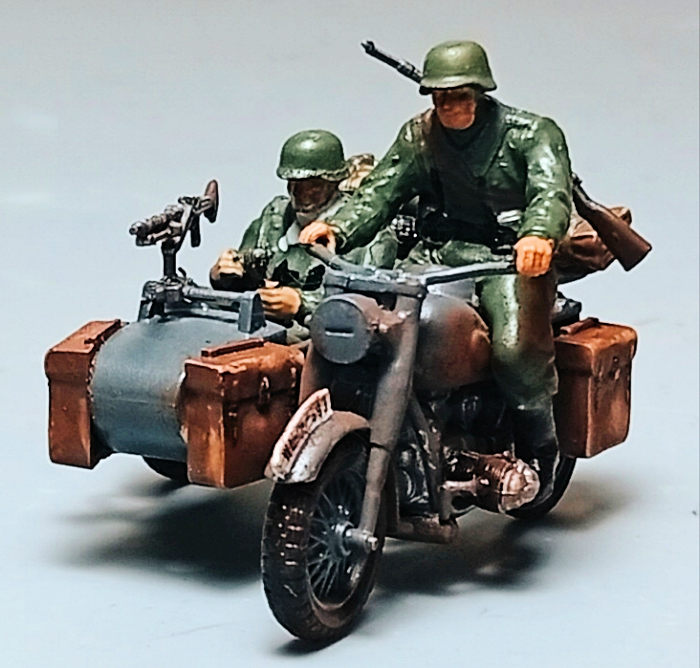 Construction
is really easy with this one. I started by attaching the left part of the engine
to the right part, which incorporates the rear frame section and rear wheel. The
cylinders were then attached to the engine. This assembly was then trapped
between the left and right frame sections, which also incorporate the fuel tank.
I then moved to the front, where the front wheel was trapped between the two
forks. The fork base plate was attached, followed by the handlebars and then the
headlight. The complete assembly was then carefully glued to the assembled rear
section. The distinctive air filter was also added to the top of the fuel tank,
completing the basic motorcycle assembly.
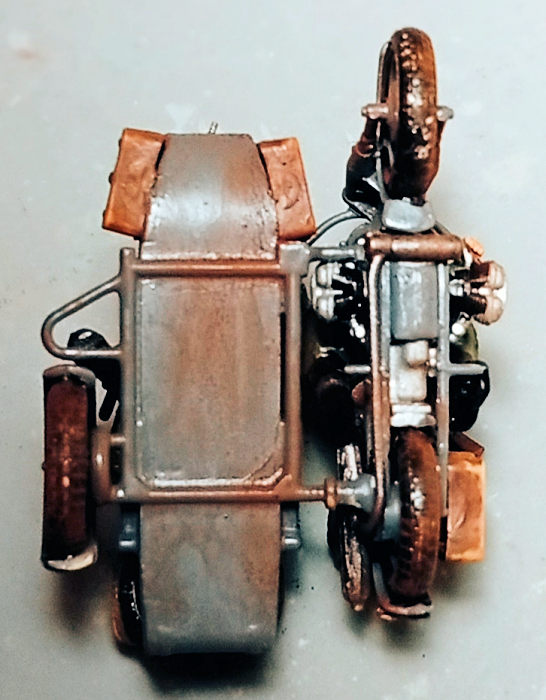
Moving on to the sidecar, I attached the two suspension components to the
sidecar base, followed by the upper sidecar section with its front handle, which
doubles as the MG34's base. The sidecar's wheel was then attached, followed by
the spare wheel. This more or less concluded the basic assembly.
The two figures were finally assembled, with some attention being required to
adjust the angles of their arms so that everything would fit naturally.
Friedrich's arms were carefully positioned to reach and grip the handlebars,
while Karl's hands were adjusted to hold his machine gun convincingly. This
small amount of adjustment was well worth the effort, as it gave the two figures
a much more natural relationship with the motorcycle and its equipment.
The construction was beautifully straightforward. The parts fit very nicely, the
sequence is logical, and there are no obvious traps waiting for the unwary
modeler. It is a very easy-going little build and should be perfectly
approachable even for a beginner.
| COLORS & MARKINGS |
The basic color of the
motorcycle was Humbrol 128 Gray. The engine was painted aluminum, with the
cylinder bases receiving black and the cylinder heads aluminum. The exhaust was
painted in a burnished metal shade, while the suspension components and the
handle between the two saddles were painted black.
The saddles were painted in a leather shade, as were the three leather carrying
bags, with black straps added for contrast. The two blankets were painted olive
drab and fitted with leather-colored straps. The handlebars were painted in the
same gray as the motorcycle, with black grips, and the number plates were
painted white.
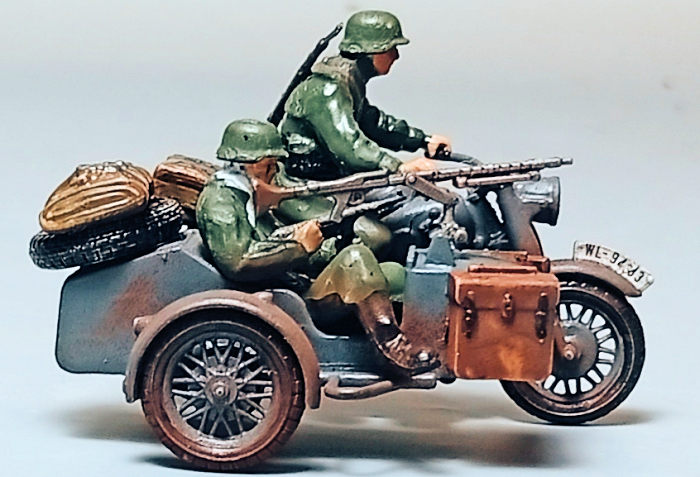
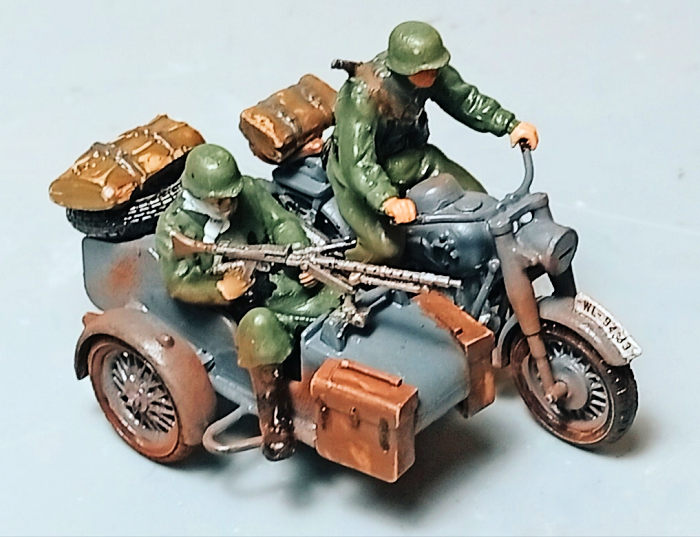 The two
figures, Friedrich and Karl, were painted in medium green uniforms, with dark
green collars and medium green helmets. Their belts, straps and boots were
painted black, while the hands and faces were finished in flesh colors. The
weapons were painted separately before being attached, with the metallic parts
receiving gunmetal and the wooden sections painted in a wood shade.
The white scarf worn by the little boy was painted accordingly around Karl's
neck, giving it a small but important visual presence in the finished scene. It
is, after all, one of the details that connects the physical model directly to
the story behind it.
All painting was done by hand, as I love hand painting, seizing every
opportunity to commence it.
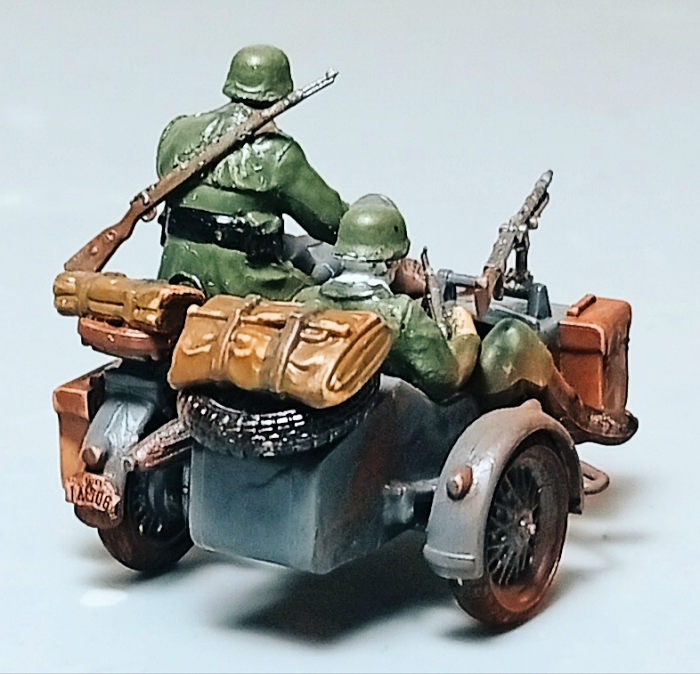
I added the decals to the number plates, but unfortunately I did not do a
particularly good job with them. Despite the decals having behaved beautifully,
in my haste, I applied a strong decal solution a little too aggressively, and
when I went over the rear decal with a brush, it lifted from its position and
became attached to the brush, where it eventually dissolved. Fortunately, only
the rear decal was destroyed, with the front two less affected. Rather than
attempting to replace them, I decided to turn the mishap into part of the
model's story, adding another of the kit registration decals and disguising the
damaged areas with some weathering, as the subject itself would feature a more
used and weather-beaten appearance.
| FINAL BITS |
The final stages
involved attaching the figures and their weapons in place. The two figures are
particularly nice for the scale and add considerably to the character of the
model. Their weapons and personal equipment make the motorcycle look genuinely
operational rather than simply like a display piece.
The inclusion of the MG34 and the various bags and blankets also provides the
modeler with plenty of opportunity to give the motorcycle some individuality.
These details are small, but in 1/48 scale they make a considerable difference.
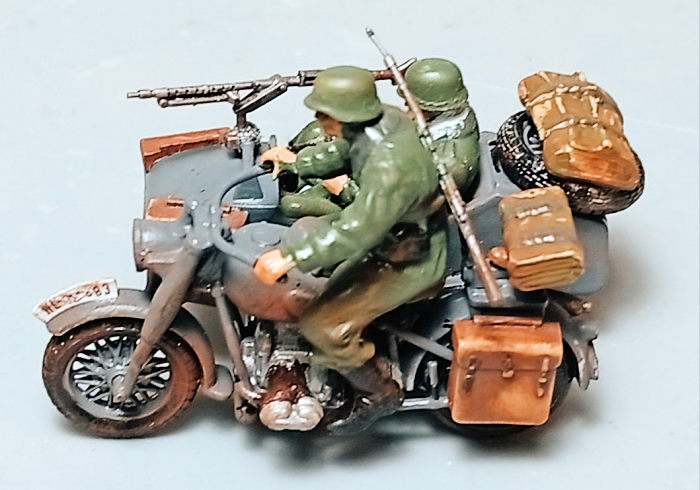 I
deliberately decided to apply some weathering to the model, mainly in the form
of dirt and mud, as this would have been the usual appearance of BMW R75
combinations operating under wartime conditions, particularly one returning from
a mission in the kind of wet and muddy terrain described in our story. I used
various shades of brown pastels, applying them deliberately over the motorcycle,
wheels, sidecar and lower areas to represent accumulated mud and dirt. This also
helped to disguise the decals' mishap, while giving the model a much more
convincing operational appearance. The result was a motorcycle that looked as
though it had actually been through the rain, mud and rough roads of the Eastern
Front rather than simply rolled out of the workshop.
A final flat coat brought everything together and gave the completed model a
consistent finish.
Once everything was assembled, painted and weathered, the model had a
surprisingly strong presence for such a small subject. The combination of the
BMW, sidecar, equipment and figures creates a miniature scene that almost
invites you to imagine where the men are going, where they have been, and what
might happen when they disappear around the next bend.
For me, that is where this particular model became more than simply another
motorcycle in the collection. The white scarf, the sidecar and the two soldiers
immediately brought the story of Friedrich and Karl to mind. Suddenly the little
BMW was no longer just a beautifully molded collection of beige styrene parts.
It had a journey behind it.
| CONCLUSIONS |
This looks like another
wonderful addition to Tamiya's 1/48 scale military range. Tamiya's 1/48 armor
kits have earned a great reputation, and this little BMW R75 proves why.
The shapes of the parts look accurate, molding is excellent, and the level of
detail is more than sufficient, especially considering the scale. The wheels,
engine and mechanical components are particularly nicely represented, while the
figures and accessories add considerably to the overall impression. The decals
are nicely printed, the instructions are beautifully produced, and the whole
package provides everything needed to produce a very attractive model straight
from the box.
The construction is simple enough that even a beginner can gradually tackle it
and finish with a wonderful result, while the experienced modeler can use the
excellent basic kit as the foundation for further detailing or weathering. At
the same time, it is inexpensive enough to make it an almost irresistible little
project.
But this particular model has become something slightly different for me.
While building it, I could not help thinking about Friedrich and Karl, two
fictional soldiers travelling through the rain on a BMW R75, unaware that a
short stop beside a forest road would become one of the most important moments
of their lives. The little white scarf wrapped around Daniel's shoulders, the
motorcycle struggling through the mud, the sidecar carrying a frightened mother
and child—all of these details have now become part of the model in my
imagination.
Perhaps that is one of the nicest things about our hobby.
We start with a box.
 Inside are a
few sprues, some small parts, a set of decals and a sheet of instructions. We
clean up the parts, glue them together, paint them and eventually place the
finished model on a shelf. But somewhere along the way, the model can become
something more. It can acquire a place, a time, a journey and even people who
never actually existed.
This BMW R75 has Friedrich and Karl.
It has Daniel and his mother.
It has a rainy road, a small village, a white scarf and the sound of an old
flat-twin engine disappearing into the darkness.
Now, whenever I look at the finished motorcycle, I don't simply see a German
military motorcycle and sidecar. I see the beginning of a story and, perhaps
more importantly, the reminder that sometimes the smallest acts of kindness can
travel much farther than the people who perform them ever imagine.
At around 12 Euros, this is also a very sensibly priced kit. It offers excellent
molding, good detail, straightforward construction and plenty of character,
while leaving the modeler with enough room to add his own imagination.
Tamiya deserves congratulations for bringing yet another
charming and highly enjoyable subject to the 1/48 scale range. It is a model
that can provide a great deal of modeling pleasure, whether approached as a
simple weekend project, a beginner's build or the basis for a more elaborate
scene.
For me, however, this little BMW will always carry something extra.
Friedrich kept the motorcycle because he could not forget the boy he once
carried through the rain.
Daniel kept the memory because he could not forget the two men who stopped.
I built the motorcycle because, sometimes, a small model deserves a story as
much as a story deserves a model.
Happy modeling!
Spiros Pendedekas
25 March 2021
Copyright ModelingMadness.com. All rights reserved. No reproduction in part or in whole without express permission.
If you would like your product reviewed fairly and fairly quickly, please contact the editor or see other details in the Note to Contributors.