| KIT #: | 03705 |
| PRICE: | $400.00 when new |
| DECALS: | One option |
| REVIEWER: | Kelly Yoho |
| NOTES: | Pontos 1/200 USS Missouri Super Deluxe Upgrade Set With Blue Deck (23003F1), Pontos 1/200 USS Missouri/Iowa 1944 Advanced Add-on Set (21002F1), and the Model Monkey 1/200 Fast Battleship and Atlanta class 5"/38 Mk.28 Mounts |
| HISTORY |
 From the
Wikipedia article: “USS Missouri (BB-63) is an Iowa-class battleship built for
the United States Navy (USN) in the 1940s and is now a museum ship. Completed in
1944, she is the last battleship commissioned by the United States. The ship was
assigned to the Pacific Theater during World War II, where she participated in
the Battles of Iwo Jima and Okinawa and shelled the Japanese home islands. Her
quarterdeck was the site where the Japanese Instrument of Surrender was signed,
officially ending World War II.”
From the
Wikipedia article: “USS Missouri (BB-63) is an Iowa-class battleship built for
the United States Navy (USN) in the 1940s and is now a museum ship. Completed in
1944, she is the last battleship commissioned by the United States. The ship was
assigned to the Pacific Theater during World War II, where she participated in
the Battles of Iwo Jima and Okinawa and shelled the Japanese home islands. Her
quarterdeck was the site where the Japanese Instrument of Surrender was signed,
officially ending World War II.”
Paul Stillwell’s “Missouri: An Illustrated History” had an interesting observation from a young ensign who had served on both the New Jersey and the Missouri. The former, which had been commissioned in 1943, he considered to be a “happy” ship, while the Missouri, commissioned a year later, was an “unhappy” ship, in part because of its large compliment of married men with children whose previous exemption from the draft had ended in 1943.
| THE KIT |
 First released
in 2013, the USS Missouri is one of a series of 1/200 WWII model ships from
Trumpeter, including the Yamato, Bismarck, Hood, and USS Arizona, the last of
which I had previously built. The Missouri kit includes 11 photo-etch sheets
(very little of which I used), a small chain for the anchors, and 1500+ plastic
parts.
First released
in 2013, the USS Missouri is one of a series of 1/200 WWII model ships from
Trumpeter, including the Yamato, Bismarck, Hood, and USS Arizona, the last of
which I had previously built. The Missouri kit includes 11 photo-etch sheets
(very little of which I used), a small chain for the anchors, and 1500+ plastic
parts.
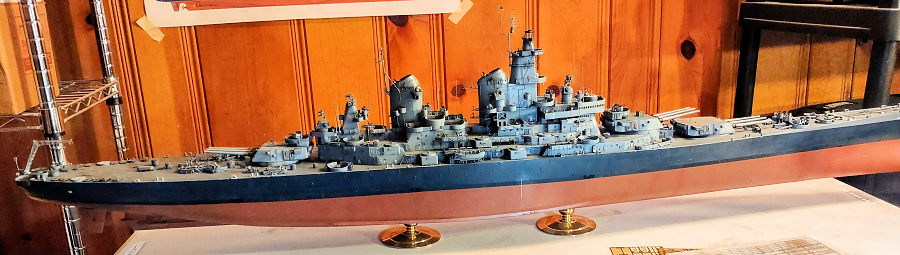
It’s a magnificent piece of engineering but, like all kits, it has a few faults, which other reviewers have noted. The front of the ship lacks the dramatic upsweep of the Iowa-class battleships; ironically, the box art on the Trumpeter kit depicts this pretty well. The kit’s bow is considerably less bulbous that the original, which some modelers try to correct with putty and plastic card (I chose not to). Finally, the 5-inch twin mount turrets are closer in shape to Mk.32 mounts instead of the correct Mk.28s. These I replaced with the aforementioned Model Monkey 3D-printed mounts.
| CONSTRUCTION |
I relied heavily on two previous Trumpeter Missouri builds to assist me, both of which are first-rate: Ben’s on the “Midwest Model Shop” YouTube channel, and a chap named Steinerman in the Large Scale Planes forum (I wish I had seen Ben’s 1/200 Arizona videos before tackling that kit). I had to decide whether to do the 1944 Measure 32 “dazzle” camouflage scheme, which I really liked, or the more subdued two-tone 1945 Measure 22. I chose the latter because of its simplicity. I also flirted with trying to recreate the September 1945 surrender ceremony – there’s at least one online build that depicts this – but chickened out when I realized that it meant painting several hundred (if not thousand) 1/200 scale dignitaries and onlookers.
The bow of the hull
consists of two pieces that need to be glued to the main hull, which I assume is
due to limitations of the injection molding process. The fit was pretty good and
with careful puttying and painting, the seam lines are almost invisible. Ben
from “Midwest Model Shop” did some subtle “oil canning” on his hull, plus he
“dinged” it where a Japanese kamikaze struck the Missouri in 1945 – neither of
which I attempted. I did, however, use the small Eduard hull plate P.E. set, and
recreated the prominent horizontal plating by masking off the hull and then
varying the thickness of the airbrushed paint. The anchor chain supplied by
Trumpeter has the incorrect link shape, but I was
 unable to
find a replacement, so I used the kit chain after letting it soak overnight in
Brass Black to make it look more worn. I had chosen the blue wooden deck version
of the Pontos upgrade set, but the color doesn’t (to my eye at least) look
anything like the Deck Blue 20-B used during the war – I wish I had gotten the
teak wood color, since I ended up painting it anyway. I also wish I had watched
Ben’s video first on how he applied these decks, which involved spraying Krylon
flat on the adhesive side, which removed the stickiness, then using wood glue to
attach them to the kit and, if necessary, reposition them. I didn’t do this for
the main deck, and couldn’t move it after I realized it was slightly out of
place – very frustrating!
unable to
find a replacement, so I used the kit chain after letting it soak overnight in
Brass Black to make it look more worn. I had chosen the blue wooden deck version
of the Pontos upgrade set, but the color doesn’t (to my eye at least) look
anything like the Deck Blue 20-B used during the war – I wish I had gotten the
teak wood color, since I ended up painting it anyway. I also wish I had watched
Ben’s video first on how he applied these decks, which involved spraying Krylon
flat on the adhesive side, which removed the stickiness, then using wood glue to
attach them to the kit and, if necessary, reposition them. I didn’t do this for
the main deck, and couldn’t move it after I realized it was slightly out of
place – very frustrating!
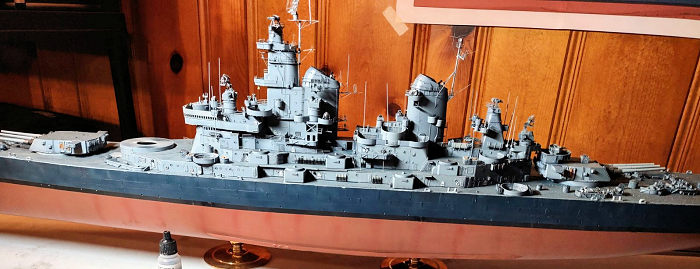
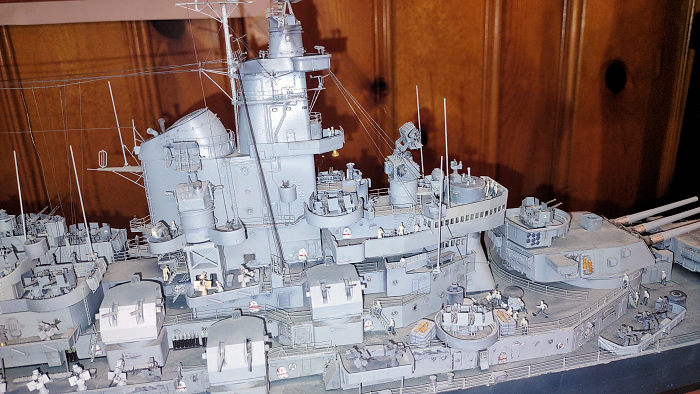
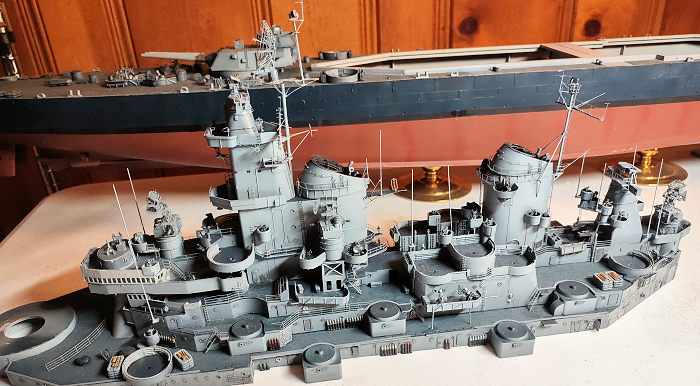
The Pontos upgrade set, which was almost as expensive as the kit itself, comes with 18 sheets of photo etch, 297 brass parts (gun barrels, antennas, capstans, etc.), 33 resin parts, and the aforementioned wooden decks – plus a small sheet of dry transfers. The set is well engineered and of high quality, but is let down by the instructions, which are frustratingly vague in spots (Ben complained about this as well). I also purchased the Pontos add-on set, which includes exquisite resin castings for the quad 40mm mounts, and 4 brass screw propellers. Assembling all of the 40mm Bofors and 20mm Oerlikon mounts (20 of the former and 49 of the latter!) with their intricate P.E. was mind-numbingly tedious. The Midwest Model Shop online store now sells 3D-printed replacements for both, and I would have used them instead had they been available during my build. The other task that really tested my sanity was attaching the hundreds of tiny vertical handrails to the superstructure and stern of the ship. Fortunately, Pontos provides templates to help you drill the 0.3mm holes needed for each rail.
The porthole detail on the
kit is excellent, but I chose to drill some of them out and use the Pontos P.E.
details (the “eyebrows”) for both the open and closed portholes. In retrospect,
doing this didn’t add a great deal to the overall look of the model. I also
fabricated oars and food and water casks for the life rafts, plus floats for the
floater net baskets. I didn’t have any serious fit or assembly issues with the
kit, with two exceptions. The first occurred when trying to add clear windows to
the Pontos photo-etch navigation bridge – I couldn’t get it to come together and
ended up using the kit parts instead. Even more frustrating was attaching the
subassembly with the forward funnel and fire control tower to the deck behind
the navigation bridge. There was so much clutter already on the dec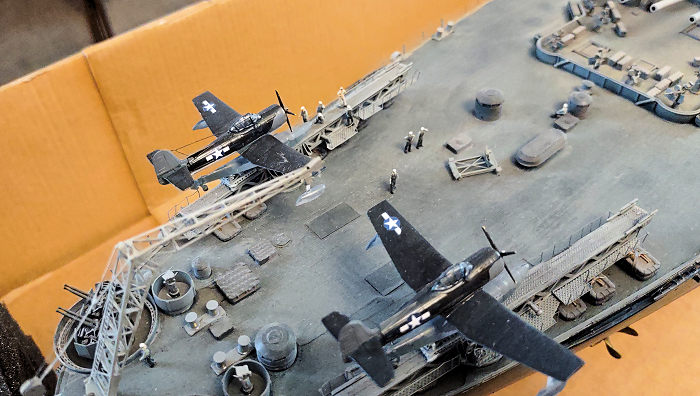 k
that the subassembly refused to go down, and I broke several parts while trying
to force it into place. Afterwards, I rewatched Ben’s video on how he handled
this assembly, and I noticed that he left off the fire control tower, as well as
the 40mm gun tubs, until the funnel was glued to the deck – which made the
process much easier.
k
that the subassembly refused to go down, and I broke several parts while trying
to force it into place. Afterwards, I rewatched Ben’s video on how he handled
this assembly, and I noticed that he left off the fire control tower, as well as
the 40mm gun tubs, until the funnel was glued to the deck – which made the
process much easier.
One of the least enjoyable tasks with any ship model is, in my opinion, the rigging – and the Missouri was no exception. I learned that there aren’t any 100% reliable guides to the ship’s WW2 configuration here – blueprints only include the most basic details, and photographs from that era also fail to capture much detail (the Trumpeter and Pontos instructions whiffed on this as well). I ended up cobbling together a “best guess” from various references and online builds. I used EZ Line Fine thread (.010" diameter), which has a built-in elasticity and is easy to attach with super glue. Ben’s rigging video recommended using thin stretched sprue for the cables between the two masts – this prevents the multiple vertical cables (antennas?) that attach from the deck from causing the horizontal cables to sag.
The Pontos railings were nicely done. There was a lot of bending and shaping involved, and I included the rail stanchions on the main deck, which were tedious to install but added to the overall realism. I also had to make periodic cuts in the railings to accommodate the chocks on the main deck – I didn’t always measure correctly and had to insert small bits of railing to cover any gaps.
Finally, I added a couple dozen 1/200 figures in various poses and locations, which help give viewers a feeling for the sheer size of the Missouri. Most were from a US Navy set by Ion, but I also used some leftover figures from my Arizona build, including the rubbery, oddly shaped ones from Trumpeter itself.
| COLORS & MARKINGS |
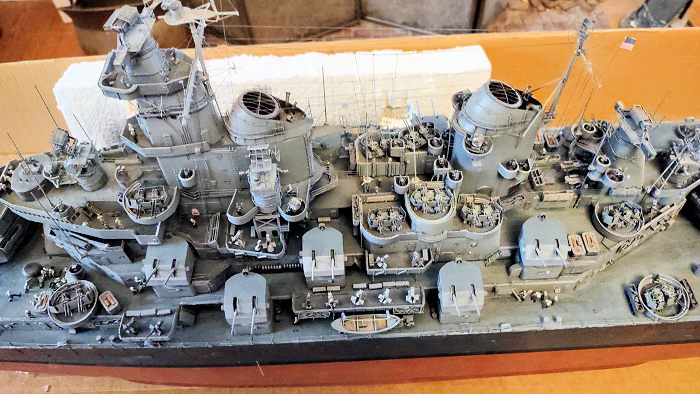 The Measure
22 camouflage scheme consists of Navy Blue 5-N and Haze Gray 5-H on the vertical
surfaces, and Deck Blue 20-B on the horizontal ones – plus Anti Fouling Red
Oxide (aka Hull Red) for the lower hull. For paint, I used Badger ModelFlex
Marine Colors and the AK Interactive Navy Camouflages sets. I found both brands
difficult to airbrush (one clogged, one ran), but it’s possible that I didn’t
thin them properly or use the correct pressure. I didn’t like either’s Deck
Blue, so I mixed my own using Tamiya acrylic paints. I also applied Taniya gray
panel wash on the Haze Gray surfaces to make the detail “pop” – something that
Ben suggested in one of his videos.
The Measure
22 camouflage scheme consists of Navy Blue 5-N and Haze Gray 5-H on the vertical
surfaces, and Deck Blue 20-B on the horizontal ones – plus Anti Fouling Red
Oxide (aka Hull Red) for the lower hull. For paint, I used Badger ModelFlex
Marine Colors and the AK Interactive Navy Camouflages sets. I found both brands
difficult to airbrush (one clogged, one ran), but it’s possible that I didn’t
thin them properly or use the correct pressure. I didn’t like either’s Deck
Blue, so I mixed my own using Tamiya acrylic paints. I also applied Taniya gray
panel wash on the Haze Gray surfaces to make the detail “pop” – something that
Ben suggested in one of his videos.
The Pontos dry transfers included draft marks and other markings, and went down without too much hassle. I copied Ben’s use of small model railroad decals to apply identification numbers to the 40mm and Mk. 51 gun director tubs, which can be seen on several WW2-era photographs, including the famous one of a kamikaze Zero menacing the side of the ship. A note of caution: the 40mm tub numbers shown in the Pontos instructions are for assembly purposes only, and don’t match the actual numbers on the side of the tubs. The latter I found in a forum post on ModelWarships.com.
| CONCLUSIONS |
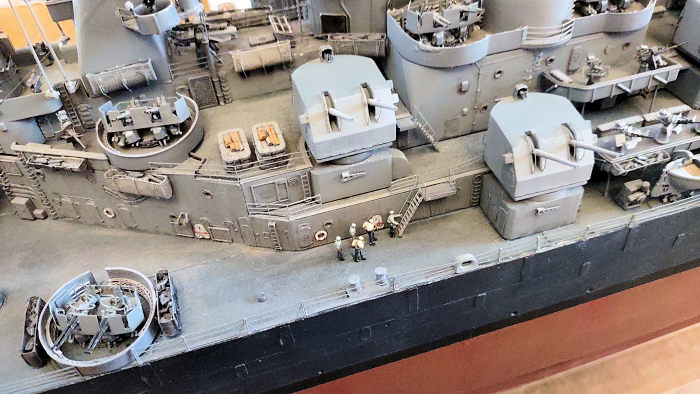 My 1/200
Trumpeter Missouri took four and a half years to finish. Unlike with my previous
Arizona build, I worked on other models (all aircraft) during this time, which
helped break up the tedium. To do justice to something this intricate – with
P.E. and resin upgrades, there were 6,000+ parts -- you need the hands and eyes
of a surgeon. Unfortunately, I don’t possess either, and close inspection of the
model reveals small globs of super glue here and there, slightly crumpled radar
masts, and misaligned 40mm barrels. Still, I was just happy to make it to the
finish line, though, to be honest, I’m not sure if I’ll ever start a project of
this size and scope again.
My 1/200
Trumpeter Missouri took four and a half years to finish. Unlike with my previous
Arizona build, I worked on other models (all aircraft) during this time, which
helped break up the tedium. To do justice to something this intricate – with
P.E. and resin upgrades, there were 6,000+ parts -- you need the hands and eyes
of a surgeon. Unfortunately, I don’t possess either, and close inspection of the
model reveals small globs of super glue here and there, slightly crumpled radar
masts, and misaligned 40mm barrels. Still, I was just happy to make it to the
finish line, though, to be honest, I’m not sure if I’ll ever start a project of
this size and scope again.
I donated the completed model to the Military History Society of Rochester’s museum, which already displayed my USS Arizona.
| REFERENCES |
The Floating Drydock’s USS Missouri BB63
USS Missouri: An Illustrated History by Paul Stillwell
The Battleship USS Missouri by Witold Koszela
Ben’s USS Missouri build YouTube videos:
https://www.youtube.com/playlist?list=PLdPY23NZym_vRY041-OCM-JPv-oYJ-XDW
Steinerman’s USS Missouri build on Large Scale Planes:
29 June 2026
Copyright ModelingMadness.com. All rights reserved. No
reproduction in part or in whole without express permission.
If you would like your product reviewed fairly and
fairly quickly, please
contact
the editor
or see other details in the
Note to
Contributors.