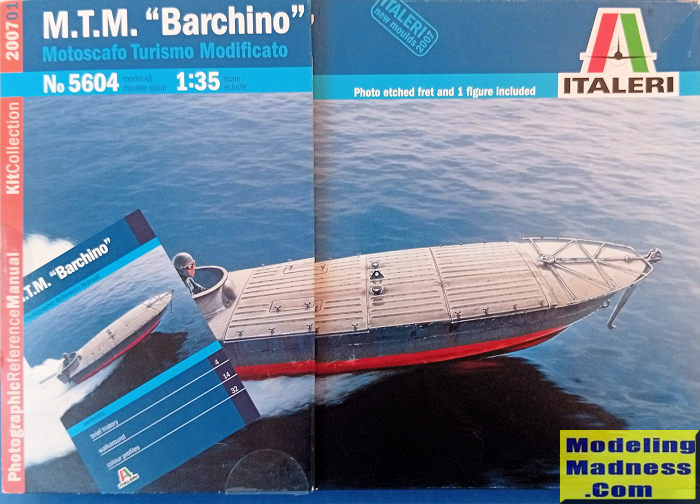
Italeri 1/35 MTM Barchino
| KIT #: | 5604 |
| PRICE: | 12 Euros on sale |
| DECALS: | Two options |
| REVIEWER: | Spiros Pendedekas |
| NOTES: | Initial release. Contains poster and reference book. |
| HISTORY |
In the history of naval warfare, there have always been men who dared to challenge the strength of an enemy fleet with weapons that seemed almost insignificant in comparison. During the Second World War, the Italian Royal Navy, the Regia Marina, became particularly renowned for its development of unconventional assault weapons designed to strike where the enemy felt safest: inside its own heavily defended harbours. Among these ingenious and fearsome creations was the M.T.M. (Motoscafo da Turismo Modificato), better known as the Barchino.
The origins of the Barchino can be traced to the mid-1930s, when Italian naval planners began exploring ways of attacking enemy warships at anchor using small, fast motorboats carrying powerful explosive charges. The concept was simple, yet audacious. Rather than attempting to defeat a heavily armed warship in a conventional engagement, a tiny craft would approach its target at high speed, penetrate the harbour defences and deliver its deadly cargo against the enemy's hull.
The resulting M.T.M. was a compact, modified motorboat with a wooden hull, powered by an Alfa Romeo engine producing approximately 95 horsepower. Depending on the version and operating conditions, it could reach speeds of around 30–34 knots. Its bow carried an explosive charge of approximately 300 kilograms, designed to detonate beneath the waterline of the target and inflict devastating damage.
The Barchino was designed for a mission in which the pilot was expected to abandon his craft shortly before impact. Approaching the target, he would accelerate towards the enemy vessel, set the steering mechanism on its final course and escape from the boat. The unmanned craft would continue towards its destination, striking the target and detonating its charge. The pilot's survival depended on timing, training and a very narrow margin for error. Every mission demanded exceptional nerve, discipline and a willingness to confront danger at almost unimaginable proximity.
These craft were employed by specialist assault personnel of the Italian Navy, including men associated with the celebrated Decima MAS. Their most famous success came during the night of 25–26 March 1941, when six explosive motorboats, commanded by Lieutenant Luigi Faggioni, penetrated the British naval anchorage at Suda Bay, Crete.
The operation was an extraordinary undertaking. Despite the harbour's defences, the Italian crews managed to reach their targets in the darkness before dawn. Two M.T.M.s struck the heavy cruiser HMS York, causing damage so severe that the vessel had to be beached to prevent her from sinking in deeper water. Another boat struck the tanker Pericles, which was also severely damaged and subsequently sank while under tow. All six Italian pilots survived the attack, although they were captured by the British.
The raid demonstrated how a relatively inexpensive weapon, operated by a small team of determined men, could put a major warship out of action. It also illustrated the philosophy behind these unconventional assault craft: surprise, speed and precision could sometimes achieve what conventional naval power could not.
The M.T.M. was neither a conventional warship nor an ordinary motorboat. It was a purpose-built weapon that combined relatively simple construction with a remarkably dangerous mission. Its small dimensions concealed considerable destructive potential, while its modest appearance belied the courage demanded of the men who operated it.
Today, the Barchino remains a fascinating subject for historians and scale modellers alike. Its distinctive lines, exposed machinery, compact proportions and unusual operational history make it much more than an obscure footnote in the story of the Italian Navy. It is a reminder of a time when naval warfare pushed engineers and fighting men towards extraordinary solutions, and when a small wooden boat, carrying a single man and a powerful explosive charge, could challenge the might of an enemy fleet.
Behind the Barchino's simple silhouette lies a story of technical ingenuity, daring and sacrifice — a story in which a seemingly insignificant craft carved its own place in the dramatic history of the Second World War.
| THE KIT |
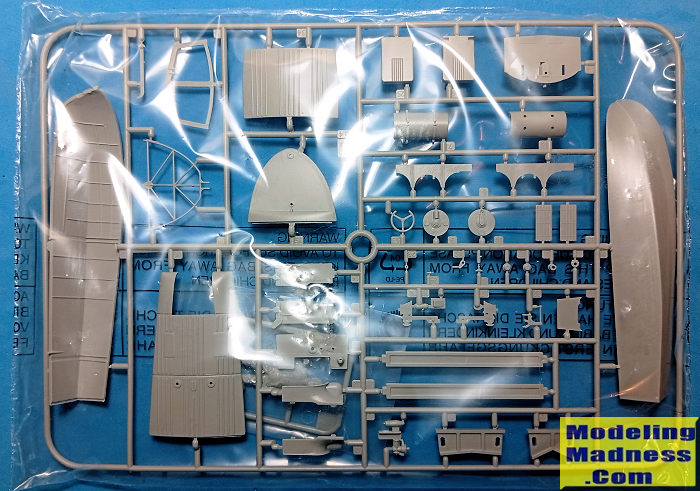 Italeri released this rather unusual subject in 2007, bringing the Italian
M.T.M. Barchino to the modeling world in the popular 1/35 scale. It is certainly
not the kind of subject we encounter every day, and that alone makes it an
interesting addition to the manufacturer's catalogue. The scale also offers some
welcome possibilities for display alongside suitable military vehicles, figures
or other subjects in the same scale.
The kit previewed here is the initial release, which comes with a few pleasant extras that add considerably to its overall presentation. Alongside the kit itself, Italeri included a nicely printed photographic reference booklet and a foldout mini-poster. These are welcome additions, particularly for a subject that may not be familiar to every modeller, and they make the package feel a little more special.
I acquired my example from one of my now-beloved online hobby shops at the almost unbelievable price of just €12. At that price, this was an opportunity I could hardly pass up!
The kit comes in Italeri's familiar side-opening cardboard box, featuring attractive artwork depicting the Barchino in action. The box itself is relatively thin and a little flimsy, so I would not recommend stacking too many other boxes on top of it. Still, it does its job, and the artwork certainly makes a good first impression.
Upon opening the box, I was greeted by 42 grey styrene parts, neatly arranged on a single sprue, accompanied by a photo-etched fret. The parts are cleanly molded, with good details and virtually no flash. While the molding may not quite match the exceptionally crisp standards of the very latest releases, it remains very good indeed, and there is little to complain about here.
The details appear well represented, and the overall impression is of a thoughtfully designed little kit. I am not a naval modeling specialist, so I will leave the final verdict on absolute accuracy to those more familiar with the subject. Nevertheless, the shapes and details look convincing to my eyes.
One particularly nice feature is the design of the upper cover of the explosive compartment. This can be left removable, allowing the modeller to display the explosive charge inside. The mechanism itself is nicely represented, and the option to show it off is a welcome touch. After all, what would be the point of building such an unusual craft if we could not occasionally lift the lid and admire what makes it so deadly?
The pilot's compartment is also well done, with the controls and instrument panel represented convincingly. The instrument panel itself is provided as a photo-etched part, with the individual instrument faces supplied as decals. This combination should produce a neat and convincing result without requiring excessive effort.
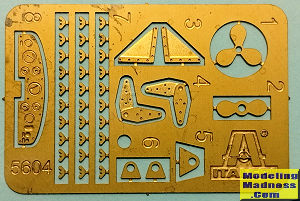 The
photo-etched fret is an indispensable part of the package, rather than merely an
afterthought. In addition to the instrument panel, it provides details that
enhance the overall appearance of the model. Even the propeller is supplied as a
photo-etched part that must be carefully bent into shape. Once assembled, it
should look considerably more delicate and realistic than a conventional solid
plastic representation.
Italeri has also included a display base and a figure, both welcome additions that offer further possibilities for presenting the completed model. The base provides a suitable platform for the Barchino, while the figure adds a human element and helps convey the small scale of the craft. Together, they offer a good starting point for a simple display or even a more elaborate diorama, should the modeller wish to take things a little further.
The instructions are also worth mentioning. As is typical of Italeri, they are nicely presented and include a brief history of the subject, a parts map, a colour chart and a construction sequence divided into thirteen steps. Colour callouts are provided wherever applicable, and the illustrations appear clear enough to guide the modeller through the assembly without unnecessary confusion. In other words, Italeri has done a good job of making the instructions straightforward and user-friendly — something we can all appreciate when we are eager to get on with the actual modeling!
Two marking options are provided. The first represents a Barchino associated with the Italian Xª Flottiglia MAS operation against the British anchorage at Suda Bay, Crete, while the second depicts a captured example in Kriegsmarine service. The two alternatives give the modeller an interesting choice between the craft's original Italian operational history and its subsequent use by the Germans.
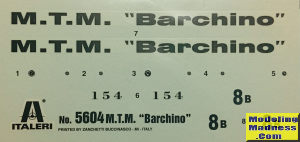 The
decals are wonderfully printed by Zanchetti Buchinasco, with sharp printing and
clearly defined details. They look very good indeed and should contribute nicely
to the final appearance of the completed model.
Colour references are given using Model Master codes, alongside generic colour descriptions, making it relatively easy to identify suitable paints.
Construction begins with the hull, followed by the assembly of the explosive mechanism, the driver's compartment and the engine and propeller area. These subassemblies are then brought together, with the upper cover fitted in place. Modellers wishing to display the explosive charge can leave the cover unglued, allowing it to be removed whenever they wish to reveal the internal details.
The construction sequence looks logical, and nothing in the instructions suggests that this should be a particularly demanding build. With the relatively modest parts count and the straightforward arrangement of the main components, this appears to be the kind of kit that can provide an enjoyable, uncomplicated modelling session without sacrificing the satisfaction of producing something a little different.
| CONCLUSIONS |
It is always nice to see manufacturers venturing beyond the familiar aircraft, tanks and armoured vehicles, and Italeri deserves credit for bringing us this unusual little naval subject. We do not encounter many small naval craft in 1/35 scale, so the M.T.M. Barchino is a welcome addition to the modelling world. Its scale also makes it an interesting candidate for a display alongside other military subjects.
The kit appears to capture the distinctive character of the real craft, with convincing shapes, nicely rendered details and a well-thought-out arrangement of the main components. Though already two decades old, molding is clean and more than adequate for an enjoyable build. The photo-etched fret complements the plastic parts very nicely, while the removable cover provides an excellent opportunity to display the explosive mechanism inside.
The instructions are clear and comprehensive, the decals by Zanchetti Buchinasco are sharply printed, and the two marking options provide some welcome choice. The photographic booklet and foldout mini-poster are pleasant extras, while the display base and figure offer further opportunities to present the finished model attractively. Construction also looks straightforward, making this an appealing choice for modellers who want to try something different without committing themselves to a complicated or demanding project.
But what really makes this kit attractive is its combination of an unusual subject, a generous presentation and, in my case, an almost killer price. At the €12 I paid, it represents outstanding value for money. It is one of those purchases that reminds us why browsing our favorite hobby shops can sometimes be just as rewarding as the actual building!
Highly recommended to anyone interested in unusual military subjects, Italian naval history or simply adding something different to their modelling collection. The Italeri M.T.M. Barchino may be small, but it certainly has plenty of character — and at this price, it is difficult to find a good reason to leave it on the shelf.
Happy Modeling!
November 2026 Copyright ModelingMadness.com. All rights reserved. No
reproduction in part or in whole without express permission from the editor. If you would like your product reviewed fairly and
fairly quickly, please
contact
the editor
or see other details in the
Note to
Contributors.