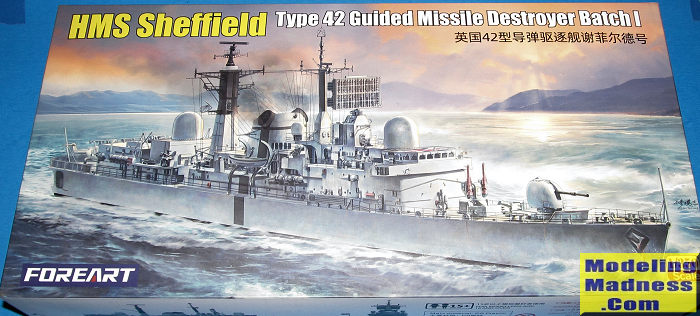
ForeArt 1/350 HMS Sheffield
| KIT #: | 3001 |
| PRICE: | $32.99 |
| DECALS: | One option |
| REVIEWER: | Dan Lee |
| NOTES: | Includes 3D and p.e. parts |
| HISTORY |
The HMS Sheffield was the first of the first batch of the Type 42 DDGs built for the Royal Navy. She had a crew of 253 officers and ratings, carried one 4.5 inch gun in the forward turret, a Sea Dart launcher with a capacity for 22 missiles, two triple anti-sub warefare torpedo tubes and one helo for long range ASW capability.
They were designed to provide long range air defence for the Royal Navy after the cancellation of the CVA01 aircraft carrier and Type 82 destroyer class. Unfortunately they were designed on the cheap due to the sad state of the British economy in the late 1960s and showed it. From their poor rough sea handling, their mediocre sensor suite to their aluminium superstructure, the Type 42s had issues that plagued the class for a while. The later batches 2&3 tried to fix some of these issues.
Many of these issues would come to haunt the Royal Navy during the 1982 Falklands war. The HMS Sheffield was stationed on radar picket duty (similar to USN Destroyers had to do during the invasion of Okinawa) because the RN didn't have an AWACS type of aircraft to provide long range radar cover unlike the USN or French Navy had at the time. The one thing that scared the RN was the Argentinian Super Entendard attack planes armed with Exocet Anti-ship missiles (ASMs). It was fortunate for the British that the Argentinians only had a few missiles (even so they were used to great success.) In another twist of fate, the Argentinians purchased two Type 42s around the same time as the HMS Sheffield so they were quite familiar with the Sea Dart SAM and it's limitations against low level targets.
On May 4, 1982, an Argentinian Neptune patrol bomber discovered the Sheffield and relayed the target data back to it's ground station. A pair of Super Entendard attack planes armed with an Exocet each were launched, refueled air to air and approached the British Fleet. At about 40 nautical miles, the two jets popped up only to be spotted by radar and fired their missiles before diving back down and leaving the danger zone at high speed.
Thanks to some rather bad luck, poor communication between ships and the 965 radar's poor detection of targets at low altitudes, one of the two Exocets slammed into the starboard amidships of the Sheffield killing 20 of her crew and injuring 63 or so.
It didn't explode but it caused enough damage to start fires that caused the aluminium superstructure to burn and disable the main damage control water pumps. Eventually, the captain ordered the crew of the Sheffield to abandon ship while leaving they sang “Look on the Bright Side of Life” from Monty Python's Life Of Brian. It would take six days for the Sheffield to sink and become the first Royal Navy ship lost in combat since WW2.
Another Type 42 destroyer, the HMS Conventry would also be sunk during the war. This lead to an inquiry about the loses and what could be done to remedy those those.
Despite their issues, the Type 42 destroyers served with the Royal Navy from 1975 to 2013.
| THE KIT |
 A new company from China,
ForeArt (formerly known as Fore Hobbies) came into existence in 2020. They've
produced some armor and ship models in their line.
A new company from China,
ForeArt (formerly known as Fore Hobbies) came into existence in 2020. They've
produced some armor and ship models in their line.
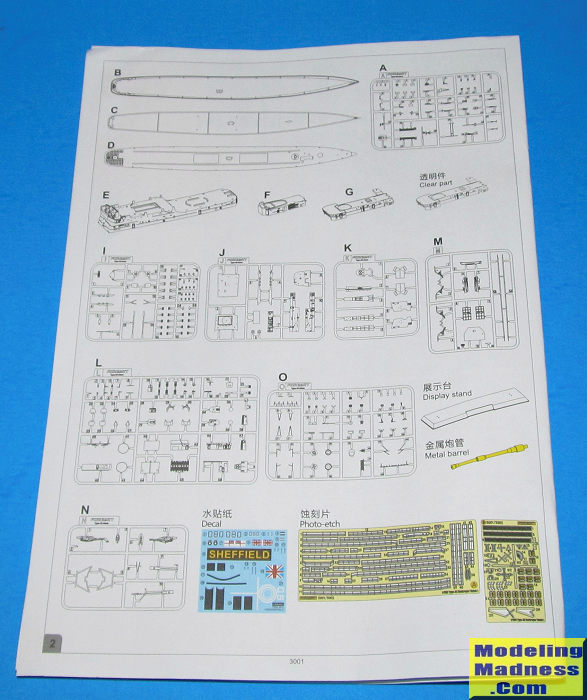
 The kit comes with 14
sprues of grey plastic including the hull sections and one clear sprue. The
parts are crisp and well done with only mold markings. The kit comes with two
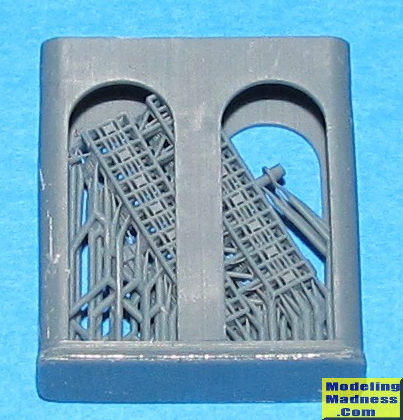
frets of Photo etch for the railings and other fine details, one block of 3d
printed resin parts for those unwilling to make PE radars (I've made enough to
not enjoy doing the necessary task), a decal sheet of all the necessary markings
for the HMS Sheffield, one brass gun barrel for the 4.5 inch cannon and finally
one styrene display stand.
The kit comes with 14
sprues of grey plastic including the hull sections and one clear sprue. The
parts are crisp and well done with only mold markings. The kit comes with two
frets of Photo etch for the railings and other fine details, one block of 3d
printed resin parts for those unwilling to make PE radars (I've made enough to
not enjoy doing the necessary task), a decal sheet of all the necessary markings
for the HMS Sheffield, one brass gun barrel for the 4.5 inch cannon and finally
one styrene display stand.
The instruction booklet seems to be decent as it goes step by step into the building process and hopefully free of errors that seem to plague other new model companies instructions.
| CONCLUSIONS |
I've always wanted to build a model of the HMS Sheffield based on its role in the Falklands War. Most of the options were resin kits. I think this is the first ever mostly styrene kit of the HMS Sheffield. Hopefully it will be a relatively easy build (for a warship) based on the instruction booklet.
June 2025
Copyright ModelingMadness.com. All rights reserved. No reproduction in part or in whole without express permission.
If you would like your product reviewed fairly and fairly quickly, please contact the editor or see other details in the Note to Contributors.