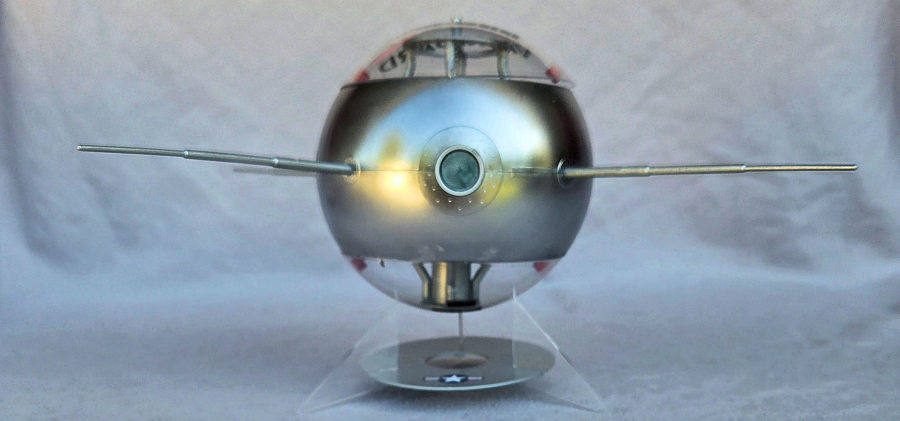
Hawk 1/5 Vanguard Satellite
| KIT #: | HL 603 |
| PRICE: | $12.00 |
| DECALS: | One option |
| REVIEWER: | John Summerford |
| NOTES: |
| HISTORY |
Courtesy NASA, February 16, 2024
 In
the dawn of the Space Age, a group of scientists and engineers from the
Naval Research Laboratory (NRL) had their eye on a new frontier: the
uncharted expanse of space. Project Vanguard, initiated in 1955, aimed to
launch the first American satellite into Earth orbit as part of the
International Geophysical Year (July 1957 to December 1958). Led by NRL, it
envisioned a three-stage rocket design and emphasized scientific
instrumentation over military application while showcasing American
ingenuity. Despite its ambitious goals, Project Vanguard encountered
difficulties. The first five Vanguard launch attempts suffered critical
failures, earning it the nickname “Flopnik” in the press. The public, eager
for American success in space following the Soviet Union’s launch of Sputnik
1, was disappointed in Vanguard’s performance. However, Vanguard’s legacy
extends beyond its initial setbacks. On March 17, 1958, Vanguard TV-4, also
known as Vanguard I, achieved orbit to become America’s second satellite and
the world’s fourth artificial satellite in space. This success marked a
major milestone and instilled renewed confidence in the project. Today,
Vanguard I remains in space as the oldest satellite orbiting the Earth.
In
the dawn of the Space Age, a group of scientists and engineers from the
Naval Research Laboratory (NRL) had their eye on a new frontier: the
uncharted expanse of space. Project Vanguard, initiated in 1955, aimed to
launch the first American satellite into Earth orbit as part of the
International Geophysical Year (July 1957 to December 1958). Led by NRL, it
envisioned a three-stage rocket design and emphasized scientific
instrumentation over military application while showcasing American
ingenuity. Despite its ambitious goals, Project Vanguard encountered
difficulties. The first five Vanguard launch attempts suffered critical
failures, earning it the nickname “Flopnik” in the press. The public, eager
for American success in space following the Soviet Union’s launch of Sputnik
1, was disappointed in Vanguard’s performance. However, Vanguard’s legacy
extends beyond its initial setbacks. On March 17, 1958, Vanguard TV-4, also
known as Vanguard I, achieved orbit to become America’s second satellite and
the world’s fourth artificial satellite in space. This success marked a
major milestone and instilled renewed confidence in the project. Today,
Vanguard I remains in space as the oldest satellite orbiting the Earth.
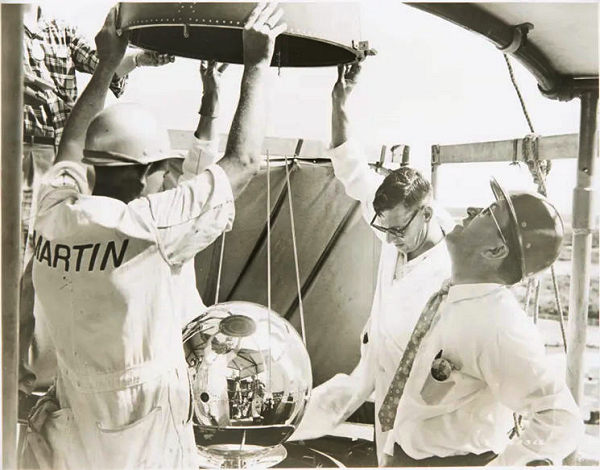
The sphere-shaped Vanguard II satellite reflects the scene in this 1959 photo from the preparations for its launch.
NASA Goddard Archives
A few months after the launch of Vanguard I in 1958, the National Aeronautics and Space Act was passed establishing the National Aeronautics and Space Administration (NASA), and on May 1, 1959, NASA Administrator Dr. T. Keith Glennan announced that the Beltsville Space Center would become Goddard Space Flight Center. The center would be under the overall guidance of Dr. Abe Silverstein, then Director of Space Flight Development at NASA Headquarters.
Recognizing the expertise and dedication of the NRL team, NASA transferred many employees from Project Vanguard to form the nucleus of the Goddard Space Flight Center in Greenbelt, Maryland. The migration of NRL scientists and engineers to Goddard wasn’t merely a paperwork shuffle, it was the transfer of their vital knowledge and experience.
 Their
impact was immediate. While initially tasked with completing Vanguard’s
mission, the Goddard center quickly expanded its scope, encompassing Earth
science, astrophysics, and space exploration. Early Goddard employees formed
the core of several projects, including the Explorer series of satellites
and the Television Infrared Observation Satellite (TIROS) Program. They
tackled the challenges of satellite communication, laying the groundwork for
technologies that would be used for years.
Their
impact was immediate. While initially tasked with completing Vanguard’s
mission, the Goddard center quickly expanded its scope, encompassing Earth
science, astrophysics, and space exploration. Early Goddard employees formed
the core of several projects, including the Explorer series of satellites
and the Television Infrared Observation Satellite (TIROS) Program. They
tackled the challenges of satellite communication, laying the groundwork for
technologies that would be used for years.
Goddard’s dedication ceremony took place on March 16, 1961, but its employees were hard at work well before that day. According to one employee’s account, the Applied Mathematics Branch moved from an office in Anacostia to the Greenbelt site on May 9, 1960. Other employees from a Massachusetts Avenue office building in Washington, DC, arrived around the same time. Those early days at Goddard were not easy. Parking lots had not been paved and signs at the center directed employees to park their cars under a large grove of oak trees. Some buildings did not yet have running water and portable toilets were available outside.
In celebration of Vanguard II’s sixtieth anniversary in 2019, the Goddard Archives installed newly preserved flight spares of Vanguard II and Vanguard III. Vanguard II hangs in the atrium of Building 33 and Vanguard III hangs in the visitor’s center. The Goddard Archives also hosted an event to highlight Goddard’s roots in Project Vanguard. In attendance were NRL historian Angelina Callahan, who gave a short talk about NRL and Project Vanguard, and five employees who worked at Goddard when it was first established. The legacy of the early work at NASA Goddard endures, not just in its scientific achievements, but also in its inspiring work exploring the frontiers of our universe.
| THE KIT |
 Hawk
produced the kit in 1958 and Round 2 Models released their version in 2015,
staying faithful to the original production, including the one-page
instructions. A detailed history is included on the backside. This is the
satellite for Vanguard TV-4.
Hawk
produced the kit in 1958 and Round 2 Models released their version in 2015,
staying faithful to the original production, including the one-page
instructions. A detailed history is included on the backside. This is the
satellite for Vanguard TV-4.
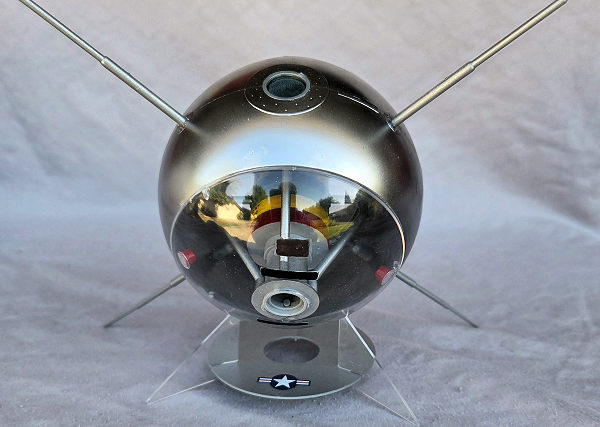
To provide more interest in the model, the basic interior can be viewed through two clear pieces, upper and lower. The interior is sandwiched between two bands and the clear parts complete the sphere. Three clear parts are legs for the stand. Total number of parts is 20.
Painting notes indicate that the body could be either silver or gold. The box lid illustration hints at gold, while photos of sister satellites show polished aluminum. The illustration also shows some wiring, but there is not a diagram for them. The decals are stencils identifying the components of the satellite.
| CONSTRUCTION |
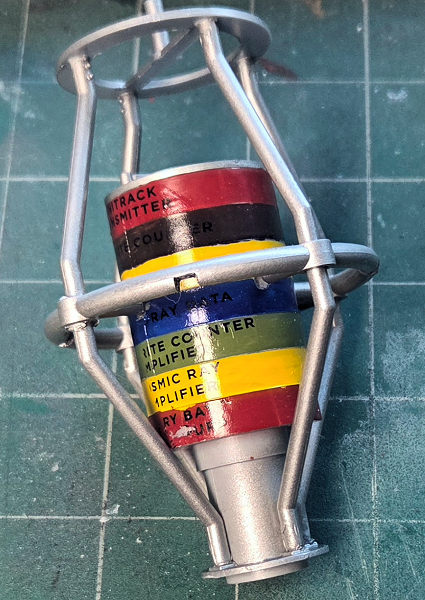 The
clear parts were found floating in the box, with some scratches in them, so
the first thing was to buff them. The gray pieces of the body were primed
and painted with Alclad Gloss Black Base and Chrome. The interior faces of
the body parts were not painted and that was a mistake. Except for the
sensor knobs, the rest of the parts were sprayed rattle can silver.
The
clear parts were found floating in the box, with some scratches in them, so
the first thing was to buff them. The gray pieces of the body were primed
and painted with Alclad Gloss Black Base and Chrome. The interior faces of
the body parts were not painted and that was a mistake. Except for the
sensor knobs, the rest of the parts were sprayed rattle can silver.
Three pieces make up the central canister holding most of the electronics. It was assembled, painted, and decaled. Due to the decal not maneuvering easily, it might be easier to cut the main decal into separate rows and apply each to own color band. The one-piece ring mount for the antennae and its bracing arms slip over the canister and the arms are intended to slot between tabs. It is easy to scratch the paint of the canister, so either the arms can be shortened and shims added after the ring is in location, or the paint can be touched up.
A pair of sensor knobs were painted red and glued to the interior of the lower clear piece. Matching circles are molded in the plastic to indicate the locations. A couple more sensors were added to the lower body piece before mating the two lower pieces together. The rest of the frame around the canister was assembled and that subassembly glued to the lower half. The notion of adding wiring was discarded due to that being akin to building a ship-in-a-bottle and not having the desire to go through that process.
Another set of sensor knobs were glued to upper clear part and the antennae glued in place to the ring. The upper body piece trapped the antennae. Before installing the upper clear part, the locating tabs needed removal due to them not aligning with their slots.
| COLORS & MARKINGS |
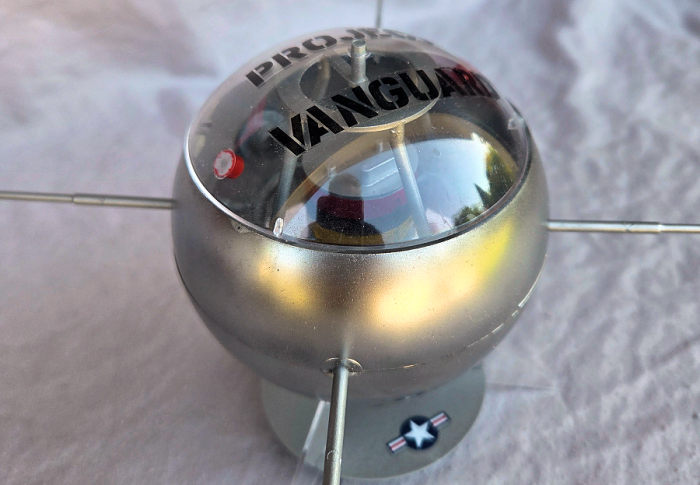
None of the photos or diagrams that I was able to find showed anything like the stenciling on the decal sheet. I think they are for educational purposes. I decided to apply “PROJECT” and “VANGUARD” to the upper clear part as an ID label. They were supple enough to lay down on the compound curve, but did not move once they hit the surface, which means that they are not parallel to each other when viewed from the top.
Three legs slot into place on a disc to make for the stand. Feeling patriotic, I added a star and bars from the decal dungeon.
| CONCLUSIONS |
To my eye, given the state of scale modeling today, this kit is …. quaint. Getting everything aligned turned out to be a more difficult than I thought.
One must decide which modeling convention to follow. Should the model be an accurate scale replica of the subject, which is a boring sphere? Or, does one follow the intent of the kit and build a somewhat accurate cut-away model? Or, does one do something in between? Regardless, it is an interesting piece of history.
A side note: reflections of yours truly holding the camera phone to take the photos can be seen.
26 May 2026 Copyright ModelingMadness.com. All rights
reserved. No reproduction in part or in whole without express permission from
the editor.
Review kit courtesy of my wallet If you would like your product reviewed fairly and fairly quickly, please contact the editor
or see other details in the
Note to
Contributors. Back to the Main Page
Back to the Review
Index Page
Back to the Previews Index Page