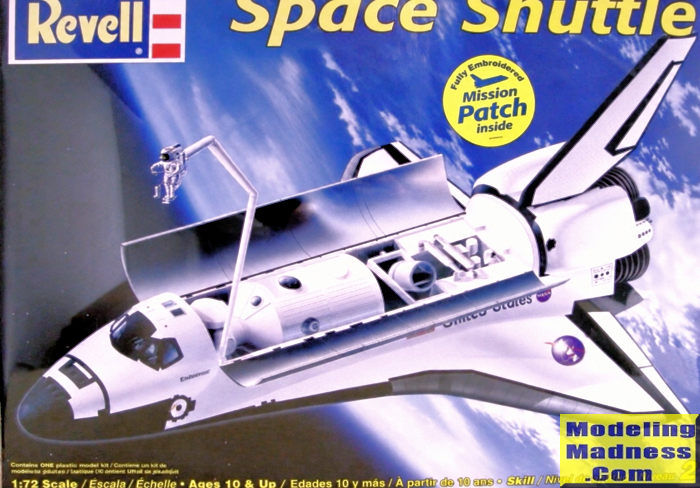
| KIT #: | 5085 |
| PRICE: | 70 Euros in 2005 |
| DECALS: | Four options |
| REVIEWER: | Spiros Pendedekas |
| NOTES: | Not the Monogram kit |
| HISTORY |
The Space Shuttle was one of the most ambitious and recognizable achievements in the history of spaceflight. Conceived during the late 1960s and formally approved by NASA in 1972, the Space Transportation System was intended to provide a partially reusable means of carrying astronauts and payloads into low Earth orbit. At its heart was the winged Orbiter, launched vertically with the aid of two Solid Rocket Boosters and a large External Tank, before returning to Earth and landing much like an aircraft.
The first Shuttle mission, STS-1, took place on April 12, 1981, when Columbia lifted off from Kennedy Space Center with astronauts John Young and Robert Crippen aboard. Over the following three decades, the Shuttle fleet became a remarkably versatile space vehicle, deploying and retrieving satellites, carrying scientific laboratories, servicing the Hubble Space Telescope and, ultimately, playing a crucial role in the construction of the International Space Station. Five orbiters eventually saw operational service: Columbia, Challenger, Discovery, Atlantis and Endeavour.
The program was also marked by tragedy, with the losses of Challenger in 1986 and Columbia in 2003. Nevertheless, the Shuttle continued to accomplish remarkable feats until the final mission, STS-135, when Atlantis landed at Kennedy Space Center on July 21, 2011. After 135 missions, the Space Shuttle era had come to an end, leaving behind a legacy that is difficult to match in the history of manned spaceflight.
| THE KIT |
 In
1979, Revell introduced its new-tool Space Shuttle, providing modelers with a
large-scale representation of NASA's revolutionary reusable spacecraft. It
should be acknowledged from the very beginning, however, that Monogram also
produced its own 1/72 Space Shuttle tooling. The two kits are different toolings
and must not be confused with one another.
In
1979, Revell introduced its new-tool Space Shuttle, providing modelers with a
large-scale representation of NASA's revolutionary reusable spacecraft. It
should be acknowledged from the very beginning, however, that Monogram also
produced its own 1/72 Space Shuttle tooling. The two kits are different toolings
and must not be confused with one another.
Revell continued reissuing the kit over the years, keeping this impressive model available to new generations of modelers. My example is the 2001 edition, which I bought in France in 2005, while serving with the Hellenic Air Force and being there on an Air Force mission. I remember paying around €70 for it at the time, a reasonable price for such a substantial kit and certainly one that was too tempting to leave behind.
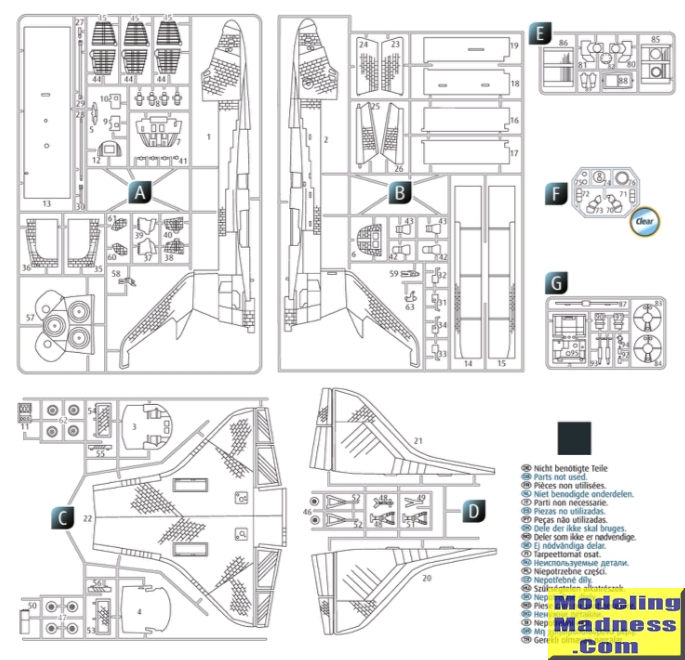
The box certainly creates an impression. It is a very large, top-opening and rather flimsy box, containing a model that is anything but flimsy! Inside are approximately one hundred white plastic parts arranged on six sprues. The molding dates back to the 1979 era and naturally reflects the standards of the time. The overall philosophy of the kit is actually quite sensible for its period: Revell provides sufficient detail, backed up by working features, without attempting to over-detail every area. The wings, landing gear and other components are relatively simple, but contain enough detail to convey the character of the real spacecraft. The same approach is evident in the surface and thermal-protection detail. It is not entirely accurate, but it is certainly effective in giving the model its unmistakable Shuttle appearance. A Mission Patch is also included, a nice touch.
The cockpit is reasonably represented, although it is not particularly elaborate. Most of the instrument panels and controls are represented by decals, which is adequate for a model of this scale and vintage. The cockpit roof is removable, allowing the flight deck to remain visible after completion, otherwise little will be seen through the small cockpit windows.
The payload area receives reasonable attention, with the Spacelab module, an infrared telescope and associated equipment included. The three main engines are adequately represented, while the landing gear is sufficiently detailed for the purpose, although the wheel wells are bland. One astronaut is included, together with his space suit.
The kit provides several movable and display options. The payload-bay doors can be opened, the rudder and body flaps are movable, and the Remote Manipulator System, or Canadarm, can be posed either stowed or extended. These features, together with the Spacelab and other equipment, give the model considerably more life than a simple static representation.
Transparencies are well molded and clear. Instructions are nice, coming at the typical level expected from Revell in the early 2000s, in the form of a 12-page black-and-white A4 booklet. The construction sequence is spread over 62 clear and concise steps, with color callouts given where applicable. They provide a straightforward guide to what initially appears to be a rather intimidating model.
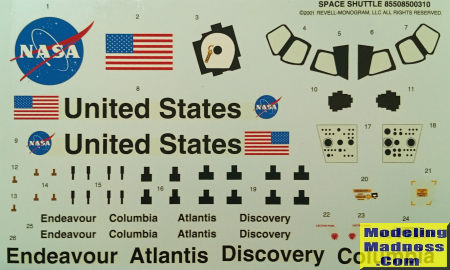 The
decal sheet provides four marking options:
The
decal sheet provides four marking options:
- OV-104 Atlantis
- OV-103 Discovery
- OV-102 Columbia
- OV-105 Endeavour, commemorating the 100th Space Shuttle flight in April 2001
Colors are given in Revell codes and in generic form. The decals are nicely printed, with sharp detail and good registration. On my example, however, the carrier film has started to yellow with age. Otherwise, they appear to be in good condition and should remain perfectly usable with appropriate care.
Construction begins with the interior, with the cockpit and payload bay assembled first. The cockpit and payload-bay components are then trapped between the two fuselage halves. The instructions do not call for any nose weight to prevent the completed model from sitting on its tail, and I am not entirely convinced any is needed, but it is certainly something worth checking before closing the fuselage.
The massive lower wing half is then attached underneath the fuselage, followed by the two upper wing halves. At this point the model becomes a truly substantial assembly, and you begin to appreciate just how large this Shuttle really is.
The three main engines follow. The Spacelab module is next, followed by the Remote Manipulator System. The arm can be positioned either stowed or extended. The landing gear and various other external components are then added as construction progresses toward completion.
The main challenge is undoubtedly the large fuselage assembly. The fuselage halves can require quite a lot of clamping and persuasion to come together properly, while filling and sanding the seams requires some care because of the surrounding surface detail. This is where patience pays dividends.
Nevertheless, construction is considerably less complicated than the enormous box might initially suggest. There is certainly a degree of complexity involved, but the actual number of parts is not excessive. Once the major fuselage and wing assemblies have been brought together, the model progresses surprisingly quickly.
| CONCLUSIONS |
There is no doubt that this Revell Space Shuttle is a product of its time. The 1979 tooling has its shortcomings, including some reported fit problems, relatively basic treatment of certain areas and a rather heavy representation of the thermal-protection system. The main engine nozzles could also benefit from improvement, while the finishing stage requires patience because of the Shuttle's extensive black-and-white paint scheme and decal work.
Yet the kit's overall philosophy works very well for its era. Revell provides enough detail to make the Orbiter convincing without making every component overly elaborated. The wings and landing gear are not over-engineered, the cockpit is reasonably represented, and the payload bay, Spacelab, Canadarm and movable features provide plenty of interest and display possibilities.
This is therefore a kit with a pleasing balance between detail, simplicity and options. It does not overwhelm the modeler with hundreds of tiny parts, but neither does it leave the large Shuttle looking barren. For a tooling conceived in the 1970s, that is quite an achievement.
For the out-of-the-box builder, the result will be a massive and impressive Space Shuttle. Those looking for absolute accuracy will find areas to improve, but the basic model has tremendous presence straight from the box. For the advanced modeler, meanwhile, its large size and relatively uncomplicated structure provide an excellent basis for additional detailing.
But perhaps the greatest attraction of this kit is simply its size. Revell has given us a genuinely large Space Shuttle, and there is something very satisfying about seeing such a model completed and displayed.
It is not perfect, and it is not without its challenges. But it is an ambitious, enjoyable and surprisingly rewarding kit, with enough detail, enough options and, above all, enough presence to make it worthwhile.
If you have the space for it and the patience to deal with its shortcomings, this is certainly a kit worth tackling.
After all, sometimes you simply want a big Space Shuttle — and this Revell kit certainly gives you one!
Happy Modeling!
September 2026
Copyright ModelingMadness.com. All rights reserved. No reproduction in any form
without express permission from the editor.
If you would like your product reviewed fairly and fairly quickly, please
contact
the editor or see other details in the
Note to
Contributors. Back to the Main Page
Back to the Review
Index Page
Back to the Previews Index Page