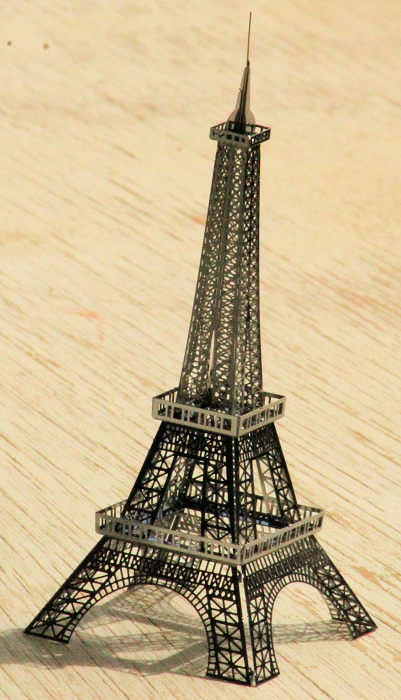
| KIT #: | |
| PRICE: | |
| DECALS: | None |
| REVIEWER: | George Oh, in Oz |
| NOTES: | Etched metal |
| HISTORY |
Gustav Eiffel is still a famous French civil engineer who constructed a lot of railway bridges from iron, and who contributed to the Statue of Liberty that France gifted to the USA (in 1876, for their 100th anniversary). He has iron structures that are still standing in other parts of the world. In 1889, the French Government held a World Fair in Paris as a commemoration of the 1789 French Revolution. Gustav Eiffel completed two icons for it. They were the ‘Paradis Latin’ (the oldest cabaret in Paris), and his most famous work, the Eiffel Tower. The Fair’s centre-piece, the Eiffel Tower is still known to Parisians as "La Dame de Fer" (French for "The Lady of Iron" - ferrous). It attracts over five million visitors each year, and thousands of couples share a kiss under its exact centre.
Side note.
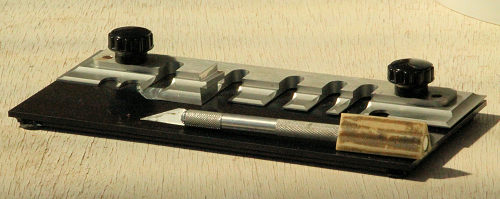 Many years
ago, The Small shop released an 8”/200mm-wide tool for accurately bending
photo-etched/PE metal parts – the Hold-n-Fold (H&F). I immediately realised its
usefulness, because I had used one 8’/2.5m-wide when I was a sheet-metal worker.
So I ordered one (and its two partners – one for accurately cutting PE parts
from their frets, and the other for rolling PE into round tubes) from them via
mail-order. Each has become one of those tools that I use once in a blue-moon,
but when needed, it is invaluable because of its speed and accuracy (dependent
on the human-factor, of course).
Many years
ago, The Small shop released an 8”/200mm-wide tool for accurately bending
photo-etched/PE metal parts – the Hold-n-Fold (H&F). I immediately realised its
usefulness, because I had used one 8’/2.5m-wide when I was a sheet-metal worker.
So I ordered one (and its two partners – one for accurately cutting PE parts
from their frets, and the other for rolling PE into round tubes) from them via
mail-order. Each has become one of those tools that I use once in a blue-moon,
but when needed, it is invaluable because of its speed and accuracy (dependent
on the human-factor, of course).
Both of these came together when the company, Metal Earth, began releasing small highly-detained models composed entirely from shiny high-quality sheet/s of PE steel(?), with varying degrees of complexity. Some are finished in colour. They do not require glue (or solder), because the parts join via small slots that accept tiny tabs that are then twisted or bent, to lock the parts together. Metal Earth models are graded at four levels - easy/moderate/challenging/expert. This one is an easy. Keep your eyes peeled, because some of them have been retired from production.
| THE KIT |
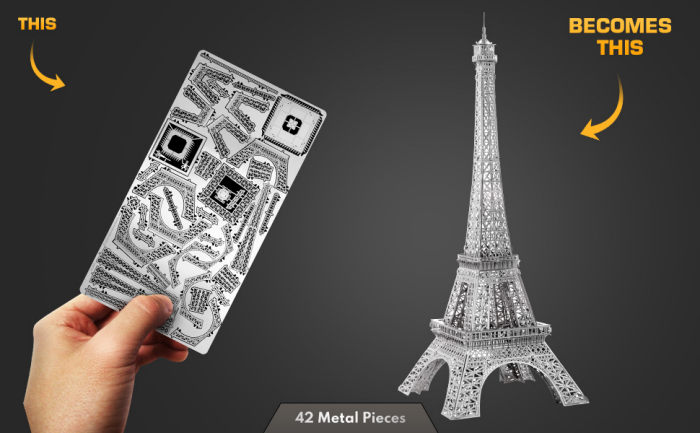 This is a
simple model that comes in a single sheet (= fret) that contains 13 parts. They
fit together perfectly, though many might find the work fiddley. Most parts
require folding along indicated fold-lines. The instructions come on a single
A4-sheet, which includes a generic legend for the directions on which way to
fold/roll the parts. The builder MUST follow the instructions slavishly (for a
change!!) because, once joined (properly) disassembly is neigh-on impossible.
And the builder MUST exercise caution because of the sharpness of the parts.
Wearing gloves ISN’T an option.
This is a
simple model that comes in a single sheet (= fret) that contains 13 parts. They
fit together perfectly, though many might find the work fiddley. Most parts
require folding along indicated fold-lines. The instructions come on a single
A4-sheet, which includes a generic legend for the directions on which way to
fold/roll the parts. The builder MUST follow the instructions slavishly (for a
change!!) because, once joined (properly) disassembly is neigh-on impossible.
And the builder MUST exercise caution because of the sharpness of the parts.
Wearing gloves ISN’T an option.
I bought it because I was two thousand km away, in my childhood stomping-grounds, and whilst visiting the still-there model shop, I felt compelled to buy something (OK, several!!).
I started building it because, I was back at home with a Model Club meeting approaching, and I wanted to be able to show that I’d completed something (other than those 2 x out-of-my-usual-genera 35-scale tanks – but THAT is another story) during the month-long Christmas/summer holiday.
| CONSTRUCTION |
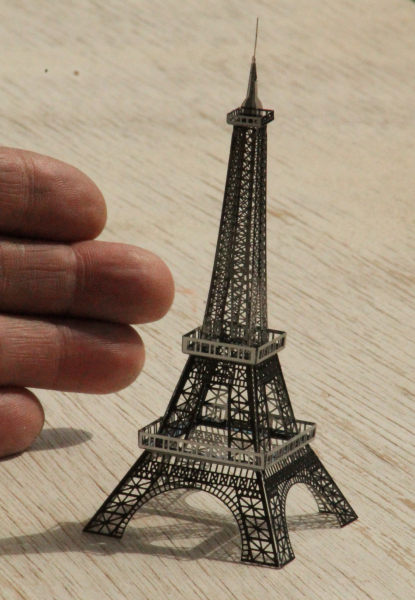 I built this
in half an afternoon while watching a movie on TV, as I sat in front of the air
conditioner because it was way too hot to take the dog out for a walk. As
detailed above, I stuck to the instruction sequence. I used a new sharp
curved/No.10 blade to extract the parts, and I used my Hold n’ Fold to bend
parts required. I deviated from the instructions in one way. In some places, I
bent the slots and tabs so that, when assembled, both were concealed inside of
the edifice. The H&F made this a piece of cake.
I built this
in half an afternoon while watching a movie on TV, as I sat in front of the air
conditioner because it was way too hot to take the dog out for a walk. As
detailed above, I stuck to the instruction sequence. I used a new sharp
curved/No.10 blade to extract the parts, and I used my Hold n’ Fold to bend
parts required. I deviated from the instructions in one way. In some places, I
bent the slots and tabs so that, when assembled, both were concealed inside of
the edifice. The H&F made this a piece of cake.
The build starts from the top and works its way down to the base. The tall slim ‘neck’ was the first large sub-assembly, and it gave me fits (at first) when I was trying to stabilise it by attaching it to the top and middle decks/levels. The reason was that it kept distorting away from its square cross-section. The cure was to wrap some masking tape around it until it had been successfully sandwiched between the aforementioned decks. After that, assembly was a breeze. The H&F made bending-up of the railings around the decks, very easy. The tiny tabs were bent down by pressing on them with the flat end of a broken No. 11 Exacto blade (My Lady will confirm that I rarely toss anything away).
| COLORS & MARKINGS |
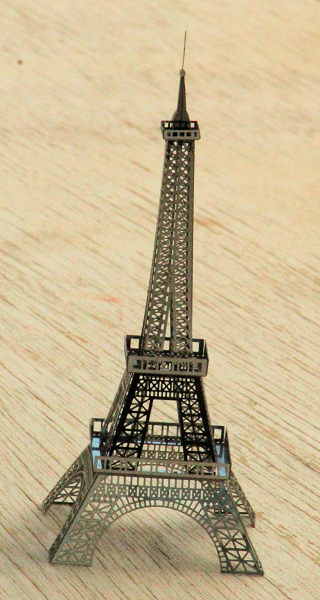 None and none
for me to stuff-up. Yay!!! I coulda’ (primed it – it’s metal, then) painted it
(Mahogany? Iron?) to look like any number of Google photos (which show lots of
different colours), but I didn’t because I like the shiny finish of the model.
None and none
for me to stuff-up. Yay!!! I coulda’ (primed it – it’s metal, then) painted it
(Mahogany? Iron?) to look like any number of Google photos (which show lots of
different colours), but I didn’t because I like the shiny finish of the model.
I added a thin wire to the top (using thin Superglue), to support a tiny French flag. Why wouldn’t you? However, further research shows that La Dame de Fer does NOT fly a flag from her top-most point. That location is the preserve of numerous communication antenna that would quickly shred a flag. Instead, the French may light her in their national colours, or hang a gigantic flag from one(?) of the decks.
| CONCLUSIONS |
This build was hindered by the hardness of the material, their sharpness, and the precision required to secure the tabs once they were located inside of their associated slots. It was enhanced by the precise fit of the parts, and the availability of the Hold n’ Fold. I would recommend it to a modeller who understands the need for caution, and who wants to have a crack at something a little different.
PS - I’ve also completed an Imperial Star Destroyer, but I’ve yet to start my Voyager probe, and my Doctor Who’s K-9 & Tardis. As well as the Hold n’ Fold, I also have confidence. NOTE – that Metal Earth has ‘retired’ some of the models.
George Oh
5 October 2026
Copyright ModelingMadness.com. All rights reserved. No
reproduction in part or in whole without express permission.
If you would like your product reviewed fairly and
fairly quickly, please
contact
the editor
or see other details in the
Note to
Contributors.