| KIT #: | 61058 |
| PRICE: | $45.00 |
| DECALS: | Three options |
| REVIEWER: | David C Jones |
| NOTES: | Aeromaster decals and Attack Squadron ordnance |
| HISTORY |
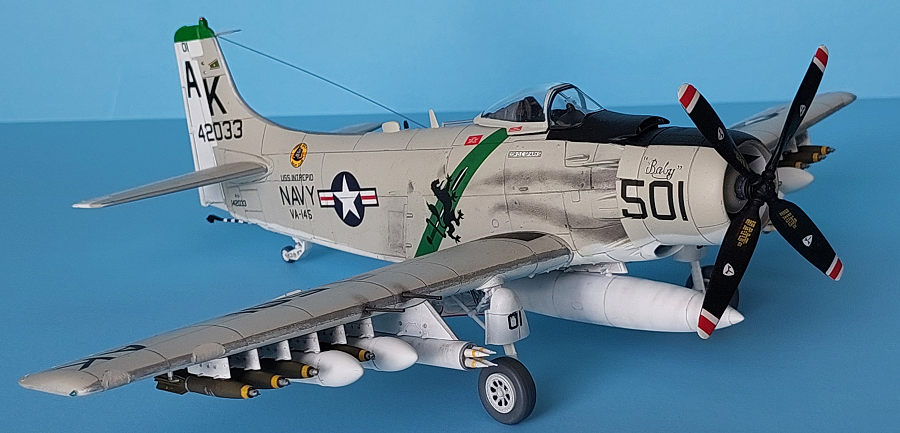
The Douglas AD Skyraider was an attack aircraft designed for the U.S. Navy in 1945 and flew all the way through Korea and into the Vietnam War. It was used by the U.S. Navy, U.S. Marines and U.S. Air Force. Among foreign users were the British Royal Navy, the French Air Force, and Vietnam Air Force.
The original designation AD (Attack Douglas) was changed in 1962 to A-1 which is what most people know the type as. The plane in this article is an AD-7 or as it was known by Vietnam, the A-1J.
| THE KIT |
 The
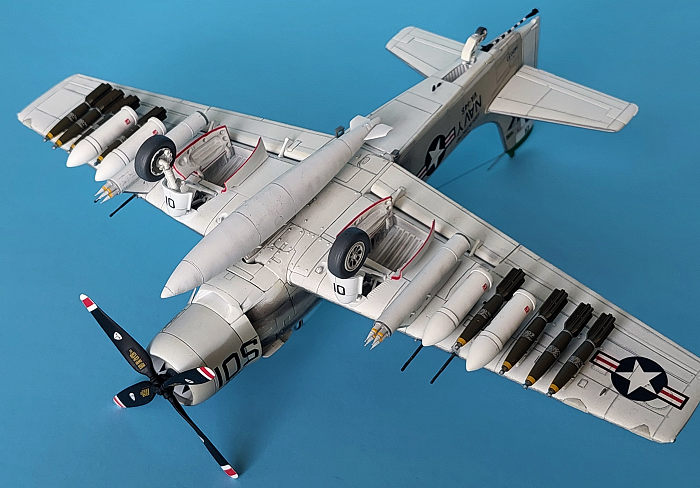
model I chose was the Tamiya Douglas A-1H U.S. Navy boxing which was put out
1998. The moldings are crisp, and the kit is very well engineered as one would
expect from Tamiya.
The
model I chose was the Tamiya Douglas A-1H U.S. Navy boxing which was put out
1998. The moldings are crisp, and the kit is very well engineered as one would
expect from Tamiya.
To detail up the cockpit up a bit, I added A-1H Seatbelts from Eduard and an A-1 Skyraider Boot Enclosure behind the headrest from Quickboost. By the Vietnam era, almost all Skyraiders had them. It has always been a head-scratcher to me as to why Tamiya left this detail out.
I also added an A-1 Skyraider Propellor from Metallic Details. The kit prop is malnourished although few people notice this.
| CONSTRUCTION |
 I
started with the cockpit as is traditional. The only thing I deviated from the
instructions was the addition of seatbelts. The cockpit was painted dark gull
gray with black consoles. The fit is a little loose in the fuselage, so I used
superglue to ensure a solid connection to the fuselage sidewall. The tailwheel
bay was painted white and installed at this time as well.
I
started with the cockpit as is traditional. The only thing I deviated from the
instructions was the addition of seatbelts. The cockpit was painted dark gull
gray with black consoles. The fit is a little loose in the fuselage, so I used
superglue to ensure a solid connection to the fuselage sidewall. The tailwheel
bay was painted white and installed at this time as well.
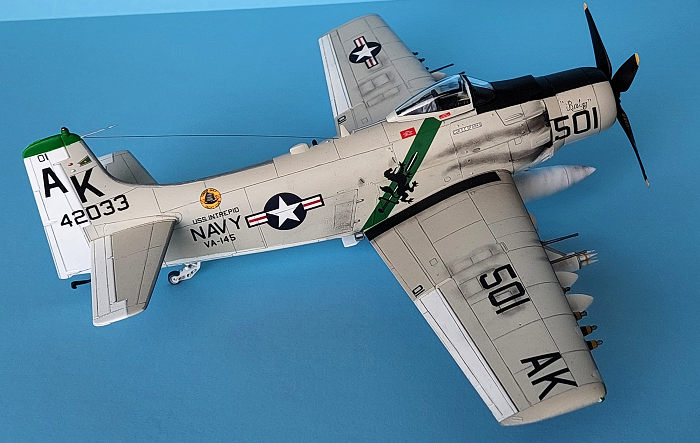
The fuselage halves were ready to close at this point, and the fit is excellent. You are given the option of the three dive flaps with (accurate) inner and outer flap parts to be posed open at this point. However, the dive flaps were seldom deployed on the ground unless they were undergoing maintenance. I left the flaps closed on my build and I left the inner parts off for a more positive fit.
The engine and cowling (minus the prop) are constructed next. I have both the front and rear cowl flaps open but that’s a matter of taste. The R-3350 engine is represented by a front only but is very nice. It can be dressed up or entirely replaced by an aftermarket engine, but I feel it’s adequate as it is. Tamiya would have you mount the engine assembly now, but I prefer to wait until things are painted due to the different contours of the cowl and fuselage.
The wings came next. The construction of the wheel well doors and inner
sidewalls is clever and fits very well, but it does not lend itself to painting.
If you have different wing surface and wheel well colors, it is a masking
nightmare. I’ve built several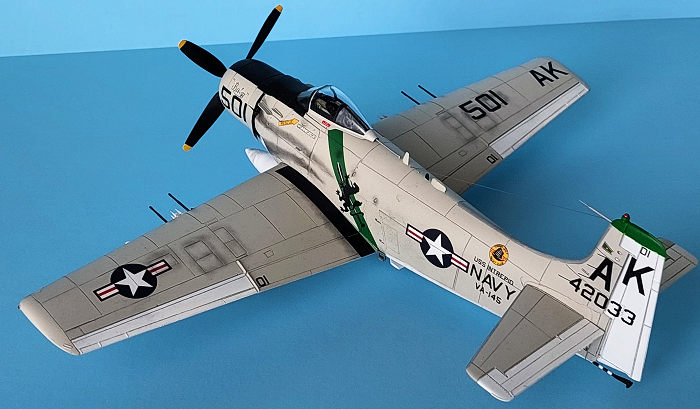 Tamiya Skyraiders in different color schemes and came up with the following
solution: Cut the gear door hinges in half so you have separate doors and inner
wheel well walls. The doors can be reattached to the hinge mounts later with
superglue after painting. It’s not for everybody but I’ve had great success with
this method.
Tamiya Skyraiders in different color schemes and came up with the following
solution: Cut the gear door hinges in half so you have separate doors and inner
wheel well walls. The doors can be reattached to the hinge mounts later with
superglue after painting. It’s not for everybody but I’ve had great success with
this method.
After that, the wings were assembled and mated to the fuselage. Then the lower dive flap and tailplanes were installed easily with a very positive fit on all parts. You have the option of lowered or raised flaps. I have mine in the raised position.
Weapons load:
I researched VA-145 pictures from the 1967 cruise and found the ordnance included in the kit was not common at the time. Typically, the squadron carried a centerline fuel tank which is included in the kit.
They also carried Zuni pods, LAU-3 rocket pods and various combinations of bombs. In the end, I chose to hang six rocket pods with Mk.81 Snakeyes to round out the load. All the miscellaneous weaponry was from Attack Squadron.
| COLORS & MARKINGS |
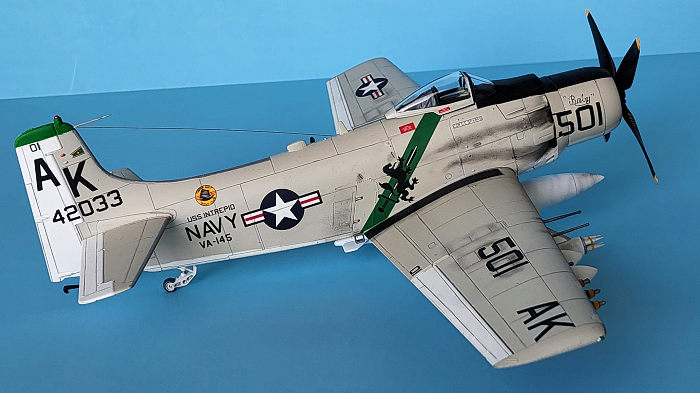 The
model was painted with a combination of Tamiya Acrylic paints. The Light Gull
Gray over White scheme was on most of the U.S. Navy’s inventory by the 1960s.
The
model was painted with a combination of Tamiya Acrylic paints. The Light Gull
Gray over White scheme was on most of the U.S. Navy’s inventory by the 1960s.
The VA-145 decals were from Aeromaster sheet 48-530 and performed well over a coat of Tamiya Acrylic Gloss.
Then the model was painted with Tamiya Flat and weathered with pastels and pencils. The photos of the actual plane show it to be semi-clean by Skyraider standards, some got absolutely filthy. I kept weathering to exhaust stains, soot around the guns and varies leaks here and there. Afterwards it was sealed with another coat of Tamiya Flat. and all the remaining pieces were put into place.
| CONCLUSIONS |
I am very happy with the results of my build. The Tamiya kit is well engineered and went together without any issues. I would recommend Tamiya’s Skyraider to anyone who has a few kits under their belt. Aside from adding seatbelts, the kit is fine out of the box but particularly regarding the ordnance, it just screams to be super detailed.
| REFERENCES |
There are many Skyraider books out there but the primary ones I used for this model are:
Douglas AD/A-1 Skyraider: Part One (Naval Fighters 98) by Steve Ginter
Douglas AD/A-1 Skyraider: Part Two (Naval Fighters 99) by Steve Ginter
Modeler’s Guide to the Skyraider by Jay Sherlock
Happy Modeling!
30 September 2025
Copyright ModelingMadness.com. All rights reserved. No reproduction in part or in whole without express permission.
If you would like your product reviewed fairly and fairly quickly, please contact the editor or see other details in the Note to Contributors.