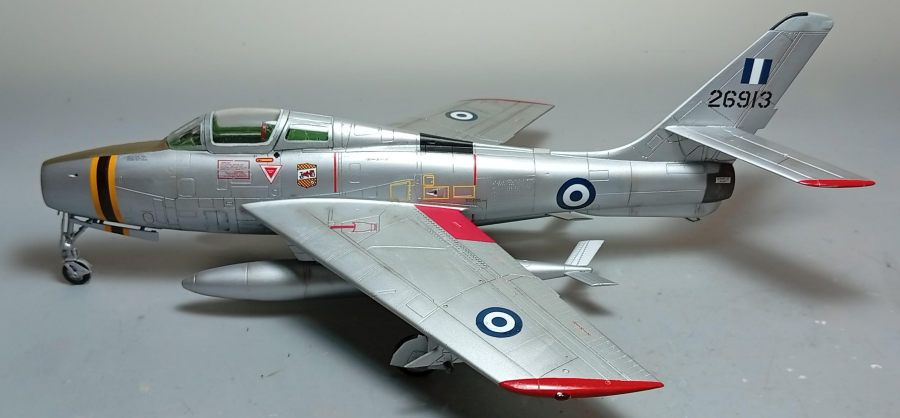
Kinetic 1/48 F-84F Thunderstreak
| KIT #: | K48069 |
| PRICE: | Around €45 |
| DECALS: | Four options |
| REVIEWER: | Spiros Pendedekas |
| NOTES: |
Icarus decals 48012 |
| HISTORY |
The Republic F-84F Thunderstreak is an American swept-wing turbojet-powered fighter-bomber. The design was originally intended to be a relatively simple upgrade to the F-84 Thunderjet to make it more competitive with the F-86 Sabre, differing largely in the use of a swept-wing and tail. The prototypes demonstrated a number of performance and handling issues, which resulted in marginal improvement over the previous versions.
Looking for a clear performance edge compared to the G models, the engine was upgraded to the much more powerful British Armstrong Siddeley Sapphire built in the United States as the Wright J65. The larger engine required the fuselage to be stretched into an oval shape and the air intake to be modified. With these and other changes, the design was finally ready to enter production, but only a fraction of the original production systems could be used and the aircraft was effectively a new design.
 The
F-84F finally entered service in November 1954, by which time the Sabre had also
undergone many upgrades and the Thunderstreak was relegated to the
fighter-bomber role. Its time as a front-line design was brief; it began to be
moved to secondary roles as early as 1958 and then offered to NATO member
countries and other allies, who took them up in large numbers.
The
F-84F finally entered service in November 1954, by which time the Sabre had also
undergone many upgrades and the Thunderstreak was relegated to the
fighter-bomber role. Its time as a front-line design was brief; it began to be
moved to secondary roles as early as 1958 and then offered to NATO member
countries and other allies, who took them up in large numbers.
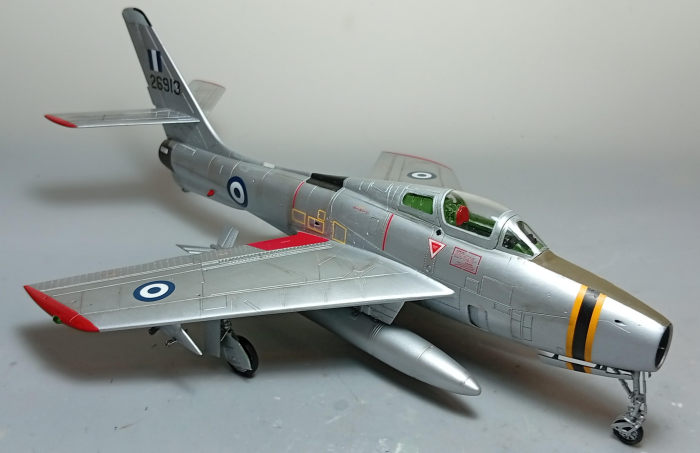
164 examples (including secondhand machines from the USAF, the Luftwaffe and the Royal Netherlands Air Force), were used by the Hellenic Air Force from 1957 to 1983, equipping nine squadrons, three of which were designated for nuclear strikes. Utilizing a Mk 7 “special weapon” Greek Thunderstreaks would fly fast and low and in a strike role, with their long range making them particularly effective. The personnel underwent intense and ongoing training, and NATO evaluations were highly stringent.
Since the total takeoff weight of 28,800 pounds in nuclear attack mode exceeded by 800 pounds the manufacturer's maximum permitted takeoff load, a pair or a quadruple of JATO rockets were mounted on a special carrier frame under the fuselage to provide extra thrust, to be jettisoned after the rocket fuel was exhausted.
Fortunately, Greek F-84Fs never had to perform such missions. However, they came too close to fire conventional weapons in anger in summer 1974 upon the Turkish invasion in Cyprus. Based at Kastelli AFB and fully loaded, they were ready to attack the Turkish bridgehead. On July 22, a takeoff order was twice issued and immediately twice cancelled, with much having been written about this cancellation. F-84s were decommissioned from service in 1983, being HAF’s dependable “truck” for more than 25 years.
| THE KIT |
 Kinetic came
with their new tool 1/48 F-84F in 2007, reboxing it twice ever since (2020 and
2022). The kit was also reboxed twice by Italeri in 2009 and 2011, with all
above kits differing only in the markings provided. The subject kit is the 2020
edition and was a gift from my good friend George Blair. It comes in a
relatively thin but otherwise medium sized, side-opening, good quality box,
featuring a nice box art of a German example.
Kinetic came
with their new tool 1/48 F-84F in 2007, reboxing it twice ever since (2020 and
2022). The kit was also reboxed twice by Italeri in 2009 and 2011, with all
above kits differing only in the markings provided. The subject kit is the 2020
edition and was a gift from my good friend George Blair. It comes in a
relatively thin but otherwise medium sized, side-opening, good quality box,
featuring a nice box art of a German example.
Essentially a modernized Monogram repop, this is a good kit of the iconic F-84,
with its pros and cons. Should you wish to have a more in-depth look at the
kit’s contents, you may do so by looking at its preview,
found in the ever growing MM archives.
| CONSTRUCTION |
I first assembled the
sufficiently detailed cockpit. Since the model depicts a 1961 machine, I decided
to go for a green basic cockpit color (including all inner anti glare areas),
for which I used a home brewed green zinc chromate. The instrument panel and
side consoles were painted black (as was the stick grip and the gunsight base)
with their raised details picked up with silver dry brushing and receiving
“pins” of red, yellow and white paint to represent various “switches and stuff”.
The seat had its main frame painted per the cockpit basic shade, its head
cushion red, its lower cushions olive drab, while the arm located ejection
handles were painted yellow with black stripes. Though not overly super
detailed, admittedly the cockpit looks totally sufficient out of the box,
especially if aided by my “de rigeur” closed canopy stubbornness.
 The gun
compartment/intake splitter subassembly was next assembled, followed by the
sufficiently detailed tail pipe, which, together with the already assembled
cockpit, were trapped between the fuselage halves. All intake innards were
painted silver, while the tailpipe section was painted Mr Hobby Burnt Iron.
The gun
compartment/intake splitter subassembly was next assembled, followed by the
sufficiently detailed tail pipe, which, together with the already assembled
cockpit, were trapped between the fuselage halves. All intake innards were
painted silver, while the tailpipe section was painted Mr Hobby Burnt Iron.
Since the model is prime candidate for tail sitting, I trapped around 40 grams
of fishing weights in the non visible front area (instructions call for two 14mm
steel balls at dedicated cutouts under the cockpit and gun drum area). The tiny
fuel vent located near the tail is also supposed to be inserted from the insides
of the fuselage and Trapped in, but, since it would have zero chance to survive
Yours Truly’s less than gentle handling, I decided to leave it off and find a
means of attaching it during end stages.
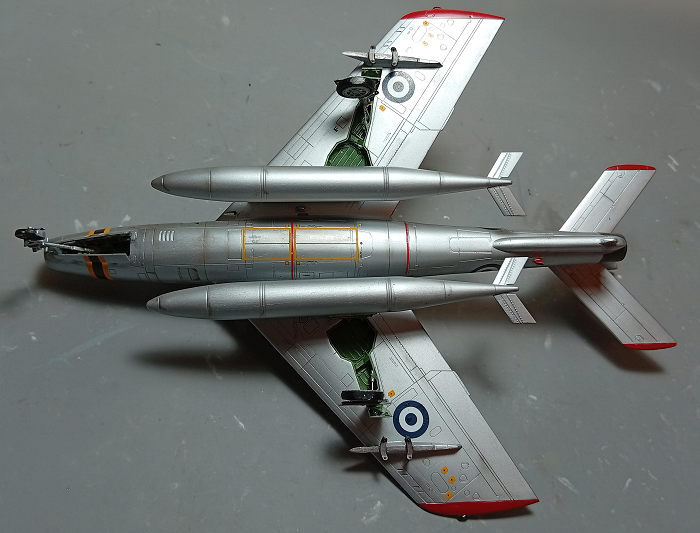
The 2-piece wings were assembled and attached, followed by the horizontal
stabilizers, the nose lip and the front top gun cover (you have the option of an
open one, if you so desire. Only the inner drop tanks were assembled (I elected
not to use the external ones, as they would compromise too much the bird’s
looks).
This concluded basic assembly, which was straightforward with no issues. Fit was
generally very good, with the exception of the nose lip and the gun cover which
needed some sanding, in order to blend in. After some filling and sanding, I
attached the four underwing pylons, the inner main gear doors (which contain
their adjacent section of the gear bay wall) and took the Thunderstreak to the
paint shop!
| COLORS & MARKINGS |
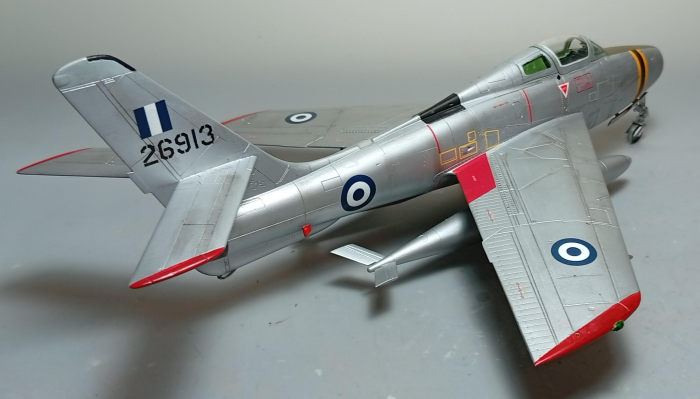
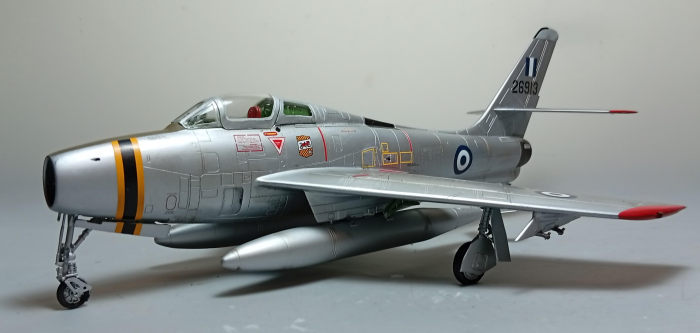 I gave
the complete model a coat of my trusty Hu11 silver, which I then buffed for
deeper, shinier looks. I then masked and painted various areas: the wingtips
and the horizontal stabilizer tips Hu220 Ferrari Red, the front anti glare
area Hu155 Olive Drab, the spine dielectric area black, the fin dielectric
area light gray with black leading edge and the rear fuselage part Mr Hobby
Burnt Iron. A coat of Future prepared the bird for decaling.
I gave
the complete model a coat of my trusty Hu11 silver, which I then buffed for
deeper, shinier looks. I then masked and painted various areas: the wingtips
and the horizontal stabilizer tips Hu220 Ferrari Red, the front anti glare
area Hu155 Olive Drab, the spine dielectric area black, the fin dielectric
area light gray with black leading edge and the rear fuselage part Mr Hobby
Burnt Iron. A coat of Future prepared the bird for decaling.| FINAL CONSTRUCTION |
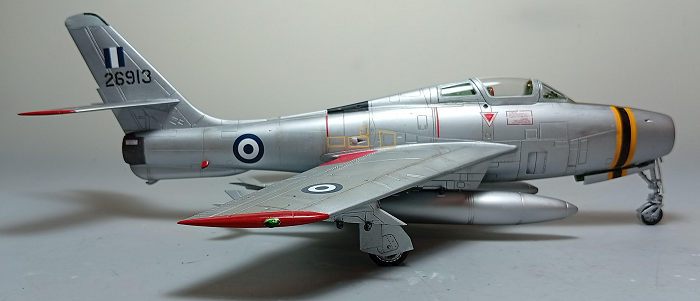 The inner
wing tanks were next glued in position, while on the external pylons I only
attached the sway braces, painted gunmetal. The aforementioned fuel vent
tube, located aft on the fuselage's starboard side, had its locating lugs
shaved off, and, after being painted red, was carefully inserted in the
fuselage and secured with a small amount of glue.
The inner
wing tanks were next glued in position, while on the external pylons I only
attached the sway braces, painted gunmetal. The aforementioned fuel vent
tube, located aft on the fuselage's starboard side, had its locating lugs
shaved off, and, after being painted red, was carefully inserted in the
fuselage and secured with a small amount of glue.| CONCLUSIONS |
5 February 2026 Copyright ModelingMadness.com. All rights reserved. No
reproduction in part or in whole without express permission. If you would like your product reviewed fairly and fairly quickly, please
contact the editor or see other details in the
Note to
Contributors.