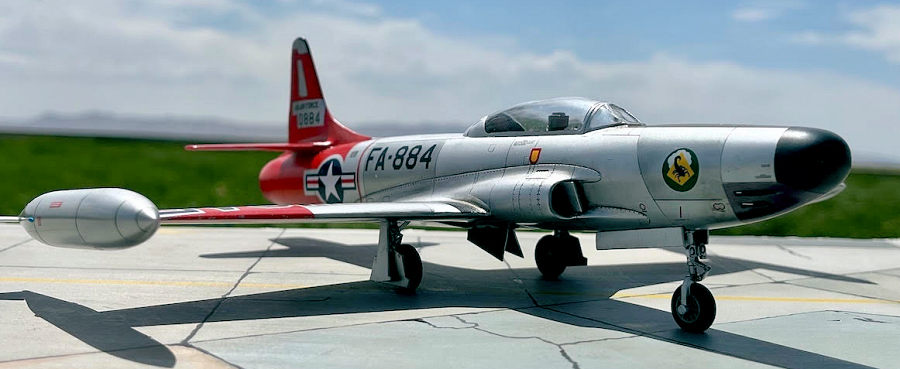
Hobbycraft 1/48 F-94B Starfire
| KIT #: | HC1598 |
| PRICE: | $25.00 'used' |
| DECALS: | Two options |
| REVIEWER: | Bob Leonard |
| NOTES: | Caracal 48241 decals |
| HISTORY |
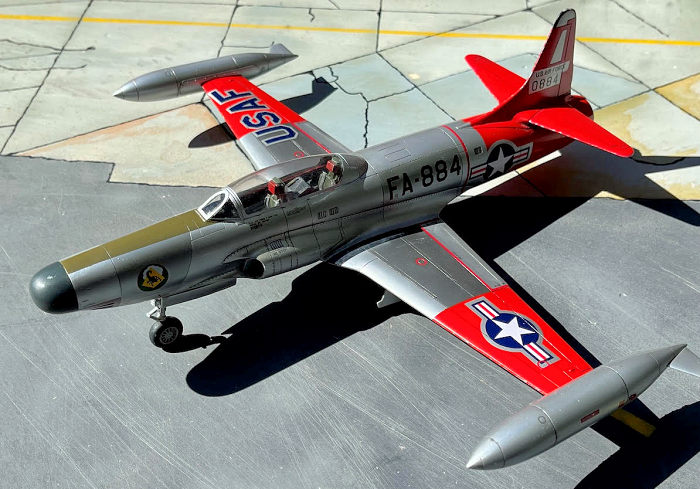 The F-94
Starfire was a jet all-weather day/night interceptor designed and produced
by Lockheed. It was the first operational USAF fighter equipped with
an afterburner and the first jet-powered all-weather fighter to enter combat
during the Korean War.
The F-94
Starfire was a jet all-weather day/night interceptor designed and produced
by Lockheed. It was the first operational USAF fighter equipped with
an afterburner and the first jet-powered all-weather fighter to enter combat
during the Korean War.
The F-94 filled a USAF specification issued in 1948, seeking a new interceptor capable of day and night operations to replace piston-engined types like the F-82 Twin Mustang. This was in response to the USSR developing a fleet of Tu-4 Bull bombers, a copy of the Boeing B-29. The F-94 was derived from the successful Lockheed T-33 Shoopting Star trainer; being a conversion from an established aircraft, USAF officials viewed it as a low risk option. Maintaining 75% parts commonality with the T-33, the majority of the F-94A/Bs external changes were related to the adoption of a larger nose that accommodated multiple guns, radar, and an automatic fire control system. Engine thrust was bolstered with an afterburner to the Allison J33 engine. First flight took place in April, 1949 with an introduction to service in May, 1950. By 1958, the USAF had retired the F-94 and the ANG followed a year later with the introduction of more capable machines like the F-89 Scorpion. Lockheed built 855 Starfires and they were not used by allied air forces.
| THE KIT |
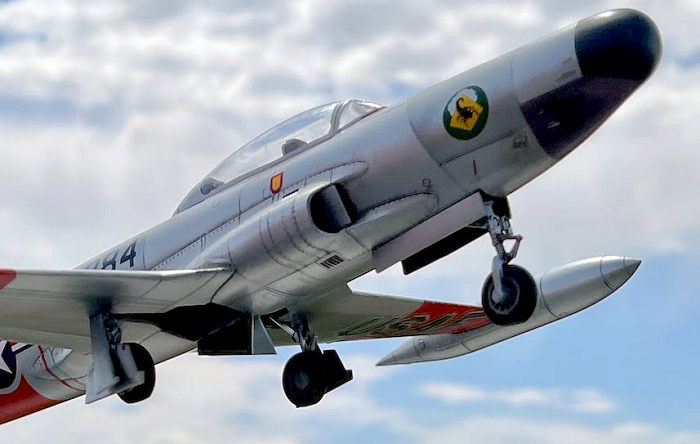 Scalemates
says Hobbycraft first issued the Starfire in 1992 and it seems to be the only
injection molded F-94A/B issued, a modification of their T-33 kit in the same
scale. Some detective work on Scalemates leads me to believe this kit was
originally tooled by Idea for Hobbycraft in Korea. Academy regularly reissues
the T-33, but the F-94A/B has not made a reappearance. The kit includes parts
for both the A and B versions, the only difference I can determine is the type
of tip tanks. The B model has the fuel tanks more in common with the T-33. The
kit features engraved panel lines, some wheel well detail, a rudimentary cockpit
with instrument panels, ejection seats, radar scope, and control stick. The
decals are standard Hobbycraft, laughably thick, matt and with fonts never used
by the USAF.
Scalemates
says Hobbycraft first issued the Starfire in 1992 and it seems to be the only
injection molded F-94A/B issued, a modification of their T-33 kit in the same
scale. Some detective work on Scalemates leads me to believe this kit was
originally tooled by Idea for Hobbycraft in Korea. Academy regularly reissues
the T-33, but the F-94A/B has not made a reappearance. The kit includes parts
for both the A and B versions, the only difference I can determine is the type
of tip tanks. The B model has the fuel tanks more in common with the T-33. The
kit features engraved panel lines, some wheel well detail, a rudimentary cockpit
with instrument panels, ejection seats, radar scope, and control stick. The
decals are standard Hobbycraft, laughably thick, matt and with fonts never used
by the USAF.
| CONSTRUCTION |
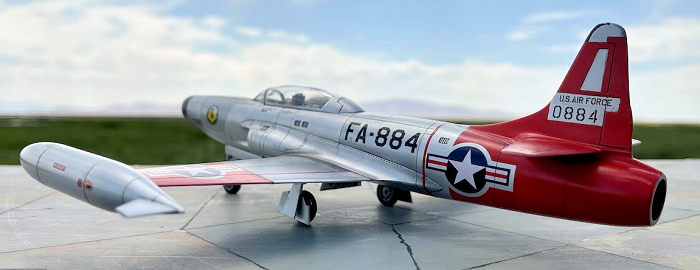 I recommend
Tom Cleaver’s review as essential reading for building this kit and a more
detailed history of the Starfire. Like Mr. Cleaver, I built my Lockheed with the
canopy closed, careful painting was enough for me with the addition generic
photo-etched seatbelts. Also, like Mr. Cleaver I mounted my flaps in the
retracted position since the flap detail was minimal and had injector pin
knockout circles. In retrospect, I should have just dealt with the injector pin
knockout circles and lowered the flaps. Repeated rounds of CA, Mr. Surfacer 500
and re-scribing were needed to make the flaps sit flush. The remainder of the
kit assembly was fairly uneventful. Walkarounds are numerous for the T-33, and I
added some piping in the wheel well bays that was noticeable in photos. For the
first time ever, I used hypodermic needles for the 0.50 inch M3 Browning machine
gun barrels that exit just behind the radome. F-94s have a characteristic nose
high stance. To replicate that, I extended the nose strut three millimeters with
K&S aluminum tubing. I read horror stories about the Hobbycraft T-33/F-94
family, but frankly I have built MUCH worse.
I recommend
Tom Cleaver’s review as essential reading for building this kit and a more
detailed history of the Starfire. Like Mr. Cleaver, I built my Lockheed with the
canopy closed, careful painting was enough for me with the addition generic
photo-etched seatbelts. Also, like Mr. Cleaver I mounted my flaps in the
retracted position since the flap detail was minimal and had injector pin
knockout circles. In retrospect, I should have just dealt with the injector pin
knockout circles and lowered the flaps. Repeated rounds of CA, Mr. Surfacer 500
and re-scribing were needed to make the flaps sit flush. The remainder of the
kit assembly was fairly uneventful. Walkarounds are numerous for the T-33, and I
added some piping in the wheel well bays that was noticeable in photos. For the
first time ever, I used hypodermic needles for the 0.50 inch M3 Browning machine
gun barrels that exit just behind the radome. F-94s have a characteristic nose
high stance. To replicate that, I extended the nose strut three millimeters with
K&S aluminum tubing. I read horror stories about the Hobbycraft T-33/F-94
family, but frankly I have built MUCH worse.
| COLORS & MARKINGS |
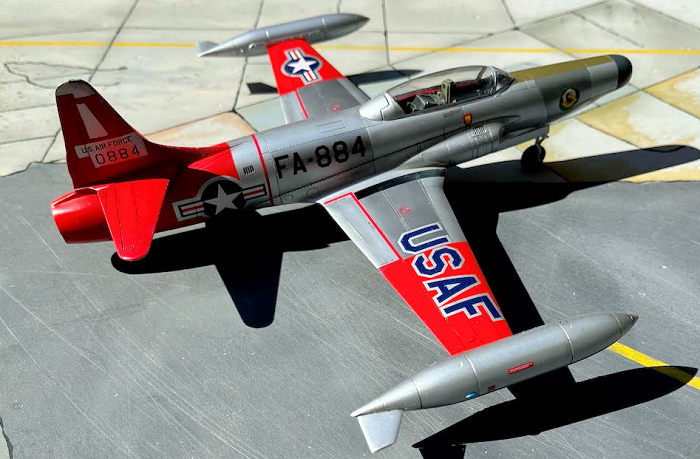 I am all
about paint schemes, and this Starfire with the Arctic Red is one of the best.
It screams “1950s USAF” to me. Natural metal was White and Dark aluminum by MRP,
as is the olive drab glare shield. MRP interior green was used in the wheel well
bays. The Arctic Red is Tamiya LP-7, standing in for Fluorescent Red FS28913.
The area around the four gun ports was Tamiya LP-20 Light Gunmetal. For
weathering, I used artist oils, Flory wash and AK Weathering pencils. Starfires
were not in service long and from the photos I saw, were kept in good condition,
so I did not go crazy on weathering. I did use a Prismacolor silver pencil for
extremely light chipping on the leading edge red portions of the wings,
horizontal stabilizer and tail. Before I decaled, I used Mr. Color GX100 Super
Clear III, 75% Mr. Color Leveling Thinner, and 25% clear gloss. The decals are
the reason I sought out this old kit. Caracal Models 48241 had a F-94B from the
64th
Fighter Interceptor Squadron, Elmendorf AFB, Alaska. I sealed everything with
GX100 sprayed through my H&S airbrush.
I am all
about paint schemes, and this Starfire with the Arctic Red is one of the best.
It screams “1950s USAF” to me. Natural metal was White and Dark aluminum by MRP,
as is the olive drab glare shield. MRP interior green was used in the wheel well
bays. The Arctic Red is Tamiya LP-7, standing in for Fluorescent Red FS28913.
The area around the four gun ports was Tamiya LP-20 Light Gunmetal. For
weathering, I used artist oils, Flory wash and AK Weathering pencils. Starfires
were not in service long and from the photos I saw, were kept in good condition,
so I did not go crazy on weathering. I did use a Prismacolor silver pencil for
extremely light chipping on the leading edge red portions of the wings,
horizontal stabilizer and tail. Before I decaled, I used Mr. Color GX100 Super
Clear III, 75% Mr. Color Leveling Thinner, and 25% clear gloss. The decals are
the reason I sought out this old kit. Caracal Models 48241 had a F-94B from the
64th
Fighter Interceptor Squadron, Elmendorf AFB, Alaska. I sealed everything with
GX100 sprayed through my H&S airbrush.
| CONCLUSIONS |
If you want an injection molded 1/48 F-94A/B, this is it. Kittyhawk has a 1/48 F-94C, but that is a substantially more altered T-33 with a still different nose, a much larger tail section, swept horizontal tail fins and rocket pods on the wings. Maybe someday. But for the F-94A/B, close this kit’s canopy, lower the flaps, get some Caracal decals and you will not have too hard of a time. After the 8 bazillion parts of the 1/48 Eduard Mig-21bis, it was nice to build something with a low parts count.
| REFERENCES |
Walkarounds of F-94A/Bs and T-33s are plentiful on the internet.
Bob Leonard
13 July 2026
Copyright ModelingMadness.com. All rights reserved. No reproduction in part or in whole without express permssion from the editor.
If you would like your product reviewed fairly and fairly quickly, please contact the editor or see other details in the Note to Contributors.