Revell 1/72 Tu-22B Blinder
| KIT #: | 04371 |
| PRICE: | 30 Euros when new |
| DECALS: | Four options |
| REVIEWER: | Spiros Pendedekas |
| NOTES: | ESCI Tooling |
| HISTORY |
The Tupolev Tu-22 was one of the most distinctive and intriguing Soviet aircraft of the Cold War. Long, sleek and somewhat menacing, with its two powerful engines mounted high on either side of the rear fuselage, it was designed during the 1950s as a supersonic successor to the Tupolev Tu-16. NATO eventually gave it the reporting name “Blinder,” a name that seems particularly appropriate for an aircraft whose appearance was every bit as striking as its intended performance.
Development work began in 1955 at the Tupolev design bureau, following studies for the Samolet 105. The first prototype, the 105, flew in June 1958, while the substantially revised 105A made its first flight on September 7, 1959. The latter incorporated the aerodynamic refinement that would lead to the characteristic appearance of the production aircraft. The first production Tu-22s followed in 1960, and the type was publicly revealed during the Moscow Aviation Day celebrations in 1961.
The original bomber version was designed to carry free-fall weapons, including nuclear bombs, and was intended to provide the Soviet Union with a fast, long-range strike aircraft. In practice, however, the Tu-22 proved to be a difficult and somewhat troublesome machine. Its range and payload were not as impressive as initially hoped, while its handling characteristics and operational reliability created considerable problems. Only a small number of the original bomber version were produced before attention turned to more specialized derivatives.
The Tu-22 nevertheless developed into a surprisingly diverse family. The Tu-22R reconnaissance version became the most numerous variant, while the Tu-22K was developed as a missile carrier for the enormous Kh-22 weapon. Electronic warfare and training versions followed, ensuring that the basic design remained in Soviet service for many years. In total, 311 Tu-22 aircraft of the various versions were produced between 1960 and 1969.
The export aircraft are particularly interesting in the context of this kit. During the 1970s, Tu-22s were supplied to friendly nations, with Iraq and Libya becoming the principal foreign operators. Iraq received its aircraft in the mid-1970s, followed by Libya. These export aircraft were simplified in a number of respects, and both countries eventually employed their Blinders in actual combat operations. Iraqi aircraft saw service during the Iran-Iraq War, while Libyan Blinders were used in several African conflicts.
This gave the Blinder a rather more interesting operational career than its relatively small production numbers might suggest. The aircraft that had been conceived in the Cold War as a high-speed Soviet strategic bomber eventually found itself operating over very different battlefields and in the hands of air forces far from the Soviet Union.
The Tu-22 was eventually superseded in the Soviet strike role by the much more capable Tu-22M family. Despite the similar designation, the Tu-22M was effectively a new design rather than simply an improved Tu-22, with variable-sweep wings and a substantially different configuration.
Nevertheless, the original Blinder remains one of those unmistakable Cold War aircraft. It was fast, large, unconventional and certainly not without its shortcomings—but it has a presence that few aircraft of its era can match. And for the modeler, that unusual shape makes it a particularly attractive subject.
| THE KIT |
 Esci
fascinated us during the 1980s and the early 1990s by bringing some fantastic
subjects to the modeling world—aircraft that many of us never thought we would
see represented in styrene. One of them was this: the Tupolev Tu-22B Blinder.
The kit was reboxed once more during the early 1990s with extra parts to cater for different versions, before Esci's demise, and the molds subsequently found a new home. Italeri acquired the Esci tooling and reissued the model, while around the same period Revell also released it using the same molds. The Revell and Italeri releases retained the original tooling but benefited from improved decal options, which added considerably to the overall presence of the model. The tooling has since appeared again once more under Italeri, but the Tu-22 has never become a regularly available subject, making these releases increasingly interesting to collectors as well as modelers.
Having built this exact kit before, this particular release represents something of a return to familiar territory for me. The kit previewed here is the Revell version, which I bought around 2020 from one of my beloved hobby shops in Athens. The sheer presence of the box attracted me immediately, and I almost couldn't believe that I was lucky enough to discover this Revell version, while the very reasonable price of around €30 made the decision considerably easier!
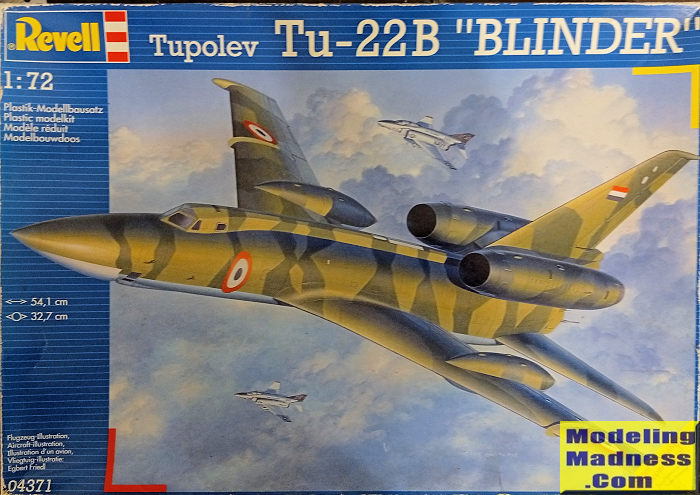
It comes in the usual large Revell top-opening box. Bit beaten by time, it is a little flimsy—not excessively so, and certainly acceptable—but neither is it particularly robust. What it does have, however, is fantastic box art by Egbert Friedl, depicting a Libyan Blinder being intercepted or escorted by US NAVY Phantoms. The exact circumstances represented by the artwork lead to the famous Aptil 1977 encounters, and as a piece of box art it certainly succeeds in conveying the atmosphere of the Cold War and the imposing character of the Blinder.
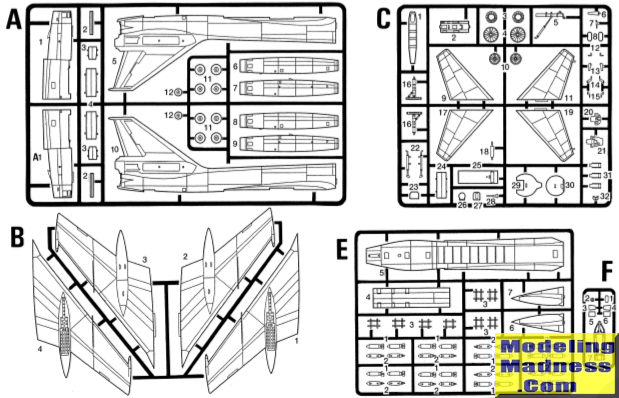
Upon opening the box, I was greeted with 113 light-gray styrene parts, neatly arranged on four sprues. A good number of these parts deal with the bombs and bomb bay, so the relatively low parts count is somewhat deceptive for such a large aircraft. It nevertheless immediately suggests that this should be a straightforward construction.
The molds are very nice, and I noticed virtually no flash on my example. This suggests that Italeri and Revell have done a good job maintaining the original tooling. Considering the age of the molds, they have held up remarkably well. The panel lines are finely engraved, which is another definite plus, especially for a kit of this vintage.
The cockpit is not overly elaborate, but it contains the basic equipment found in the real aircraft. Decals are provided for the instruments, although the instrument panels themselves feature raised detail, giving the modeler the choice of using the decals or painting the instruments by hand. Naturally, the cockpit looks somewhat dated by modern standards, but this is perfectly understandable for an older tooling. More importantly, very little will be visible through the canopy anyway.
The landing gear is reasonably done for a kit of this vintage. The parts are averagely molded—not toy-like, but certainly not highly detailed either. The landing-gear bays feature some ribbing detail, although there is not much more to them.
The engines are rather nicely represented. They include good-looking compressor faces and believable exhaust sections, and considering the prominent position of the two engines on the real aircraft, this is an important area of the kit.
The bomb bay is another nice feature. It contains some ribbing detail and can be loaded with the bombs supplied in the kit. The modeler therefore has the option of displaying the bay open and showing off the weapons, which adds some welcome visual interest to the finished model.
A word should be said about accuracy. The kit has been reported to contain some dimensional inaccuracies, particularly concerning the fuselage and wings. The fuselage is somewhat short, while the wing dimensions and geometry have also been questioned. These discrepancies are worth keeping in mind for anyone seeking absolute accuracy.
At the same time, they are perhaps understandable when we consider the period in which the original Esci kit was designed. The Tu-22 was still very much a Cold War subject, and Western manufacturers had extremely limited access to the real aircraft and to reliable technical information. Some of the resulting inaccuracies therefore remained in the tooling.
The clear parts are thick, but nicely molded and crystal clear. The instructions are the usual Revell excellent style of the period, presented as a 12-page booklet. They include a photograph of a completed model, a short history of the aircraft, a sprue map and a color chart, with construction spread over 38 clear and logically arranged steps. Color call-outs are provided where necessary, and overall the instructions are very easy to follow.
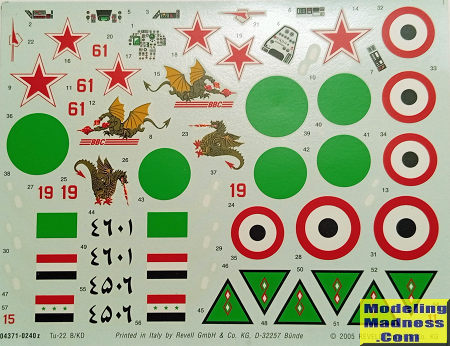 Four color
schemes are provided: two Libyan, one Iraqi and one Soviet machine. The decals
are wonderfully printed and, despite their age, still look to be in very usable
condition. They should add considerably to the overall presence of the finished
model. The paint references are given in Revell codes as well as in generic
terms.
Construction begins with the cockpit. Some side windows are attached to the forward fuselage halves, after which the cockpit assembly is trapped between them. Revell recommends 10 grams of nose weight, but I would definitely add some more just to be on the safe side. There is also no reason why some of that weight could not be placed farther forward in the nose, where it would have greater leverage.
The rear fuselage, which incorporates the large vertical fin, is assembled next. The forward fuselage is then joined to it, followed by the two-piece nose.
The wings are assembled and attached next, followed by the elevators and the rather good-looking engine assemblies. The landing gear follows, with the option of displaying the aircraft either with the gear extended or retracted.
The bomb bay and bombs come next, again offering the option of presenting the bay open or closed. Construction is then completed by adding the various smaller details around the aircraft—antennas, pitot tubes and other fittings—before finally attaching the canopy.
The construction is definitely straightforward and uncomplicated. Apart from the fuselage split in front and rear (which might indicate mold limitations of the era), there is nothing particularly complex about the engineering, although the large dimensions of some of the parts mean that some attention will be needed during assembly. Having built the kit myself in the past, I can say that it goes together in a relatively straightforward manner,, although some gaps can arise and will require treatment..
Overall, however, this is certainly not a kit that should frighten the average modeler.
| CONCLUSIONS |
There are, of course, more modern alternatives available today for anyone wishing to build a Tupolev Tu-22B in 1/72 scale, notably the more recent offerings from Modelsvit and Trumpeter. These kits bring a considerably higher level of detail to the subject, but this inevitably comes at the cost of many more parts and a much more complex construction. In their own way, these newer kits represent the latest and greatest approach to the Blinder.
The older Revell/Esci tooling takes a very different approach. It is a simpler and less accurate representation of the aircraft, and one has to take the known dimensional inaccuracies into account. The fuselage and wing geometry are not perfect, and anyone looking for absolute accuracy will certainly find shortcomings here. But this does not mean that the kit is obsolete at all.
It is still a nice-looking representation of the Blinder, and the finished model will unquestionably look like a Tu-22B. The parts count is relatively low, the molding is nice, the panel lines are finely engraved, the construction is straightforward, the engines and bomb bay are reasonably represented, the clear parts are genuinely clear, and the decals in this Revell release are wonderful—even after all these years.
With some care, particularly when dealing with the fit of the larger components, an imposing and impressive Tu-22B can result. It may not be the most accurate Blinder available today, but it certainly has the presence of the real aircraft, and that counts for a lot.
There is also something rather special about the kit itself. Esci was one of those companies that, during the 1980s and early 1990s, dared to give us subjects that we simply did not expect to find in plastic, even in our wildest dreams. The Tu-22 was exactly that kind of subject. At a time when information about Soviet aircraft was limited and many of these machines seemed almost mysterious to Western modelers, finding such an unusual aircraft in a hobby shop was quite an experience. That feeling remains with this old tooling.
So, if you find the Revell Tu-22B at a good price, I really cannot see why you shouldn't take it home and tackle it. You have to accept its limitations, of course, but in return you get a relatively uncomplicated build and the opportunity to put a very large, very unusual and unmistakable Cold War aircraft on your shelf.
There is one final consideration. As time passes, kits such as this become increasingly interesting as collector's items, and prices will inevitably start rising again as their availability decreases.
But that's another story.
For the modeler, the important thing is much simpler: if you find one at a good price, take it and build it. There is still plenty of enjoyment to be found in this old Revell Tu-22B.
Happy Modeling!
Spiros Pendedekas
Copyright ModelingMadness.com. All rights reserved. No reproduction in part or in whole without express permission of the editor.
If you would like your product reviewed fairly and fairly quickly, please contact the editor or see other details in the Note to Contributors.
Back to the Main Page Back to the Review Index Page Back to the Previews Index Page