| KIT #: | 301 |
| PRICE: | |
| DECALS: | Two options |
| REVIEWER: | Spiros Pendedekas |
| NOTES: | Initial release. Thunderbirds boxing. |
| HISTORY |
The Lockheed T-33 Shooting Star was one of the most successful jet trainers of the early Cold War era, introducing generations of pilots to the challenges of jet flight. Developed from the single-seat P-80/F-80 Shooting Star fighter, it was created to provide a two-seat training aircraft that retained the flying characteristics of its predecessor. Originally designated TF-80C, the prototype first flew in March 1948, and the T-33 entered service with the United States Air Force in 1949. Powered by an Allison J33 turbojet, it offered a relatively straightforward introduction to high-speed flight at a time when military aviation was undergoing a rapid transformation.
Although primarily designed for training, the T-33 proved to be an exceptionally versatile aircraft. It served with air forces around the world, undertaking advanced training, proficiency flying, liaison duties and a variety of other assignments. Some aircraft were adapted for reconnaissance, with the single-seat RT-33A representing a particularly interesting development. Equipped for photographic missions, these aircraft demonstrated that the dependable Shooting Star airframe could perform useful operational duties well beyond its original training role. France was among the countries that operated T-33s, and its reconnaissance aircraft provide an especially attractive subject for modelers interested in the less familiar chapters of post-war military aviation.
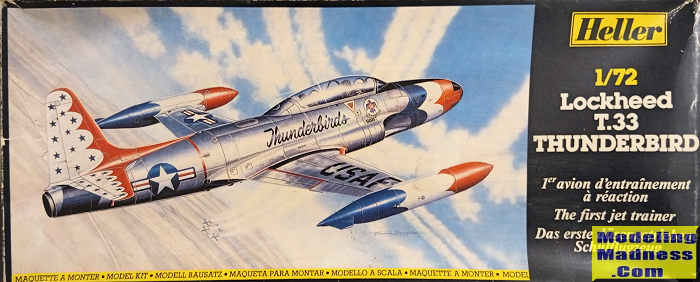
The T-33 also became associated with the famous United States Air Force Thunderbirds, established in 1953. Although it was not one of the team's principal demonstration aircraft, the Shooting Star served in support and familiarisation roles during the team's early years. Its connection with the Thunderbirds nevertheless adds to the appeal of Heller's box-art choice, which captures the aircraft in the team's distinctive markings. The combination of an elegant airframe and colourful display-team insignia makes this version particularly attractive, even for those who normally prefer operational military schemes.
With production exceeding 6,500 aircraft, including examples manufactured under licence in Canada and Japan, the T-33 enjoyed an exceptionally long and widespread career. Its reliability, relatively forgiving handling and straightforward maintenance helped it remain in service for decades, even as more modern trainers gradually took over its original duties. The Shooting Star became much more than a two-seat derivative of an early jet fighter: it was a Cold War classic in its own right, remembered by generations of pilots and serving as a familiar bridge between the pioneering years of jet aviation and the more sophisticated aircraft that followed.
| THE KIT |
 Heller
was really going strong during the late 1970s and throughout the 1980s, offering
us many wonderful subjects, and the 1/72 T-33 is certainly one of them. These
are what I like to call sweet kits. Very sweet, indeed! The specific example
reviewed here is the initial release from 1980, kindly donated to me by the
widow of a friend and fellow member of my local modeling club. This gives the
kit a special meaning for me, beyond its age and modeling appeal.
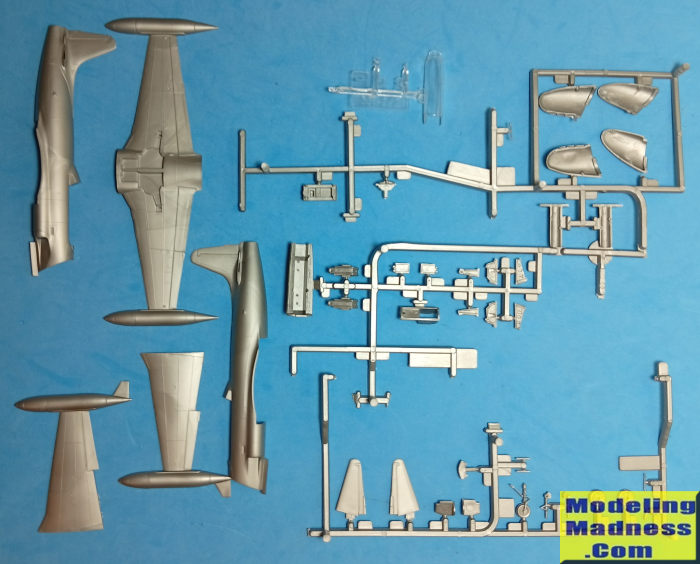
The kit comes in Heller's usual long, top-opening box of excellent quality, partly beaten by time, featuring attractive artwork by Francis Bergèse depicting a Thunderbird T-33 gracefully flying through the sky. Upon opening the box, I was greeted by 39 silver-gray styrene parts, nicely arranged on their sprues, although a few had already become detached in my example. Being the initial release, the molding is crisp and sharp, with no noticeable flash, which is particularly pleasing for a kit of this vintage. There are, however, several ejector-pin marks, some of them unfortunately located in areas that will remain visible after assembly. This is something one might reasonably expect from an early-1980s mold. The panel lines are raised throughout, but they are finely rendered and look quite appropriate for a kit of the period.
The cockpit is rather basic, with seats, control sticks and instrument panels providing the main features. By today's standards, the detail is average at best, but it was perfectly acceptable for the time. The kit offers the possibility of building either the standard two-seat trainer or the single-seat photographic reconnaissance version. Accordingly, two different noses are provided, along with the appropriate cockpit arrangement for each version. The landing gear is similarly straightforward, offering a reasonable representation for the scale without being either particularly elaborate or toy-like. Some detail is also present on a few of the landing-gear doors, although the wheel wells themselves are completely flat and devoid of detail.
The exhaust has a respectable depth and should look quite convincing once painted, although the seam running through it will need some attention. The intakes, on the other hand, are devoid of internal detail, but painting their supplied ends flat black should help create a convincing impression of depth. The wings come with the standard wingtip fuel tanks molded in place. This is a nice touch that simplifies construction, barely limiting the modeler to this particular tank arrangement. To my understanding, the T-33 could carry other tiptank types during its earlier service life, but the supplied configuration is entirely appropriate for a standard example.
The reconnaissance nose is molded as a solid piece. Anyone wishing to go a little further could carefully open the appropriate camera windows and add transparent inserts, although simply painting these areas silver is another option for those who prefer to keep things simple. The transparencies are reasonably well molded and quite clear, which is always welcome in a kit featuring such a prominent cockpit canopy.
The instructions follow Heller's welcoming familiar style and consist of four A4-sized pages, including a short history of the aircraft and some technical characteristics. Construction is divided into seven main steps, with clear and concise illustrations that should present no difficulties. Color references are given in Heller's own paint codes, so having a conversion chart handy will probably be necessary.
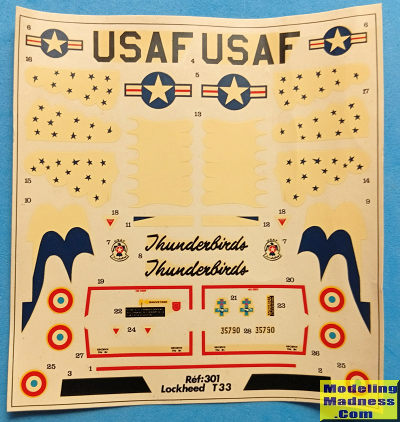 Two finishing
options are provided: the attractive Thunderbird aircraft featured on the box
art and a particularly interesting French photographic reconnaissance T-33 in
Natural Metal Finish. The 46yo decals look reasonably well produced for their
age. However, time has certainly passed since then, and I cannot be sure how
well they have survived decades of storage. I may nevertheless try my luck with
the French insignia when the time comes to build my example.
Construction begins with the cockpit, using the appropriate parts for the chosen version, together with the intake components and exhaust, all of which are trapped between the fuselage halves. The corresponding nose is then attached, followed by the wings and tailplanes. Personally, I would consider changing the suggested sequence slightly, assembling and attaching the wings and tailplanes first, then easily figuring out and securing the weight needed to avoid tail sitting to the nose, before attaching it to the fuselage.
The landing gear and remaining smaller components follow, with the canopy and wheels completing the assembly. Overall, the construction looks straightforward and uncomplicated, making this a kit that even a beginner could approach with confidence.
| CONCLUSIONS |
This is definitely a very nice kit, a genuinely sweet little model that should be appreciated for what it is: a product of its time. Judged on its own terms, it can still produce a very decent 1/72 T-33, with a pleasing overall shape and a reasonable level of detail. The crisp molding of this initial release is particularly impressive, although the raised panel lines, basic cockpit and sparse wheel wells naturally reveal its age. Newer kits offer considerably more detail, but that does not diminish the appeal of this Heller offering.
Having read our Editor's preview of a later release of this very same kit, I cannot agree more with his comments. It is always interesting to see how another modeler appreciates a classic kit, particularly when the observations echo one's own feelings about an old favorite. Despite the years that have passed, this Heller T-33 retains the qualities that make such kits enjoyable: simplicity, attractive proportions and the promise of a satisfying result without the complications that often accompany more modern, detail-heavy offerings.
Surprisingly, Heller does not appear to have reissued the kit in recent years, and I am not certain whether the mold has subsequently been used by another manufacturer. Should you come across one at a reasonable price, however, I see no reason not to give it a go. It offers a welcome opportunity to enjoy a simpler era of modeling, when a handful of well-molded parts, a little patience and some careful painting were often all that was needed to produce a satisfying miniature.
My example has an additional significance, as it reminds me of a friend who is no longer with us. Being an initial release, it also has some appeal as a collectible. Nevertheless, I will resist the temptation to leave it untouched in its box and intend to build it one day. After all, kits like this were made to be enjoyed, not simply admired on a shelf.
A sweet little kit, indeed, and one well worth tackling.
Happy modeling!
Spiros Pendedekas
November 2026
Copyright ModelingMadness.com. All rights reserved. No
reproduction in part or in whole without express permission.
If you would like your product reviewed fairly and
fairly quickly, please
contact
the editor
or see other details in the
Note to
Contributors.