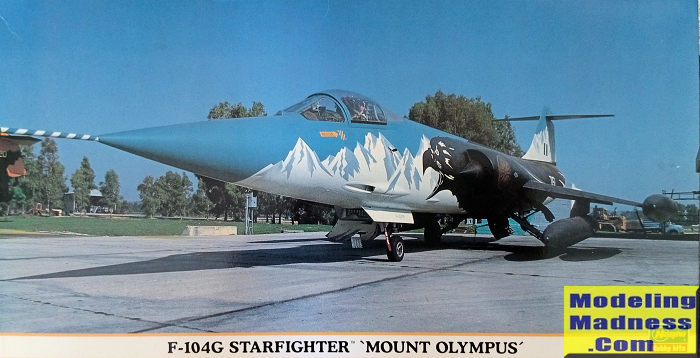
Hasegawa 1/48 F-104G Starfighter 'Mount Olympus'
| KIT #: | 09505 |
| PRICE: | €29.00 Euros when new |
| DECALS: | Two options |
| REVIEWER: | Spiros Pendedekas |
| NOTES: |
| HISTORY |
The 335 “Tiger” Squadron celebrated its 50th anniversary in December 1991 with a particularly striking F-104G, 63-12720, carrying an elaborate tiger-themed scheme. It was a fitting farewell for an aircraft and a squadron that had shared so many years of operational service. The normally austere Starfighter suddenly became a wonderfully colorful ambassador for the unit, and the “Tiger” remains one of the most recognizable Greek F-104s.
336 “Olympus” Squadron followed with another spectacular aircraft. F-104G 7151, formerly German 22+70, received its special “Mount Olympus” scheme in 1992 to commemorate the squadron’s 40th anniversary. The blue finish, incorporating the squadron’s emblem and the imagery of Mount Olympus, transformed the Starfighter into an exceptionally attractive commemorative aircraft. It was a particularly appropriate tribute to a squadron whose identity was so closely connected with Greece’s legendary mountain.
Fortunately, both of these remarkable aircraft had a good fate after their operational careers ended. Rather than disappearing into obscurity, the “Tiger” and “Mount Olympus” Starfighters have been carefully preserved and can today be admired at the Hellenic Air Force Museum. Seeing them preserved in such excellent condition makes these colorful machines much more than just interesting photographs from the final years of the Starfighter era; they are tangible reminders of a remarkable chapter in Greek military aviation history.
| THE KIT |
 Hasegawa
introduced its new-tool 1/48 F-104 Starfighter in 2000 and subsequently reboxed
and reissued many times. The basic tooling was used to cover a wide range of
Starfighter variants, with releases from other companies as well, including
Revell and Eduard. In this way, the tooling eventually covered practically all
the important F-104 variations, including the two-seat version, which appeared a
few years after the single-seater and filled a significant gap in the 1/48
Starfighter modeling world.
The kit made quite an impression when it first appeared, and it continues to impress today with its excellent overall shape and very high level of detail. Some modelers have expressed reservations about the prominent riveted surface detail, but personally, I have never regarded this as a problem. To my eye, it looks very convincing and certainly contributes to the character of the finished model. As was usual with Hasegawa, the tooling was subsequently used for a great number of different releases, and one of them was the particularly attractive Greek commemorative edition featuring the Mount Olympus and Tiger aircraft.
That release appeared on the shelves in 2003 and surprised quite a few modelers. Hasegawa had undertaken the task of presenting two very attractive commemorative Greek Starfighters, and the decision was warmly received by the modeling community. I certainly did not hesitate. I immediately grabbed one when it appeared, and this is the very kit I am previewing here, all these years later.
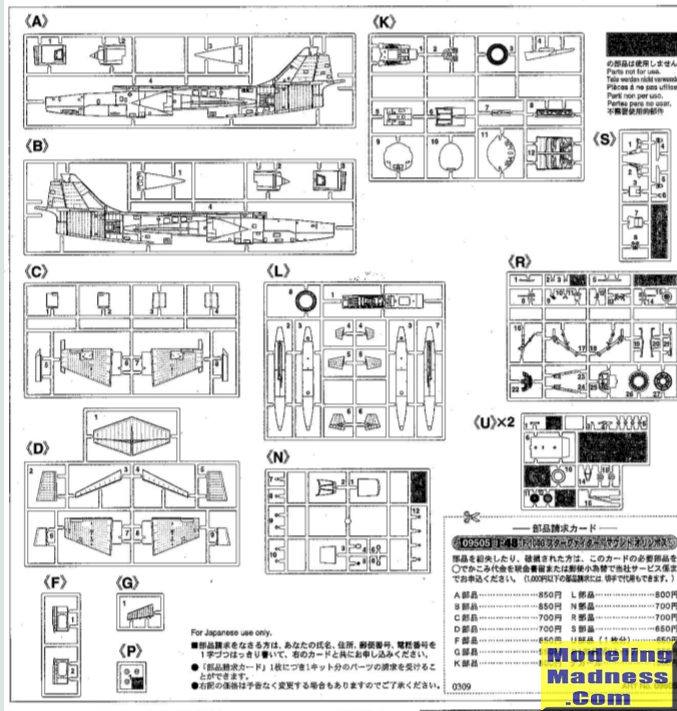
The kit comes in Hasegawa’s usual excellent-quality, top-opening box, featuring a photograph of the Mount Olympus aircraft. Opening the box reveals around 140 light-gray styrene parts contained in no fewer than twelve variably sized sprues. From the start, it is quite obvious that Hasegawa designed the kit around a modular arrangement, using common sprues for the basic Starfighter components and additional sprues to accommodate the various versions. Consequently, not all parts are to be used for the specific version.
Molding was sharp when the kit was initially released and continues to be, with beautifully recessed surface detail complemented by a considerable amount of riveting and, importantly, virtually no flash to speak of. There are, however, quite a few ejector-pin marks at various locations. Most are relatively shallow and some are conveniently hidden once the model is assembled. Others, unfortunately, are more visible, appearing on areas such as the landing-gear doors, the wingtip tanks fins and other aerodynamic surfaces. They are not too difficult to deal with, but they are definitely there and will require some attention from the modeler if a really clean finish is desired.
The riveted surface detail has been discussed by many modelers over the years, but personally I rather like it. The overall effect is busy without looking objectionable, and it should produce a very attractive finished model.
The cockpit is nicely done, with a good-looking ejection seat and convincing molded-on detail throughout. The instrument panel features raised instrument detail onto which the appropriate decal can be applied if desired. Certainly a modeler can add more detail here, including a more realistic representation of the famous blanket covering the top front area, but what is provided is certainly adequate. The landing gear is equally well represented, with believable detail on the struts, wheel wells and doors.
The intakes are also nicely reproduced. They are not especially deep, but in practice very little can be seen through their relatively shallow openings, so this is unlikely to be an issue on the completed model. Two different styles of exhausts are provided to cater for the various versions represented by the tooling. The exhaust itself is deep and nicely detailed.
The airbrakes may be displayed open or closed, and their housings feature nice molded detail. The same applies to the wings, which have separate slats, ailerons and flaps, allowing the modeler to position them at different angles. However, it is worth remembering that the F-104 normally sat on the ground with all above surfaces in their neutral positions.
Only the distinctive wingtip tanks are included in this particular release; neither the underwing tanks are provided, despite being seen on the box art, nor any other load options. The transparencies, meanwhile, are beautifully clear and should require little more than careful handling and masking.
The instructions are presented in Hasegawa’s usual excellent style. Printed in pamphlet-style, they include a small photograph of the real aircraft, a short history, a sprue map and a color chart, followed by the construction sequence. The build is divided into 17 clear and concise steps, with color callouts provided throughout.
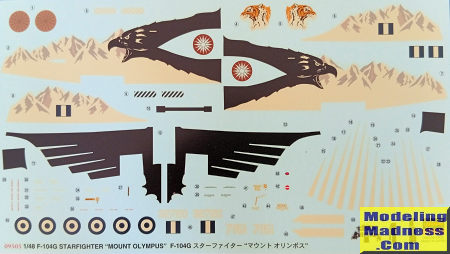 Two schemes
are included, covering the Mount Olympus and Greek Tiger commemorative
Starfighters. Color references are provided in Gunze codes, along with generic
color descriptions and a selection of FS numbers. The decals are sharply printed
and, considering the age of the kit, apart from some yellowing, mine remain in
good condition. There is, however, one characteristic Hasegawa issue that should
be mentioned. The white areas are printed more as an ivory shade, something that
was fairly common in Hasegawa decal sheets of the period. Personally, I can live
with it, and I have built models using these decals as supplied, but many
modelers have criticized this characteristic, and with good reason. It is
certainly something worth taking into consideration before beginning the model.
Construction begins with the cockpit, followed by the main wheel bay and the nicely detailed exhaust assembly. These components are then trapped between the fuselage halves. No nose weight is mentioned in the instructions, and I believe none should be necessary.
The lower fuselage sections are then attached, followed by the intakes, nose cone, cockpit coaming and the remaining upper cockpit components. The wings are assembled next and attached to the fuselage.
The airbrakes follow and may be posed open if desired, although again, they would normally be closed on a parked aircraft. The horizontal stabilizer and rudder are then attached, followed by the landing gear, appropriate exhaust, wingtip tanks, canopy and the remaining smaller components. Overall, the construction looks straightforward and should result in a relatively uncomplicated build, particularly for a model of an aircraft with the distinctive and somewhat complex appearance of the Starfighter.
| CONCLUSIONS |
Although some newer offerings may provide a little more detail in certain areas, Hasegawa’s 1/48 F-104 Starfighter remains a superb kit in many respects. It offers an excellent overall shape, very good and more than acceptable detail throughout and beautifully clear transparencies. Personally, I also like the riveted surface detail and have never considered it a problem.
The molding is generally excellent, with crisp detail and virtually no flash, but the modeler should be prepared to deal with the ejector-pin marks found on a number of parts. Most are shallow and some are hidden after assembly, but others are visible. They are not a major issue, but they do require some careful filling and sanding if one wants the best possible result.
The instructions are excellent, the engineering appears straightforward, and the kit should allow an impressive F-104 to be built straight from the box. The decals are nicely printed and, in my example, still in good condition, although the ivory representation of white is certainly the main drawback and something the modeler should be aware of. A super-detailer can, of course, add further refinements, but there is certainly no need to do so to obtain an attractive Starfighter.
What makes this particular release especially appealing, however, is its subject. The Mount Olympus and Tiger commemorative aircraft are among the most colorful and evocative Greek Starfighters, and having both options in a Hasegawa 1/48 kit was a lovely surprise when this release appeared in 2003. At the time, I immediately grabbed one, and I can still understand the excitement it generated among modelers.
Coupled with its attractive price, excellent quality and two superb Greek subjects, this is a kit that is very easy to recommend to anyone with an interest in the F-104 or the Hellenic Air Force. It offers a straightforward build, plenty of detail and, most importantly, the opportunity to create a spectacular model straight from the box. For me, that combination makes this particular Hasegawa Starfighter a very special release indeed.
Happy Modeling!
October 2026
Copyright ModelingMadness.com. All rights reserved.
No reproduction in part or in whole without express permission. If you would like your product reviewed fairly and fairly quickly, please
contact
the editor
or see other details in the
Note to
Contributors.